eBook - ePub
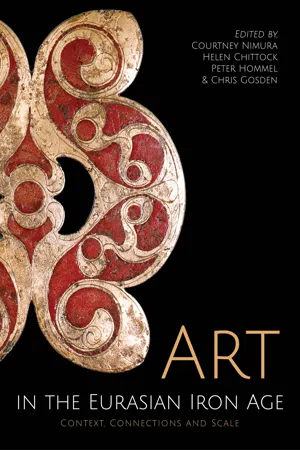
Art in the Eurasian Iron Age
Context, Connections and Scale
- 260 pages
- English
- ePUB (mobile friendly)
- Available on iOS & Android
eBook - ePub
Art in the Eurasian Iron Age
Context, Connections and Scale
About this book
Since early discoveries of so-called Celtic Art during the 19th century, archaeologists have mused on the origins of this major art tradition, which emerged in Europe around 500 BC. Classical influence has often been cited as the main impetus for this new and distinctive way of decorating, but although Classical and Celtic Art share certain motifs, many of the design principles behind the two styles differ fundamentally. Instead, the idea that Celtic Art shares its essential forms and themes of transformation and animism with Iron Age art from across northern Eurasia has recently gained currency, partly thanks to a move away from the study of motifs in prehistoric art and towards considerations of the contexts in which they appear. This volume explores Iron Age art at different scales and specifically considers the long-distance connections, mutual influences and shared 'ways of seeing' that link Celtic Art to other art traditions across northern Eurasia. It brings together 13 papers on varied subjects such as animal and human imagery, technologies of production and the design theory behind Iron Age art, balancing pan-Eurasian scale commentary with regional and site scale studies and detailed analyses of individual objects, as well as introductory and summary papers. This multi-scalar approach allows connections to be made across wide geographical areas, whilst maintaining the detail required to carry out sensitive studies of objects.
Information
Subtopic
European HistoryIndex
HistoryChapter 1
Art, ambiguity and transformation
Chris Gosden
Abstract
Iron Age cultures were large, connected, volatile, varied and contested. After 150 years or more of concerted study we are only just getting a sense of what life in the 1st millennium BC was like. This chapter concerns the role of art in such societies, looking at how it might have been used performatively and as a means of coming to grips with an unstable cultural situation. I will start with a brief characterisation of the Iron Age, provide a theoretical model for thinking about general Iron Age relations using three terms (network, assemblage and event), before focusing on art in particular. The art of the Iron Age, or more especially the later Iron Age after around 450 BC, was the mirror image of the more realistic arts of the Greek and Roman worlds that grew up at the same time. Rather than a commitment to realism (a contested term, I know), so-called Celtic Art played with form and material, combining plants, animals and people, playing with the four dimensions of space and time, while contradicting any notion that the world was static. The most interesting pieces were many things at once, containing visual allusions, illusions and puns. Assemblages of objects enhanced this notion of motility and change. I will assess the assemblage from Waldalgesheim to look at combinations of form and ornament. The chapter ends with some thoughts on the role of art in the volatile world of the mid-1st millennium BC.
We are gaining an ever-richer sense of what European Iron Age cultural forms were like at an empirical level, but this new richness has not, so far, led to a very profound shake up of our overall pictures of the Iron Age. I will concentrate on art here, but in order to position the changes in material culture happening in the later Iron Age, it is necessary to provide some broader context of the cultural matrix within which so-called Celtic Art grew up and helped shape people’s worlds. These ideas will be developed at greater length in the monograph publication of the European Celtic Art in Context project (see Gosden et al. 2016).
Two broad assumptions underlie my thoughts, which need stating so that the reader can see their influence, even if they cannot be fully discussed now. First, I see material culture as an active quality in people’s lives. People do not first have social and cultural aims and then develop material forms to realise these aims. Rather the world is made intelligible in the process of making and using things, so that a world that makes sense is co-produced by people and their material means (such ideas derive from the approach known as Material Engagement Theory – see Malafouris 2013). Here I will argue that style is a technology for allowing us to understand the world in a particular way. Secondly, it is important to stress the importance of process, highlighting becoming rather than being (Gosden & Malafouris 2015). Such a stress takes us beyond divisions into simple archaeological periods and allows us to look at time in a more complex manner, encompassing links to the past as well as movements into the future. Change and process should be seen as non-directional and non-teleological. Human history, or any part of it, such as the Iron Age, does not have a set direction, much less a progressive tendency from the more simple to the more complex.
Moving from these very broad assumptions to something a little more concrete, I would like to briefly introduce three crucial terms: network, assemblage and event.
Networks
A network is composed of the totality of connections in which a group is enmeshed. Networks are made up of people and things in combination. The lure of things helps shape connections as much as links between people. Networks are dense and complicated, involving plants and animals, hills and streams, as well as artefacts of all kinds. All elements of these networks have their own shape and purposes, so that people were one element among many, never in charge of relations, although striving to shape them. Networks can be seen as local, encountered by people every day in the ongoing process of living their lives. Other networks were between groups and areas. Such broader connections are not just, or indeed mainly, constructed through trade. Groups exchange partners in marriage, people move for many reasons, as do ideas and materials. These forms of movement take place through the important, but vaguely defined processes of diffusion, to which we need to give more thought. Networks are nested, with the densest links being local and gradually rippling out across Eurasia in the Iron Age. Archaeological indicators of such networks are given by the distribution of artefacts of particular styles and materials, as well as, where available, information on human movement from isotopes and genetics.
In more concrete terms, Iron Age networks are made up of those within temperate Europe itself, but they also bring in materials from Etruria, Greece and later Rome, from the Pontic area, the Persian world and the steppe groups to the east. Steppe connections have been of particular interest to our project (Gosden et al. 2018). Networks are varied and discontinuous across space – Martin Guggisberg (2018) has made the point that there are a number of contemporary forms of art in Europe from La Tène A including Celtic and Scythian Art. Each of these has concentrations of finds in some areas and many fewer in others, a variability that is only partly due to burial practices. Imports of Mediterranean items vary also in intensity, and some of this variation, but not all, is because of the geography of connections along rivers and over mountain passes. Scythian artefacts are found in eastern Europe, with Celtic Art to the west. There are considerable numbers of La Tène style artefacts within the area of Scythian distribution with fewer Scythian artefacts coming west (Wells 2012), an imbalance that needs further investigation.
Assemblages
Constellations of artefacts, which we call assemblages, have two dimensions. First, they are situated within and help form local patterns of practice. The world is made intelligible through the items we make and use. A world that makes sense is also a world that works in a more practical sense, providing food, shelter and technical means. Across Iron Age Europe there are both similarities in material things, but also many variations on the broader themes, with uptakes of some items and not others. The history and distribution of wheel-turned pottery in the earlier Iron Age is a prime example, with some groups making pots on the wheel around 500 BC and others sticking to hand-forming techniques for centuries after that (Fitzpatrick et al. 2008). Second, assemblages are partly put together through the position of a group or region with networks. The streams of connections across Eurasia help shape what is available to people and what is not. From the things that are available, people will pick and choose those they want, rejecting things that do not fit in with current means of shaping the world. Broader trends in material engagement are also influential. In Britain after 800 BC, the use and deposition of bronze declines markedly, but the uptake of iron is slow. From around 800 to 400 BC, there is relatively little metal in use compared to earlier and later periods. When iron starts to become more common, after around 400 BC, so too does bronze (and indeed gold and silver). The start of the Iron Age sees not so much a replacement of bronze by iron, but a relative lack of interest in both metals (which cannot be due either to a technological lack or difficulties of supply), which is reversed relatively rapidly around the Middle Iron Age (Garrow & Gosden 2012, chapter 3). Whether such trends are seen elsewhere in Europe needs further research. The values attached to materials fluctuate, often for reasons that are not straightforwardly functional.
Events
An event is an individual set of actions that punctuates broader trends. It occurs relatively rapidly, judged by the timescales to which archaeologists are accustomed. An obvious example of an event is the construction of a large mound and the burial of one or more people within it. Large and spectacular burials might in reality occur in smaller stages, which can be picked apart by careful excavation. Nevertheless, their duration is relatively short and punctuates the flow of cultural action, perhaps re-directing it in some way. A further example of an event would be the construction of the gate at the Heuneburg (Fernández-Götz & Krausse 2016, 322), which significantly changed the approach to, and entry into, the settlement. Where networks and assemblages are shaped by broader and longer lasting trends, events may derive from local contingency, or from the direction of action by an individual or small group. The Iron Age of Europe appears very eventful, punctuated by many dramatic forms of social action, designed to create heightened emotion or draw bodily attention to particular sets of relationships. No two events are the same, so that burials under mounds during Hallstatt D and La Tène A are never identical, either in the construction of the mound and its landscape setting or the exact set of materials placed within the grave. Variability in burial is only partly due to change through time. Power in the Iron Age derived in considerable part from performance, whether this was a military victory, a large feast, the founding of a new settlement, or the burial of an important individual. For performances to be powerful, they had to both fit within accepted tropes of action, but also bring some originality and difference to the event. Compared with later forms of power in Europe, social standing in the earlier Iron Age had a somewhat insecure base, deriving not from the ownership of land and its produce, but from a manipulation of the theatre of cultural life, due in turn to the individual’s position within a network, their command of assemblages, and their ability to stage a compelling event.
A number of features stand out of the period of interest here, that is from Hallstatt D, when the cultural setting in which Celtic Art grew up first formed, and La Tène C (rather later in Britain). The societies of Hallstatt D and La Tène A were volatile, changing rapidly. This is most obviously seen in the growth of Fürstensitze (princely seats) in the few areas where they were found. People aggregated together in some thousands, constructing impressive buildings and engaging in craft production and an intense social life, before dispersing again two or three generations later. Elsewhere, for instance in lowland Britain, large aggregation sites of a similar period, but very different type, were found, for instance as evidenced by the large midden deposits at Potterne and All Cannings Cross (Barrett & McComish 2009; Lawson 2000). Here no emphasis on architecture or permanent settlement was found, but the mass of animal bones, evidence of craft production and of the human dead has some parallels across the channel in the so-called Fürstensitze. Much has and should be said about this period of change and creativity, but the one point to raise here is that it was intense connections between people that were important through the medium of material culture, both large (architectural forms) and small (portable artefacts).
In the terms used above, networks were worked hard to bring in raw materials and finished things from near and far, through a great range of social connections. Many things were fashioned to be striking, appealing to the senses and moving the emotions. Similar items were found across large areas of Europe, but each more local assemblage had its own special characteristics. Lastly, such a seething mass of material and social action occasionally crystallised out in spectacular events, in which the most stunning artefacts were used in pieces of social theatre, such as burial or the creation of a new architectural form. As an aside, the volatility of Hallstatt D and La Tène A cultural forms has made it difficult to construct a chronology that works over larger regions. More discussion and disagreement have occurred over dating of sites and assemblages from 650 to 400 BC than any other period of the Iron Age (e.g. Garrow et al. 2009). Chronological complexity contains an important indication of the nature of life in these centuries, in that various areas had their own sequences, reshaped around important events, in which material forms were crucial. Finally, the nature of life in Hallstatt D and La Tène A is thrown into relief by the succeeding La Tène B period, when, in many areas, people settle into smaller farmsteads with their own territories and often neighbouring flat cemeteries, with many fewer spectacular burials. Large settlements are also absent in most areas. Imports from various external regions are still found, but at much lower levels than before. Celtic Art continues, but in a new cultural context.
Celtic Art, as a series of more-or-less spectacular objects, emerged within a performative cultural setting, helping also to shape it. Before considering Celtic Art more directly, some more general remarks are necessary on what art is and what its social position can be.
The role of art
There have been long debates as to what constitutes art (see Garrow & Gosden 2012, chapter 2) and whether as a concept it is too bound up with western preconceptions of high culture, galleries and patrons to be useful cross-culturally. My main intention here is to argue that objects act to channel, reinforce or refract human actions. It is not what objects mean that counts, but what they do. I have come to define art as things that need skill to make, but also that require skill to appreciate. Art is skilled practice for the makers and those engaging with it. Art is not representation – it is not a mirror that reflects reality back at us by creating images that re-create the world in different media. Rather art helps shape our perception of the world, highlighting certain aspects of the relationships and processes of the world. Art is an active engagement with the world, which brings together the capacities of the human body with objects that shape perceptions and reactions. Art engages perception and action so that compelling art objects are ones with which we enter an active relationship. In this sense, art is a technology that helps us create and understand the world; complexities of form and decoration attract attention not just of sight, but also through touch, heft and even sound.
In such a view, art becomes a technology for producing the world in particular ways, in ways that make certain sorts of sense. Such a statement is misleading if it makes us think that art as technology settles and fixes a view of the world. The most interesting forms of art are those that engage intellectually, raising questions about the constitution of the world, partly through playing with the primary elements of our experience of the world: the three dimensions of space and that of time. If we accept that our experience of space and time are not hard-wired into us, but culturally and individually variable due to the education of our senses while young, then the world around us is crucial in creating such basic channeling of experience and sense. The artefacts we interact with, the landscapes we live in, and the forms of people, animals and plants we encounter all slowly structure our perceptions of shape, size and duration. The artefactual domain in any culture has its own tropes and rules of production and use, its own preferred range of materials, and a sense of how long objects should last or when they become redundant. Objects which more consciously play with such elements are those we might call art.
We have divided art forms into styles. Gell (1998) has described style as ‘relations between relations’. The material from which an object is made, its size and broad shape, the use of line to create spaces and shapes, the infilling of those shapes through lines, cells or dots, the use of colour – all these and many more elements form a set of relations together constituting a style. Style teaches us to see and appreciate the world in particular ways, shaping our perceptions. When art works powerfully it imposes its rules upon us, encouraging or forcing us to live through the style to some extent. A further important aspect that Gell brings out is the longevity of style, which to some mysterious degree evolves independently of humans. In discussing the inter-artefactual domain using the example of carved Maori houses from Aetearoa/New Zealand (drawing on the work of Roger Neich), Gell looks at how one house influences another in its form and carving, so that houses evolve over many human generations in a manner which is not straightforwardly to do with human choice and decisions, but rather through carvers working within a strong tradition. It is almost as though the houses were using human muscles and capabilities to reproduce themselves. Styles are obviously not totally outside human control, but in choosing to work in a style people are following rules transmitted from older human generations, which are given form and effect through the medium of objects.
People do not exist independently of objects, but with and through them. Celtic Art created an important corpus of articles through which to live, variable over space and across time, but with ...
Table of contents
- Cover
- Title
- Copyright
- Contents
- List of figures and tables
- List of contributors
- Introduction: Context, connections and scale: Chris Gosden, Helen Chittock, Peter Hommel and Courtney Nimura
- 1. Art, ambiguity and transformation: Chris Gosden
- 2. Collecting Iron Age art: Courtney Nimura, Peter Hommel, Helen Chittock and Chris Gosden
- 3. Eurasian Iron Age interactions: A perspective on the sources and purposes of La Tène style (‘Celtic’) art: Peter S. Wells
- 4. Fantastic beasts and where to find them: Composite animals in the context of Eurasian Early Iron Age art: Rebecca O’Sullivan and Peter Hommel
- 5. Bodies and objects in Iron Age Europe and beyond: An integrated approach to anthropomorphic imagery: Helen Chittock
- 6. How Celts perceived the world: Early Celtic art and analogical thought: Laurent Olivier
- 7. How can Celtic art styles and motifs act? A case study from later Iron Age Norfolk: Jody Joy
- 8. Visual memory and perceptions in ancient Celtic art: Nathalie Ginoux
- 9. Celtic art before the Early Style: Some new data from south-west Germany and the Heuneburg: Dirk Krausse
- 10. Sign o’ the times: The re-use of pre-Roman Iron Age British and European symbols on Late Iron Age Irish : a282a">Rena Maguire
- 11. ‘Damn clever metal bashers’: The thoughts and insights of 21st century goldsmiths, silversmiths and jewellers regarding Iron Age gold : a294">Tess Machling and Roland Williamson
- 12. Refugees, networks, politics and east–west connections in Early Celtic art: Paul Jacobsthal’s ‘History of a Monster’ : a311">Sally Crawford and Katharina Ulmschneider
- 13. The history of : a329">Paul Jacobsthal
- Discussion: Dialogues with Jacobsthal: Tim Champion
Trusted by 375,005 students
Access to over 1.5 million titles for a fair monthly price.
Study more efficiently using our study tools.
Frequently asked questions
Yes, you can cancel anytime from the Subscription tab in your account settings on the Perlego website. Your subscription will stay active until the end of your current billing period. Learn how to cancel your subscription
No, books cannot be downloaded as external files, such as PDFs, for use outside of Perlego. However, you can download books within the Perlego app for offline reading on mobile or tablet. Learn how to download books offline
Perlego offers two plans: Essential and Complete
- Essential is ideal for learners and professionals who enjoy exploring a wide range of subjects. Access the Essential Library with 800,000+ trusted titles and best-sellers across business, personal growth, and the humanities. Includes unlimited reading time and Standard Read Aloud voice.
- Complete: Perfect for advanced learners and researchers needing full, unrestricted access. Unlock 1.5M+ books across hundreds of subjects, including academic and specialized titles. The Complete Plan also includes advanced features like Premium Read Aloud and Research Assistant.
We are an online textbook subscription service, where you can get access to an entire online library for less than the price of a single book per month. With over 1.5 million books across 990+ topics, we’ve got you covered! Learn about our mission
Look out for the read-aloud symbol on your next book to see if you can listen to it. The read-aloud tool reads text aloud for you, highlighting the text as it is being read. You can pause it, speed it up and slow it down. Learn more about Read Aloud
Yes! You can use the Perlego app on both iOS and Android devices to read anytime, anywhere — even offline. Perfect for commutes or when you’re on the go.
Please note we cannot support devices running on iOS 13 and Android 7 or earlier. Learn more about using the app
Please note we cannot support devices running on iOS 13 and Android 7 or earlier. Learn more about using the app
Yes, you can access Art in the Eurasian Iron Age by Courtney Nimura, Helen Chittock, Peter Hommel, Chris Gosden, Courtney Nimura,Helen Chittock,Peter Hommel,Chris Gosden in PDF and/or ePUB format, as well as other popular books in History & European History. We have over 1.5 million books available in our catalogue for you to explore.