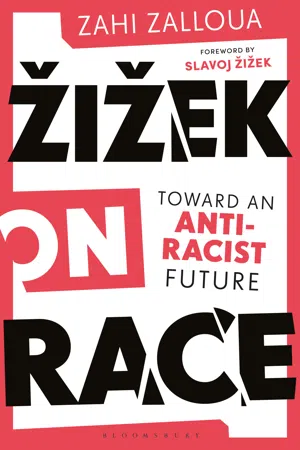
Slavoj Žižek's prolific comments on anti-Semitism, Islamophobia, scapegoating, popular nationalism, the refugee crisis, Eurocentrism, the War on Terror, neocolonialism, global justice, and rioting comprise a dizzying array of thinking. But what can we pull out of his various writings and commentaries on race in the contemporary world? Is there anything approaching a Žižekian philosophy of race?
Zahi Zalloua argues here that there is and that the often polemical style of Žižek's pronouncements shouldn't undermine the importance and urgency of his work in this area. Zalloua not only examines Žižek's philosophy of race but addresses the misconceptions that have arisen and some of the perceived shortcomings in his work to date. Žižek on Race also puts Žižek in dialogue with critical race and anti-colonial studies, dwelling on the sparks struck up by this dialogue and the differences, gaps, and absences it points up. Engaging Žižek's singular contribution to the analysis of race and racism, Žižek on Race both patiently interrogates and critically extends his direct comments on the topic, developing more fully the potential of his thought.
In a response to the book, Žižek boldly reaffirms his theoretical stance, clarifying further his often difficult-to-work-out positions on some of his more controversial pronouncements.
- 256 pages
- English
- ePUB (mobile friendly)
- Available on iOS & Android
eBook - ePub
About this book
Information
1 LIBERAL MULTICULTURALISM: FROM “CHECKING YOUR PRIVILEGE” TO “CHECKING OUR FANTASY”
Whiteness is not really a color at all, but a set of power relations.
CHARLES W. MILLS1
Multiculturalism is a racism which empties its own position of all positive content (the multiculturalist is not a direct racist, he doesn’t oppose to the Other the particular values of his own culture), but nonetheless retains this position as the privileged empty point of universality from which one is able to appreciate (and depreciate) properly other particular cultures—the multiculturalist respect for the Other’s specificity is the very form of asserting one’s own superiority.
SLAVOJ ŽIŽEK2
Liberal multiculturalism is a sympathetic response to the ills of global capitalism. It counters the malaise and nativist violence provoked by capitalism with a dose of diversity, infusing an appreciation of relativism and the plurality of cultures within its economic matrix. It conceives of its enemy as the intolerant white male subject threatened by globalization and the mixing of cultures. On Žižek’s account, however, liberal multiculturalism’s pedagogical model misses the target; it fails to properly conceptualize capitalism’s globally devastating reach. Its commitment to reforming capitalism—to “capitalism with a human face”—blinds it to the latter’s systemic violence, and, more importantly, proposes an answer to racism that only compounds the problem by mystifying the situation. Žižek insists on “this global dimension of capitalism,” exposing the fakeness of liberal multiculturalism’s “anti-capitalism”3 since it still fantasizes about a progressive capitalism, a capitalism more tolerant of differing ways of life. Žižek even folds Michel Foucault’s anti-normative practices—“these Foucauldian practices of inventing new strategies, new identities, are ways of playing the late capitalist game of subjectivity”—into a liberal multicultural framework.4 Liberal multiculturalism’s valorization of diversity “bears witness to the unprecedented homogenization of the contemporary world. It is effectively as if . . . everybody silently accepts that capitalism is here to stay—critical energy has found a substitute outlet in fighting for cultural differences which leave the basic homogeneity of the capitalist world-system intact.”5
What we are left with, then, are competing tribes whose “politics”/wrongs are articulated almost exclusively at the cultural register.6 Identity politics becomes a defense of certain ways of life and their inclusion in the social fabric, a defense that excludes the economy and class relations from serious critical analysis.7 In its desire to give voice to society’s marginalized voices, liberal multiculturalism de-emphasizes or flattens society’s “antagonistic gap,”8 and, consequently, the true enemy is eclipsed.9 To be clear, Žižek does not reject “multiculturalism as such,” which he views as a necessary counter to the fetishization of one’s heritage or culture (a problem that is not caused solely by capitalism); what he objects to is “the idea that it constitutes the fundamental struggle of today.”10 Preaching tolerance and respect for alterity while ignoring capitalism’s systemic violence produces a toothless anti-racism, an anti-racism only comfortable with blaming the type of behavior witnessed in the events of Charlottesville.11 This type of anti-racism is never sufficient to produce meaningful change. Against liberal multiculturalism’s bland program of cultural tolerance, Žižek argues refreshingly for intolerance, for the need to refocus on global, economic antagonisms and to politicize them:
One should thoroughly reject the standard multiculturalist idea that, against ethnic intolerance, one should learn to respect and live with the Otherness of the Other, to develop a tolerance for different lifestyles, and so on—the way to fight ethnic hatred effectively is not through its immediate counterpart, ethnic tolerance; on the contrary, what we need is even more hatred, but proper political hatred: hatred directed at the common political enemy.12
Attentiveness to this “common political enemy” marks Žižek’s difference from Sara Ahmed’s own perceptive critique of liberal multiculturalism. Ahmed contests Žižek’s claim that multiculturalism’s hegemonic reign is an empirical fact. What we have, according to Ahmed, is not multiculturalism as a reality but as a fantasy: “Multiculturalism is a fantasy which conceals forms of racism, violence and inequality as if the organisation/nation can now say: how can you experience racism when we are committed to diversity?”13 Liberals would like to be multiculturalists, but in reality they have never stopped being monoculturalists:
The best description of today’s hegemony is “liberal monoculturalism” in which common values are read as under threat by the support for the other’s difference, as a form of support that supports the fantasy of the nation as being respectful at the same time as it allows the withdrawal of this so-called respect. The speech act that declares liberal multiculturalism as hegemonic is the hegemonic position.14
In his response to Ahmed, Žižek agrees that liberal multiculturalism is through and through ideological in nature but disagrees that it hides a liberal monoculturalism.15 Liberal multiculturalism is not about sameness—adherence to the (impossible and cruel) injunction: be Western like us!—but about reified and manageable differences.16 It takes up “the privileged empty point of universality from which one is able to appreciate (and depreciate) properly other particular cultures,”17 a false universality that is really only the truly racist assumption of one’s own culture as the norm, a norm from which others are excluded: “multiculturalism is a disavowed, inverted, self-referential form of racism, a ‘racism with a distance’—it ‘respects’ the Other’s identity, conceiving the Other as a self-enclosed ‘authentic’ community towards which he, the multiculturalist, maintains a distance rendered possible by his privileged universal position.”18 This respect for the other is not the respect one shows an equal (with whom you might freely and openly disagree) but rather the patronizing deference one shows a child so as not to upset them. “When multiculturalists tell you to respect the others,” Žižek observes, “I always have this uncanny association that this is dangerously close to how we treat our children: the idea that we should respect them, even when we know that what they believe is not true.”19
Liberal multiculturalism engages, as Ahmed puts it, in “non-performatives,” that is, “speech acts that do not do what they say, and that do not bring into effect what they name.”20 It pays lip service to cultural difference when what it really wants is “cultural apartheid”: as Žižek puts it, paraphrasing this line of thought, “others should not come too close to us, we should protect our ‘way of life.’”21 Of course the latter concern for protecting our “way of life” is couched ethically as a concern for the other: don’t lose your authentic (natural, innocent, organic, exotic, etc.) “way of life” and become too modern like us. Žižek reminds us that this line of argument was deployed by South Africa’s Afrikaners whose “official regime’s ideology was multiculturalist”; they shamelessly argued that “apartheid was needed so that all the diverse African tribes would not get drowned in white civilization.”22
Does this make liberal multiculturalism irremediable? After all, doesn’t a fake multiculturalism at least suggest the possibility of a “true” multiculturalism, one that overcomes or exorcizes its monoculturalism? We can see this type of self-critical work being done by liberal multiculturalists who have turned to privilege theory as a corrective to these shortcomings. Liberal multiculturalism 2.0 takes “whiteness,” the undeserved privileges accumulated by whites, as today’s most challenging social problem. The true enemy, then, turns out to be the liberal multicultural subject itself. But from a Žižekian vantage point, privilege theory can only exacerbate the limitations of liberal multiculturalism, repeating the latter’s flight from universality. In this chapter, I want to critically engage with privilege theory and the now widespread liberal activist slogan “check your privilege” so prevalent on US college campuses. Feminists were the first to criticize unearned privilege, and in particular male privilege, as well as resistance on the part of the privileged to recognizing that privilege, as exclusionary. Feminists also sought in their critique to draw out the structural dimensions of such privilege. But what does it mean today to “check” privilege? What is privilege theory’s critical force? Is it adequate as a strategy for social change? Does privilege-checking transform the racial polity? Simply stated, what is privilege theory questioning and what is it leaving intact and reproducing? We might indeed ask whether it is really privilege that needs checking. Does this prevailing conception of anti-racism require instead a psychoanalytic supplement? A Žižekian response to the challenges of liberal multiculturalism might be formulated as an injunction to shift from privilege to fantasy: from the imperative to “check your privilege” to the psychoanalytic injunction to “check our fantasy.”
Privilege and its Limits
In discovering her own white privilege, American feminist Peggy McIntosh comments, “I have come to see white privilege as an invisible package of unearned assets that I can count on cashing in each day, but about which I was ‘meant’ to remain oblivious.”23 To correct such shortcomings, privilege theory teaches that there is no privilege without the unprivileged. Privilege is entrenched and difficult even to acknowledge as such. Some men react negatively to the critique of male privilege, McIntosh notes for example, illustrating their reluctance to give up their power.24 Even when men acknowledge historical discrimination against women, according to McIntosh, they often fail to see privilege as divisive: they fail to see, that is, how the notion of privilege is governed by a logic of exclusion. What comes out of the analysis of McIntosh and others, then, is the imperative to self-analyze, to check one’s privilege.
The critique of privilege theory has emanated from two main camps: the Right condemns privilege theory for creating a victim industry and helping to legitimize a stifling atmosphere of political correctness (one in which marginalized groups—the unprivileged—are seen as exempt from criticism while white, Christian, heterosexual males are fair game), while the Left questions privilege theory’s approach for its failure to truly get at oppression, seeing it as reformist rather than revolutionary.25 Žižek gestures toward a third line of critique. His objections to privilege theory share much with the Left’s verdict that this approach does not go far enough—as well as the Right’s suspicion of political correctness, of tolerant liberal multiculturalism more generally—but, as we shall see, these lines of thought converge here for significantly different reasons.
Again, in its best forms, privilege theory makes important observations about social inequality and the normalization of power, about the ways privilege infiltrates all aspects of social existence. As Barbara Applebaum puts it, “privilege is not only a matter of receiving benefits but also consists in ways of being in the world.”26 The call to check one’s privilege, as I’ve already mentioned, is an invitation for self-critique, for knowing yourself, for scrutinizing your “being in the world,” your perspective of the world and others. Some of the more leftist advocates of privilege theory underscore that privilege is a structural and relational problem, and that self-critique does not merely entail looking inward into one’s character but is rather about developing awareness of one’s position and vantage point in relation to others. As the editors of Privilege: A Reader point out, “Refusing to be male, white, or straight does neither the privileged nor the unprivileged much good. One can no more renounce privilege than one can stop breathing.”27 This makes the imperative “check your privilege” more of a rhetorical gesture, and a performative doing: by checking my privilege I’m actually producing a certain kind of subjectivity, a more tolerant and vigilant subject. This self-critical subject is, more often than not, today’s liberal subject, the subject who is attentive to the marginalization of others (especially those of different cultures), who prides itself on its multiculturalism (its reformed, liberal, less Eurocentric sensibility) and its respect for diversity, and who stands apart precisely from those individuals who fail to check their implicit biases: whites who benefit from the system without knowing it—or rather who actively produce and sustain their racialized ignorance, their ignorance of racial matters28—who blissfully dwell in existential comfort, and whose happiness is fundamentally procured at the expense of the unprivileged members of society.
This tolerant multicultural subject is often highly invested in policing verbal and visual representations, to the exclusion of a deeper engagement with socioeconomic structures as well as the productive potential of those representations deemed politically incorrect. We can see this type of policing at work in the reception of Barry Blitt’s cover for the July 2008 New Yorker, caricaturing Michelle and Barack Obama as Black Panthers and terrorists. The image was published when Obama was the presumptive nominee of the Democratic Party. The response to the cartoon was almost unanimously negative. It seemed that everybody objected to it: from the self-styled progressive news channel MSNBC to the opposing McCain camp, the charge was that the New Yorker had crossed the line,...
Table of contents
- Cover
- Half-title Page
- Dedication Page
- Also Available at Bloomsbury
- Title Page
- CONTENTS
- ACKNOWLEDGMENTS
- FOREWORD: THE IMPORTANCE OF THEORY
- INTRODUCTION: THE POST-POLITICAL IS THE POST-RACIAL
- 1 LIBERAL MULTICULTURALISM: FROM “CHECKING YOUR PRIVILEGE” TO “CHECKING OUR FANTASY”
- 2 DECONSTRUCTION: HOSPITALITY, HOSTILITY, AND THE “REAL” NEIGHBOR
- 3 POSTCOLONIALISM: FROM THE CULTURALIZATION OF POLITICS TO THE POLITICIZATION OF CULTURE
- 4 CRITICAL RACE THEORY: THE SUBJECT SUPPOSED TO LOOT, RAPE, AND TERRORIZE
- 5 AFRO-PESSIMISM: TRAVERSING THE FANTASY OF THE HUMAN, OR REWRITING THE GRAMMAR OF SUFFERING
- CONCLUSION: “ALL LIVES MATTER” OR “BLACK LIVES MATTER”? YES, PLEASE!
- NOTES
- BIBLIOGRAPHY
- INDEX
- Copyright Page
Trusted by 375,005 students
Access to over 1.5 million titles for a fair monthly price.
Study more efficiently using our study tools.
Frequently asked questions
Yes, you can cancel anytime from the Subscription tab in your account settings on the Perlego website. Your subscription will stay active until the end of your current billing period. Learn how to cancel your subscription
No, books cannot be downloaded as external files, such as PDFs, for use outside of Perlego. However, you can download books within the Perlego app for offline reading on mobile or tablet. Learn how to download books offline
Perlego offers two plans: Essential and Complete
- Essential is ideal for learners and professionals who enjoy exploring a wide range of subjects. Access the Essential Library with 800,000+ trusted titles and best-sellers across business, personal growth, and the humanities. Includes unlimited reading time and Standard Read Aloud voice.
- Complete: Perfect for advanced learners and researchers needing full, unrestricted access. Unlock 1.5M+ books across hundreds of subjects, including academic and specialized titles. The Complete Plan also includes advanced features like Premium Read Aloud and Research Assistant.
We are an online textbook subscription service, where you can get access to an entire online library for less than the price of a single book per month. With over 1.5 million books across 990+ topics, we’ve got you covered! Learn about our mission
Look out for the read-aloud symbol on your next book to see if you can listen to it. The read-aloud tool reads text aloud for you, highlighting the text as it is being read. You can pause it, speed it up and slow it down. Learn more about Read Aloud
Yes! You can use the Perlego app on both iOS and Android devices to read anytime, anywhere — even offline. Perfect for commutes or when you’re on the go.
Please note we cannot support devices running on iOS 13 and Android 7 or earlier. Learn more about using the app
Please note we cannot support devices running on iOS 13 and Android 7 or earlier. Learn more about using the app
Yes, you can access Žižek on Race by Zahi Zalloua in PDF and/or ePUB format, as well as other popular books in Philosophy & Critical Theory. We have over 1.5 million books available in our catalogue for you to explore.