In 13th century, the Szeklers were granted a territory (Terra Sirulorum) on the eastern border of the kingdom of Hungary. These lands were donated by the king to the community as a whole, in exchange for the armed border guard service. The use of Szekler customary law, based on a military-judicial -- and most likely multi-ethnic – clan structure was confirmed by the Hungarian crown.
Based on extensive archival sources from the 13th to 16th centuries, this fascinating book examines how customary law maintains complex structures of clan membership as a condition of access to judicial and military dignities, and how the Szeklers developed rules for land ownership and devolution. These documents recall legal principles in which the clan has pre-eminence over individuals, all free and equal before their laws. In this period, one can observe an evolution towards individual property, a factor of inequality, constantly shaped and limited by the Szeklers' determination to safeguard their freedom.
This unique text is vital reading for scholars interested in Hungarian history, medieval law, and clan structures.
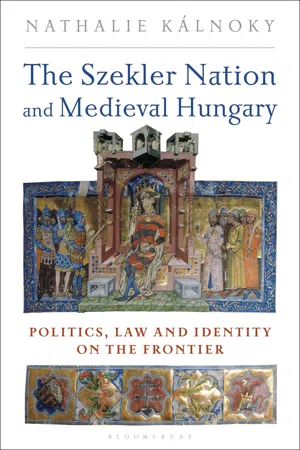
eBook - ePub
The Szekler Nation and Medieval Hungary
Politics, Law and Identity on the Frontier
- 264 pages
- English
- ePUB (mobile friendly)
- Available on iOS & Android
eBook - ePub
About this book
Information
Part I
THE STRUCTURES OF THE SZEKLER COMMUNITY (THIRTEENTH–FIFTEENTH CENTURIES)
Besides the unavoidable theories about the origins of the Szeklers, we should consider their military role in the tenth to twelfth centuries, their migration to Transylvania, the land that was to be theirs, and the first indications about their tribal structures described in data about this period.
By the end of the thirteenth century, the Szekler community was a structured society established in its territory, the Szeklerland, and in its military function, that of guarding the eastern frontier. These two factors – territorial and functional – characteristic of the Szekler community, were complemented by a third: their possession of collective privileges, structured along tribal lines.
What is the origin of this ‘sharing out of property and offices among tribes and kinships’ that Werbőczy noted?
Chapter 1
ON THE ORIGINS OF THE MILITARY AUXILIARY PEOPLE AND THEIR SETTLING IN THE SZEKLERLAND
Within the principal object of this study, the analysis of the medieval customs of the Szeklers of Transylvania, a brief digression in time and space is in order, far away from Transylvania, at a time when Western Europe is already in the Middle Ages but which is still ‘medieval’ for the kingdom of Hungary. Our interest encompasses the question of institutions – military structures, those of the state (i.e. organization of a kingdom), and territorial and ecclesiastic organization – before properly considering questions of law and legal systems.
There are practically no data of a strictly juridical nature on the Szekler community prior to its establishment in the Székelyföld (Szeklerland) of Transylvania. This said, there are certain aspects of the still unresolved question of their origin, of their military function and their peregrinations across the kingdom of Hungary towards what was to become the Szeklerland that suggest a ternary structure, ethnic or military-territorial in nature, which would persist, without really merging with the tribal structure that was to determine the organization of the Szekler community of Transylvania, until the middle of the sixteenth century.
I. ‘Privileged nobles, descendants of the Scythians’ – The Origins of the Szeklers
Without anticipating a final and irrefutable resolution of this question, it seems more than likely that the Szeklers – at least part of them – descend from the Kavar tribes, allied to the Hungarians several decades before the Conquest. As a point of view shared by the majority of historians who have delved into the question, it helps, but serves only to shift the venue: who are the Kavars and who are the Hungarians?
This sort of designation – like those for the ‘Bulgarians’, the ‘Turks’, or the ‘Huns’ – is misleadingly simple and certainly should not be used with any implication of ‘ethnic purity’. Rather, we are dealing with federative structures motivated essentially by military expediency: tribal membership came by birth, but it could just as well be obtained by integration. Membership by integration entailed acceptance of the established tribal order. Such integration, however, did not necessarily carry with it a renunciation of divergent civil traditions (as opposed, say, to the military), provided they could be accommodated, or even adopted, by the order in force. Thus, in the case of the Szeklers, internal structures that could serve to improve the efficacious execution of military functions assigned by the leaders of the host federation could readily be accommodated.
But why would Werbőczy, like his contemporaries of the beginning of the sixteenth century, consider the Szeklers to be descendants of the Scythians? And would such an ancestry in the opinion of the time have distinguished them from that of the Hungarians?
The very first Hungarian chronicles identify the Hungarians with the ‘Scythians’, one more designation the definition of which is left largely in the realm of speculation. This Scythian ancestry, culled by the medieval Hungarian writers from occidental sources (themselves relying on Byzantine sources), was further embellished by assertions of a Hunno-Hungarian kinship, drawn from the same occidental sources, which blandly amalgamated Huns, Avars and Hungarians. The Hunno-Hungarian kinship theory has its ardent followers to this day.
A. The Theories on the Origin of the Szeklers
1. The Tradition since the Earliest Chronicles: Attila and Scythia
The earliest Gesta Hungarorum, now lost but referred to in the Gesta Hungarorum of the notary Anonymus around 1200 and in those of Simon Kézai around 1280, claim Hunor and Magor, sons of the Scythian kings Gog and Magog, as the ancestors of the Hungarians. With the same aim of legitimizing the powers in place by tracing them back to ancient times, the Hunno-Hungarian kinship is evoked in these chronicles. The Illuminated Chronicle of Vienna (Chronicon Pictum) of the mid-fourteenth century in turn cites the Chronicle of Simon Kézai.
The Gesta Hungarorum – written at the beginning of the thirteenth century by the notary Anonymus, identified as ‘Master P.’, no doubt the provost of the archdiocese of Esztergom and notary of king Béla III – recount the glorious land-taking Conquest and early Hungarian history in the manner characteristic for the period. According to Gy. Györffy1 this account of the past is a reconstruction, reflecting the interests of the nobility in a position of power at the time it was written.
One notes the effort to trace back ancestries, even to kings mentioned in the Bible, no doubt under the influence of the Church – but, curious irony, we find the lineage Gog and Magog, not the most reputable of ancestors in the Judeo-Christian tradition! Not so long before, prayers were still imploring ‘de sagittis Hungarorum libera nos Domine’. The Gesta also enlist Attila, whose grandeur was painted in diabolic hues, perpetuated in the surname ‘the scourge of God’. Along the way, references to Scythia are interspersed.
It is in this context that the Szeklers are presented as being one of the peoples of the king Attila,2 already conscious of an identity of their own and, ‘calling themselves Szeklers’,3 who, after the death of Attila (this point is not mentioned by the notary Anonymus, but by Simon Kézai4) joined his son Csaba – the legendary ancestor of Árpád – and were already in the Pannonian basin to welcome the arriving Hungarians as the long-awaited relatives for its (re-)conquest.
During the second half of the nineteenth century, B. Orbán, in his writings on the Szeklerland, is of the opinion that ‘the theory that the Szeklers are survivors of Attila’s Huns has attained the dignity of an historical fact’.5 Ch. d’Eszláry agreed in 1958, when he said that: ‘The Szeklers’ conviction that they are a very ancient population of Hungary, settled there before the conquest of the Carpathian basin by the Hungarians themselves and descending from Attila, could not have become so engrained without some basis in fact.’6
2. The Onset of Critical Analysis: Functionalism, Etymology and Totemism
Starting in the eighteenth century, doubts arose around this traditional concept. The accumulation of tenuous terms, epochs, peoples and historically dubious conceptions, produced a variety of speculative theories.
A document7 cited in the Székely Archives is viewed with disdain by K. Szabó for the functionalist interpretation made of it by one of his predecessors. This royal privilege accorded to the Szekler community of Vág (in the region of Pozsony/Bratislava, Pressburg in German, in Slovakia today) leads Gy. Fejér, a historian of the first half of the nineteenth century, to construct a theory that resolves the question of the Szeklers’ origin. According to him, the term ‘Székely’ (Siculus) refers to the function of frontier guard and has nothing to do with ethnic considerations. K. Szabó notes this hypothesis in a footnote only to refute it vehemently. He points out that the charters granting collective royal privileges always designate the exact ethnic entity concerned: Pechenegs, Cumans, etc., never just the function performed or the service rendered that merit the granting of a privilege.
A number of hypotheses have been proposed – and refuted – based on the name ‘Székely’ (Siculus). In the interest of benefiting from linguistic competence, reference is made here to the synthesis of interpretations published by Bernard Le Calloc’h:8 Székely derived from szék (sedes, seat); from sikil (meaning ‘runaway’ in Turk); or from a tribe named yikil, from ‘sikil’ (‘pure’ in Tchagatâï), but for the linguists it seems obvious that these hypotheses are unfounded.9 According to I. Bóna10 the first mention of the name dates from 1092, in the form of Scicul/Scichul:
King Béla II’s authenticated charter from around 1131, confirmed king Ladislas I’s grant of the right to transport salt of 1092 [ …/… ]. The twenty-four names copied from the charter of 1092 support the Transylvanian origin of the salt transporters. It is in this charter that the word Scicul/Scichul, which is the oldest form of the designation ‘Székely’ first appears.
It should be noted that the word appears here as a proper name. During the thirteenth to fourteenth centuries, we find more than a dozen spellings. Zoltán Kordé11 lists the forms: Zakuli, Zekuli, Zekeli, Siculi, Syculi, Sycli, Sjcli, Scecul, Scekel, Zecul, Dzsikil, Eszekel. Starting in the fifteenth century, we find essentially the Latin spelling Siculus, while the Hungarian orthography remains more unstable; we find Zekely in the registers of the early seventeenth century12 alongside the present spelling Székely. The etymology of this name is still disputed.
Linguistics and ethnology have converged on a ‘Turkic’ term, sikül or säkül, interpreted to mean ‘horse with white hoofs’, which would make the name Székely a derivative of the totem animal.13
3. Archaeology and the Theory of the Double Conquest
The theory referred to as that of the ‘Double Conquest’ was developed by Gy. László on the basis of archaeological data and references in the chronicles to a people said to have already been present in order to welcome Árpád on his arrival in the Carpathian basin at the end of the ninth century. From these indications, Gy. László concludes that peoples related to the Hungarians had arrived well before Árpád – with Attila or with the Avars around 670.
Gy. Györffy discussed in 1965 how his theory implicates the Szeklers; ‘nevertheless we need to point out that the question of the origin of the Szeklers is still unresolved and there are some who think that the notary Anonymus mentions the Szeklers as Attila’s people because they had preceded the Hungarians on this territory by several centuries and had lived before that in the Avar Empire.’14 In a note he points out: ‘This opinion is shared by Gy. László.’
L. Makkai similarly refers to this theory on the origin of the Szeklers, only to refute it, from a linguistic point of view.15
Despite the demise of Gy. László in June 1998, and continuing scepticism, the theory of the double conquest has not been abandoned completely. It came to light again in connection with recent archaeological discoveries in the southern Hungarian county of Somogy.16
4. The Khazaro-Kavar Theory in the Light of Byzantine Sources
But for now, back to the Steppes. Between the seventh and ninth centuries the empire of the Khazars – these ‘civilized Turks’ (René Grousset) – dominates the peoples of the region, the Hungarians among them. Without going into details that might lead us to stray too far from the Transylvanian Szeklers of the thirteenth to fifteenth centuries, let us just establish that, in the course of the ninth century, one of the groups of the Khazar empire, the Kavars, rebelled against the Khazar leadership – maybe as a result of the latter’s conversion to Judaism. Defeated, the Kavars joined up with the Hungarians, who at that time were an auxiliary people within the Khazar empire, and the Hungarians and Kavars acquainted themselves with each others’ languages. Composed of three groups (γενεάις), this dissident faction (‘kabar’ is said to mean ‘rebel’) of the Khazar empire went on to participate in the conquest of the Pannonian basin.17
In 1927,18 L. Szádeczky-Kardoss dealt with the Kavar origin of the Szeklers, pointing out that references to the tres genera Siculorum appear very early (1339)19 in the Székely Archives, which cannot but evoke the tripartite composition of the Kavar tribe. Thus, the ancestors of the Szeklers appear to have arrived with the Hungarians at the time of the land-taking Conquest.
In 1941,20 Gy. Györff...
Table of contents
- Cover
- Halftitle
- Title Page
- Contents
- LIST OF MAPS
- List of Tables
- List of Illustrations
- Translator’s Preface
- Preamble
- Introduction
- Part I The Structures of the Szekler Community (Thirteenth–Fifteenth Centuries)
- Part II Customary Law, as Practised – and Recorded (Fifteenth–Sixteenth Centuries)
- Glossary
- Abbreviations
- Sources
- Notes
- English Bibliography Supplement
- Bibliography
- Index
- Imprint
Trusted by 375,005 students
Access to over 1.5 million titles for a fair monthly price.
Study more efficiently using our study tools.
Frequently asked questions
Yes, you can cancel anytime from the Subscription tab in your account settings on the Perlego website. Your subscription will stay active until the end of your current billing period. Learn how to cancel your subscription
No, books cannot be downloaded as external files, such as PDFs, for use outside of Perlego. However, you can download books within the Perlego app for offline reading on mobile or tablet. Learn how to download books offline
Perlego offers two plans: Essential and Complete
- Essential is ideal for learners and professionals who enjoy exploring a wide range of subjects. Access the Essential Library with 800,000+ trusted titles and best-sellers across business, personal growth, and the humanities. Includes unlimited reading time and Standard Read Aloud voice.
- Complete: Perfect for advanced learners and researchers needing full, unrestricted access. Unlock 1.5M+ books across hundreds of subjects, including academic and specialized titles. The Complete Plan also includes advanced features like Premium Read Aloud and Research Assistant.
We are an online textbook subscription service, where you can get access to an entire online library for less than the price of a single book per month. With over 1.5 million books across 990+ topics, we’ve got you covered! Learn about our mission
Look out for the read-aloud symbol on your next book to see if you can listen to it. The read-aloud tool reads text aloud for you, highlighting the text as it is being read. You can pause it, speed it up and slow it down. Learn more about Read Aloud
Yes! You can use the Perlego app on both iOS and Android devices to read anytime, anywhere — even offline. Perfect for commutes or when you’re on the go.
Please note we cannot support devices running on iOS 13 and Android 7 or earlier. Learn more about using the app
Please note we cannot support devices running on iOS 13 and Android 7 or earlier. Learn more about using the app
Yes, you can access The Szekler Nation and Medieval Hungary by Nathalie Kalnoky in PDF and/or ePUB format, as well as other popular books in History & Eastern European History. We have over 1.5 million books available in our catalogue for you to explore.