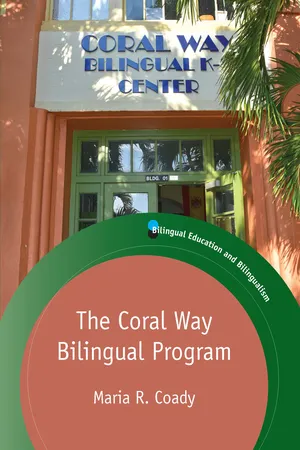
This book introduces readers to the first publicly funded, two-way bilingual program in the United States, Coral Way Elementary School. It details the historical, social and political origins of the school; reviews the various discussions and conceptualization of the bilingual education program as a 50: 50 model; and describes the training of the teachers and their work in designing curriculum for the bilingual students. Finally, it reviews whether the program was a success and outlines what lessons can be learned from the Coral Way Experiment for future bilingual programs. It is essential reading for all scholars of dual language education, for educational historians, for students of language policy and planning, and for teachers and educators who work in the context of dual language education in the US and worldwide.
- English
- ePUB (mobile friendly)
- Available on iOS & Android
eBook - ePub
The Coral Way Bilingual Program
About this book
Information
1 Origin of the Experiment
Cuban Exodus to the United States
Although Coral Way is a legacy in the field of bilingual education, known for its contribution to the use of two languages as mediums of instruction in school with students from different language backgrounds, the story of Coral Way begins as far back as January 1959, the month and year in which Fidel Castro descended from the mountainous countryside of Cuba and overthrew the Batista government. Little could anyone have known that a revolution on a small island country located 90 miles off the US coast that education in the United States would be fundamentally transformed for decades to come.
Early in 1959, the Castro regime, in power following then-President Batista’s flee to Mexico, began implementing policies that ruptured the existing lifestyle of the majority of Cubans. Under the rule of the People’s Socialist Party, Cubans on the island feared leftist, communist programs and policies being implemented. Many white-collar professionals on the island were sent to labor camps, despite their professional credentials. The Castro government wasted no time in closing down churches and banning clergy from practice. A staunchly Catholic country, many Cubans began to leave the island for fear of imprisonment and restrictions on their religious beliefs. Guerra (2012) reports that families who remained on the island also feared for the welfare and religious orientation of their children.
For many Cubans, Miami, Florida, was a logical destination during and after Castro’s ascent to power. Increasing numbers of Cubans began to leave the island, many destined for Miami due to its proximity (less than 100 miles) and its social, economic and cultural connections to Cuba. Before Castro rose to power, Cubans frequently traveled to and maintained strong ties with the United States. Miami was considered the preferred vacation spot for the Cuban middle class and a place where affluent Cubans practiced their English and acquired business skills. Wealthy Cubans traveled to Miami for weekend shopping. Sandoval (1991: 6) notes that ‘it was only natural [that] when the political oppression of Castro’s regime set in, many chose Florida as the place to go’ to wait out their imminent return to the island. However, the return to Cuba has not yet occurred.
Cubans seeking refuge in the United States received some financial backing and support from the US government. Guerra (2012) notes the financial influence that the US Central Intelligence Agency (CIA) provided to Cuban refugees in the early 1960s. She describes that between 1960 and 1965, the CIA distributed more than $50 million through their operating station located at the University of Miami. A report by Mitchell in 1966 indicated that the US government had been providing financial resettlement funding as early as 1961 under the Cuban Refugee Program (Mitchell, 1966), starting with about $1 million of presidential discretionary funding. Two of the nine major directives of the program included:
6. Furnish federal assistance for local public school operating costs related to the unforeseen impact of Cuban refugee children on local teaching facilities;
7. Initiate needed measures to augment training and educational opportunities for Cuban refugees, including physicians, teachers, and those with other professional backgrounds. (Mitchell, 1966: 3)
In 1961, the total amount of funding allocated to the Cuban Refugee Program was $4 million. While many Cubans sought ways to leave the island, the activities and economic aid of the US government played a role in supporting families’ transition, including healthcare, professional retraining for employment, childcare, food distribution and housing. Guerra (2012) writes further that this amounted to a certain degree of enticement provided to Cubans to leave the island, with material supports put in place to ensure that Cubans would not have to struggle in ways that many other immigrant groups to the United States had previously.
Among the mass of people leaving Cuba were highly educated professionals, teachers and children. The education system in Cuba was acclaimed to be rigorous and of the highest standards, and scholars continue to note the benefits of the Cuban centralized education system (Carnoy et al., 2007).
One area where Cuban education excelled was in language teaching and learning. As early as the 1940s, the Cuban education system offered children and adults the opportunity to learn English as a foreign language. Rosa Guas Inclán, a professor at the University of Havana and a teacher at the American school, the Ruston Academy, founded the first Modern Foreign Language Association in Cuba. Inclán became a consultant to Florida’s Dade County Public Schools (DCPS), preparing teachers to work with Spanish-speaking children. She ended up as a full-time administrator working for the school district and made significant contributions to recruiting and preparing Cuban teachers to work in DCPS. She was described by colleagues who worked with her as the ground force.
Another English language teacher who arrived in Miami after Castro came to power was Dr Josefina Sánchez Pando. Sánchez underscored the sentiment that emigrating Cubans were highly educated in the area of languages. She remarked that ‘at the same time that in Miami nobody would be teaching Spanish, the Centro Especiales de Inglés, special English centers, existed in every other school in Havana in which English was taught to the population’.1 Born in Cuba on 27 August 1927, Sánchez held a PhD in the field of education. Like other refugees who fled Cuba, Sánchez arrived in Miami in 1961 without papers or academic credentials, because the Cuban government would not allow documents to be taken out of the country. Sánchez described the high education standards that existed in Cuba in the mid-20th century, stating ‘our standards of education were much higher than any other South or Central American country’.2 She attributes the quality of education in Cuba to the influence of Europe, proudly reporting, ‘we were a combination of… the best of Europe and the criollo… that had come out of the mixture and the acculturation of 200–300 years of excellent education in Cuba’.
Operation Pedro Pan
Adding to the increasing number of Cuban students in Dade schools was a clandestine operation that essentially smuggled children out of Cuba (Vidal de Haymes, 2004). Between 1960 and 1962, a largely unknown US-backed operation supported the emigration of Cuban children between the ages of 3 and 16 to the United States (Torres, 2003). The operation was called Peter Pan, or Operación Pedro Pan, titled subsequent to the arrival of a 15-year-old boy from Cuba named Pedro, who sought refuge and was provided assistance from the US-based Catholic Welfare Bureau.
Father Bryan Walsh, representing the Catholic Welfare Bureau, led the US-side of Operation Pedro Pan and his task was to ensure that Cuban children were housed and cared for on their arrival in the United States. Back in Havana, a British teacher at the Ruston Academy named Penny Powers, along with Polita Grau and her brother Ramon Grau organized visa paperwork and airline tickets for children to travel from Cuba to the United States. Their task included whiting out names and birth dates on existing visa waivers and reproducing the waivers for Cuban children to enter the United States legally (Bravo, 2010; Conde, 1999). They also produced passports for children to leave Cuba. Between 1961 and 1965, the group secured the exodus of more than 14,000 children and later obtained visas for the children’s parents (Conde, 1999; Gonzalez-Pando, 2014). Polita and her brother were eventually tried for ‘taking the youth out of Cuba’ and for an alleged assassination attempt on Castro. They were each sentenced to 30 years in a Cuban prison of which Polita served 14 years (Gonzalez-Pando, 2014).
During Operation Pedro Pan, Cuban children up to 16 years old entered the United States alone and facing extremely unknown futures. Between 26 December 1960 and 23 October 1962, more than 14,000 parentless children were airlifted from Havana to Miami. Children arrived on flights twice daily: 3pm and 5pm. Those organizing the pro...
Table of contents
- Cover-Page
- Half-Title
- series
- Title
- Copyright
- Contents
- Acknowledgments
- Foreword by Dr Lourdes Rovira
- Overview
- Prologue
- 1 Origin of the Experiment
- 2 The ‘50:50’ Two-Way Model
- 3 Cuban Educators: Aides, ‘The Marines’ and Teachers
- 4 The Miami Linguistic Readers and Curriculum Development
- 5 Did it Work? Findings from the Coral Way Experiment
- 6 The Building of a Bilingual Network
- Epilogue
- Index
Trusted by 375,005 students
Access to over 1.5 million titles for a fair monthly price.
Study more efficiently using our study tools.
Frequently asked questions
Yes, you can cancel anytime from the Subscription tab in your account settings on the Perlego website. Your subscription will stay active until the end of your current billing period. Learn how to cancel your subscription
No, books cannot be downloaded as external files, such as PDFs, for use outside of Perlego. However, you can download books within the Perlego app for offline reading on mobile or tablet. Learn how to download books offline
Perlego offers two plans: Essential and Complete
- Essential is ideal for learners and professionals who enjoy exploring a wide range of subjects. Access the Essential Library with 800,000+ trusted titles and best-sellers across business, personal growth, and the humanities. Includes unlimited reading time and Standard Read Aloud voice.
- Complete: Perfect for advanced learners and researchers needing full, unrestricted access. Unlock 1.5M+ books across hundreds of subjects, including academic and specialized titles. The Complete Plan also includes advanced features like Premium Read Aloud and Research Assistant.
We are an online textbook subscription service, where you can get access to an entire online library for less than the price of a single book per month. With over 1.5 million books across 990+ topics, we’ve got you covered! Learn about our mission
Look out for the read-aloud symbol on your next book to see if you can listen to it. The read-aloud tool reads text aloud for you, highlighting the text as it is being read. You can pause it, speed it up and slow it down. Learn more about Read Aloud
Yes! You can use the Perlego app on both iOS and Android devices to read anytime, anywhere — even offline. Perfect for commutes or when you’re on the go.
Please note we cannot support devices running on iOS 13 and Android 7 or earlier. Learn more about using the app
Please note we cannot support devices running on iOS 13 and Android 7 or earlier. Learn more about using the app
Yes, you can access The Coral Way Bilingual Program by Maria R. Coady in PDF and/or ePUB format, as well as other popular books in Languages & Linguistics & Educational Policy. We have over 1.5 million books available in our catalogue for you to explore.