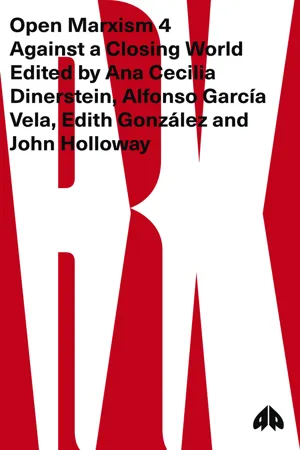
The publication of the first three volumes of Open Marxism in the 1990s has had a transformative impact on how we think about Marxism in the twenty-first century. 'Open Marxism' aims to think of Marxism as a theory of struggle, not as an objective analysis of capitalist domination, arguing that money, capital and the state are forms of struggle from above and therefore open to resistance and rebellion. As critical thought is squeezed out of universities and geographical shifts shape the terrain of theoretical discussion, the editors argue now is the time for a new volume that reflects the work that has been carried out during the past decade. Emphasising the contemporary relevance of 'open Marxism' in our moment of political and economic uncertainty, the collection shines a light on its significance for activists and academics today.
eBook - ePub
Open Marxism 4
Against a Closing World
- 224 pages
- English
- ePUB (mobile friendly)
- Available on iOS & Android
eBook - ePub
Open Marxism 4
Against a Closing World
About this book
Information
PART I
OPEN MARXISM AND CRITICAL THEORY
1
Recognition and Revolution
Richard Gunn and Adrian Wilding
How might an open Marxist school of thought be developed? The authors of the present chapter are keen readers of Hegel (1770–1831) and of ‘German Idealism’ more generally. It strikes us that themes highlighted by open Marxism echo a strand of thought in Hegel’s Phenomenology of Spirit (1807).1 In pointing to this strand, which is central to our recent work, we underline a continuity between Hegel and Marx. Stated differently, we attempt to renew what is referred to as ‘Left’ or ‘Young’ Hegelianism – which has become all but moribund in neoliberal years.
Marxism has traditionally aimed at emancipation – or, to quote Marx’s words, a society where ‘the development of each is the condition for the development of all’ (Marx and Engels 1976b: 506). In the present chapter, we argue that the form of society which Marx seeks to establish is a form which has roots in Hegel’s Phenomenology of Spirit. It is well known that Marx started his intellectual life as a Young Hegelian – the Young Hegelians being theorists of the 1830s and 1840s who emphasised emancipatory strands in Hegel’s work. In a number of early writings, Marx criticised the Young Hegelians.2 It may be just as important to say, however, that he always remained faithful to Young Hegelian ideas.
The key idea which concerns us here is ‘recognition’. In Hegel’s Phenomenology of Spirit, although not in his later and more conservative Philosophy of Right (1821), the term ‘mutual recognition’ has overtones of the freedom and self-determination at which the French Revolution of 1789 aimed. In a society where recognition is ‘mutual’ – or, to use an alternative term, ‘reciprocal’ – freedom is not alienated or contradicted. Where recognition is denied, freedom is denied for its part. A society where there is mutual recognition is one where individuals see or acknowledge one another’s freedom. Where mutual recognition is present, freedom obtains.
Why, it may be asked, bring ‘recognition’ into the picture? Why not merely say that Marx favours social relations of an emancipatory kind? One answer is that ‘pure’ or ‘mutual’ recognition is linked to a reciprocal to-and-fro process of interaction that Hegel’s Phenomenology does its best to explain (see Hegel 1977: 111–12). It is important, we think, to highlight this process: to-and-fro interaction is part of what emancipation entails.
A second answer is that ‘recognition’ – and, thence, recognition which is mutual – is a term that has not merely a cognitive but a constitutive force. That is to say: the way that individuals are ‘seen’ or recognised makes them who and what they are. When individuals are recognised as self-determining, therefore, their self-determination is accentuated. They become self-determining through the process of recognition that Hegel describes. Individuals who are mutually recognitive do not merely sit alongside one another. They cast one another’s self-determination into relief.
A further reason for talking about ‘recognition’ is political: in emancipatory political projects, recognition as set out in Hegel’s Phenomenology and in Marx is a much-foregrounded theme. In, for example, an ‘alternative’ cooperative – and we are thinking of a cooperative of a ‘prefigurative’ kind3 – much energy goes into experimentation. Experimentation with what? The answer which suggests itself is: ‘experimentation with forms of recognition’. It is, of course, possible to reply: ‘experimentation with social relations’. Such a reply, however, tells us little about the content of the relations in question. It is, we suggest, mutual recognition that provides the detail of emancipation which radical theory (including Marxism) often merely sketches. Moreover, by introducing ‘recognition’ into our conceptual picture, we find a term that highlights an activity which, from the seventeenth century onwards, radicals have regarded as key.4 The notion of mutual or to-and-fro recognition embodies the form of society which, for generations, revolutionaries sought to achieve.
It is true that, amongst orthodox or DIAMAT-style Marxists, ‘recognition’ has not found favour either as a theoretical term or a practical concern. One reason for this is that, for the decades of the Soviet Union’s pre-eminence, Marxism was gripped by the ‘base/superstructure’ metaphor.5 If everything in society must be allocated to a ‘base’ or a ‘superstructure’, recognition is superstructural to say the least. When open Marxism breaks with economistic and ‘base/superstructure’ dogmatism and focuses instead on everyday and grassroots issues (see Gunn 2017), the way is clear to give ‘recognition’ a central place. This done, a central aim of revolutionary activity is moved to the centre of theory’s stage.
Hegel on Recognition
In the present chapter, considerations of time and space prevent us from considering Hegel’s work in a systematic fashion. Elsewhere, we have written on Hegel and given the Phenomenology and its discussion of ‘Lord’ and ‘Bondsman’ (the so-called ‘Master-Slave dialectic’) an emphatic place.6 Here, our concern is with Marx – whom we regard not as a theorist of base and superstructure but as a theorist of recognition.
Whilst not attempting a detailed discussion of Hegel, our article cannot avoid drawing Hegelian issues into play. When Hegel wrote his Phenomenology, the French Revolution of 1789 struck him as an event that paved the way to emancipation. French Revolutionary emancipation seemed to him the practical basis on which truthful thought (or ‘science’, in Hegel’s meaning of the term) – for example the ‘science’ of the Phenomenology itself – rests.7 In chapters IV and, especially, VI of the Phenomenology, Hegel traces an outline of European history from the Ancient Greek polis to the French Revolution of his own day. Each phase of this history represents a distinctive pattern of recognition; this history ends with the French Revolution, when mutual recognition or non-alienated recognition is attained.
At this point, some detail regarding the Phenomenology is unavoidable. Although the French Revolution is, for the Hegel of 1806–7, the event which brings mutual recognition into being, the section of the book headed ‘Absolute Freedom and Terror’, wherein the events of the Revolution are discussed, is no straightforward triumphalist text. Hegel’s starting point is that, in the Revolutionary crowd, ‘each [individual], undivided from the whole, always does everything, and what appears as done by the whole is the direct and conscious deed of each’ (1977: 357). This formulation echoes a phrase used by Hegel when he first introduces the idea of mutual recognition. There, he envisages a situation where there is an ‘“I” that is “We” and “We” that is “I”’ (1977: 110). Hegel’s return to this vocabulary of reciprocity at the end of his outline of European history allows us to see what the French Revolution has achieved. In effect, mutual recognition makes its first appearance on the streets of Revolutionary Paris. Hegel’s claim in the passage cited above is that Revolutionary freedom and mutual recognition are one and the same thing. He is aware, of course, that crowd activity is unstable and evanescent: the problem faced by the Revolution is to give mutual recognition a lasting being. The difficulty faced by the French Revolution is that attempts to instantiate mutual recognition contradict mutual recognition itself. When the Revolution turns to the ‘universal work’ of constitution building, for instance, it sets up a social structure that stands over against the individual and alienates freedom once again.8 What Hegel terms ‘deeds proper’ (1977: 359) – by which he understands military ventures – contradict and alienate freedom in a novel way. When, finally, the Revolution turns to state Terror, the contradiction is evident: ‘The sole work and deed of universal freedom is ... death’ (1977: 360). It would be fair to say that, although the French Revolution has brought the principle of mutual recognition into being, it has not shown how mutual recognition can be instantiated in a stable way. For the Hegel of the Phenomenology, the problems of mutual recognition lie out ahead. They represent problems for the present and future, as the Young Hegelians and Marx saw.
A further detailed point which deserves emphasis here concerns the course of history. We have suggested that, for the Hegel of the Phenomenology, historical periods are patterns of recognition. The point we wish to emphasise is that these patterns are, without exception, patterns of contradictory – or, to state the point differently, patterns of alienated or contradicted – recognition. Only at the end of the Phenomenology’s historical narrative does recognition exist in an uncontradicted – which is to say, a mutual – way. When the Hegel of the Phenomenology writes of contradictory or contradicted recognition, what contradictions – what sorts of contradiction – does he have in mind? We pause to clarify this point because it has a bearing on Marx’s claims.
One form of contradiction that the Phenomenology envisages is what Hegel terms ‘one-sided and unequal’ recognition (1977: 116). The most famous example of this is the recognition that obtains between a Lord (Herr) and a Bondsman (Knecht). Recognition that is ‘one-sided and unequal’ is contradictory in that it undermines itself. It undermines itself because a Lord depends on recognition by a Bondsman – and yet he, the Lord, denies that the Bondsman is capable of recognition. From the Lord’s point of view, the Bondsman is beneath contempt. A relation of domination (Herrschaft), Hegel tells us – and the implications of this are considerable – is not just reprehensible but self-defeating, a tower built on sand.
In the Phenomenology, ‘one-sided and unequal’ recognition is a key form that contradictory recognition takes. But there is a second form, and it is important to acknowledge this because it too reappears in Marx’s work. This form of contradictory recognition is recognition that goes forward in terms of role definitions, which the Phenomenology regards as inscribed in social institutions. Social institutions – Hegel’s phrase is ‘geistige Massen’ (see Hegel 1977: 300, 356–7) – stand over against individuals. In relation to social institutions, an individual can only lead an alienated life. An individual who is recognised only in terms of social role definitions is divided against him- or herself: the part of the individual included in the role definition (the ‘universal’ part) is socially acknowledged but the multifaceted remainder of the individual (the ‘particular’ part) falls out of account. The individual is not acknowledged as a coherent and self-determining being. Individuals defined by roles and the institutions which generate them are not free in and through one another. In a world of institutions, individuals no longer cast each other’s self-determination into relief.
This second form of contradictory recognition is taken up by Marx when he refers to, and criticises, ‘ökonomischen Charaktermasken’ (1975a: 114). It is implied when, in the Grundrisse, Marx declares that, in a market, individuals ‘recognize one another as proprietors’ (1973: 243). Unless the Phenomenology’s second form of contradictory recognition is borne in mind, passages such as that just cited can send one on a hunt for tacit aspects of mutual recognition in capitalist market relations.9 As we show later, no such potentially reformist motifs are present in Marx’s thought.
Whilst on the subject of details in Hegel, it is important to underline the difference between recognition which exists in the course of history – or, as Marx phrases the point, in the history ‘of all hitherto existing society’ (Marx and Engels 1976b: 482) – and recognition in a mutual and, so to say, post-historical world.10 The difference is that between recognition which is alienated and recognition where a self-determining and emancipatory perspective is restored. Exploring this difference, we come upon a point that is not merely one of detail but is essential to our claims. We have suggested that mutual recognition has a to-and-fro and interactive dynamic. It is, we propose, analogous to a good conversation – by which we mean a conversation that is open to all comers and which follows the subject matter wherever it leads. If the conversation is restricted by external requirements – for example, requirements on which this or that social institution or social role insists – it ceases to be ‘good’. It ceases to be a ‘conversation’. It becomes an empty ritual propping up the power structure that the social role or institution serves. Stating this point in slightly different terms: if recognition is to be mutual, and to have a to-and-fro dynamic, it must (just as a ‘good’ conversation must follow the subject matter where it leads) be answerable to nothing but itself. If recognition is to have a structure, the structure must be its own. It must be ‘unstructured’ – not in the sense that it is chaotic or random but in the sense that it gives its dynamic to itself. In this sense, we readily admit that our view of recognition is anarchistic.
Marx on Recognition
Just as recognition is at the core of Hegel’s thought, so too is it a theme which runs through Marx’s thinking and makes sense of a diverse range of his concerns. Of course, to argue that Marx is a thinker of recognition is, in Marxist terms, unorthodox. Due to longstanding prejudices, the concept of recognition has an ‘unmarxist’ ring. At best, recognition features at the edges of discussions of the topic of alienation; at worst it is assumed to belong to the Hegelian baggage supposedly jettisoned by the ‘mature’ Marx. A further prejudice blocks the way to a recognitiv...
Table of contents
- Cover
- Title
- Copyright
- Contents
- Foreword by Werner Bonefeld
- Acknowledgements
- Introduction: Open Marxism Against a Closing World
- Part I: Open marxism and critical theory
- Part II: State, Capital, Crisis
- Part III: Democracy, revolution and emancipation
- Notes on Contributors
- Index
Trusted by 375,005 students
Access to over 1.5 million titles for a fair monthly price.
Study more efficiently using our study tools.
Frequently asked questions
Yes, you can cancel anytime from the Subscription tab in your account settings on the Perlego website. Your subscription will stay active until the end of your current billing period. Learn how to cancel your subscription
No, books cannot be downloaded as external files, such as PDFs, for use outside of Perlego. However, you can download books within the Perlego app for offline reading on mobile or tablet. Learn how to download books offline
Perlego offers two plans: Essential and Complete
- Essential is ideal for learners and professionals who enjoy exploring a wide range of subjects. Access the Essential Library with 800,000+ trusted titles and best-sellers across business, personal growth, and the humanities. Includes unlimited reading time and Standard Read Aloud voice.
- Complete: Perfect for advanced learners and researchers needing full, unrestricted access. Unlock 1.5M+ books across hundreds of subjects, including academic and specialized titles. The Complete Plan also includes advanced features like Premium Read Aloud and Research Assistant.
We are an online textbook subscription service, where you can get access to an entire online library for less than the price of a single book per month. With over 1.5 million books across 990+ topics, we’ve got you covered! Learn about our mission
Look out for the read-aloud symbol on your next book to see if you can listen to it. The read-aloud tool reads text aloud for you, highlighting the text as it is being read. You can pause it, speed it up and slow it down. Learn more about Read Aloud
Yes! You can use the Perlego app on both iOS and Android devices to read anytime, anywhere — even offline. Perfect for commutes or when you’re on the go.
Please note we cannot support devices running on iOS 13 and Android 7 or earlier. Learn more about using the app
Please note we cannot support devices running on iOS 13 and Android 7 or earlier. Learn more about using the app
Yes, you can access Open Marxism 4 by Ana Cecilia Dinerstein, Alfonso García Vela, Edith González, John Holloway in PDF and/or ePUB format, as well as other popular books in Politique et relations internationales & Philosophie politique. We have over 1.5 million books available in our catalogue for you to explore.