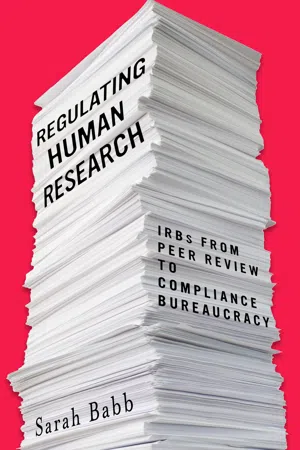
Institutional review boards (IRBs) are panels charged with protecting the rights of humans who participate in research studies ranging from biomedicine to social science. Regulating Human Research provides a fresh look at these influential and sometimes controversial boards, tracing their historic transformation from academic committees to compliance bureaucracies: non-governmental offices where specialized staff define and apply federal regulations. In opening the black box of contemporary IRB decision-making, author Sarah Babb argues that compliance bureaucracy is an adaptive response to the dynamics and dysfunctions of American governance. Yet this solution has had unforeseen consequences, including the rise of a profitable ethics review industry.
- 171 pages
- English
- ePUB (mobile friendly)
- Available on iOS & Android
eBook - ePub
About this book
Information
Publisher
Stanford University PressYear
2020Print ISBN
9781503611221
9781503610149
Edition
1eBook ISBN
9781503611238
1
The Federal Crackdown and the Twilight of Approximate Compliance
“BOY, THIS WAS A WAKE-UP CALL,” Alan recalled. “When we looked at headlines, we said, ‘Wow, look what the government did! I wonder if we’re in any jeopardy?’” (compliance office director, academic medical center). It was the late 1990s, and federal regulators were penalizing leading research institutions for failing to comply with the IRB rules. In 1998, Rush Presbyterian Medical Center was ordered to suspend its federally funded research with human subjects. In 1999, both the Duke University Medical Center and the Los Angeles Veterans Administration Medical Center were similarly ordered to shut down thousands of studies.
The federal crackdown that Alan remembered so vividly was triggered by shocking research scandals, a growing sense in Washington that the IRB system was broken, and mounting pressure on regulators to act. This chapter explores the deeper roots of the crackdown and analyzes the regulatory framework within which it occurred. IRBs were part of a workaround system—one that delegated decisions to local boards, relied on the labor of unpaid faculty volunteers, and was overseen by under-resourced offices located in hidden corners of the federal bureaucracy. This structure was a legacy of political obstacles to building a more robust system back in the early 1970s, when the National Research Act was passed, as well as hurdles to reforming the system in the decades that followed.
For many years, this structure functioned adequately enough. Yet, as the world of biomedical research became larger, more commercialized, and more complex, there was a growing disproportion between the enormous task apportioned to IRBs and the scant resources they could deploy to address it. This set the stage for an outbreak of research scandals—and for regulators to respond by disciplining errant research institutions. The crackdown would profoundly and permanently alter how IRBs approached their duties.
The IRB System in Brief
IRBs are on the front lines of two overlapping regulatory systems. Among academics, the better known of the two has jurisdiction over institutions that receive federal research funding, and is governed by the Code of Federal Regulations, Title 45, Part 46 (45 CFR 46), today usually referred to as the Common Rule. Compliance with the Common Rule is overseen by an office within the Department of Health and Human Services (DHHS), the parent organization of the National Institutes of Health (NIH). A second structure has jurisdiction over privately sponsored research, such as clinical trials financed by pharmaceutical companies. This system is governed by 21 CFR 50, 56 and overseen by the U.S. Food and Drug Administration (FDA), an agency also located within DHHS that in practice behaves quite autonomously. Many IRBs manage compliance with both the Common Rule (for federally funded studies) and FDA regulations (for privately funded studies).
These two sets of regulations rely on distinct enforcement mechanisms, reflecting the different powers of their respective enforcers. The office overseeing the Common Rule wields the power of the purse. Every institution receiving research funds from NIH (as well as from other federal agencies that are part of the rule) must sign a formal “assurance” that it will uphold the IRB policy: research with human subjects sponsored by these agencies must be reviewed by a duly constituted board following federal rules. Regulators can suspend the assurances of institutions found to be out of compliance—and thereby suspend their federally funded research.
In contrast, FDA’s power lies in its ability to withhold its approval from drugs, biologics, and medical devices, and thereby keep them off the market. An applicant for FDA approval must report the name of the IRB that reviewed the research. FDA has the ability to suspend or disqualify an offending IRB’s ability to review studies. The agency can also restrict, disqualify, or even criminally prosecute investigators if they fail to adhere to human subjects protection rules.1
The Common Rule and FDA regulations are nevertheless closely aligned. Under both, boards review research proposals to determine whether subjects are being put at risk, whether risks outweigh benefits to subjects, and whether they are being given the opportunity to provide informed consent. IRBs are also charged with conducting periodic follow-up (“continuing”) reviews. Regulations require that IRBs have at least five members, including at least one “non-scientist” and at least one member not affiliated with the institution. Boards must follow prescribed regulatory procedures and file reports with federal agencies when research goes awry.
Such stipulations aside, IRBs exercise tremendous autonomy. The federal offices entrusted with their oversight are empowered neither to set precedents nor to accept appeals. It is a structure designed to delegate judgment to local boards.2
The Workaround Regulation of Research Ethics
The origins of this system can be traced back to the decades following the Second World War, a time of rapidly expanding funding for biomedical research. Most of this money was channeled through NIH, which began to require that its researchers submit their proposals for ethics review by a panel of their colleagues.3 This became the official policy of NIH’s parent agency, and was expanded to extramural researchers. The notion that ethics assessment should be conducted by a local group of professional colleagues spread and flourished, as federally sanctioned “institutional peer review committees” began to crop up around the country at hospitals and universities receiving NIH funding.4 At around this time, FDA—which was housed with NIH under the roof of the same agency—began to require similar review of new investigational drug applications.5
This embryonic IRB framework was already in place when Senate hearings in the early 1970s revealed a shocking array of ethical abuses in biomedical research. In addition to the horrors of the Tuskegee syphilis study, there were many other examples, some of which included a clinical trial for birth control in which women were given a placebo without their knowledge, frontal lobotomies in psychosurgery research, and military cancer victims being treated with lethal levels of full-body radiation.6
In light of these blood-curdling reports, Congress sought to replace federal agencies’ internal policies with more substantial oversight, and debated various alternatives. One bill introduced by Senator Hubert Humphrey (S. 934) proposed the creation of a powerful National Human Experimentation Board, similar to the National Labor Relations Board. The board would be empowered to pass regulations, set precedents, and “review all planned medical experiments that involve human beings which are funded in whole or in part with Federal funds.” National board members would be paid federal salaries, and would be “persons of demonstrated knowledge, education, and experience in the field of clinical investigations” appointed by the president.7
Humphrey’s National Human Experimentation Board would have set American human research protections on a centralizing trajectory, similar to what emerged in European countries many decades later.8 This proposal quickly dropped out of Senate discussions. Subsequent debates focused on a second bill, proposed by Senator Edward Kennedy (S. 2072) that would have set up a permanent national commission with the power to promulgate and enforce regulations, as well as to certify local review boards. Unlike Humphrey’s plan, the Kennedy option would have kept local IRBs in charge of reviewing NIH research. Nevertheless, it would have provided them with strong leadership and direction: a permanent expert commission with the authority to set the agenda for review boards across the country and to serve as a precedent-setting appeals body.9
Although a version of Kennedy’s plan was made law in the National Research Act of 1974, the bill was significantly watered down in the process of political compromise. Although the law established a national commission, it was a temporary one with a purely advisory function. The act also authorized the promulgation of new regulations (45 CFR 46) that were practically identical to the old NIH policy and that would be overseen by the same small office within NIH. These regulations, along with all their subsequent iterations, were founded on two premises: the wholesale delegation of decisions to local boards financed by research institutions, and their oversight by subagencies located deep within the federal health bureaucracy.10
In hindsight, it is clear that more centralized federal governance of human research ethics was doomed by two features of the American political landscape. First, centralization was antithetical to the interests of powerful actors. The biomedical research community strongly opposed any potential imposition on their professional autonomy. In this, they had the backing of their powerful patron, NIH, which also preferred a decentralized system because it insulated the institute from legal problems and public controversy.11
Second, there was limited appetite among lawmakers for expanding state capacity in this way. Although Democrats controlled both chambers of Congress, House Democrats were warier of big-government solutions than their colleagues in the Senate.12 Kennedy’s original proposal was also strongly opposed by the Nixon administration. As one top health official explained at the time, the administration “wanted to try . . . to stop the continued federal intrusion into matters that were not properly the concern of the government.”13
For liberal reformers during the 1960s and 1970s, such political limitations posed a perpetual dilemma, commonly addressed through a variety of workarounds, such as relying on private lawsuits for enforcement, or by devolving costs onto state governments.14 In the case of human research protections, the solution was to build on the existing NIH policy, complete with its weak core and delegated decision making. This was the founding workaround of the IRB system—the compromise that enabled legislation and regulations to protect human subjects, but that would also lead to problems down the line.
The Era of Approximate Compliance
In 1974, the die was cast for the decentralized governance of human research protections, with regulations that replicated the delegated logic of the earlier NIH policy. In 1981, these regulations were updated to reflect some of the recommendations of the National Commission for the Protection of Human Subjects of Biomedical and Behavioral Research, and a similar set of FDA rules was issued. A decade later, in 1991, a long list of government agencies signed on to a third version of the 45 CFR 46 regulations, which became known as the Common Rule. A continuous theme running throughout these iterations was the outsourcing of ethical judgments to local committees with limited government oversight.
The evidence suggests that until the mid-1990s or so, IRBs complied with the regulations approximately. One former regulator recalled finding that “it seemed like a lot of IRBs . . . didn’t pay a whole lot of attention to the letter of the regulations. You know, they were seen more as general principles rather than regulations.”15 This impression was echoed by other former regulators among my informants. At that time, IRB members were often guided by informal norms—their own habitual practices, or the practices of other boards—rather than by a close reading of the rules.
Such an imprecise approach was encouraged by a confluence of circumstances. For one thing, full-fledged compliance had become steadily more labor-intensive. The 1981 update to the regulations had marked a conceptual turning point, in which IRBs became something more than peer review committees. They were required to have at least one “non-scientist” member, and at least one member not affiliated with the institution. More significantly (for the purposes of this chapter), they were charged with more extensive regulatory and administrative responsibilities—to follow in detail the procedures spelled out the regulations, and to record that these procedures had been followed.16
With the transformation of internal policies into regulations, and with each subsequent update, these mandated procedures increased in volume and complexity. The 1981 regulat...
Table of contents
- Cover
- Title Page
- Copyright
- Dedication
- Contents
- Acknowledgments
- Introduction
- 1. The Federal Crackdown and the Twilight of Approximate Compliance
- 2. Leaving It to the Professionals
- 3. Organizing for Efficiency
- 4. Ethics Review, Inc.
- 5. The Common Rule and Social Research
- 6. Varieties of Compliance
- Conclusion
- Appendix: Research Informants
- Notes
- Bibliography
- Index
Trusted by 375,005 students
Access to over 1.5 million titles for a fair monthly price.
Study more efficiently using our study tools.
Frequently asked questions
Yes, you can cancel anytime from the Subscription tab in your account settings on the Perlego website. Your subscription will stay active until the end of your current billing period. Learn how to cancel your subscription
No, books cannot be downloaded as external files, such as PDFs, for use outside of Perlego. However, you can download books within the Perlego app for offline reading on mobile or tablet. Learn how to download books offline
Perlego offers two plans: Essential and Complete
- Essential is ideal for learners and professionals who enjoy exploring a wide range of subjects. Access the Essential Library with 800,000+ trusted titles and best-sellers across business, personal growth, and the humanities. Includes unlimited reading time and Standard Read Aloud voice.
- Complete: Perfect for advanced learners and researchers needing full, unrestricted access. Unlock 1.5M+ books across hundreds of subjects, including academic and specialized titles. The Complete Plan also includes advanced features like Premium Read Aloud and Research Assistant.
We are an online textbook subscription service, where you can get access to an entire online library for less than the price of a single book per month. With over 1.5 million books across 990+ topics, we’ve got you covered! Learn about our mission
Look out for the read-aloud symbol on your next book to see if you can listen to it. The read-aloud tool reads text aloud for you, highlighting the text as it is being read. You can pause it, speed it up and slow it down. Learn more about Read Aloud
Yes! You can use the Perlego app on both iOS and Android devices to read anytime, anywhere — even offline. Perfect for commutes or when you’re on the go.
Please note we cannot support devices running on iOS 13 and Android 7 or earlier. Learn more about using the app
Please note we cannot support devices running on iOS 13 and Android 7 or earlier. Learn more about using the app
Yes, you can access Regulating Human Research by Sarah Babb in PDF and/or ePUB format, as well as other popular books in Social Sciences & Organisational Behaviour. We have over 1.5 million books available in our catalogue for you to explore.