The origins of a transnational adoption strategy that secured the future for Korean-black children
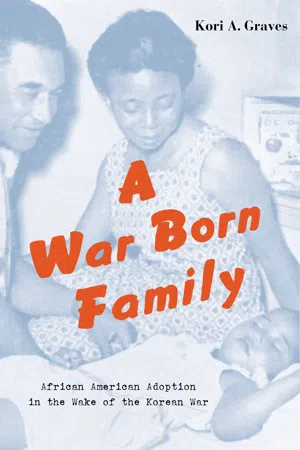
The Korean War left hundreds of thousands of children in dire circumstances, but the first large-scale transnational adoption efforts involved the children of American soldiers and Korean women. Korean laws and traditions stipulated that citizenship and status passed from father to child, which made the children of US soldiers legally stateless. Korean-black children faced additional hardships because of Korean beliefs about racial purity, and the segregation that structured African American soldiers' lives in the military and throughout US society. The African American families who tried to adopt Korean-black children also faced and challenged discrimination in the child welfare agencies that arranged adoptions.
Drawing on extensive research in black newspapers and magazines, interviews with African American soldiers, and case notes about African American adoptive families, A War Born Family demonstrates how the Cold War and the struggle for civil rights led child welfare agencies to reevaluate African American men and women as suitable adoptive parents, advancing the cause of Korean transnational adoption.
- English
- ePUB (mobile friendly)
- Available on iOS & Android
eBook - ePub
About this book
Information
1
African American Soldiers and the Origins of Korean Transnational Adoption
In February 1953, Captain Sylvester Booker became the first African American to bring a Korean child to the United States for adoption. Captain Booker’s effort to adopt Rhee Song Wu made him a member of a small but growing number of Westerners who attempted to rescue children they believed to be war orphans during the Korean War. When Booker began his 18-month-long bureaucratic struggle to adopt Rhee, the child was not officially an orphan because his mother was alive. But Booker claimed that Rhee’s mother wanted him to adopt her son. According to him, she had even signed papers to that effect because she believed Rhee would have a better life in the United States.1 Booker agreed. He was confident that he could provide Rhee “a good home, excellent schooling, and an opportunity to make himself a first-rate citizen.”2 But getting Rhee to the United States was not easy. Booker had to request that the US Congress pass a private law that would bypass immigration restrictions that imposed limits on the number of visas available to citizens of Asian nations. Although Booker was in Korea when he began investigating ways to adopt Rhee, he was not able to secure the necessary paperwork to take Rhee with him when his tour ended. However, on July 9, 1952, Congress passed Private Law 82–801, “An Act for the Relief of Rhee Song Wu,” and less than a year later, Rhee was on his way to live with Bookers.3
The media coverage of the Booker adoption presented the story as a triumph of humanitarianism. Articles about their separation and reunion appeared in African American and white newspapers from 1952 to 1954. Most publications only alluded to the tragedies Rhee experienced before he left Korea or the circumstances that would set the stage for the unprecedented growth of transnational adoptions involving Korean children in the postwar years.4 Instead, articles described Rhee as a charming and spunky youngster who was “not afraid of anything except little girls.”5 Many publications also characterized Booker as an accomplished and caring medic who attended to Rhee’s injured hand and then “took the waif into his camp, fed him, clothed him, taught him to speak English and, in the process, came to love him as a son.”6 Several pieces did not make Booker’s race a central element of the story. In fact, the Congressional Record of Booker’s case and a number of the white publications such as the Los Angeles Times did not reference his race at all. Even when articles mentioned that Booker was an African American, most publications emphasized the ways he was an exemplary American who would be able to raise Rhee to be the same.7 In the decades after the Korean War, many African American soldiers would join Captain Booker and attempt to adopt Korean children. Much like Booker, the experiences they had and the circumstances they encountered while serving in Korea inspired this response. This chapter evaluates those circumstances to demonstrate how they became the roots of Korean transnational adoption for black soldiers.
During the Korean War, black soldiers devised many formal and informal ways to assist the Korean children they encountered. These efforts often began with small gestures of charity that grew to become more long-term commitments of care. This form of benevolence attracted considerable attention because it made sense in the context of a war that brought men from wealthy nations into contact with impoverished children in a war-torn country. Discussions of soldiers’ kindness toward children also served multiple political and social purposes. As SooJin Pate describes, during and after the war “military humanitarianism became the primary tool in which to assuage the image of the United States as colonizer and occupier . . . [and] the phenomenon of GIs as humanitarians became the strategy in which to do so.”8 Political leaders, military officials, and members of the media emphasized how all soldiers’ efforts to aid Korean children were politically and culturally significant to US foreign relations. Yet, the black press’s emphasis on the “American” qualities of the black soldiers who provided care for Korean children was consequential because of the civil rights struggles that embroiled many African Americans in efforts to redefine the terms of their citizenship.9
Throughout the Korean War, the black press mobilized depictions of compassionate African American soldiers as part of a larger campaign to bolster appeals for racial equality in the US military and society. In this context, the cultural and political significance of black soldiers’ child-focused charity evolved as the goals of the Civil Rights Movement shifted. This chapter evaluates how civil rights struggles shaped popular characterizations of African American soldiers’ child-focused charity as well as their social and sexual relations with Korean women during the Korean War. Ideas presented in African American newspapers, and especially the Afro-American, are central to this analysis. In most cases, stories in the black press about African American soldiers’ humanitarian activities were overwhelmingly positive. These assessments helped counter the criticisms of black soldiers’ conduct on and off the battlefield that followed them throughout the conflict. But soldiers’ actions in Korean communities had many far-reaching negative effects because they took place within a web of intricate political and social relations. While some soldiers sacrificed to provided material aid to some Korean children, they also engaged in the very martial activities that decimated Korean communities. Similarly, black soldiers’ social and sexual relations with Korean women contributed to community instability, and the children born as a result of these relationships suffered because of the war and because they were mixed-race. The black press was largely uncritical of black soldiers’ roles in these destructive aspects of the war, which obscured the ways some African American men were complicit in the violence and exploitation that harmed Korean women and the Korean children they aided, fathered, and would adopt. Instead, the black press developed narratives that highlighted themes of rescue and responsibility that influenced African Americans’ wartime ideas about Korean children.10
Scholarship exploring the contradictory nature of soldiers’ military humanitarianism during the Korean War has focused largely on the behaviors of white soldiers.11 A few scholars of African American history have attempted to make sense of black soldiers’ child-centric benevolence by situating their Korean War experiences in the genealogy of the Civil Rights Movement.12 Indeed, such histories explore the ways soldiers and civil rights activists characterized African American men’s military service as a leading wedge in the fight to dismantle segregation in the military and US society. However, ideas about gender, and not just race, defined African American soldiers’ experiences and assessments of their conduct. Consequently, many activists prioritized the defense of black manhood, because “the link between valorous military service and civil rights was so tight . . . that many critics feared admission to black faltering would only damage their claims to full civil rights as well as the inherent assertion of equal manhood.”13 This chapter builds on these assessments to evaluate what scholar Katharine H. S. Moon calls the “people-to people” strand of US-Korean relations that influenced black men’s military service, roles in wartime Korean child welfare, relationships with Korean women, and involvement in early Korean transnational adoptions.14
African American Soldiers in Korea’s Military and Child Welfare Crises
African American soldiers were among the first United Nations (UN) troops to fight in the conflict that began after the June 25, 1950 melee at the 38th parallel between the Korean People’s Army (KPA) and the army of the Republic of Korea (ROK). Immediately after the KPA began its invasion of South Korea, the UN Security Council condemned North Korean leaders for orchestrating the attack. Within days, US president Harry Truman ordered air strikes to slow the advance of the KPA in South Korea. These measures were insufficient to stop North Korean troops and by June 29, they had routed ROK forces in Seoul and taken control of South Korea’s capital city. The retreat of the army of the ROK, South Korean president Syngman Rhee, and other political officials revealed that ROK troops were not equipped to fight a full-scale ground war. Advised by his Secretary of State, Dean Acheson, that Korea was strategically significant in the fight against the spread of communism, President Truman ordered combat troops into the conflict in early July. Although civil rights activists had been agitating for years for the desegregation of the armed forces, Truman sent a segregated army to Korea to take part in what he called a police action.
Members of the all-black Twenty-Fourth Infantry Regiment traveled to Korea the second week of July 1950 and immediately observed the deprivation that affected many Korean children. A number of veterans who served with the Twenty-Fourth had vivid memories of the stark environments they encountered in the early days of the conflict. Decades after the war, these men could still describe the chaos that characterized the troop mobilization from Japan, where they had been members of the occupation forces in that nation. Many recalled traveling for more than twelve hours on poorly provisioned, non-military vessels that smelled of fish and fertilizer. After landing in Pusan, a port city on the peninsula’s southeastern coast, some had to unload equipment alongside Korean dockworkers that seemed reluctant to assist them. A few veterans recalled the smell of what they learned to euphemistically call the honey wagons, which were carts of human waste Koreans used to fertilize crops. The heat of summer would have accentuated the smells and the discomfort these tired and hungry soldiers felt as they boarded the trains or trucks that took some to Yecheon and others to Kumchon, where they attempted to stop the advancing KPA forces.15
In spite of this unpleasantness and uncertainty, the great need they witnessed surprised these soldiers, and some responded with small acts of kindness. Sharing their food or other supplies with Korean children began for some soldiers as soon as they landed in Korea. In his memoir describing the time he spent as a white officer of an all-black platoon in Korea, Lieutenant Colonel Lyle Rishell recounted how he attempted to help a Korean child he encountered during his first night on the peninsula. Touched by the tattered appearance of one Korean boy, Rishell spent the evening hemming an old pair of pajamas to give to the youngster. That same night, Rishell observed a number of his men sharing their meager rations with the children they met near the Port of Pusan, whose circumstances would only worsen as the war continued.16
The first US soldiers in Korea had received the requisite amount of basic training, but it did not prepare them for the privations they would observe and experience. Nor did it equip them to wage a full-scale war against the well-trained KPA forces. After World War II, the US government had drastically cut the size of the military and reduced military expenditures. As a result of the postwar demobilization, army enlistments dropped from just over eight million men in 1945 to around six hundred thousand men when the Korean War began. The regiments that made up the occupying forces in Japan were not operating at full strength, and replacements sent to fill these units often had minimal basic training and limited infantry training. For African American soldiers, the army’s pattern of assigning black soldiers to service units compounded the situation. As veteran Julius Becton Jr. remembered, prior to going to Korea his unit was under strength, so commanders filled its ranks with men from service units who had little if any infantry training. Regardless of the amount or type of training soldiers had received, they quickly learned that they would have to adapt to fight in Korea’s mountainous terrain against troops using guerilla tactics.17
The KPA’s ranks included seasoned soldiers who had fought alongside Chinese communists during China’s civil war. These men were combat ready. The KPA also had Russian artillery and tanks. By the fall of 1950, it had control over much of the southern half of the peninsula. Although US political and military leaders had expected a quick and decisive victory, the KPA and guerilla fighters overwhelmed UN troops, and defeat seemed imminent. According to historian Bruce Cumings, US casualties in the first three months of the war amounted to 2,954 dead in addition to “13,659 wounded, and 3,877 missing in action.”18 The casualty rates of African American soldiers were high. After just six weeks in combat, 1,235 of the Twenty-Fourth Infantry Regiment’s 3,157 servicemen in Korea had died.19 The carnage of the war was stunning for soldiers who had expected to be home by Christmas. Veterans like Charles Berry remembered the shock of seeing the dead bodies of the hundreds of soldiers he had to transport from the front lines.20
US troop casualties did not compare with Korean losses. Ground combat, US aerial bombings, and UN soldiers’ systematic burning of villages left much of Korea in ruins and disrupted the lives of millions of civilians. In a number of cases, UN soldiers responded with violence to perceived and real threats from civilians, including children, who seemed to support the KPA or the guerilla fighters who hid in civilian communities. Charles Rangel, a Korean War veteran who later became a member of the US House of Representatives, remembered other soldiers warning him that people who appeared to be noncombatants could be the enemy.21 The guerilla tactics of KPA forces and the support they had from Korean villagers surprised UN troops and made UN forces suspicious of Korean soldiers and civilians alike. Reports of attacks by civilians who appeared to be peaceably fleeing war zones encouraged military officials and soldiers to resort to brutal tactics that included burning villages and, in some cases, mass murder. In their chilling account of one of the confirmed mass murders carried out by US troops in Korea, Charles J. Hanley, Martha Mendoza, and Choe Sang-Hun chronicle the events that led soldiers to kill more than 400 women, children, and elderly Koreans at No Gun Ri.22 Although government and military officials attempted to cover up these war crimes, it was not uncommon for soldiers to talk about and plan for smaller-scale acts of violence against Korean civilians.23
Violence against combatants and civilians contributed to the staggeringly high rate of Korean casualties in the first year of the war. Between June and October 1950, more than 110,000 South Koreans died, 106,000 sustained injuries, and another 57,000 went missing. Scholars do not have precise figures of the number of North Korean losses, but it is certain that the 50,000 acknowledged by the North Korean government represents the low end of estimated casualties for that nation. The fighting between the KPA and UN troops also left hundreds of thousands of civilians homeless, and reports of the dire circumstances of the orphaned Korean children and the children who were among the injured and homeless quickly circulated in the United States.24
Numerous articles in mainstream newspapers heralded the professionals and volunteers who scrambled to get needed supplies to Korea. Major newspapers like the Boston Globe and Los Angeles Times ran stories about the growing refugee crisis and the efforts of international organizations to address the needs of Korean children.25 For months, the New York Times described the negotiations that resulted in the UN’s commitment of millions of dollars in aid for Korean children. The New York Times also reported on the numerous aid organizations that quickly collected food, money, clothing, and medical supplies. When organizations mobilized to provide aid to Koreans displaced by the war, efforts on behalf of children received widespread attention and support. While the large donations from international organizations were vital, they did not overshadow the charity of average citizens in the United States. The stories ...
Table of contents
- Cover
- Title Page
- Copyright Page
- Contents
- Introduction
- 1. African American Soldiers and the Origins of Korean Transnational Adoption
- 2. The National Urban League and the Fight for US Adoption Reform
- 3. African American Families, Korean Black Children, and the Evolution of Transnational Race Rescue
- 4. The New Family Ideal for Korean Black Adoption
- 5. Pearl S. Buck and the Institutional and Rhetorical Reframing of US and Korean Adoption
- Conclusion
- Acknowledgments
- Notes
- Bibliography
- Index
- About the Author
Trusted by 375,005 students
Access to over 1.5 million titles for a fair monthly price.
Study more efficiently using our study tools.
Frequently asked questions
Yes, you can cancel anytime from the Subscription tab in your account settings on the Perlego website. Your subscription will stay active until the end of your current billing period. Learn how to cancel your subscription
No, books cannot be downloaded as external files, such as PDFs, for use outside of Perlego. However, you can download books within the Perlego app for offline reading on mobile or tablet. Learn how to download books offline
Perlego offers two plans: Essential and Complete
- Essential is ideal for learners and professionals who enjoy exploring a wide range of subjects. Access the Essential Library with 800,000+ trusted titles and best-sellers across business, personal growth, and the humanities. Includes unlimited reading time and Standard Read Aloud voice.
- Complete: Perfect for advanced learners and researchers needing full, unrestricted access. Unlock 1.5M+ books across hundreds of subjects, including academic and specialized titles. The Complete Plan also includes advanced features like Premium Read Aloud and Research Assistant.
We are an online textbook subscription service, where you can get access to an entire online library for less than the price of a single book per month. With over 1.5 million books across 990+ topics, we’ve got you covered! Learn about our mission
Look out for the read-aloud symbol on your next book to see if you can listen to it. The read-aloud tool reads text aloud for you, highlighting the text as it is being read. You can pause it, speed it up and slow it down. Learn more about Read Aloud
Yes! You can use the Perlego app on both iOS and Android devices to read anytime, anywhere — even offline. Perfect for commutes or when you’re on the go.
Please note we cannot support devices running on iOS 13 and Android 7 or earlier. Learn more about using the app
Please note we cannot support devices running on iOS 13 and Android 7 or earlier. Learn more about using the app
Yes, you can access A War Born Family by Kori A. Graves in PDF and/or ePUB format, as well as other popular books in History & Korean History. We have over 1.5 million books available in our catalogue for you to explore.