Honorable Mention, Barnard Hewitt Award from the American Society for Theater Research
Explores the intersection and history of American literary realism and the performance of spiritual and racial embodiment.
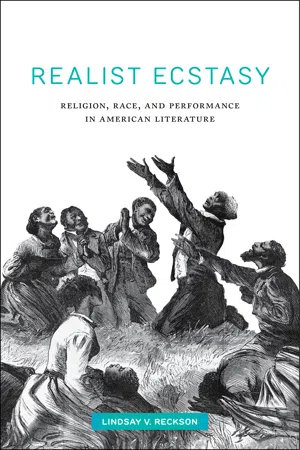
Recovering a series of ecstatic performances in late nineteenth- and early twentieth-century American realism, Realist Ecstasy travels from camp meetings to Native American ghost dances to storefront church revivals to explore realism's relationship to spiritual experience. In her approach to realism as both an unruly archive of performance and a wide-ranging repertoire of media practices—including literature, photography, audio recording, and early film—Lindsay V. Reckson argues that the real was repetitively enacted and reenacted through bodily practice. Realist Ecstasy demonstrates how the realist imagining of possessed bodies helped construct and naturalize racial difference, while excavating the complex, shifting, and dynamic possibilities embedded in ecstatic performance: its production of new and immanent forms of being beside.
Across her readings of Stephen Crane, James Weldon Johnson, and Nella Larsen, among others, Reckson triangulates secularism, realism, and racial formation in the post-Reconstruction moment. Realist Ecstasy shows how post-Reconstruction realist texts mobilized gestures—especially the gestures associated with religious ecstasy—to racialize secularism itself. Reckson offers us a distinctly new vision of American realism as a performative practice, a sustained account of how performance lives in and through literary archives, and a rich sense of how closely secularization and racialization were linked in Jim Crow America.
eBook - ePub
Realist Ecstasy
Religion, Race, and Performance in American Literature
- English
- ePUB (mobile friendly)
- Available on iOS & Android
eBook - ePub
About this book
Information
1
Reconstructing Secularisms
In the dramatic revelation that structures William Dean Howells’s 1891 novella An Imperative Duty, Rhoda Aldgate learns that her grandmother was an enslaved woman. Rhoda experiences the attendant loss of her legal whiteness like a phantom limb: “She emerged from it at moments with a refusal to accept the loss of her former self, like that of the mutilated man who looks where his arm was, and cannot believe it gone. Like him, she had a full sense of what was lost, the unbroken consciousness of what was lopped away.”1 If whiteness secures Rhoda’s bodily sense of being continuous with herself (and, in the logic of Jim Crow, with a history of “undiluted” whiteness), the disclosure of her ancestry enacts what the late nineteenth century understood as a more or less hysterical dis-integration of self. In The Principles of Psychology (1890), an important source text for An Imperative Duty, William James observed that an “incessant and fine-grained form” of discontinuity marked nearly all consciousness; at the same time, he drew on the work of French psychologist Pierre Janet to signal hysteria as an extreme instance of such discontinuity: “How far this splitting up of the mind into separate consciousnesses may exist in each one of us is a problem. M. Janet holds that it is only possible where there is abnormal weakness, and consequently a defect of unifying or co-ordinating power. An hysterical woman abandons part of her consciousness because she is too weak nervously to hold it together. The abandoned part meanwhile may solidify into a secondary or sub-conscious self.”2 In An Imperative Duty, the split self of the hysteric operates as a crucial hermeneutic—and in some sense, substitution—for Jim Crow regimes of personhood, with their apportioning of the racialized subject into (in Rhoda’s case) “one-sixteenth” blackness. In keeping with what the novel pathologizes and feminizes as a broader hysteria of racial difference under such regimes, the sense of disintegration that marks Rhoda’s “loss of her former self” aligns closely with the hysteric’s sense of an imposing “secondary personage” (as James noted, “The anaesthesias, paralyses, contractions, and other irregularities from which hysterics suffer seem then to be due to the fact that their secondary personage has enriched itself by robbing the primary one of a function which the latter ought to have retained”).3 Similarly, the attachment to whiteness as a kind of phantom limb—that which she ought to have retained—accords with Rhoda’s sense that she must face her blackness like the specter of a secondary self: “It’s like a ghost: if I keep going towards it, it won’t hurt me; I mustn’t be afraid of it.”4
The force of this move, and of An Imperative Duty more broadly, is to diagnose the US body politic with a kind of racial hysteria, curable only through a hearty skepticism toward the specters of essential or biological difference. Indeed, as many readers have noted, the novella is structured less as a struggle between black and white (embodied in the trope of the tragic mulatta) than as a struggle between belief and disbelief in the reality of racial difference. This struggle is born out early in the novella in an extended dialogue between Rhoda’s aunt, Mrs. Meredith, long the keeper of her ancestral secret, and Dr. Edward Olney, “a specialist in nervous diseases” who treats Mrs. Meredith and who eventually woos and marries her niece. Confiding Rhoda’s secret to Olney, Mrs. Meredith frames her identity in decidedly occult terms:
Mrs. Meredith added, with hysterical haste: “It might come out in a hundred ways. I can hear it in her voice at times—it’s a black voice! I can see it in her looks! I can feel it in her character—so easy, so irresponsible, so fond of what is soft and pleasant! . . . She cannot forecast consequences; she’s a creature of the present hour; she’s like them all! I think that in some occult, dreadful way she feels her affinity with them, and that’s the reason why she’s so attracted by them, so fond of them. It’s her race calling her! . . .”5
In response to Mrs. Meredith’s insistence on her ability to perceive the signs of racial difference—an insistence that characterized many turn-of-the-century white observers, and that African American writers like Frances Ellen Watkins Harper would treat with rightful derision—Dr. Olney prescribes only a course of very limited intervention: “I think you ought to leave it to her.”6 In such moments, Olney administers a seemingly sagacious corrective; against Mrs. Meredith’s hysterical attachment to race, Olney offers a privatized solution to the “problem” of Rhoda’s ancestry.7 Yet Howells figures Olney’s romantic interest in Rhoda in terms that reproduce Mrs. Meredith’s vision of an occult affinity; for Olney, “the remote taint of her servile and savage origin gave her a kind of fascination which refuses to let itself be put in words: it was like the grace of a limp, the occult, indefinable loveableness of a deformity, but transcending these by its allurement in infinite degree, and going for the reason of its effect deep into the mysterious place of being where the spirit and animal meet and part in us.”8 As in the trope of the phantom limb—a crucial idiom in the postbellum imagining of sectional and psychic repair—here Howells aligns Rhoda’s “servile origin” with the de-formation of an ostensibly integrated self, a distinctly sexual allurement that likewise dis-integrates Dr. Olney himself into the Enlightenment’s higher and lower orders of “spirit” and “animal.”
While racial difference is pitched throughout An Imperative Duty in the key of the feminized occult, the novella on the whole seems to slouch toward disenchantment, as emotional leveling becomes the fix for the cultural fetish of absolute difference. Olney treats with “tender mockery” Rhoda’s outsized sense of duty toward her “mother’s race,” and in the novella’s final chapter, which secures Rhoda’s marriage to Olney, her “meditated melodrama” meets with his determination to treat the affair “in no lurid twilight gloom, but in plain, simply, matter-of-fact noonday.”9 In this sense, the debunking of an occult or hysterical perception of racial difference is linked to the realist idiom of a clear-eyed, holistic, and masculinist moral vision (Olney realizes early on that as Mrs. Meredith’s physician, he will need to “combine the functions of the priest and the leech”).10 Similarly, the novella treats racial types themselves with a kind of tender mockery, transforming the sentimental type of the tragic mulatta into the realist type of the neurasthenic.11 By the end of the novella, Olney signals his regret that Rhoda tends less toward the “sunny-natured antetypes of her mother’s race” and more toward “that hypochondria of the soul into which the Puritanism of her father’s race had sickened her.”12 Here Howells amalgamates racial and psychological types to insist that whiteness, too, is a hysterical formation—a distinctly American pathology in need of realist treatment.
This was a powerful intervention, and one that W. E. B. Du Bois praised in a 1913 essay in The Crisis on “Howells and Black Folk.” Du Bois noted that in An Imperative Duty, Howells had “faced our national foolishness and shuffling and evasion” on matters of race, depicting a woman who “peers beyond the Veil and shudders and then—tells her story frankly, marries her man, and goes her way as thousands of others have done and are doing.”13 Yet if An Imperative Duty aims at some level to exorcise an occult vision of racial difference—by priest or by leech—it nevertheless does so under the terms of a secular ideology that is radically commingled with white supremacy. As many scholars have worked to elaborate, secularism’s purported absence or diminution of religion as such belies a disciplinary formation linked to the management of what counts as good or “proper” religion, and to the concomitant regulation of race, gender, and sexuality.14 Vincent Lloyd notes that secularism “create[s] the horizons of possibility for both religious and racialized lives,” and it is the management of such horizons of possibility to which An Imperative Duty often testifies.15 It is no mistake, for example, that Howells’s novella (as Michele Birnbaum has pointed out) traffics in a distinctly pathologized vision of racial womanhood in its effort to demystify race, or that the physic it applies for hysterical women is ultimately linked to the reproduction of whiteness (Olney believes that through intermarriage his race will “absorb” the inferior qualities of other races, a progress narrative that closely parallels the shift from “occult” racial types to “modern” psychological ones).16 As in the idiom of the phantom limb or loveable limp, An Imperative Duty treats Rhoda’s “hypochondria of the soul” as a narrative of racial disease and secular rehabilitation, one in which race and religious difference operate as conjoined “handicaps” that will eventually be overcome.17
Historical accounts of secularism in the US context have largely leapfrogged the post-Reconstruction period, focusing either on the antebellum consolidation of what John Lardas Modern describes as a “metaphysics of secularism”—a normative and “invisible consensus . . . that both habituated and secured versions of true religion emanating from the precincts of Anglo-Protestantism”—or on the relationship between twentieth-century American religious pluralism and the regulatory function of secular progress narratives.18 And while scholars such as Tracy Fessenden, Molly McGarry, and Josef Sorett have explored the hegemonic force of the secular in structuring the imaginative and cultural work of both Anglo- and Afro-Protestantism in the years following the Civil War, few have directly examined links between the affective life of secularism and the protracted violence of post-Reconstruction period.19 That violence, as Du Bois and others recognized, was as much spiritual as it was material; indeed, it governed the limits of each. In this chapter, I ask how might we approach turn-of-the-century secularism—itself never a stable or uncontested formation—as constituted in part through the backlash against black freedom and self-determination, as well as (in less direct ways) through this period’s racialized imagining of the very bounds of immanence and transcendence. If realism could reinforce such boundaries—as, we’ll see, in the case of An Imperative Duty—it could also, as I’ll argue later in this chapter, serve as a performative redrawing of them. Recognizing, with George Schulman, that secularism is part of a structure that “designates who and what is counted as real,” then realism—the dominant if strongly contested mode of literary production in this period—offers a crucial terrain through which the normative energies of the secular and various challenges to it might be understood.20
This approach demands we understand realism and secularism as interlocking but not coextensive, a set of conjoined practices or comportments that reinforce one another without being exactly the same. In this opening section, I’ll detail the ways in which realism’s secular comportment aligns with the post-Reconstruction consolidation of Jim Crow racial hierarchies, in particular the violence of co-constituting forms of religious and racial otherness.21 In An Imperative Duty, as we’ll see, that consolidation takes shape through imagining the black church as a site of emotional and bodily excess, utterly alien to the psychological complexity of its heroine and thus situated at the very limits of realist narration. In the sections that follow, I explore a series of texts that radically challenge this formation, from Anna Julia Cooper’s explicit critique of Howells in A Voice from the South (1892), to Frances Ellen Watkins Harper’s (re)visionary novel Iola Leroy (1892), to Du Bois’s own early experiment with realist narrative in “Of the Coming of John,” the only fictional chapter of The Souls of Black Folk (1903). I bring this particular constellation of texts into dialogue in order to demonstrate that turn-of-the-century arguments over the boundaries of literary realism were inextricably linked to the politics of secularism, while highlighting texts that are rarely if ever included within those boundaries. Their exclusion, I would argue, says something important not just about realist discourse and practice in the post-Reconstruction era but also about the immanent secularism of literary history, which has largely omitted texts like “Of the Coming of John” and Iola Leroy from the boundaries of realism perhaps in part because they articulate a critical relationship to secularism as a silent but hegemonic force in the post-Reconstruction era’s hysterical regulation of racial difference.22 As we’ll see, Cooper, Harper, and Du Bois each attest to secularism’s deep reliance on—and fundamental ties with—constructions of whiteness.
Nowhere is the link between secularism and white supremacy more distinct in An Imperative Duty than in Rhoda’s visit to a black church, soon after learning from Mrs. Meredith that her ancestors were enslaved. Reeling from the revelation, Rhoda drifts toward the “colored” section of segregated Boston with a markedly divided self: “There seemed two selves of her, one that lived before that awful knowledge, and one that had lived as long since, and again a third that knew and pitied them both.” This description has been much noted; in describing Rhoda’s “double consciousness of trouble,” Howells (like Du Bois after him) likely drew from James’s Principles as well as from a broader and long-circulating discourse on psychic division.23 In this sense, as Henry Wonham argues, “Howells’s speculation on the psychology of racial difference set a crucial precedent for Du Bois by introducing the medical discourse of ‘double consciousness’ into the context of racial and cultural identity.”24 Yet if Howells’s and Du Bois’s sense of divided selves owed much to late nineteenth-century psychopathology, it was also indebted to the concomitant emergence of “religion” as a category of ethnographic and sociological description.25 James would notably return to the notion of double consciousness in his 1901–1902 Gifford Lectures, The Varieties of Religious Experience, in which he described the “twice born character” of the religious melancholic as the quality of an “incompletely unified moral and intellectual constitution,” a kind of spiritual and psychic “heterogeneity.”26 While James left the cause of such heterogeneity unexplored (he noted that while “heterogeneous personality has been explained as the result of inheritance,” such explanation “needs corroboration”), Howells and Du Bois concertedly mapped discourses of spiritual heterogeneity—of being beside the self, at once in and out—onto the “problem” of being black in America.
But whereas Du Bois would insist on the historicity of double consciousness, recasting it as “second sight” or a form of black prophetic vision, Rhoda’s sense of multiple selves—of being beside herself as a force of her social and legal otherness—leads less to the collective work of spiritual striving than to an image of grotesque religious expressivity. Indeed, as a remedy for her dis-integrated self, Rhoda attempts—quite ironically, from the narrator’s perspective—to integrate herself into an African American religious community that the novella as a whole insists is utterly foreign. Steppi...
Table of contents
- Cover
- Title Page
- Copyright Page
- Dedication
- Contents
- Introduction: Being Beside
- 1. Reconstructing Secularisms
- 2. Archival Enthusiasm
- 3. The Ghost Dance and Realism’s Techno-Spiritual Frontier
- 4. Touching a Button
- 5. Born, Again
- Coda: Behind, Before, Beside
- Acknowledgments
- Notes
- Bibliography
- Index
- About the Author
Trusted by 375,005 students
Access to over 1.5 million titles for a fair monthly price.
Study more efficiently using our study tools.
Frequently asked questions
Yes, you can cancel anytime from the Subscription tab in your account settings on the Perlego website. Your subscription will stay active until the end of your current billing period. Learn how to cancel your subscription
No, books cannot be downloaded as external files, such as PDFs, for use outside of Perlego. However, you can download books within the Perlego app for offline reading on mobile or tablet. Learn how to download books offline
Perlego offers two plans: Essential and Complete
- Essential is ideal for learners and professionals who enjoy exploring a wide range of subjects. Access the Essential Library with 800,000+ trusted titles and best-sellers across business, personal growth, and the humanities. Includes unlimited reading time and Standard Read Aloud voice.
- Complete: Perfect for advanced learners and researchers needing full, unrestricted access. Unlock 1.5M+ books across hundreds of subjects, including academic and specialized titles. The Complete Plan also includes advanced features like Premium Read Aloud and Research Assistant.
We are an online textbook subscription service, where you can get access to an entire online library for less than the price of a single book per month. With over 1.5 million books across 990+ topics, we’ve got you covered! Learn about our mission
Look out for the read-aloud symbol on your next book to see if you can listen to it. The read-aloud tool reads text aloud for you, highlighting the text as it is being read. You can pause it, speed it up and slow it down. Learn more about Read Aloud
Yes! You can use the Perlego app on both iOS and Android devices to read anytime, anywhere — even offline. Perfect for commutes or when you’re on the go.
Please note we cannot support devices running on iOS 13 and Android 7 or earlier. Learn more about using the app
Please note we cannot support devices running on iOS 13 and Android 7 or earlier. Learn more about using the app
Yes, you can access Realist Ecstasy by Lindsay V. Reckson in PDF and/or ePUB format, as well as other popular books in Social Sciences & Performing Arts. We have over 1.5 million books available in our catalogue for you to explore.