![]()
1
Introduction
WHY STUDY THE CRUSADES?
The study of the history of the crusades is flourishing in schools and universities, in academic research (in Europe, the Middle East and North America); it is also a subject that attracts considerable interest from the general public. In part this is a consequence of the enduring fascination fostered by such a dramatic and important aspect of the histories of western Europe and the Middle East, of Christianity and Islam and, to a lesser extent, Christianity and Judaism. The sense of adventure in trying to conquer and hold a distant and unknown land still exerts a powerful pull on the imagination of the modern West; the perceived glamour of men such as Richard the Lionheart and Saladin has great allure too. Alongside this, there is, to some modern western eyes at least, curiosity and confusion as to how and why people could fight and kill in the name of God.
There is also the historical legacy of the crusades – a legacy of brutality and fanaticism that has cast a deep shadow across relations between Christianity and Islam, Christianity and Judaism, and amongst Christians themselves. From the sixteenth century onwards, first the Protestant Church and then an increasingly secular European society began to relegate the crusades to a distant and exotic escapade carried out by barbaric and foolhardy knights. During the nineteenth century, however, the crusades found new resonance. The colonial empires of Europe spread into North Africa and the Near East, reviving memories of times gone by while the emergence of nationalism as a powerful force during this period meant that people looked back positively to past successes and times of unity (such as the First Crusade). In the world of literature the phenomenal international success of historical writers such as Sir Walter Scott, author of Ivanhoe (1819) and The Talisman (1825) did much to spawn artistic and musical material that glorified the age of chivalry, including the crusades. World War I proved a fertile ground for combatants on all sides to depict their struggle as a righteous fight against the devil and to use crusading language and imagery. During the 1930s bishops who supported General Franco’s Nationalist forces invoked divine help and Franco described himself as a crusader. The unprecedented horrors of World War II and the nuclear age largely expunged any sense of romanticism in warfare and in the West the ideas and imagery of the crusade have largely faded from an explicitly military context. One grim exception to this was the appalling massacre perpetrated by the Norwegian extremist, Anders Brevnik, in 2011 whose manifesto invoked a crusading message in his hatred of Muslims.
Recent academic scholarship has formulated a more sophisticated picture of the crusades as a complex and central element in the history of medieval Europe. In discovering how this legacy has endured though the centuries, it is evident that the origins and meaning of the word have become obscured. From the nineteenth century the term ‘crusade’ has also been used in a non-military context in western society such as by the Women’s Temperance Movement of 1873 in Ohio, or participants in the Jarrow March who bore the banner ‘Jarrow Crusade’ in 1936. Today it has become casualised and secularised. It is used readily in everyday life: a crusade to cut hospital waiting lists, a crusade for fair play in sport. Given the fact that, ultimately, the crusades to the Holy Land collapsed, the continued deployment of the word in such ways shows how far removed it has become from historical reality. Why do people want to identify with something that failed? In its contemporary, generic meaning, therefore, people are embracing a sense of moral right, and/or a quest for justice. Such sentiments have their roots in the medieval usage and this broadly positive meaning explains why the word still has such currency.
In the world of contemporary Islam, however, the crusades have retained a much sharper and more vivid presence, in large part because the outline of events in the medieval period have a number of pertinent parallels to the present. In 1099 the armies of the First Crusade (representing the Catholic Church of western Europe) captured Jerusalem and were popularly reported as wading ankle-deep in the blood of their slain Muslim foes; in the wake of this conquest the Crusader States were formed and Christian rule was established in the Levant. By 1187 Saladin had drawn together the Muslims of the Eastern Mediterranean region under the banner of the jihad, or holy war. The forces of Islam retook the city of Jerusalem and relegated the Christians to a strip of land on the Mediterranean coast until their eventual expulsion in 1291. For the Muslim world of modern times the ingredients seem familiar: violent western incursions, slaughter and oppression of the faithful and the loss of the holy city of Jerusalem. These are among the reasons why the crusade still has such a high profile in the Muslim Middle East. Emerging scholarship shows that, contrary to previous claims by historians, the memory of the crusades and the standing of Saladin as a man of admirable virtues, had not (as previously thought) disappeared from view but remained clearly perceptible down the centuries and grew stronger once the western Europeans began to invade the region with Napoleon’s attempted conquest of Egypt in 1798.
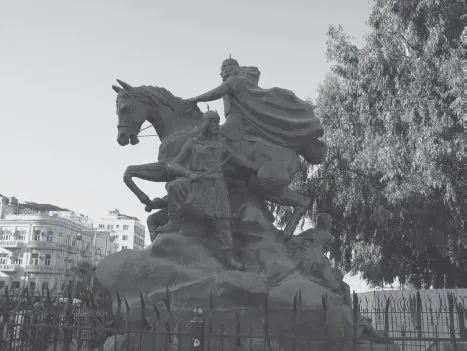
At the start of the twentieth century, as the Arab Near East began to shake off the shackles of western imperialism, their predecessors’ struggles against the crusaders seemed especially relevant and this is a perception that has continued. Even more significantly, Saladin provided a redily available role model: a devout Muslim who had succeeded in driving out the invaders. Such a figure has obvious attractions in the modern age and contemporary political leaders have often sought to appropriate his legacy. In the late 1950s President Nasser of Egypt clashed with the British and French over the Suez Canal. He also created the United Arab Republic (1959–61) which joined Syria and Egypt together – just as Saladin had done in the twelfth century. Nasser frequently invoked the sultan in his struggles against the West and drew parallels between the defeats of the crusaders and his actions in Suez and his hopes for the recovery of Jerusalem. President Saddam Hussein of Iraq also compared himself to Saladin, not least because they were both born in Takrit in northern Iraq. A mural depicting Saddam leading his Iraqi tanks into battle against the West alongside Saladin who rode at the head of his mounted warriors conveyed the appropriate message. Similar representations appeared on more prosaic and mass-produced items, such as bathmats, showing the wide circulation of such an image. Saddam, therefore, identified himself as someone who, like Saladin, would defeat the westerners and drive them from the Middle East. In 1992, the late President Hafiz Asad of Syria commissioned a large equestrian statue of Saladin in Damascus. The emir is shown riding to victory, guarded by Muslim holy men as defeated crusaders slump behind his horse. Placed just outside the old citadel of Damascus, Saladin is, of course, symbolically protecting the city, while the West bows to him.
A further, important parallel with the age of the crusades exists for Muslim militants in the form of the state of Israel. Although the First (and subsequent) crusades were responsible for numerous atrocities against the Jews of Jerusalem (in 1099) and in western Europe (1096, 1147, 1190), the close identification of Israel with the USA, and, in the eyes of some, as an enemy of Palestine and occupier of the holy city, means a perception that the crusader kingdom of Jerusalem was a forerunner of the modern Israeli state. Some Muslim polemicists argue that the creation of Israel was the West’s revenge for the failure of the crusades and they point out that the Christians were eventually expelled from the Levant: inevitably, therefore, they argue that the Jews will suffer the same fate. The militant Islamic groups in the Middle East, Hamas and Hizbollah, both invoke the struggle between the crusaders and jihad in their efforts to liberate Palestine.
1. Statue of Saladin outside the citadel of Damascus
Undoubtedly the most high-profile use of the word ‘crusade’ in recent times was when, after the terrible attacks of 11 September 2001, President George W. Bush stated that ‘this crusade … this war on terror is going to take a while’. Once the implications of the word were revealed to him, Bush tried to distance himself from the comment but it was too late. In calling the fight against bin Laden a crusade he had created the historical parallel the Islamist leader had long claimed existed and offered an opportunity to tap into the emotional tinderbox of centuries of conflict: ‘So, Bush has declared in his own words: “crusader attack.” The odd thing about this is that he has taken the words right out of our mouth … So the world today is split into two parts, as Bush said: either you are with us or you are with terrorism. Either you are with the crusade or you are with Islam. Bush’s image of him today is of him being in the front of the line, yelling and carrying his big cross.’ Just to complete the circle, the head of the CIA unit charged with hunting bin Laden described him as: ‘an Islamic hero, as the faith’s ideal type, and almost as a modern-day Saladin’ (Phillips, 2009: 348).
THE PURPOSE OF THIS BOOK
This book is concerned to move back from the modern constructs and possible misconceptions of the crusades to explore the origins and development of the idea in its historical context. It will outline the key events and issues in the history of the crusades to the Holy Land down to the end of the Fourth Crusade. The work sets out to show the roots of the First Crusade; to consider the various motives of the First Crusaders; to reveal the challenges of conquest and settlement in the Levant; to indicate the complexities of dealings among the Frankish settlers and also their relations with the indigenous people of the Near East, as well as contact with their co-religionists in western Europe. It will also assess the impact of the crusades in the Eastern Mediterranean and follow the Muslim response to the crusades through the rise of the jihad. The mixture of narrative and thematic chapters is designed to analyse and tell the story of events, but also to provide an insight into new areas of research and to synthesise them into a mainstream textbook. The Documents have been chosen from as wide a range of sources as possible with material from the Latin West and the Frankish East, as well as Muslim, Byzantine and Jewish writers. Narratives, official documents and letters, charters, poetry, songs and art are all represented. It is hoped that this selection will, in some small way, demonstrate the breadth of evidence available to the historian and also help to bring this intriguing subject to life.
HISTORIOGRAPHY AND DEFINITION
The historiography of the crusades continues to develop rapidly, both in terms of approach and interpretation. The first recognisably modern analysis of the crusades was produced in the early nineteenth century by the Frenchman Joseph-François Michaud who wrote (1811–22) a multi-volume narrative based on extensive, if uncritical, use of many original texts and without the judgemental tone of Protestant or Enlightenment authors. Michaud’s account was immensely popular being revised and reprinted many times, widely translated and also produced in a schools’ edition. He portrayed the crusades as a glorious episode of French history, fighting, as Tyerman neatly summarises, ‘against the barbarism of Islam, [demonstrating] the superiority of western culture and vindicating conservative religious and political values … the idea of the crusades as a witness to western supremacy reflected and informed the creation of the colonial mentality in France’ (Tyerman, 2011: 108–9).
The aftermath of World War I and the creation of the French mandates in Syria and Lebanon provoked further comparisons with the past and scholars, such as René Grousset in his three-volume history, published 1934–36, portrayed the Frankish East as a forerunner of French colonial enterprise. The next phase of scholarship, represented, for example, by the multi-volume history edited by Kenneth Setton (Setton, 1969–89), was strongly grounded in detailed narrative and looked towards economic motives for the crusades, ignoring much of the evidence for contemporary religiosity. The most important work to come out of this period was Sir Steven Runciman’s A History of the Crusades, 3 volumes (Runciman, 1951–54), which is still in print today and has exerted an enormous influence over the subject and the image of the crusades ever since. Runciman’s beautifully written work does much to capture the excitement of the crusades, but as well as the issues just noted in Setton’s work, it has a further, significant flaw. The author was, first and foremost, a historian of the Byzantine Empire and for him, the sack of his beloved city of Constantinople by the Fourth Crusade in 1204 was the ultimate act of betrayal by a bloodthirsty and misguided movement. The contrast with the sophistication of Byzantium and Islam could not have been plainer and the crusaders were seen as ignorant thugs. The violence of the crusading age cannot, and should not, be denied, although any comments about the medieval age being especially brutal in comparison to the modern world can, after the briefest of reflections on present day conflicts, be set aside. Warfare in the twelfth century must be seen in the context of western European society of the time and through proper examination of contemporary motives and values. Furthermore, medieval Byzantium and Islam were hardly immune from perpetrating acts of savagery on their own and other peoples too. Without the constricting judgement imposed by Runciman, we can see that a complex, and at times innovative, society emerged in the Levant and crusading itself was an adaptable and sophisticated concept that developed over both time and space.
The next body of crusading history is represented by the work of Jean Richard (1979), Joshua Prawer (1980), Jonathan Riley-Smith (1973) and Hans Eberhard Mayer (1988), and has done much to illuminate the judicial, constitutional and structural form of the institutions of the Latin East and is now absorbed into many mainstream texts.
Since the early 1980s several significant developments have emerged in crusading studies. The first and most important is a conceptual one: previously, ‘true’ crusading had tended to be regarded as taking place only in the Eastern Mediterranean and was something that effectively finished in 1291 with the fall of Acre and the end of the Catholic hold on the Levant. In other words, the expeditions to the Baltic, the reconquest of Spain, the attacks on Albigensian heretics in southern France, the wars against political opponents of the papacy, expeditions against the Ottoman Turks in the fifteenth century and even the Spanish Armada against Protestant England were distortions of the original idea and were to be treated as separate species. Based on an analysis of the temporal and spiritual privileges (the Indulgence) granted by the papacy, and on a closer examination of contemporary assessments of this issue, crusade historians now accept a much broader (pluralist) and more flexible definition of the subject to encompass these other theatres of war as equals to the crusade to the Holy Land in all but prestige. A workable definition of a crusade is thus: ‘An expedition authorised by the pope on Christ’s behalf, the leading participants in which took vows and consequently wore crosses and enjoyed the privileges of protection at home and the Indulgence, which, when the campaign was not destined for the East, was equated with that granted to crusaders to the Holy Land’ (Riley-Smith, 2009: 5). This present book is primarily concerned with crusade and settlement in the Levant down to 1204, and therefore the distinction between expeditions to the Latin East and elsewhere does not perhaps seem immediately relevant. But, this concept is crucial in understanding the broader development of crusading (particularly in the thirteenth century and beyond) and does have significant connections with several episodes concerning crusades to the Eastern Mediterranean, connections which, by their very existence, serve to underline the validity of the pluralist understanding of the subject.
Christopher Tyerman, in his The Invention of the Crusades (Tyerman, 1998), questioned the whole development of crusading during the twelfth century. He argued that because the distinctive institutions and definitions of the crusade were not in place until the legislative programme initiated by Pope Innocent III (1198–1216), the notion of ‘crusade’ in the twelfth century is a construct of modern historians. He claims that the word crucignatus does not appear until the later decades of the twelth century, although Vertannes notes that it was used by Peter the Deacon at the abbey of Monte Cassino in the 1130s or 1140s (Vertannes, 2013). This view has found little favour for a number of reasons, however. First, simply because a movement lacks formal and defined institutions does not mean that contemporaries failed to understand what was happening. The distinction between a pilgrim and a crusader that historians sometimes struggle with was evident enough to those contemporaries who wrote pilgrim guides to the religious sites of the Holy Land or answered a papal appeal to fight the infidel in the Levant. It is true that in some cases the evidence is hazy: the practice whereby a western noble would fight in defence of the Holy Land for a year (see below, p. 101) was not linked to a call for a crusade, but more to a sense of Christian honour and duty – although the spiritual rewards for such an act are not specified in any surviving material. By the time of the Second Crusade (1145–49), however, the picture was clearer and, as the relevant chapter shows, this expedition confirms crusading to be a geographically flexible concept, but with the key ideas, privileges and rewards plainly defined to all. When Pope Eugenius III (1145–53) or Pope Alexander III (1159–81) put out crusade appeals to the Holy Land (five separate calls in the latter’s case), their audiences knew what they were committing themselves to and the range of privileges and benefits that they would receive: Eugenius and Alexander were working through an idea with consistency and logic. Furthermore, their care in guarding the preaching of such expeditions reveals papal concern over the concept of crusading and an understanding of what lay inside and outside its boundaries. Tyerman also neglects two further points. First, crusading in the Iberian peninsula. The series of privileges and bulls issued here (see below, pp. 87, 203–4) indicates again the development and regulation of the idea from the time of the First Crusade. Furthermore, he ignores the foundation of the military orders – institutions inexorably linked to crusading whose growth again indicates a more rapid maturation than Tyerman allows.
The second notable advance in crusading studies over recent years is a concern with the spiritual motivation of crusaders and the roots of this in the society of eleventh-century Europe. The use of charte...