Criminal Law
eBook - ePub

Criminal Law

  1. 312 pages
  2. English
  3. ePUB (mobile friendly)
  4. Available on iOS & Android
eBook - ePub

Criminal Law

About this book

Key Facts Key Cases: Criminal Law will ensure you grasp the main concepts of your Criminal Law module with ease. This book explains the facts and associated case law for:


  • the important concepts of actus reus, mens rea and strict liability


  • the main fatal and non-fatal offences against the person


  • a wide range of property offences


  • general defences


  • the topics of participation and inchoate offences

Key Facts Key Cases is the essential series for anyone studying law at LLB, postgraduate and conversion courses. The series provides the simplest and most effective way to absorb and retain all of the material essential for passing your exams. Each chapter includes:


  • diagrams at the start of chapters to summarise key points


  • structured headings and numbered points to allow for clear recall of the essential points


  • charts and tables to break down more complex information

Chapters are also supported by a Key Cases section which provides the simplest and most effective way to absorb and memorise essential cases needed for exam success.


  • Essential and leading cases are explained


  • The style, layout and explanations are user friendly


  • Cases are broken down into key components by use of a clear system of symbols for quick and easy visual recognition

Frequently asked questions

Yes, you can cancel anytime from the Subscription tab in your account settings on the Perlego website. Your subscription will stay active until the end of your current billing period. Learn how to cancel your subscription.
At the moment all of our mobile-responsive ePub books are available to download via the app. Most of our PDFs are also available to download and we're working on making the final remaining ones downloadable now. Learn more here.
Perlego offers two plans: Essential and Complete
  • Essential is ideal for learners and professionals who enjoy exploring a wide range of subjects. Access the Essential Library with 800,000+ trusted titles and best-sellers across business, personal growth, and the humanities. Includes unlimited reading time and Standard Read Aloud voice.
  • Complete: Perfect for advanced learners and researchers needing full, unrestricted access. Unlock 1.4M+ books across hundreds of subjects, including academic and specialized titles. The Complete Plan also includes advanced features like Premium Read Aloud and Research Assistant.
Both plans are available with monthly, semester, or annual billing cycles.
We are an online textbook subscription service, where you can get access to an entire online library for less than the price of a single book per month. With over 1 million books across 1000+ topics, we’ve got you covered! Learn more here.
Look out for the read-aloud symbol on your next book to see if you can listen to it. The read-aloud tool reads text aloud for you, highlighting the text as it is being read. You can pause it, speed it up and slow it down. Learn more here.
Yes! You can use the Perlego app on both iOS or Android devices to read anytime, anywhere — even offline. Perfect for commutes or when you’re on the go.
Please note we cannot support devices running on iOS 13 and Android 7 or earlier. Learn more about using the app.
Yes, you can access Criminal Law by Jacqueline Martin in PDF and/or ePUB format, as well as other popular books in Law & Criminal Law. We have over one million books available in our catalogue for you to explore.

Information

Year
2014
eBook ISBN
9781317976455
Edition
1
Topic
Law
Subtopic
Criminal Law
Index
Law
1
Introduction to criminal law
Image
Image
1.1 The purpose of criminal law
The main purposes are to:
1 Protect individuals and their property from harm.
2 Preserve order in society.
3 Punish those who deserve punishment. (N.B. There are also other aims when sentencing offenders, including incapacitation, deterrence, reformation and reparation.)
1.1.1 Should the law enforce moral values?
This area is controversial. It is argued that it is not the function of criminal law to interfere in the private lives of citizens unless it is necessary to try to impose certain standards of behaviour. The Wolfenden Committee (1957) felt that intervention in private lives should only be:
• to preserve public order and decency;
• to protect the citizen from what is offensive or injurious; and
• to provide sufficient safeguards against exploitation and corruption of others, particularly those who are especially vulnerable
Lord Devlin in the Enforcement of Morals (1965) disagreed. He felt that ā€˜there are acts so gross and outrageous that they must be prevented at any cost’.
1.1.2 Conflicting cases
The courts are not always consistent in their approach to this area of law. Brown (1993): The House of Lords upheld convictions for assault causing actual bodily harm (s 47 Offences against the Person Act 1861) and malicious wounding (s 20 Offences against the Person Act 1861) for acts done in private by a group of consenting adult sado-masochists. Wilson (1996): The Court of Appeal quashed a conviction for assault causing actual bodily harm (s 47 Offences against the Person Act 1861) where a husband had branded his initials on his wife’s buttocks, at her request.
Image
1.2 Defining a crime
1 A crime is conduct forbidden by the State and to which a punishment has been attached because the conduct is regarded by the State as being criminal.
2 The statement above is the only definition which covers all crimes.
3 What conduct is criminal will, therefore, vary from country to country and from one time to another. The law is likely to change when there is a change in the values of government and society.
1.2.1 Example of the changing nature of criminal law
• The Criminal Law Amendment Act 1885 criminalised consensual homosexual acts between adults in private.
• The Sexual Offences Act 1967 decriminalised such behaviour between those aged 21 and over.
• The Criminal Justice and Public Order Act 1994 decriminalised such behaviour for those aged 18 and over.
• In 2000, the government reduced the age of consent for homosexual acts to 16, though the Parliament Acts had to be used as the House of Lords voted against the change in the law.
1.2.2 Judicial law-making
1 Some conduct is criminalised not by the State but by judges.
2 This happened in Shaw v DPP (1962) where the offence of conspiracy to corrupt public morals was created. The creation of the offence was confirmed in Knuller (Publishing, Printing and Promotions) Ltd v DPP (1973).
3 Another example is the offence of outraging public decency which has never been enacted by Parliament. It is an invention of the judges, yet people can be convicted of it (Gibson (1991)).
4 Marital rape has also been criminalised by the decisions of judges (R v R (1991)).
5 See also the cases of Brown (1993) and Wilson (1996) in 1.1.2.
Image
1.3 Classification of offences
There are many ways of classifying offences depending on the purpose of the classification.
1.3.1 Classification by where a case will be tried
One of the most important ways of classifying offences is by the categories that affect where and how a case will be tried. For this purpose offences are classified as:
1 Indictable only offences, which must be tried on indictment at the Crown Court (e.g. murder, manslaughter, rape).
2 Triable either way offences which can be tried either on indictment at the Crown Court or summarily at the magistrates’ court (e.g. theft, burglary, assault occasioning actual bodily harm).
3 Summary offences which can only be tried at the magistrates’ court (e.g. assaulting a policeman in the execution of his duty, common assault).
1.3.2 Categories for police powers of detention
1 Police powers to detain a suspect who has been arrested depend o...
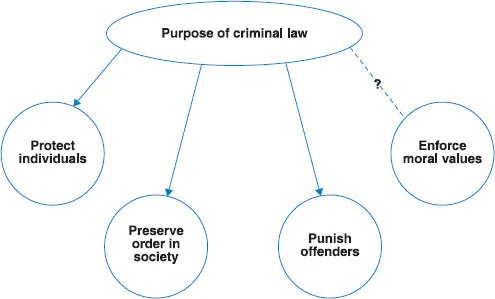
Table of contents

  1. Cover
  2. Half Title
  3. Title Page
  4. Copyright Page
  5. Table of Contents
  6. PREFACE
  7. TABLE OF CASES
  8. Chapter 1 INTRODUCTION TO CRIMINAL LAW
  9. Chapter 2 ACTUS REUS
  10. Chapter 3 MENS REA
  11. Chapter 4 STRICT LIABILITY
  12. Chapter 5 PARTICIPATION
  13. Chapter 6 INCHOATE OFFENCES
  14. Chapter 7 CAPACITY
  15. Chapter 8 GENERAL DEFENCES
  16. Chapter 9 MENTAL CAPACITY DEFENCES
  17. Chapter 10 HOMICIDE
  18. Chapter 11 NON-FATAL OFFENCES AGAINST THE PERSON
  19. Chapter 12 SEXUAL OFFENCES
  20. Chapter 13 THEFT
  21. Chapter 14 OTHER OFFENCES UNDER THE THEFT ACTS
  22. Chapter 15 FRAUD ACT 2006
  23. Chapter 16 CRIMINAL DAMAGE
  24. Chapter 17 PUBLIC ORDER OFFENCES
  25. INDEX