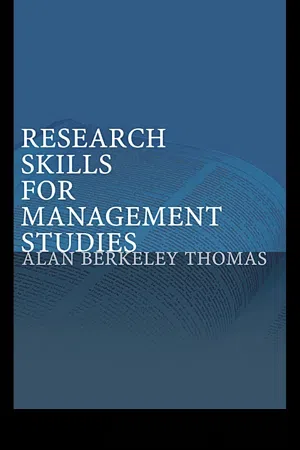
The recent growth of interest in the systematic study of management has transformed a once neglected area of research into one that now attracts a huge number of postgraduate students. Despite this, there has been a distinct lack of research guides tailored specifically for management studies.
Designed as a comprehensive introduction to the main phases of a research project, this textbook fills that void. It leads students from the very first stage of initiation through to final publication, considering the nature of research skills and the fundamental elements of the research process, whilst exploring the institutional context in which management research is carried out.
Taking current debates and the surrounding philosophical and strategic issues in hand, this book combines the key theories with the best practical advice to offer a completely rounded introduction to the topic. It includes guidance and specific reference to real management research projects, as well as case examples, activities and further reading lists, and is essential reading for anyone undertaking a management studies research project.
- 288 pages
- English
- ePUB (mobile friendly)
- Available on iOS & Android
eBook - ePub
Research Skills for Management Studies
About this book
1 Research skills and how to acquire them
There are only two kinds of researchers: those who have got problems and those who are going to have problems.
Researchers are sometimes thought of as rather special and perhaps even peculiar people. The cartoon image of the research worker as a ‘mad scientist’ or an inspired genius still has some credence with the public. Yet it was the prolific inventor Thomas Edison who, when asked how he accounted for his success, replied, ‘Genius is one per cent inspiration, ninety-nine per cent perspiration.’ Research is very largely a problem-solving activity, and while inspiration is certainly needed in order to make progress, it is rarely sufficient. Successful researchers are those who possess the knowledge and skill that enable them to overcome the problems inherent to the process of research. They may appear to proceed purely by means of flashes of insight and serendipitous hunches but in fact they are specialists in complex problem-solving.
This book is intended as a guide to these problem-solving skills for those who are preparing to undertake research projects in management. Although written mainly for research students who are studying for degrees at master’s or doctoral level, undergraduates are also likely to find much of the material presented here to be of value to them. The fundamental ideas and outlooks that underpin research are common whatever the level or scale of the project undertaken. Similarly, managers engaged in research investigations for professional purposes, or who need to use the products of management research, may also find this book a helpful source of insight into what goes on behind the scenes in academia. It may also provide them with guidance on how their own research may be carried out more effectively.
Management is a field of study with indistinct boundaries and it includes a wide range of specialisms such as marketing, organizational behaviour, strategy, human resource management (HRM), accounting, finance and operations as well as multidisciplinary studies which cross these boundaries. You may already have an undergraduate degree in business studies or one of the social sciences and possibly an MBA, but research students in management tend to be drawn from a wide range of disciplinary backgrounds. Whatever your previous experience and irrespective of your current field, this book should prove helpful in developing your research skills.
Box 1.1 The value of research skills
Whilst a key element of the ESRC mission is to train postgraduates for careers in academic research it is recognized that not all research postgraduates wish, or will be able, to pursue a career in academic research. Nor might they be able, whatever their career patterns, to pursue research solely related to the specialized topic of a thesis. Of those who do follow academic careers, many will be required to supervise or teach research students using or assessing the applicability of a wide range of methodologies and methods. . . . Whatever career paths PhD graduates may follow, there are clear advantages to students if they have acquired general research skills and transferable employment-related skills.
(Economic and Social Research Council, 2001, Section D1)
Some basic assumptions
This book makes a number of assumptions about the nature of research and ways of developing expertise in it. They are briefly outlined below although several of these points will be taken up in more detail later.
Assumptions about research
Among the most important assumptions I have made about research are the following:
The world of management research is a messy world
The management scientist Russell Ackoff has argued that managers do not solve well-specified problems in well-specified ways. Rather, they grapple with ‘messes’: whole collections of complex and interrelated problems (Ackoff, 1979, 1993). The domain of management is messy. Not surprisingly, then, doing research in management studies is a bit like that. This is because the world of research methodology is also a messy world.
Sometimes research methodology is portrayed as if it were simply a set of tools and techniques used to solve research problems. The tools and techniques are not themselves seen to be problematic, and learning about them seems likely to be a rather dull and dreary business. Methods are thus seen as peripheral to the substantive issues facing a discipline.
But this is far from being the case. As May (1997, p. 1) says, ‘Research methods are a central part of the social sciences’, and methodology in social research has been an area of great controversy and debate. Many fundamental questions about our capacity to know the social world are raised when we set out to do research and to help others learn how to do it. Such questions are as relevant to management research as they are to other social research fields. Encountering them at first hand in the course of designing a research project can be far from dull!
There is no one best way to do research
Once upon a time something called ‘the scientific method’ dominated understanding of the proper way to do research. This advocated the use of carefully controlled experiments and quantitative measurements in order to test hypotheses about causal relationships between phenomena. Implicit in this view was the idea that there was ‘one best way’ to do scientific research; good research was taken to follow this method.
One alternative to this ‘monistic’ view is methodological nihilism (Feyerabend, 1975; Phillips, 1973). This denies that science proceeds according to any specific method at all; there is no need to discuss research methods because ‘anything goes’. Methodological ‘pluralism’ (Bell and Newby, 1977), on the other hand, is a point of view that holds that there are many approaches to doing scientific research and many ways of producing knowledge rather than one or none. This is now a widely accepted view and it is the one adopted here.
In keeping with this pluralist view, research is not to be equated with hypothesis-testing. This is too narrow a definition to encompass the range of possibilities in management research. A broader conception is likely to be more helpful, so here we define research as the process of obtaining and analysing data in order to answer questions, solve problems or test hypotheses and so contribute to our understanding and knowledge of the world.
There are common elements in all research
Although there are many different ways to do research, and although different fields have their preferred research styles, all research does share certain features:
- Research is empirical; it involves studying the world outside ourselves.
- Research adopts systematic and explicit methods; it is essentially a public endeavour in which it is possible, in principle, for others to repeat investigations and check on their accuracy.
Research is a complex craft
There is a tendency to associate research with the idea of precise results obtained by means of controlled experimentation using sophisticated techniques and technologies. This image significantly underplays the messiness and uncertainty that accompany researching. Reports by researchers of how they have actually conducted their studies give a very different impression from the one given by the formal, prescriptive accounts found in methodology textbooks (see, for example, Bell and Newby, 1977; Bryman, 1988; Hammond, 1964). In practice, research projects have to be adapted to local circumstances, and adapting them may involve considerable ingenuity and methodological improvisation. There are few, if any, research procedures that can be applied with completely predictable results; much depends on the context in which they are used. There is much uncertainty surrounding research methods and many judgements have to be made.
Box 1.2 The craft of research
Research involves basic attitudes and ways of thinking. Research is a craft. Like other crafts activities are not analyzable. . . . Cause–effect relationships are not clear. Unexpected problems appear. Procedures are not available to describe each aspect of research activity. The learning of craft skills may take years of trial and error. Through practice one learns how to ask research questions, how to conduct research projects, and what to strive for when writing a research paper. Significant research, then, is the outcome of a way of thinking that can be called craftsmanship.
(Daft, 1983, p. 539)
Furthermore, every research study is unique. Research projects are not standardized products but custom-built enterprises that require considerable skill and judgement in their design and execution. The research process can thus be thought of as akin to making a sculpture: the artist starts with a formless mass of stone and then, after much careful chipping and shaping, the finished product emerges. The final form partly reflects the sculptor’s initial vision but is also a result of the insights and ideas that have developed during the sculpting process. Doing research is literally a creative activity.
Assumptions about learning to do research
Experiential learning pays
Research is a skilled craft and, like any craft, learning about it from books can only take one so far. There is no substitute for hands-on practice. Professional musicians, for example, have to learn music theory as part of their musical education, but it is unlikely to be of much help when it comes to playing an instrument and performing in front of an audience. A good deal of any craft must be learned by experience, both directly, through practice, and indirectly through learning from accomplished practitioners. In research, in order to develop skill in interviewing it is necessary to interview people; to become a competent questionnaire designer you need to design questionnaires; to become an expert in case-study method you need to conduct case studies; and so on.
Box 1.3 Acquiring research skills: more than learning the rules
Acquisition of researchers’ basic skills is no different from acquisition of other skills. Researchers do not need to be able to formulate rules for their skills in order to practice them with success. On the contrary, studies show that rules can obstruct the continuous exercise of high-level skills. There is nothing which indicates that researchers at expert level – those who have achieved genuine mastery in their field – use mainly context-independent rules or traditional rationality in their best scientific performances, even though they might depict it as such when they get around to writing their scholarly articles or memoirs.
(Flyvbjerg, 2001, p. 34)
Because research is a craft, it is not surprising that the traditional way of acquiring research skills is by apprenticeship. The research student is apprenticed to a master craftsman or craftswoman who supervises their work and leads them ...
Table of contents
- Cover Page
- Title Page
- Copyright Page
- Illustrations
- Activities
- Preface
- Acknowledgements
- 1. Research Skills and How to Acquire Them
- 2. What Is Research?
- 3. Ways of Knowing
- 4. Problem Fields
- 5. Problem Identification
- 6. Research Ethics
- 7. Research Strategies: The Experiment and Survey
- 8. Research Strategies: The Case Study, Ethnography and Action Research
- 9. Data Construction By Asking Questions
- 10. Data Construction By Making Observations
- 11. Data Construction By Using Documents and Records
- 12. Data Analysis and Interpretation
- 13. Writing and Publication
- Bibliography
Trusted by 375,005 students
Access to over 1.5 million titles for a fair monthly price.
Study more efficiently using our study tools.
Frequently asked questions
Yes, you can cancel anytime from the Subscription tab in your account settings on the Perlego website. Your subscription will stay active until the end of your current billing period. Learn how to cancel your subscription
No, books cannot be downloaded as external files, such as PDFs, for use outside of Perlego. However, you can download books within the Perlego app for offline reading on mobile or tablet. Learn how to download books offline
Perlego offers two plans: Essential and Complete
- Essential is ideal for learners and professionals who enjoy exploring a wide range of subjects. Access the Essential Library with 800,000+ trusted titles and best-sellers across business, personal growth, and the humanities. Includes unlimited reading time and Standard Read Aloud voice.
- Complete: Perfect for advanced learners and researchers needing full, unrestricted access. Unlock 1.5M+ books across hundreds of subjects, including academic and specialized titles. The Complete Plan also includes advanced features like Premium Read Aloud and Research Assistant.
We are an online textbook subscription service, where you can get access to an entire online library for less than the price of a single book per month. With over 1.5 million books across 990+ topics, we’ve got you covered! Learn about our mission
Look out for the read-aloud symbol on your next book to see if you can listen to it. The read-aloud tool reads text aloud for you, highlighting the text as it is being read. You can pause it, speed it up and slow it down. Learn more about Read Aloud
Yes! You can use the Perlego app on both iOS and Android devices to read anytime, anywhere — even offline. Perfect for commutes or when you’re on the go.
Please note we cannot support devices running on iOS 13 and Android 7 or earlier. Learn more about using the app
Please note we cannot support devices running on iOS 13 and Android 7 or earlier. Learn more about using the app
Yes, you can access Research Skills for Management Studies by Alan Berkeley Thomas in PDF and/or ePUB format, as well as other popular books in Business & Business General. We have over 1.5 million books available in our catalogue for you to explore.