Relationship Marketing: Creating Stakeholder Value extends the analysis of the change in the marketing rationale from a crude concern for increased market share to a strategy aimed at creating long-term profitable relationships with targeted customers.
Offering a cutting edge vision of relationship marketing, Relationship Marketing: Creating Stakeholder Value is a seminal text for all students and managers in the field. With new up-to-date case materials and examples of best practice, the book covers all the stakeholder markets - employees, suppliers, influencers, customers and consumers - for which the relationship approach is critical. It also provides crucial advice on how to develop, integrate and implement the various strands of a successful relationship strategy.
- 264 pages
- English
- ePUB (mobile friendly)
- Available on iOS & Android
eBook - ePub
Relationship Marketing
About this book
Chapter 1 | Creating value for the customer |
INTRODUCTION
The widespread adoption of the marketing concept by organisations is a relatively recent event. With one or two exceptions marketing literature is barely fifty years old. But during those fifty years the way we think about marketing and the way it is practised has changed significantly. Marketing has progressed from a simplistic focus on ‘giving the customers what they want’ to a pan-company orientation in which the specific capabilities of the business are focused around creating and delivering customer value to targeted market segments.
Philip Kotler, who has probably done more than any writer in the past fifty years to articulate the changes in marketing thinking, captured the essence of conventional marketing in the first edition of his groundbreaking book Marketing Management1in 1967:

In the growth markets of the 1960s and 1970s, the marketers’ challenge was to capture as much of that growth in demand as early as possible. This led them to focus on volume and market share, or what we would now term a ‘transactional’ approach to marketing. As many markets matured in the closing decades of the twentieth century, the emphasis gradually switched from the corporate objective of maximising market share towards a concern with the ‘quality of share’ in recognition of the fact that not all customers are equally profitable. This has led to the notion that the purpose of marketing is to create profitable and enduring relationships with selected customers. A key role of marketing in this new framework is to determine what value propositions to create and deliver to which customers.
Today's marketing-oriented companies are actually ‘market driven’, in the sense that they are structured, organised and managed with the sole purpose of creating and delivering value to chosen markets. Ideas and phrases such as customer intimacy, customer-centric and customer focus summarise the new concept of the corporation as an entity that exists to deliver value to carefully selected market segments. This is not some altruistic or idealistic view of the firm as the provider of customer satisfaction at any cost. Rather it is a hard-edged business model that recognises that long-term profits are more likely to be maximised through satisfied customers who keep returning to spend more money.
This is the backdrop against which the recently emerged paradigm of ‘relationship marketing’ should be viewed.
The evolution of relationship marketing
Marketing literature provides a useful guide to the way marketing theory and practice have developed. In the 1950s frameworks were formulated to manipulate and exploit market demand. The most enduring of these was the idea of the ‘marketing mix’, particularly as enshrined in the shorthand of the ‘4Ps’ of product, price, promotion and place. These were the levers that, if pulled appropriately, would lead to increased demand for the company's offer. Marketing management aimed to devise strategies that would optimise expenditure on the marketing mix to maximise sales.2
The fundamental concept of the marketing mix still applies today in the sense that organisations need to understand and manage the influences on demand. Yet we need to remember that these original frameworks for marketing action were devised in a unique environment. They emerged from the United States during a period of unprecedented growth and prosperity, and focused on fast-moving consumer goods.
But though the tools and techniques developed in a particular era and for particular products might not necessarily be successfully applied more universally, the basic ideas of ‘4Ps marketing’ were rapidly extended into industrial markets,3 then service markets4 and even not-for-profit markets.5
During the closing years of the twentieth century some of these basic tenets of marketing were increasingly being questioned. The marketplace was vastly different from that of the 1950s. In many instances consumers and customers were more sophisticated and less responsive to the traditional marketing pressures – particularly advertising. There was greater choice, partly as a result of the globalisation of markets and new sources of competition. And many markets had matured, in the sense that growth was low or non-existent.
As a result of these and many other pressures, brand loyalty is weaker than it used to be6 and simplistic 4Ps marketing is unlikely to win or retain customers either in consumer or industrial markets. The efficacy of conventional marketing has been repeatedly challenged in articles and conference papers along the lines of ‘Is marketing dead?’7, 8
It is against this background that the new wave of marketing thinking has become apparent, and the label ‘relationship marketing’ applied to describe the revised framework or paradigm.9
In the earlier edition of this book,10 we developed a general model of relationship marketing. We have since refined it, but it still embodies the following elements. Relationship marketing:

This broader concept of relationship marketing is depicted in Figure 1.1.
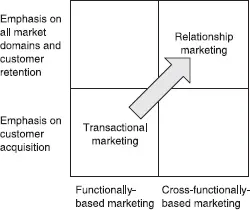
FIGURE 1.1 The transition to relationship marketing
The fundamental principles of relationship marketing
As Figure 1.1 suggests, a number of characteristics distinguish relationship marketing from earlier frameworks. The first is an emphasis on extending the ‘lifetime value’ of customers through strategies that focus on retaining targeted customers. The second is the recognition that companies need to forge relationships with a number of market domains or ‘stakeholders’ if they are to achieve long-term success in the final marketplace. And the third is that marketing has moved from being the sole responsibility of the marketing department to become ‘pan-company’ and cross-functional.
Maximising the lifetime value of a customer is a fundamental goal of relationship marketing.
Maximising the lifetime value of a customer is a fundamental goal of relationship marketing. In this context, we define the lifetime value of a customer as the future flow of net profit, discounted back to the present, that can be attributed to a specific customer. Adopting the principle of maximising customer lifetime value forces the organisation to recognise that not all customers are equally profitable and that it must devise strategies to enhance the profitability of those customers it seeks to target. We go on to explore these ideas in more depth in Chapter 2. But, in essence, companies need to tailor and customise their relationship marketing strategies even to the extent of so called ‘one-to-one’ marketing.11
The second differentiating feature of relationship marketing is the concept of focusing marketing action on multiple markets. Conventionally, marketing strategy has been structured solely around the customer. Of course, the ultimate aim of relationship marketing strategies is to compete successfully for profitable customers. But to do this firms need to define more broadly the markets that need to be addressed. Relationship marketing recognises that multiple market domains can directly or indirectly affect a business's ability to win or retain profitable customers. These other markets include suppliers, employees, influencers, distributors and alliance partners. We have previously defined10 this multiple market focus as the ‘six markets model’. But there is nothing sacrosanct about the number six, and in any given circumstance firms may need to encompass fewer or more ‘stakeholders’ within their overall relationship marketing strategies. We explore the concept of the multiple market model in greater detail in Chapter 3.
The third key element of relationship marketing is that it must be cross-functional.
David Packard, a co-founder of Hewlett-Packard, is reported to have said that ‘marketing is too important to be left to the marketing department’. You could interpret this in a number of ways (for example, the marketing department is not up to the task!) but we choose to understand it as a call to bring marketing out of its functional silo and inculcate the concept and the philosophy of marketing across the business.
In practice this needs to be accompanied by an organisational change that fosters cross-functional working and develops the mindset that everyone within the business serves a customer, be they internal or external customers.
In addition to these three key differentia...
Table of contents
- Cover Page
- Half Title
- Title Page
- Copyright
- Contents
- Acknowledgements
- Introduction
- 1 Creating value for the customer
- 2 Creating value for the organisation
- 3 Building marketing relationships: the six markets model
- 4 Managing relationships in networks
- 5 Relationship marketing: integrating quality, customer service and marketing
- 6 Developing and implementing a relationship strategy
- Index
Trusted by 375,005 students
Access to over 1.5 million titles for a fair monthly price.
Study more efficiently using our study tools.
Frequently asked questions
Yes, you can cancel anytime from the Subscription tab in your account settings on the Perlego website. Your subscription will stay active until the end of your current billing period. Learn how to cancel your subscription
No, books cannot be downloaded as external files, such as PDFs, for use outside of Perlego. However, you can download books within the Perlego app for offline reading on mobile or tablet. Learn how to download books offline
Perlego offers two plans: Essential and Complete
- Essential is ideal for learners and professionals who enjoy exploring a wide range of subjects. Access the Essential Library with 800,000+ trusted titles and best-sellers across business, personal growth, and the humanities. Includes unlimited reading time and Standard Read Aloud voice.
- Complete: Perfect for advanced learners and researchers needing full, unrestricted access. Unlock 1.5M+ books across hundreds of subjects, including academic and specialized titles. The Complete Plan also includes advanced features like Premium Read Aloud and Research Assistant.
We are an online textbook subscription service, where you can get access to an entire online library for less than the price of a single book per month. With over 1.5 million books across 990+ topics, we’ve got you covered! Learn about our mission
Look out for the read-aloud symbol on your next book to see if you can listen to it. The read-aloud tool reads text aloud for you, highlighting the text as it is being read. You can pause it, speed it up and slow it down. Learn more about Read Aloud
Yes! You can use the Perlego app on both iOS and Android devices to read anytime, anywhere — even offline. Perfect for commutes or when you’re on the go.
Please note we cannot support devices running on iOS 13 and Android 7 or earlier. Learn more about using the app
Please note we cannot support devices running on iOS 13 and Android 7 or earlier. Learn more about using the app
Yes, you can access Relationship Marketing by Martin Christopher,Adrian Payne,David Ballantyne in PDF and/or ePUB format, as well as other popular books in Business & Business General. We have over 1.5 million books available in our catalogue for you to explore.