This superb introduction to the field of organizational psychology and organizational behaviour builds on the foundation of the highly successful first edition to provide up-to-date explanations of all the key topics in a clear, coherent and accessible style. The text is supported by numerous illustrations and examples as well as end-of-chapter summaries and concluding remarks. Topic sections on key research studies, as well as applied aspects such as human resources applications and cross-cultural issues, lead the reader through the complexities of the theory to its practical application.
The Psychology of Behaviour at Work covers all major topics in the field, from vocational choice, personality, attitudes, motivation and stress, to cooperation, learning, training, group dynamics, decision making and leadership. Further sections introduce corporate culture and climate, as well as organisational structure, change and development, and a final section outlines predictions not only for the future study of organizational psychology, but of the future of work itself.
As with the first edition, The Psychology of Behaviour at Work will prove to be an invaluable resource for psychology students on work and organizational psychology courses, business students on organizational behaviour courses, and human resources managers eager to expand their knowledge of this fascinating field.

- 848 pages
- English
- ePUB (mobile friendly)
- Available on iOS & Android
eBook - ePub
About this book
Information
Publisher
Psychology PressYear
2012Print ISBN
9781841695044
9781841695037
Edition
2eBook ISBN
9781135422882
1 Introduction
What is organizational or work psychology?
Most of us are born and die in organizations. We are educated and work in organizations. We spend a great deal of our in leisure time playing and praying in organizations. Furthermore, one of the largest and most powerful of organizations – the government or state – prescribes and proscribes how we should behave throughout our lives. We are shaped, nurtured, controlled, rewarded and punished by organizations all our lives. We are social animals who live in groups most of which might be called organizations.
Just after the Second World War, work psychology was conceived in terms of two simple and memorable epithets: “fitting the person to the job” and “fitting the job to the person”. Today this would be called vocational and occupational psychology, management and ergonomics. But what do we understand work psychology to be today halfway through the first decade of the first century of the second millennium? Three ways of discovering the nature of work psychology is to look at definitions of it, how different academic disciplines contribute to it, and the subfields of work psychology.
Textbook definitions on the topic differ considerably. Consider the following:
• Cherrington (1989: 27): “The field of organizational behavior developed primarily from the contributions of psychology, sociology, and anthropology. Each of these three disciplines contributed ideas relevant to – organizational events that were combined into a separate study called organizational behavior. Three other disciplines that had a minor influence on the development of organizational behavior included economics, political science and history”.
• Jewell (1985: 10): “Organizational behavior (work psychology) is a specialty area within the study of management. The difference between I/O [industrial/organizational] psychology as a subject for study and organizational behavior is not difficult to define conceptually. Industrial/organizational psychologists are interested in human behavior in general and human behavior in organizations in particular. Organizational behaviorists are interested in organizations in general and in the people component of organizations in particular. The basic distinction between I/O psychology and organizational behavior as academic areas of study is often difficult to maintain in applied organizational settings. The American Psychological Association formally recognized the interrelatedness of these two approaches to the same basic problems in 1973. At that time, the old designation of industrial psychology was replaced with the term now in standard use, industrial/organizational psychology”.
• Baron & Greenberg (1990: 4): “The field of organizational behavior seeks knowledge of all aspects of behavior in organizational settings through systematic study of individual, group and organizational processes; the primary goals of such knowledge are enhancing effectiveness and individual well being”.
• Spector (2003: 6): “The field of I/O psychology has a dual nature. First, it is the science of people at work. This aspect ties it to other areas of psychology, such as cognitive and social. Second I/O psychology is the application of psychological principles to organizational and work settings. There is no other area of psychology in which a closer correspondence between application and science exists. It covers many topics ranging from methods of hiring employees to theories of how organizations work. It is concerned with helping organizations get the most from their employees or human resources as well as which organizations take care of employee health and well-being”.
As all students of the social sciences soon discover, definitions are of limited use, although they do highlight slightly different emphases between both writers and the disciplines they rely on most heavily. Certainly, there appears to be no shared and parsimonious definition of work psychology (or for that matter industrial and organizational psychology, or management science). Disciplines change and develop and encompass a very wide range of issues. However, the following may be proposed as a definition of organizational psychology:
Organizational psychology is the study of how individuals are recruited, selected and socialized into organizations; how they are rewarded and motivated; how organizations are structured formally and informally into groups, sections and teams; and how leaders emerge and behave. It also examines how the organization influences the thoughts, feelings and behaviour of all employees by the actual, imagined or implied behaviour of others in their organization. Organizational psychology is the study of the individual in the organization, but it is also concerned with small and large groups and the organization as a whole as it impacts on the individual. Organizational psychology is a relatively young science. Like cognitive science, it is a hybrid discipline that is happy to break down disciplinary boundaries. From a psychological perspective, the major branches of the discipline to have influenced organizational psychology are experimental, differential, engineering and social psychology.
Another common way to understand work psychology is to look at its behavioural science founder disciplines, their contributions and special units of analysis. It is agreed that, of necessity, the subject of work psychology must be multidisciplinary. Psychology needs to take into consideration sociological factors; economics must take into consideration the foibles and idiosyncrasies so often researched by psychologists. So, work psychology is a hybrid that has borrowed (or stolen) ideas, concepts, methods and insights from some of the most established – subjects, particularly economics, psychology and sociology.
Figure 1.1 (based on Robbins, 1991: p. 14) illustrates the major contributory behavioural sciences. Four important points need to be made:
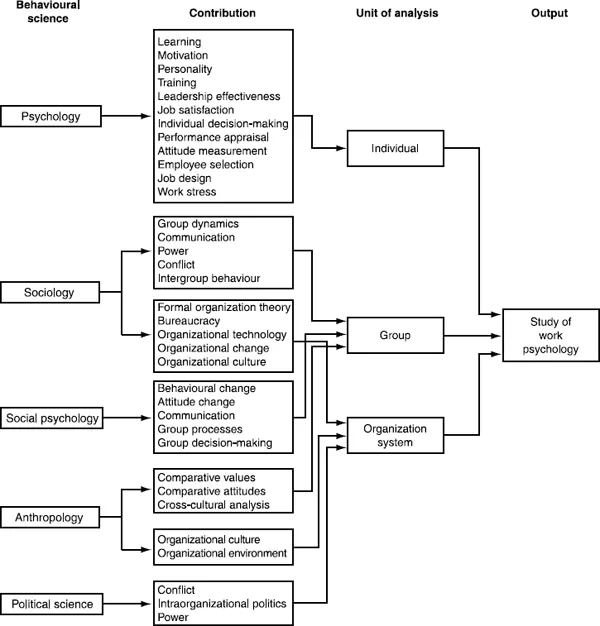
Figure 1.1 Towards a work psychology discipline. Adapted from Robbins (1991). Reproduced with the permission of Prentice-Hall, Inc.
• First, a good case could be made for including other disciplines, such as social administration/policy, industrial relations, international relations and computer science, although many of these are themselves hybrids.
• Secondly, the list of contributions in the second column are highly debatable – what is included and what not. Certainly, different writers would come up with different lists.
• Thirdly, the third column is very instructive; indeed, many textbooks are organized around the unit of analysis: the individual (intra- and interpersonal factors), the group (intra- and intergroup factors) and the organization (again inter- and intra-). Note that only psychology focuses on the individual, although branches of psychology focus not on “whole-person” research but some specific process such as memory or perception.
• Fourthly, this figure is too neat and it neglects to mention that various clashes or differences occur. Social psychologists and sociologists often study the same thing, but with different methods and assumptions. Economists and political scientists come to blows over ideology and epistemology. There is no neat slicing up of the cake of the natural phenomena of work psychology “carving-nature-at-her-joints”. It is messier and more unhappy than suggested above. Academic disciplines have competing mutually exclusive theories and, rather than favouring eclecticism, prefer exclusivity.
However, what is important to remember is that many academic disciplines continue to contribute to the development of work psychology. This is because of the very large number of issues and problems that are traditionally covered by work psychology.
A third way of describing the field of work psychology is to list the various components or separate subfields covered by work psychology specialists. Thus, Muchinsky (1983) listed six different subspecialities in an attempt at conceptual clarification:
• Personnel psychology examines the important role of individual differences in selecting and placing employees, in appraising the level of employees’ work performance, and in training recently hired, as well as veteran, employees to improve various aspects of their job-related behaviour.
• Organizational behaviour studies the impact of group and other social influences on role-related behaviours, on personal feelings of motivation and commitment, and on communication within the organizational setting.
• Organizational development concerns planned changes within organizations that can involve people, work procedures, job design and technology, and the structure of organizational relationships.
• Industrial relations concerns the interactions between and among employees and employers, and often involves organized labour unions.
• Vocational and career counselling examines the nature of rewarding and satisfying career paths in the context of individuals’ different patterns of interests and abilities.
• Engineering psychology generally focuses on the design of tools, equipment and work environments with an eye towards maximizing the effectiveness of women and men as they operate in human–machine systems.
Lowenberg and Conrad (1998) suggest five slightly different areas based on a survey of working American psychologists. They are organizational development and change (examining structure and roles and their impact on productivity and satisfaction); individual development (mentoring, stress management, counselling); performance evaluation and selection (developing assessment tools for selection, placement, classification and promotion); preparing and presenting results (including research activities); and compensation and benefits (developing criteria, measuring utility and evaluating the level of accomplishment.
By giving one an idea of the specialities within work psychology, rather than the disciplines that contribute to it, it becomes easier to understand the range of issues dealt with by organizational psychologists.
Another way to discover the range of the disciplines is to examine the common topics covered on courses. The following is typical of the course topics covered in work psychology programmes (Dipboye, Smith, & Howell, 1994):
History and systems of psychology
Fields of psychology
Work motivation theory
Vocational choice
Organizational development
Attitude measurement and theory
Psychometrics
Decision theory
Human performance/human factors
Consumer behaviour
Measurement of personality and individual differences
Small group processes
Performance appraisal and fe...
Table of contents
- Cover
- Half title
- Title
- Copyright
- Dedication
- Contents
- Preface
- 1. Introduction
- 2. The history of organizational psychology and the study of work psychology
- 3. Vocational choice, organizational selection and socialization
- 4. Personality and individual differences
- 5. Work-related attitudes, values and perceptions
- 6. Work motivation and satisfaction
- 7. Stress at work
- 8. Cooperation, power and ethical behaviour in organizations
- 9. Learning and training at work
- 10. Group dynamics
- 11. Decision-making
- 12. Leadership
- 13. Culture at work
- 14. Organizational structure, change and development
- 15. Working abroad
- 16. The future of work
- Author Index
- Subject Index
Trusted by 375,005 students
Access to over 1.5 million titles for a fair monthly price.
Study more efficiently using our study tools.
Frequently asked questions
Yes, you can cancel anytime from the Subscription tab in your account settings on the Perlego website. Your subscription will stay active until the end of your current billing period. Learn how to cancel your subscription
No, books cannot be downloaded as external files, such as PDFs, for use outside of Perlego. However, you can download books within the Perlego app for offline reading on mobile or tablet. Learn how to download books offline
Perlego offers two plans: Essential and Complete
- Essential is ideal for learners and professionals who enjoy exploring a wide range of subjects. Access the Essential Library with 800,000+ trusted titles and best-sellers across business, personal growth, and the humanities. Includes unlimited reading time and Standard Read Aloud voice.
- Complete: Perfect for advanced learners and researchers needing full, unrestricted access. Unlock 1.5M+ books across hundreds of subjects, including academic and specialized titles. The Complete Plan also includes advanced features like Premium Read Aloud and Research Assistant.
We are an online textbook subscription service, where you can get access to an entire online library for less than the price of a single book per month. With over 1.5 million books across 990+ topics, we’ve got you covered! Learn about our mission
Look out for the read-aloud symbol on your next book to see if you can listen to it. The read-aloud tool reads text aloud for you, highlighting the text as it is being read. You can pause it, speed it up and slow it down. Learn more about Read Aloud
Yes! You can use the Perlego app on both iOS and Android devices to read anytime, anywhere — even offline. Perfect for commutes or when you’re on the go.
Please note we cannot support devices running on iOS 13 and Android 7 or earlier. Learn more about using the app
Please note we cannot support devices running on iOS 13 and Android 7 or earlier. Learn more about using the app
Yes, you can access The Psychology of Behaviour at Work by Adrian Furnham in PDF and/or ePUB format, as well as other popular books in Psychology & Organisational Behaviour. We have over 1.5 million books available in our catalogue for you to explore.