English Legal System
eBook - ePub

English Legal System

  1. 224 pages
  2. English
  3. ePUB (mobile friendly)
  4. Available on iOS & Android
eBook - ePub

English Legal System

About this book

Key Facts Key Cases: English Legal System will ensure you grasp the main concepts of your English Legal System module with ease. This book explains in concise and straightforward terms:

• Discussion of the courts system, both civil and criminal;
• Details of the tribunal system
• The doctrine of precedent
• Statutory interpretation
• Personnel in the legal system, both professional and lay

Key Facts Key Cases is the essential series for anyone studying law at LLB, postgraduate and conversion courses and professional courses such as ILEX. The series provides the simplest and most effective way to absorb and retain all of the material essential for passing your exams. Each chapter includes:


  • diagrams at the start of chapters to summarise key points


  • structured headings and numbered points to allow for clear recall of the essential points


  • charts and tables to break down more complex information

Where relevant, chapters also contain a Key Cases section which provides the simplest and most effective way to absorb and memorise essential cases needed for exam success.


  • Essential and leading cases are explained


  • The style, layout and explanations are user friendly


  • Cases are broken down into key components by use of a clear system of symbols for quick and easy visual recognition

Frequently asked questions

Yes, you can cancel anytime from the Subscription tab in your account settings on the Perlego website. Your subscription will stay active until the end of your current billing period. Learn how to cancel your subscription.
At the moment all of our mobile-responsive ePub books are available to download via the app. Most of our PDFs are also available to download and we're working on making the final remaining ones downloadable now. Learn more here.
Perlego offers two plans: Essential and Complete
  • Essential is ideal for learners and professionals who enjoy exploring a wide range of subjects. Access the Essential Library with 800,000+ trusted titles and best-sellers across business, personal growth, and the humanities. Includes unlimited reading time and Standard Read Aloud voice.
  • Complete: Perfect for advanced learners and researchers needing full, unrestricted access. Unlock 1.4M+ books across hundreds of subjects, including academic and specialized titles. The Complete Plan also includes advanced features like Premium Read Aloud and Research Assistant.
Both plans are available with monthly, semester, or annual billing cycles.
We are an online textbook subscription service, where you can get access to an entire online library for less than the price of a single book per month. With over 1 million books across 1000+ topics, we’ve got you covered! Learn more here.
Look out for the read-aloud symbol on your next book to see if you can listen to it. The read-aloud tool reads text aloud for you, highlighting the text as it is being read. You can pause it, speed it up and slow it down. Learn more here.
Yes! You can use the Perlego app on both iOS or Android devices to read anytime, anywhere — even offline. Perfect for commutes or when you’re on the go.
Please note we cannot support devices running on iOS 13 and Android 7 or earlier. Learn more about using the app.
Yes, you can access English Legal System by Jacqueline Martin in PDF and/or ePUB format, as well as other popular books in Law & Law Theory & Practice. We have over one million books available in our catalogue for you to explore.

Information

Year
2014
eBook ISBN
9781134653478
Edition
1
Topic
Law
Index
Law
1
What is law?
Image
1.1 The nature of law
1.1.1 Definition of ‘law’
A brief definition of ‘law’ is difficult, but the following are some suggestions.
1 Law is a set of rules that plays an important part in the creation and maintenance of social order.
2 John Austin defined law as a command issued from a Sovereign power to an inferior and enforced by coercion.
3 Sir John Salmond defined law as being ‘the body of principles recognised and applied by the State in the administration of justice’.
4 Although law is a formal mechanism for controlling society, it is not the only mechanism; less formal rules of morality and custom also play a part.
1.1.2 Law and morality
1 Morality is what is right and wrong according to a set of values or beliefs governing a group’s behaviour.
2 Morality is not fixed and will vary from one group/society to another. Moral values may also change over time.
3 Law and morality usually overlap on major issues, but may differ on other matters.
4 Murder is an example of an overlap. It is both legally and morally wrong. However, even on this major issue there are some who believe that euthanasia should be allowed, and legally it has been ruled that the withdrawal of sustenance from a person in a persistent vegetative state is not murder (Airedale NHS Trust v Bland (1993)).
5 Law and morality diverge on many issues. For example:
abortion is legal under the Abortion Act 1967, but some groups believe it is morally wrong;
smoking cannabis is legally wrong but many people believe it is not morally wrong.
6 Whether law and morality should be the same is a question that is debated. Positivists such as Hart and Kelsen state that law and morality are essentially separate, but proponents of the natural law theory (based on the theories of Aristotle and St. Thomas Aquinas) believe that law and morality should coincide.
1.1.3 A legal system
Professor Hart suggested five factors that he believed had to co-exist to create a legal system. These are:
a)
rules that forbid certain conduct and rules that compel certain conduct on pain of sanctions;
b)
rules requiring people to compensate those whom they injure;
c)
rules stating what needs to be done in certain ‘mechanical’ areas of law, such as making a contract or making a will;
d)
a system of courts to determine what the rules are, whether they have been broken, and what the appropriate sanction is;
e)
a body whose responsibility it is to make rules and amend or repeal them when necessary.
Image
1.2 Classification of law
It is possible to classify law in many ways. For a law student, the most important ways are by:
the type of law (ie the matters that the law is regulating);
the source from which it comes; this affects the status of the law.
1.2.1 Classification by types of law
Image
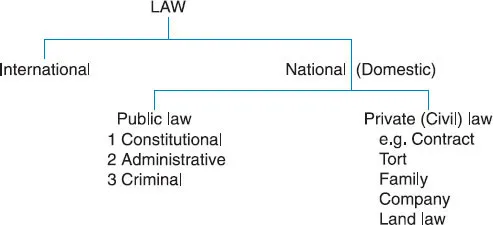
1 Law can be classified as international or national (domestic).
2 International law can be divided into public international law, which governs relationships between countries, and private international law, which governs which country’s law should apply to individuals where there are links with at least two different countries. For example, which country’s law should govern who inherits on a person’s death.
3 National law can also be divided into public law and private law. Public law involves the State in some way, while private (civil) la...
Table of contents

  1. Cover
  2. Half Title
  3. Title Page
  4. Copyright Page
  5. Table of Contents
  6. PREFACE
  7. TABLE OF CASES
  8. Chapter 1 WHAT IS LAW?
  9. Chapter 2 JUDICIAL PRECEDENT
  10. Chapter 3 LEGISLATION
  11. Chapter 4 STATUTORY INTERPRETATION
  12. Chapter 5 EUROPEAN UNION LAW
  13. Chapter 6 LAW REFORM
  14. Chapter 7 THE CIVIL JUSTICE SYSTEM
  15. Chapter 8 TRIBUNALS AND INQUIRIES
  16. Chapter 9 POLICE POWERS
  17. Chapter 10 THE CRIMINAL PROCESS AND COURTS
  18. Chapter 11 SENTENCING
  19. Chapter 12 THE LEGAL PROFESSION
  20. Chapter 13 THE JUDICIARY
  21. Chapter 14 LAY MAGISTRATES
  22. Chapter 15 JURIES
  23. Chapter 16 LEGAL SERVICES AND FUNDING
  24. INDEX