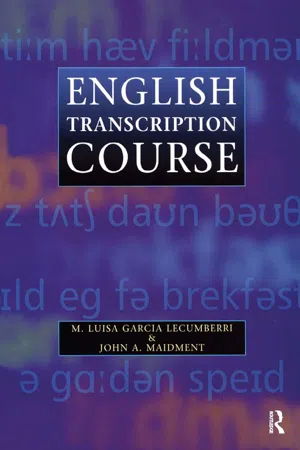
Have you ever been confused by the fact that the words 'though' and 'bough' are pronounced differently, or frustrated by the realisation that 'hint' and 'pint' don't rhyme? It is well known that the spelling system of English is notoriously unhelpful as an indicator of how to pronounce English words. Spoken and written representations of English are mutually inconsistent, making it difficult to interpret the 'logic' of the language. Learning to transcribe English phonetically, however, provides an accurate visual interpretation of pronunciation: it helps you to realise what you actually say, rather than what you think you say.
English Transcription Course is the ideal workbook for anyone wishing to practice their transcription skills. It provides a series of eight lessons, each dealing with a particular aspect of pronunciation, and introduces and explains the most important features of connected speech in modern British English - such as assimilation, elision and weak forms, concentrating on achieving a relaxed, informal style of speech. Each lesson is followed by a set of exercises which allow for extensive practise of the skills learnt in both current and previous chapters. Students can check their progress with the 'model' answers provided in the appendix.
- 160 pages
- English
- ePUB (mobile friendly)
- Available on iOS & Android
eBook - ePub
English Transcription Course
About this book
Information
Lesson 1
Symbols and terminology
In this lesson we shall introduce the symbols that will be used throughout the book. There are various sets of symbols used for the transcription of English. In this book we shall use the symbols in the Longman Pronunciation Dictionary (Wells, 1990). The basic terminology used to describe speech sounds will also be introduced in this lesson.
Consonant symbols
There are 24 consonant sounds in RP English. They may be classified according to their place and manner of articulation and voicing, as set out in Table 1.1 below. In the table, the first of a pair of symbols represents a voiceless sound and the second a voiced sound. Each of the above consonants is illustrated by a keyword in Table 1.2 which follows. The consonant is usually found at the beginning of the keyword, but for some sounds which cannot occur initially in a word the consonant is in bold type.
Voicing: A voiced consonant is one which is accompanied by vibration of the vocal folds. If you pronounce a long /z/ sound, as if imitating the buzzing of a bee, and at the same time place your thumb and finger on your throat, you should be able to feel the vibrations. For some voiced sounds, specifically voiced plosives, the vibration of the vocal folds does not always continue throughout the sound, but starts immediately after the end of the sound. Voiceless sounds have no vocal fold vibration. Try a long /s/ sound, imitating the hissing of a snake. You should not feel any vibrations in your throat.
Table 1.1 Consonant symbols

Table 1.2 Consonant keywords and their transcriptions

The voiceless consonants of RP English are:
p t k f θ s ∫ t ∫ h
The voiced consonants of RP English are:
b d g v ð z ʒ dʒ m n ŋ w l r j
Exercise 1.1 Look at the following short passage and try to identify all the voiceless consonants in it.
I haven’t got a car at the moment. My car was stolen last Friday. I left it at the station all day and when I got back in the evening it had vanished. I hope the insurance company will send me a cheque soon, so that I can go and buy another one.
Exercise 1.2 Which of the following words contain only voiced consonant sounds?
much, moody, number, yellow, roses, knees, youth, loses, doses, dozes, wishing, leisure, those, under, jeans, this, his, wins, garage, universal.
Place of articulation: All speech sounds are made with a stream of air moving through the vocal tract. For all the sounds of English, most of the time, the airstream is set in motion by the lungs and travels up the windpipe (also called the trachea), through the voice-box (the larynx) where the vocal folds are situated, through the pharynx and then through the oral cavity or the nasal cavity (or both). Speech sounds are made by interfering with this stream of air, usually at some point within the oral cavity. The exact point of such interference is known as the place of articulation (poa) of the sound. RP English makes use of the following places (Table 1.3).
Table 1.3 Places of articulation
bilabial | the two lips approach one another to interfere with the airstream; RP English bilabial sounds are /p b m/ |
labiodental | the lower lip approaches the upper front teeth; RP labiodental sounds are /f v/ |
dental | the tip of the tongue approaches the back of the upper front teeth; RP dental sounds are /θ ð/ |
alveolar | the tip of the tongue approaches the area just behind the upper front teeth; this area is known as the alveolar ridge; RP alveolar sounds are /t d n s z l/ |
Table of contents
- Cover
- Title Page
- Copyright Page
- Table of Contents
- Introduction
- Lesson 1: Symbols and terminology
- Lesson 2: Transcription hints
- Lesson 3: Stress, rhythm and weak forms
- Lesson 4: Sandhi r
- Lesson 5: Consonant syllabicity
- Lesson 6: Elision
- Lesson 7: Assimilation
- Lesson 8: Glottaling
- Lesson 9: Further practice
- Appendix: Answers to exercises
- Glossary
- Bibliography
Trusted by 375,005 students
Access to over 1.5 million titles for a fair monthly price.
Study more efficiently using our study tools.
Frequently asked questions
Yes, you can cancel anytime from the Subscription tab in your account settings on the Perlego website. Your subscription will stay active until the end of your current billing period. Learn how to cancel your subscription
No, books cannot be downloaded as external files, such as PDFs, for use outside of Perlego. However, you can download books within the Perlego app for offline reading on mobile or tablet. Learn how to download books offline
We are an online textbook subscription service, where you can get access to an entire online library for less than the price of a single book per month. With over 1.5 million books across 990+ topics, we’ve got you covered! Learn about our mission
Look out for the read-aloud symbol on your next book to see if you can listen to it. The read-aloud tool reads text aloud for you, highlighting the text as it is being read. You can pause it, speed it up and slow it down. Learn more about Read Aloud
Yes! You can use the Perlego app on both iOS and Android devices to read anytime, anywhere — even offline. Perfect for commutes or when you’re on the go.
Please note we cannot support devices running on iOS 13 and Android 7 or earlier. Learn more about using the app
Please note we cannot support devices running on iOS 13 and Android 7 or earlier. Learn more about using the app
Yes, you can access English Transcription Course by Maria Lecumberri,J. A. Maidment in PDF and/or ePUB format, as well as other popular books in Languages & Linguistics & Linguistics. We have over 1.5 million books available in our catalogue for you to explore.