Engineering Science
eBook - ePub

Engineering Science

For Foundation Degree and Higher National

  1. 552 pages
  2. English
  3. ePUB (mobile friendly)
  4. Available on iOS & Android
eBook - ePub

Engineering Science

For Foundation Degree and Higher National

About this book

Engineering Science will help you understand the scientific principles involved in engineering.

Focusing primarily upon core mechanical and electrical science topics, students enrolled on an Engineering Foundation degree and Higher National Engineering qualification will find this book an invaluable aid to their learning.

The subject matter covered includes sections on the mechanics of solids, dynamics, thermodynamics, electrostatics and electromagnetic principles, and AC and DC circuit theory.

Knowledge-check questions, summary sections and activities are included throughout the book, and the necessary background mathematics is applied and integrated alongside the appropriate areas of engineering being studied. The result is a clear, straightforward and easily accessible textbook that encourages independent study and covers most of the scientific principles that students are likely to meet at this level.

It is supported with a companion website at http://www.key2engineeringscience.com for students and lecturers:

  • Solutions to the Test your Knowledge questions in the book
  • Further guidance onessential mathematics
  • Extra chapters on vapour properties, cycles and plants
  • Downloadable SCILAB scriptsthat helps simplifyadvanced mathematical content

Frequently asked questions

Yes, you can cancel anytime from the Subscription tab in your account settings on the Perlego website. Your subscription will stay active until the end of your current billing period. Learn how to cancel your subscription.
No, books cannot be downloaded as external files, such as PDFs, for use outside of Perlego. However, you can download books within the Perlego app for offline reading on mobile or tablet. Learn more here.
Perlego offers two plans: Essential and Complete
  • Essential is ideal for learners and professionals who enjoy exploring a wide range of subjects. Access the Essential Library with 800,000+ trusted titles and best-sellers across business, personal growth, and the humanities. Includes unlimited reading time and Standard Read Aloud voice.
  • Complete: Perfect for advanced learners and researchers needing full, unrestricted access. Unlock 1.4M+ books across hundreds of subjects, including academic and specialized titles. The Complete Plan also includes advanced features like Premium Read Aloud and Research Assistant.
Both plans are available with monthly, semester, or annual billing cycles.
We are an online textbook subscription service, where you can get access to an entire online library for less than the price of a single book per month. With over 1 million books across 1000+ topics, we’ve got you covered! Learn more here.
Look out for the read-aloud symbol on your next book to see if you can listen to it. The read-aloud tool reads text aloud for you, highlighting the text as it is being read. You can pause it, speed it up and slow it down. Learn more here.
Yes! You can use the Perlego app on both iOS or Android devices to read anytime, anywhere — even offline. Perfect for commutes or when you’re on the go.
Please note we cannot support devices running on iOS 13 and Android 7 or earlier. Learn more about using the app.
Yes, you can access Engineering Science by Mike Tooley, Lloyd Dingle in PDF and/or ePUB format, as well as other popular books in Technology & Engineering & Civil Engineering. We have over one million books available in our catalogue for you to explore.

Part I
Mechanics of materials

The study of the mechanics of materials is concerned with the behaviour of solid bodies under the influence of loads. The ways in which these bodies behave as a result of the loads imposed on them, the stresses they endure, their subsequent strains and deflections, together with their internal reaction to these externally imposed loads, are of the utmost importance to engineers, particularly with respect to the design and in-service endurance of engineering structures.
In Chapter 1 some fundamental concepts are covered that may or may not be familiar to the reader but which are designed to provide essential background for the topics that follow. These topics include forces, resolution of forces, coplanar force systems, simple stress and strain, and thermal stress and strain. Chapter 2 is concerned with the analysis of beams and includes topics on shear force and bending moment, engineers’ theory of bending, centroid and second moment of area, beam selection and the slope and deflection of beams. In Chapter 3 we consider the concept of torsion in shafts used as power transmitters; topics covered include engineers’ theory of torsion, polar second moments of area and the power transmitted by shafts. Chapter 4 is concerned with the forces and stresses created by and acting on pressure vessels, where both thick-walled and thin-walled pressure vessels are considered, together with an application of the theory to the stress design of pressure vessels for specific functions. In Chapter 5 concentrically loaded columns and struts are considered; topics covered include the determination of parameters such as slenderness ratio, radius of gyration and effective length, Euler theory and the Rankine– Gordon relationship. Chapter 6 provides an introduction to strain energy, where strain energy is considered as a result of direct stress, shear stress, torsion and bending. Castigliano’s theorem is introduced and its use for analysing deflection of beams from externally loaded components is covered. Finally, in Chapter 7, we analyse complex stress and strain, starting with the analysis of stresses on oblique planes that result from direct tensile loading. Two-dimensional stresses acting both directly and in shear are analysed, together with the use of Mohr’s circle. Complex strain is then analysed and principal strains determined. The chapter finishes with a section on strain gauging and the use of strain gauge rosettes to determine principal strains.

Chapter 1
Fundamentals

1.1 Force

In its simplest sense a force is a push or pull exerted by one object on another. In a member in a static structure, a push causes compression and a pull causes tension. Members subject to compressive and tensile forces have special names. A member of a structure that is in compression is known as a strut and a member in tension is called a tie.
Only rigid members of a structure have the capacity to act as both a strut and a tie. Flexible members, such as ropes, wires or chains, can only act as ties.
Force cannot exist without opposition, as you will know from your previous study of Newton’s laws. An applied force is called an action and the opposing force it produces is called a reaction.
The effects of any force depend on its three characteristics: magnitude, direction and point of application.
In general, force is that which changes, or tends to change, the state of rest or uniform motion of a body.
This formula is a consequence of Newton’s second law, which you should already be familiar with. If not, you should refer to Part II of this book, where Newton’s laws are revised at the...
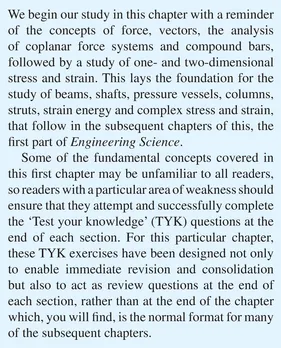
Table of contents

  1. Cover
  2. Title
  3. Copyright
  4. Contents
  5. Preface
  6. PART I MECHANICS OF MATERIALS
  7. PART II DYNAMICS
  8. PART III THERMODYNAMICS
  9. PART IV ELECTROSTATICS AND ELECTROMAGNETISM
  10. PART V DIRECT CURRENT
  11. PART VI TRANSIENTS
  12. PART VII ALTERNATING CURRENT
  13. Index

