Electronic Circuits
eBook - ePub

Electronic Circuits

Fundamentals & Applications

  1. 475 pages
  2. English
  3. ePUB (mobile friendly)
  4. Available on iOS & Android
eBook - ePub

Electronic Circuits

Fundamentals & Applications

About this book

Electronics explained in one volume, using both theoretical and practical applications.

  • New chapter on Raspberry Pi


  • Companion website contains free electronic tools to aid learning for students and a question bank for lecturers


  • Practical investigations and questions within each chapter help reinforce learning


Mike Tooley provides all the information required to get to grips with the fundamentals of electronics, detailing the underpinning knowledge necessary to appreciate the operation of a wide range of electronic circuits, including amplifiers, logic circuits, power supplies and oscillators. The fourth edition now offers an even more extensive range of topics, with extended coverage of practical areas such as Raspberry Pi.

The book's content is matched to the latest pre-degree level courses (from Level 2 up to, and including, Foundation Degree and HND), making this an invaluable reference text for all study levels, and its broad coverage is combined with practical case studies based in real-world engineering contexts. In addition, each chapter includes a practical investigation designed to reinforce learning and provide a basis for further practical work. A new companion website at www.key2electronics.com offers the reader a set of spreadsheet design tools that can be used to simplify circuit calculations, as well as circuit models and templates that will enable virtual simulation of circuits in the book. These are accompanied by online self-test multiple choice questions for each chapter with automatic marking, to enable students to continually monitor their own progress and understanding. A bank of online questions for lecturers to set as assignments is also available.

Tools to learn more effectively

Saving Books

Saving Books

Keyword Search

Keyword Search

Annotating Text

Annotating Text

Listen to it instead

Listen to it instead

Chapter 1
Electrical fundamentals

Chapter summary
This chapter has been designed to provide you with the background knowledge required to help you understand the concepts introduced in the later chapters. If you have studied electrical science, electrical principles or electronics beyond school level then you will already be familiar with many of these concepts. If, on the other hand, you are returning to study or are a newcomer to electronics or electrical technology this chapter will help you get up to speed.

Fundamental units

You will already know that the units that we now use to describe such things as length, mass and time are standardized within the International System of Units. This SI system is based upon the seven fundamental units (see Table 1.1).

Derived units

All other units are derived from these seven fundamental units. These derived units generally have their own names and those commonly encountered in electrical circuits are summarized in Table 1.2 together with the corresponding physical quantities.
If you find the exponent notation shown in Table 1.2 a little confusing, just remember that V−1 is simply 1/V, s−1 is 1/s, m−2 is 1/m−2, and so on.

Example 1.1

The unit of flux density (the Tesla) is defined as the magnetic flux per unit area. Express this in terms of the fundamental units.

Solution

The SI unit of flux is the Weber (Wb). Area is directly proportional to length squared and, expressed in terms of the fundamental SI units, this is square metres (m2). Dividing the flux (Wb) by the area (m2) gives Wb/m2 or Wb m−2. Hence, in terms of the fundamental SI units, the Tesla is expressed in Wb m−2.
Table 1.1 SI units
Quantity Unit Abbreviation
Current ampere A
Length metre m
Luminous intensity candela cd
Mass kilogram kg
Temperature Kelvin K
Time second s
Matter mol mol
(Note that 0 K is equal to -273 °C and an interval of 1 K is the same as an interval of 1 °C.)
Table 1.2 Electrical quantities
Quantity Derived unit Abbreviation Equivalent (in terms of fundamental units)
Capacitance Farad F A s V-1
Charge Coulomb C A s
Energy Joule J N m
Force Newton N kg m s-1
Frequency Hertz Hz s-1
Illuminance Lux lx lm m-2
Inductance Henry H V s A-1
Luminous flux Lumen lm cd sr
Magnetic flux Weber Wb V s
Potential Volt V W A-1
Power Watt W J s-1
Resistance Ohm Ω V A-1

Example 1.2

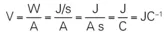
The unit of electrical potential, the volt (V), is defined as the difference in potential between two points in a conductor which, when carrying a current of one amp (A), dissipates a power of one watt (W). Express the volt (V) in terms of joules (J) and coulombs (C).

Solution

In terms of the derived units:
Note that: watts = joules/seconds and also that amperes × seconds = coulombs
Alternatively, in terms of the symbols used to denote the units:
Hence, one volt is equivalent to one joule per coulomb.

Measuring angles

You might think it strange to be concerned with angles in electrical circuits. The reason is simply that, in analogue and a.c. circuits, signals are based on repetitive waves (often sinusoidal in shape). We can refer to a point on such a wave in one of two basic ways, either in terms of the time from the start of the cycle or in terms of the angle (a cycle starts at 0° and finishes as 360° (see Fig. 1.1)). In practice, it is often more convenient to use angles rather than time; however, the two methods of measurement are interchangeable and it’s important to be able to work in either of these units.
In electrical circuits, angles are measured in either degrees or radians (both of which are strictly dimensionless units). You will doubtless already be familiar with angular measure in degrees where one complete circular revolution is equivalent to an angular change of 360°. The alternative method of measuring angles, the radian, is defined somewhat differently. It is the angle subtended at the centre of a circle by an arc having length which is equal to the radius of the circle (see Fig. 1.2).
You may sometimes find that you need to convert from radians to degrees, and vice versa. A complete circular revolution is equivalent to a rotation of 360° or 2π radians (note that π is approximately equal to 3.142). Thus one radian is equivalent to 360/2π degrees (or approximately 57....
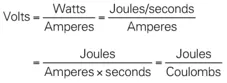
Table of contents

  1. Cover
  2. Title
  3. Copyright
  4. Contents
  5. Preface
  6. A note for teachers and lecturers
  7. A word about safety
  8. 1 Electrical fundamentals
  9. 2 Passive components
  10. 3 D.C. circuits
  11. 4 Alternating voltage and current
  12. 5 Semiconductors
  13. 6 Power supplies
  14. 7 Amplifiers
  15. 8 Operational amplifiers
  16. 9 Oscillators
  17. 10 Logic circuits
  18. 11 Microprocessers
  19. 12 The 555 timer
  20. 13 Test equipment and measurements
  21. 14 Fault finding
  22. 15 Sensors and interfacing
  23. 16 Circuit simulation
  24. 17 The PIC microcontroller
  25. 18 Electronic applications and the Raspberry Pi
  26. 19 Circuit construction
  27. Appendix 1 Student assignments
  28. Appendix 2 Revision problems
  29. Appendix 3 Answers to problems with numerical solutions
  30. Appendix 4 Semiconductor pin connections
  31. Appendix 5 1N4148 data sheet
  32. Appendix 6 2N3904 data sheet
  33. Appendix 7 Decibels
  34. Appendix 8 Mathematics for electronics
  35. Appendix 9 Useful web addresses
  36. Appendix 10 A low-cost bench power supply
  37. Index

Frequently asked questions

Yes, you can cancel anytime from the Subscription tab in your account settings on the Perlego website. Your subscription will stay active until the end of your current billing period. Learn how to cancel your subscription
No, books cannot be downloaded as external files, such as PDFs, for use outside of Perlego. However, you can download books within the Perlego app for offline reading on mobile or tablet. Learn how to download books offline
Perlego offers two plans: Essential and Complete
  • Essential is ideal for learners and professionals who enjoy exploring a wide range of subjects. Access the Essential Library with 800,000+ trusted titles and best-sellers across business, personal growth, and the humanities. Includes unlimited reading time and Standard Read Aloud voice.
  • Complete: Perfect for advanced learners and researchers needing full, unrestricted access. Unlock 1.4M+ books across hundreds of subjects, including academic and specialized titles. The Complete Plan also includes advanced features like Premium Read Aloud and Research Assistant.
Both plans are available with monthly, semester, or annual billing cycles.
We are an online textbook subscription service, where you can get access to an entire online library for less than the price of a single book per month. With over 1 million books across 990+ topics, we’ve got you covered! Learn about our mission
Look out for the read-aloud symbol on your next book to see if you can listen to it. The read-aloud tool reads text aloud for you, highlighting the text as it is being read. You can pause it, speed it up and slow it down. Learn more about Read Aloud
Yes! You can use the Perlego app on both iOS and Android devices to read anytime, anywhere — even offline. Perfect for commutes or when you’re on the go.
Please note we cannot support devices running on iOS 13 and Android 7 or earlier. Learn more about using the app
Yes, you can access Electronic Circuits by Mike Tooley in PDF and/or ePUB format, as well as other popular books in Technology & Engineering & Electrical Engineering & Telecommunications. We have over one million books available in our catalogue for you to explore.