![]()
1 Introduction: Britain in 1867
INTRODUCTION
The toilet roll lay four years in the future. To the 1870s also belonged the appearance of chewing-gum, jeans and milk chocolate. The men and women of 1867 were without all these everyday articles which ease our path through life in the twentieth century. They would have to wait 19 years for Coca-Cola, 26 for breakfast cereals and 30 years for arguably the greatest of all medicines: the humble aspirin. Milk bottles, bras and soap powder would not offer their welcome presence until the early years of the present century. It was a world, in various important aspects, very different from our own.
What events distinguished 1867, the thirtieth year of Queen Victoria’s reign, from those that followed it and preceded it? On the eastern borders of Europe, Count Leo Tolstoy was writing War and Peace. In far away Japan perhaps the most momentous events of the year were taking place as Emperor Meiji revoked the powers of the shogunate and launched Japan on its revolutionary course of modernization. In central Europe the North German Confederation came into existence, a major step towards the eventual unification of Germany under Prussian, and more particularly Bismarck’s, leadership. In Paris the emperor Napoleon III enjoyed the Paris exhibition which drew vast crowds, and Verdi’s new opera ‘Don Carlos’ had its opening. Manet, Degas and other Impressionist painters were rocking the art establishment of France -and establishing their reputations.
In Britain the Second Reform Act became law in August, giving the vote to one in three males. Women were, of course, excluded. However, for the first time the working classes formed a majority of the electorate and for many Conservatives the nightmare concept of democracy had apparently become a reality. The new iron-clad HMS Hercules was launched, emphasizing Britain’s technological pre-eminence and the fact that Britannia really did rule the waves. Darker deeds marked the ending of the year when Fenians in their fight for an independent Ireland blew up the outer wall of London’s Clerkenwell prison. Over-generous with their quantities of explosives they killed twelve people, injured 120, and demolished several houses. The Fenians had used gun-powder but the year also saw the invention of dynamite. From now on bigger explosions would be possible.
PEOPLE AND PLACES
There were considerably fewer Britons in 1867 than there are in the late twentieth century. England and Wales contained 21.5 million people, compared to the present 50 million, and Scotland had just over 3 million, compared to today’s figure of a little over 5 million. In Ireland the position was reversed with at least 1 million more Irish men and women in the 1860s than in the 1980s. It was the Celtic fringes which provided the largest percentage of migrants to all parts of the globe in the last quarter of the nineteenth century. In the United Kingdom as a whole there were 800,000 more women than there were men, and children formed a greater percentage of the population. There were many fewer old folk, especially those over 70.
The population had been rising rapidly throughout the nineteenth century. The birth rate per thousand was three times that of the late twentieth century. The death rate was twice as great and causes of death changed with seasons – the cold carrying most off in the winter months and water-borne diseases taking their toll in the summer. In the 1860s the already high mortality rates actually increased, at least for the first part of the decade, and there had been no significant improvement compared with the early years of the century. Many people were under-nourished but then a large proportion of the population had always gone hungry. Despite all the efforts of the Public Health reformers of the 1830s and 1840s much remained to be done. It was in the overcrowded cities that mortality rates were highest. Cholera, the new curse of the nineteenth century, had its last great outbreak in 1866–7, killing over 2,000 people in Liverpool alone. Smallpox, the ‘grim reaper’ of the eighteenth century, was still rampant and the last swipe of this disease in the early 1870s took the lives of nearly one thousand people. However, the chief killers remained the more mundane diarrhoea and dysentery that succeeded in carrying off 50,000 in Liverpool in the 1860s. In the same decade whooping cough killed another 32,000 in that city. Many of the victims were children, and infant mortality remained stubbornly high at around 150 per 1,000 live births up until the First World War.
In the last quarter of the nineteenth century market forces and state and municipal action combined to produce a dramatic improvement in life expectancy. The state finally grasped the nettle of public health by legislating on such fundamental issues as sewage disposal and water supply. It is significant that the last cholera outbreak in Britain only really affected those parts of the East End untouched by the new improved water system of London. Birmingham was much worse affected than Manchester but then half of Birmingham’s water came from wells some of which filled with seepage from the city’s largest graveyard. Manchester’s water supply, on the other hand, was a model for the rest of the country.
Market forces provided a vast improvement in food supplies and consequently in living standards. From the late 1870s the price of wheat tumbled as foreign imports flooded in. Canned meat from the Americas and refrigerated lamb from the Antipodes combined to boost the diet of Britons to hitherto unknown heights, even higher than the previous zenith of the 1450s when plague and population loss had left the survivors with ample food supplies. In the late nineteenth century the food production of the newly settled regions of the world, many of them populated by British migrants, gave the British Isles not just a temporary feast but a steadily improving diet. By 1900 life expectancy was over 50, an improvement of some twenty years on what it had been in 1800. The New World had come to the rescue of the Old.
There was a price to be paid for this dietary bonanza, which was met by rural Britain and even more so by rural Ireland. The collapse of grain prices had a devastating effect on British agriculture. In the 1860s however this lay in the future. The protective Corn Laws had been repealed in 1846 and despite dire warnings of the flood of foreign grain English agriculture had prospered in the 1850s and 1860s in what has been described as its ‘Golden Age’. The largest occupation category of the 1861 Census was ‘Agricultural labourer, farm servant and shepherd’, of which 1,188,789 were recorded. A further quarter of a million were described as ‘Farmers or graiziers’. Agriculture remained overwhelmingly the largest employer with three times as many workers as the second largest, the textile industry. Blacksmiths numbered 100,000 and there were 32,000 millers. Yet the same census records a momentous change in its report of 1863:
781 towns . . . contained 10,960,998 inhabitants; while the villages and country parishes contained 9,105,226, a large population in itself, and exceeding indeed in number the whole population of England and Wales in 1801, but less by 1,855,772 than the population of the towns in 1861.
The English nation then, without losing its hold on the country, and still largely diffused over 37 million acres of territory, has assumed the character of a preponderating city population.
(Parliamentary Papers, 1863, vol. LIII/I, p. 11)
Many of these 781 towns were, in fact, small country towns, essentially rural rather than urban in character. Only 28.8 per cent lived in cities containing over 100,000 inhabitants. Even so Britain was unique in the world and the world’s history. It had become, by this time, a predominantly urban society and the implications of this were enormous.
London was a world phenomenon. The greater London conurbation contained some 3.5 million people by 1867. The capital of the 1860s caught the attention of various writers, each giving different insights and impressions and emphasizing different aspects. As Henry James wrote in 1868, ‘Its immensity was the great fact, and that was a charm; the miles of housetops and viaducts, the complications of junctions and signals through which the train made its way to the station had already given me the scale.’ Large as it was, great tracts of what we think of today as Greater London were fields and villages. Hampstead retained its separate village identity and Harrow lay far out through fields and country from the newly urbanized area of Paddington.
The capital was a city of many extremes and contrasts. The rush hour was already established, and the traffic jam clearly existed too, especially at the bottle necks at crossing points of the river. Dickens, in his last great novel, Our Mutual Friend, published in 1865, shows us the low-life London of the river and also scenes from the more affluent London of the rich Boffins. Trollope’s political novels of the late 1860s and the 1870s describe the high political world which was also sketched from time to time in the London Illustrated News. The world of the Mall with its male swells and shapely, well-tailored females is not far from the Haymarket with its army of prostitutes and dolly mops – part-time prostitutes which some authorities have estimated numbered 80,000 throughout London as a whole.
In one sense there was nothing new about the relative size and dominance of nineteenth-century London. In Elizabethan times its crowded streets and teeming population had stood in stark contrast to the villages of Tudor England. Now in the reign of Victoria other great manufacturing centres rose to rival the capital and grew with astonishing speed. Liverpool, already mentioned for its appalling health record, was the second city of England. Manchester, capital of the ‘Cotton Kingdom’ of Lancashire, ranked third with a population of 357,979 in 1861. These and other northern and Midland cities were the new urban England of the nineteenth century, the product of the Industrial Revolution, enriched by their trade and industry and proud of their achievements, as their new town halls and libraries still proclaim to the twentieth century. Manchester seemed to embody this new England in the early nineteenth century, and Birmingham in later decades. There is a danger of stereotyping these throbbing industrial centres of steam, smoke and squalor. Dickens himself was guilty of this in his 1850s creation of Coketown in Hard Times. Perhaps Mrs Gaskell’s Milton – surely her own Manchester – is more balanced: ‘the chimneys smoked the ceaseless roar and mighty beat and dazzling whirl of machinery struggled and strove perpetually.’ Here also was real poverty and suffering to set against the image of the prosperous thrifty skilled worker.
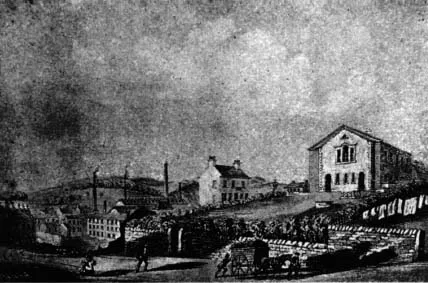
Glossop in the 1850s
Besides the great cities of Leeds, Bradford, Manchester, among others, were the new little industrial centres – hamlets and villages in the eighteenth century but now bustling communities with their factories lining the banks of rivers and their rows of workers’ cottages filling the fields. Glossop in north-west Derbyshire had swelled its numbers from a mere 2,759 in 1801 to 19,126 by 1861. Its new town centre covered an area of former marsh ground, and bricks and mortar rolled down the valley bottom alongside the great cotton factories of Wood and Sumner. The Glossop gas company had been established in 1845 and eight years later piped water was available for mill and cottage. Churches and chapels multiplied along with the public houses and in 1866 came the crowning glory: borough status. The growth of Manchester, Liverpool and Glossop all reflected the growing importance of cotton textile manufacture, a vital component in the national wealth – contributing as it did 8 per cent to Great Britain’s national income in 1850 (agriculture contributed 20 per cent). A large proportion of the cloth produced, perhaps 67 per cent in the late 1860s, was exported. By the 1860s the steam engine was everywhere triumphant. The handloom weaver whose cries of despair echoed in the 1830s and 1840s was now largely extinct. The factory system and factory life was the norm.
Across the Pennines the older woollen industry grew and likewise adopted factory production methods but it never equalled in the late nineteenth century the size and importance of its Lancastrian rival. Coalmining, iron-production and ship-building were the other great industries which made Britain foremost in the world in 1867. In each case Britain had out-produced all other countries. Coal-mining still had a long way to go before its output peaked in 1914 but it was already a large and very visible industry, making an immediate impact on the landscape of north-east England, South Wales and other coal-mining regions. In 1870 Britain produced 50 per cent of the world’s pig-iron and 40 per cent of the world’s steel, much of the latter produced by the new mass production techniques pioneered by the English inventor Henry Bessemer in the 1850s. In ship-building sail still outstripped steam and in 1860 there was still ten times the tonnage under sail as under steam. The position was changing rapidly, though, and British shipyards, which had been struggling against American and Scandinavian rivals in wooden construction, n...