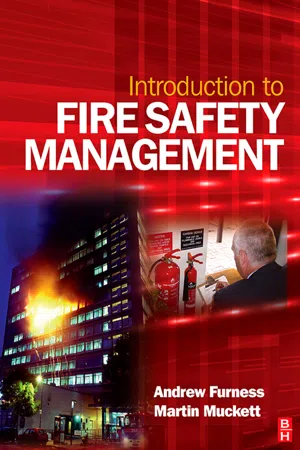
Andrew Furness and Martin Muckett give an introduction to all areas of fire safety management, including the legal framework, causes and prevention of fire and explosions, fire protection measures, fire risk assessment, and fire investigation. Fire safety is not treated as an isolated area but linked into an effective health and safety management system.
Introduction to Fire Safety Management has been developed for the NEBOSH Certificate in Fire Safety and Risk Management and is also suitable for other NVQ level 3 and 4 fire safety courses. The text is highly illustrated in full colour, easy to read and supported by checklists, report forms and record sheets. This practical approach makes the book a valuable reference for health and safety professionals, fire officers, facility managers, safety reps, managers, supervisors and HR personnel in companies, as well as fire safety engineers, architects, construction managers and emergency fire services personnel.
Andrew Furness CFIOSH, GIFireE, Dip2OSH, MIIRSM, MRSH, is Managing Director of Salvus Consulting Limited who specialise in Fire Safety. He was the chairman of the NEBOSH / IOSH working party that developed the NEBOSH Fire Safety and Risk Management certificate.
Martin Muckett MA, MBA, CMIOSH, MIFireE, Dip2OSH, former Principal Health and Safety Advisor to The Fire Service Inspectorate and Principal Fire Safety Officer, Martin is currently Salvus Consulting Limited's Senior Fire Safety Trainer / Consultant.
- 440 pages
- English
- ePUB (mobile friendly)
- Available on iOS & Android
eBook - ePub
Introduction to Fire Safety Management
About this book
Information
| 1 | Fire Safety Foundations |
To enable successful management of both fire and health and safety it is vital to develop a solid base of understanding and the key elements that will provide a foundation upon which to build. For students and safety professionals alike the information presented in this book outlines the legal requirements and management considerations that will assist the reader to successfully minimise the risk of harm from fire in the workplace.
1.1 Definitions
The terms relating to the management of safety in this chapter are defined by a variety of publications. To clarify the meaning of the text, it is important to establish a common understanding of the following, frequently used basic terminology:
This chapter discusses the following key elements:
- The scope and nature of both fire and occupational health and safety
- The moral, legal and financial reasons for promoting good standards of safety within an organisation
- The legal framework for the regulation of fire and health and safety
- The legal and financial consequences of failure to manage safety
- The nature and significance of key sources of fire and health and safety information
- The basis of a system for managing safety.
Occupational health and safety – factors and conditions that can affect the well-being of persons within the workplace, i.e. employees, contractors, temporary workers and visitors.
Safety – the freedom from unacceptable risk from harm.
Fire/combustion – a chemical reaction or series of reactions involving the process of oxidisation, producing heat, light and smoke. There are two classes of fire: conflagration (where combustion occurs relatively slowly) and detonation (where combustion occurs instantaneously).
Ill health – the term ill health includes acute and chronic physical or mental illness which can be caused or made worse by physical, chemical or biological agents, work activity or environment.
Accident – an undesired event resulting in death, ill health, injury, damage, environmental loss or other loss.
Incident – an undesired event that does not result in any harm or loss. Incidents are often referred to as near misses; some organisations refer more accurately to ‘incidents’ as ‘near hits’.
False alarm – an unwanted fire signal resulting from a deliberate operation of a fire safety system, the unintentional electrical actuation of a fire safety system, or the actuation of a fire safety system with good intent (believing there to be a fire).
Environmental protection – management arrangements to cover the protection of the environment, including mitigating the effects from fire fighting and other emergency operations from pollution, caused by workplace operations.
Hazard – a source or situation with the potential to cause harm (death, injury, ill health, damage to property or environment).
Risk – the combination of the likelihood and severity (consequences) of a hazard causing harm.
Further definitions will be provided throughout the book.
1.2 Scope and Nature
In today’s complex world effective safety management is the cornerstone of managing an economically viable business. The requirement to manage safety effectively extends to all private and public business sectors. Legal responsibilities for safety performance extend throughout all organisations from the management board to the student on work experience.
Every operation within any organisation has an impact on the safety not only of those undertaking and managing the work but also of others who may be affected by their work activities. Any product or service provided to any body must be designed or delivered in such a way as to reduce the risks to the end users to an acceptable level. Therefore it can be seen that safety is inextricably linked with all facets of work.
The failure to manage safety adequately all too often results in death or injury, chronic ill health and damage to property and/or the environment. Such results have a significant impact on the physical and economic well-being of society.
In the Health and Safety Commission’s (HSC) revitalising health and safety strategy statement the cost of health and safety failures to society as a whole was estimated as being as high as £18 billion annually. In terms of the cost of fire alone in the UK, the direct costs were estimated to be in the region of £8 billion for 2003, which is equivalent to about 1% of the gross domestic profit (GDP) of the English and Welsh economy.

Figure 1.1 Aftermath of fire – the cost of failing to manage fire safety
In Europe, the guiding philosophy of legislation since the early 1990s has been for those who work with hazards and risks in relation to fire and health and safety to effectively control them. This requires organisations and individuals to assess the potential risks associated with their work activities and to introduce effective measures to control such risks.
High profile prosecutions in the UK have reinforced the message that the responsibility for effective safety management rests not only with the body corporate but also with individuals within an organisation.
1.3 The Moral, Legal and Financial Reasons for Promoting Good Standards of Safety Within an Organisation
1.3.1 Moral (Humane) Reasons
There are a number of convincing arguments for the promotion of good safety standards. The human consequences of fires, accidents and incidents are widespread and affect a number of different people in differ ent ways.
The most obvious result of a fire or an accident at work is that the persons directly involved are likely to suffer. The impact on these individuals ranges from death through to relatively minor injuries. In addition to the physical impact on a person, it is often the case that individuals involved in any form of safety event suffer some form of physiological ill health.
Less obvious, but no less real, are the effects upon the families and dependants of those who suffer injury or ill health caused at work. The impact on these groups can be significant and wide ranging, e.g.:
- The emotional stress of seeing a family member suffer
- Financial hardship due to loss of earnings
- The loss of social amenity
- The potential requirement for the provision of long-term care.
In addition to those directly affected, work colleagues and other witnesses of any serious work-related injury are proven to be susceptible to a number of related physiological disorders such as post-traumatic stress disorder (PTSD).
There can also be significant emotional and physiological consequences for those who may consider themselves to some degree directly responsible for killing or injuring a work colleague, member of the public or a product/service user by either failing to manage safety effectively or through simply making a mistake.
Every working day in Great Britain, at least one person is killed and over 6000 are injured as a result of work activities and about one million people take time off because of what they regard as work-related illness. In total, accidents and work-related ill health result in about 30 million lost work-days.

Figure 1.2 The human cost of fire
1.3.2 Financial Reasons (Economic Costs)
It is widely accepted and understood that safety events (accidents, incidents, fires, environmental damage, etc.) cost money. The financial costs to an organisation following a fire are substantial. There is a perception that the majority of such costs are insurable; however, as can be seen from the research undertaken on behalf of the HSE, The Cost of Accidents at Work, there are numerous areas which are not covered by insurance.
Financial surveys undertaken on behalf of the insurance organisations identify clearly the cost of fires to the British economy, details of which are shown in the graph in Figure 1.3.

Figure 1.3 Graph detailing estimated fire losses

Figure 1.4 Uninsured costs
As can be seen from the graph the estimated financial losses attributed to fire are based upon those causing losses in excess of £250 000. There are many fires falling outside the scope of the survey that result in an organisation failing to recover, particularly those relating to small to medium enterprises (SMEs).
These reflect the costs to insurers (claims settlement) but do not, however, take into account a wide range of non-insurable costs. It is also often the case in industry now that organisations underwrite their own losses, particularly in relation to fire and thus are responsible for finding the financial sums to cover claims and losses which are often considerable amounts.
Regardless of whether people are injured or not, there will be a financial cost to organisations. The Accident Prevention Advisory Unit (APAU) of the Health and Safety Executive (HSE) has carried out extensive research into the cost of accidents at work, the results of which are summarised in the publication The Cost of Accidents at Work (HS(G)96).
Some accident costs are obvious, e.g. compensation payments, property damage, damaged product, sick pay, etc. These costs are referred to in HS(G)96 as the direct costs.
The indirect costs of accidents are not so obvious, e.g. replacement staff, investigation costs, poor publicity. In addition, many of the direct and indirect costs are not recoverable as insured losses.
The relationship between insured and uninsured costs of accidents is highlighted in HS(G)96 where for every £1 paid in insurance premiums, the average non-recoverable costs were about 10 times the amount ...
Table of contents
- Cover
- Half Title
- Title Page
- Copyright
- Contents
- Preface
- Acknowledgements
- About the Authors
- Illustrations Credits
- 1. Fire Safety Foundations
- 2. Safety Policy
- 3. Organising for Safety
- 4. Safety Culture
- 5. Principles of Risk Assessment
- 6. General Principles of Control
- 7. Principles of Fire and Explosion
- 8. Causes and Prevention of Fire
- 9. Fire Protection in Buildings
- 10. Safety of People in the Event of a Fire
- 11. Monitoring, Auditing and Reviewing Fire Safety Systems
- 12. Reactive Monitoring – Reporting, Recording and Investigation
- 13. Environmental Impact of Fire
- 14. Fire Risk Assessment
- 15. Summary of Key Legal Requirements
- Abbreviations
- Index
Trusted by 375,005 students
Access to over 1.5 million titles for a fair monthly price.
Study more efficiently using our study tools.
Frequently asked questions
Yes, you can cancel anytime from the Subscription tab in your account settings on the Perlego website. Your subscription will stay active until the end of your current billing period. Learn how to cancel your subscription
No, books cannot be downloaded as external files, such as PDFs, for use outside of Perlego. However, you can download books within the Perlego app for offline reading on mobile or tablet. Learn how to download books offline
Perlego offers two plans: Essential and Complete
- Essential is ideal for learners and professionals who enjoy exploring a wide range of subjects. Access the Essential Library with 800,000+ trusted titles and best-sellers across business, personal growth, and the humanities. Includes unlimited reading time and Standard Read Aloud voice.
- Complete: Perfect for advanced learners and researchers needing full, unrestricted access. Unlock 1.5M+ books across hundreds of subjects, including academic and specialized titles. The Complete Plan also includes advanced features like Premium Read Aloud and Research Assistant.
We are an online textbook subscription service, where you can get access to an entire online library for less than the price of a single book per month. With over 1.5 million books across 990+ topics, we’ve got you covered! Learn about our mission
Look out for the read-aloud symbol on your next book to see if you can listen to it. The read-aloud tool reads text aloud for you, highlighting the text as it is being read. You can pause it, speed it up and slow it down. Learn more about Read Aloud
Yes! You can use the Perlego app on both iOS and Android devices to read anytime, anywhere — even offline. Perfect for commutes or when you’re on the go.
Please note we cannot support devices running on iOS 13 and Android 7 or earlier. Learn more about using the app
Please note we cannot support devices running on iOS 13 and Android 7 or earlier. Learn more about using the app
Yes, you can access Introduction to Fire Safety Management by Andrew Furness,Martin Muckett in PDF and/or ePUB format, as well as other popular books in Technology & Engineering & Business General. We have over 1.5 million books available in our catalogue for you to explore.