Workshop Processes, Practices and Materials
eBook - ePub

Workshop Processes, Practices and Materials

  1. 328 pages
  2. English
  3. ePUB (mobile friendly)
  4. Available on iOS & Android
eBook - ePub

Workshop Processes, Practices and Materials

About this book

Workshop Processes, Practices and Materials is an ideal introduction for entry level engineers and workshop technicians, as well as engineering university students with little or no practical experience. With detailed illustrations throughout and simple, clear language, this is a practical introduction to what can be a very complex subject. It has been significantly updated and revised to include new material on current Health and Safety legislation, gauging and digital measuring instruments, as well as modern measuring techniques such as laser scan micrometer, co-ordinate and visual measuring systems. A new chapter on an introduction to CNC milling and turning has been added. This book covers all standard workshop topics, including safe practices, measuring equipment, hand and machine tools, metal and plastics materials, joining methods including welding, presswork, primary forming, casting and moving loads, making it an indispensable handbook for use both in class and the workshop. Its broad coverage makes it a useful reference book for many different courses worldwide.


  • Health and Safety chapter covers current best practice and has been checked by a certified health and safety examiner.


  • Addition of modern measuring techniques using laser scan micrometer, co-ordinate and visual measuring systems.


  • Addition of an introduction to CNC milling and turning.

Frequently asked questions

Yes, you can cancel anytime from the Subscription tab in your account settings on the Perlego website. Your subscription will stay active until the end of your current billing period. Learn how to cancel your subscription.
No, books cannot be downloaded as external files, such as PDFs, for use outside of Perlego. However, you can download books within the Perlego app for offline reading on mobile or tablet. Learn more here.
Perlego offers two plans: Essential and Complete
  • Essential is ideal for learners and professionals who enjoy exploring a wide range of subjects. Access the Essential Library with 800,000+ trusted titles and best-sellers across business, personal growth, and the humanities. Includes unlimited reading time and Standard Read Aloud voice.
  • Complete: Perfect for advanced learners and researchers needing full, unrestricted access. Unlock 1.4M+ books across hundreds of subjects, including academic and specialized titles. The Complete Plan also includes advanced features like Premium Read Aloud and Research Assistant.
Both plans are available with monthly, semester, or annual billing cycles.
We are an online textbook subscription service, where you can get access to an entire online library for less than the price of a single book per month. With over 1 million books across 1000+ topics, we’ve got you covered! Learn more here.
Look out for the read-aloud symbol on your next book to see if you can listen to it. The read-aloud tool reads text aloud for you, highlighting the text as it is being read. You can pause it, speed it up and slow it down. Learn more here.
Yes! You can use the Perlego app on both iOS or Android devices to read anytime, anywhere — even offline. Perfect for commutes or when you’re on the go.
Please note we cannot support devices running on iOS 13 and Android 7 or earlier. Learn more about using the app.
Yes, you can access Workshop Processes, Practices and Materials by Bruce Black in PDF and/or ePUB format, as well as other popular books in Technology & Engineering & Civil Engineering. We have over one million books available in our catalogue for you to explore.
CHAPTER
1
Safe practices
Almost everyone working in a factory has at some stage in his or her career suffered an injury requiring some kind of treatment or first aid. It may have been a cut finger or something more serious. The cause may have been carelessness by the victim or a colleague, defective safety equipment, not using the safety equipment provided or inadequate protective clothing. Whatever the explanation given for the accident, the true cause was most likely a failure to think ahead. You must learn to work safely. Your workplace will have its own safety rules so obey them at all times. Ask if you don’t understand any instruction and do report anything which seems dangerous, damaged or faulty.
1.1 Health and Safety at Work Act 1974 (HSWA) (as amended)
This Act of Parliament came into force in April 1975 and covers all people at work except domestic servants in a private household. It is aimed at people and their activities, rather than at factories and the processes carried out within them.
The purpose of the Act is to provide a legal framework to encourage high standards of health and safety at work.
Its aims are:
Image
to secure the health, safety and welfare of people at work;
Image
to protect other people against risks to health or safety arising from the activity of people at work;
Image
to control the keeping and use of dangerous substances and prevent people from unlawfully having or using them;
Image
to control the emission into the atmosphere of noxious or offensive substances from premises.
What the law requires is what good management and common sense would lead employers to do anyway, i.e. to look at what the risks are and take sensible measures to tackle them.
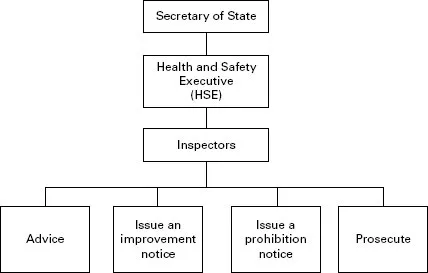
1.2 Health and safety organisation (Fig. 1.1)
The HSWA established two bodies, the Health and Safety Commission and the Health and Safety Executive (HSE). These were merged in 2008 to form a single body, the HSE. The HSE is a statutory body established by the HSWA (as amended) which consists of a chairperson and between 7 and 12 executive directors.
The HSE Board is responsible to appropriate ministers for the administration of the 1974 Act.
Image
Figure 1.1 Health and safety organisation
The HSE’s mission is: ā€˜the prevention of death, injury and ill health to those at work and those affected by work activities’.
HSE’s aims are to protect the health, safety and welfare of people at work, and to safeguard others, mainly members of the public, who may be exposed to risks from the way work is carried out.
HSE’s statutory functions include:
Image
proposing new and updated laws and standards;
Image
conducting research;
Image
providing information and advice;
Image
making adequate arrangements for the enforcement of health and safety laws.
In recent years much of Britain’s health and safety law has originated in Europe. Proposals from the European Commission may be agreed by member states who are then responsible for making them part of their domestic law. Where HSE consider action is necessary to supplement existing arrangements, their three main options are to provide:
1. guidance;
2. approved codes of practice (ACOPs);
3. regulations.
Guidance – can be specific to health and safety problems of an industry or of a particular process used in a number of industries.
The main purposes of guidance are to:
Image
help people understand what the law says;
Image
help people comply with the law;
Image
give technical advice.
Following guidance is not compulsory, but if followed, will normally be enough to comply with the law.
Approved codes of practice – offer practical examples of good practice. They give advice on how to comply with the law by, for example, providing a guide to what is ā€˜reasonably practicable’.
Approved codes of practice have a special legal status. If employers are prosecuted for a breach of health and safety law, and it is proved that they have not followed the relevant provisions of the approved code of practice, a court can find ...
Table of contents

  1. Cover
  2. Half Title
  3. Title Page
  4. Copyright Page
  5. Dedication
  6. Table of Contents
  7. Preface to the first edition
  8. Preface to the second edition
  9. Preface to the third edition
  10. Preface to the fourth edition
  11. Preface to the fifth edition
  12. Acknowledgements
  13. 1 Safe practices
  14. 2 Hand processes
  15. 3 Marking out
  16. 4 Sheet-Metal operation
  17. 5 Standards, measurement and gauging
  18. 6 Measuring equipment
  19. 7 Cutting tools and cutting fluids
  20. 8 Drilling
  21. 9 Turning
  22. 10 Surface grinding
  23. 11 Milling
  24. 12 Introduction to computer numerical control
  25. 13 Joining Methods
  26. 14 Materials
  27. 15 Plastics
  28. 16 Primary forming processes
  29. 17 Presswork
  30. 18 Investment casting, lost foam casting and shell moulding
  31. 19 Die-casting and metal injection moulding
  32. 20 Moving loads
  33. 21 Drawing, specifications and data
  34. Appendices
  35. Index