eBook - ePub
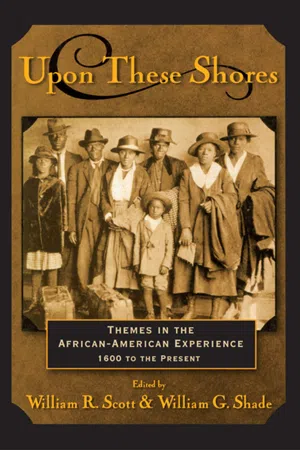
Upon these Shores
Themes in the African-American Experience 1600 to the Present
- 480 pages
- English
- ePUB (mobile friendly)
- Available on iOS & Android
eBook - ePub
Upon these Shores
Themes in the African-American Experience 1600 to the Present
About this book
This one-volume, comprehensive overview of African American history brings together original essays by some of the foremost authorities in the field. Arranged both thematically and chronologically, these papers discuss a wide range of topics - from the Middle Passage to the Civil Rights Movement; from abolition to the Great Migration; from issues in religion, class and family to literature, education and politics.
part 1
Out of Africa
chapter 1
Africa, the Slave Trade, and the Diaspora
AFRICANS BROUGHT TO NORTH AMERICA as slaves were a small minority, probably fewer than 6 percent, of some twelve million men, women, and children shoved below the decks of ships lying at anchor off Africa’s Atlantic shores between the fifteenth and the nineteenth centuries. Although they all shared the humiliation and brutality of enslavement in the New World, they came from diverse backgrounds in a continent as different from north to south, and from the coast to its vast interior, as were the Americas themselves. As African Americans they came to bear the common burdens of racial prejudice, burdens even heavier than the subjugation to masters and mistresses effectively unrestrained by law. However, they also created an infinite variety of new lives for themselves out of local circumstances—out of their work as miners, on sugar plantations, in tobacco fields, as domestic servants in town houses, in factories; out of their masters’ cultural inclinations and economic fortunes; out of the backgrounds that their fellow slaves brought from Africa; and out of the personal resources—wits, skills, physical abilities—with which each of them had arrived. The experiences of the Africans taken to North America, disparate as they were, converged under the peculiar combination there of slavery and freedom in ways that distinguished their experiences from those of enslaved Africans in other parts of the New World.
African Backgrounds
Slaves were taken to the Americas from every inhabited part of Africa’s Atlantic coast, from the Sahara Desert in the north to the Kalahari Desert in the south. In the fifteenth century, when the Portuguese bought their first captives in northwestern Africa, most Africans lived in highly localized agricultural communities, where they grew up learning farming and hunting techniques refined by their parents and grandparents who knew the delicate environment intimately and adapted to it over the years. Near the Sahara, in the desert-edge latitudes, long rainless months each year encouraged farmers to rely on drought-resistant millets that they planted in river valleys or other better-watered areas.
These farmers tried to maintain cordial relations with herders who devoted their mobile lives to cattle that they grazed in the drier lands. The herders passed through the farmlands during the dry season each year in search of winter pastures and eagerly exchanged livestock products for surpluses of grain that the farmers harvested. Soils there were too sandy, fragile, and shallow to sustain deep cultivation with the plow, and the hoe was the basic agricultural implement they used. But the herders had to move their animals constantly, across hundreds of miles, as they sought fresh, sweet grasses for them, and the farmers had to remain close by water and their fields. As a result, hoe cultivators and livestock raisers both specialized in separate ways of living and traded with each other.
Closer to the equator, in the Southern as well as the Northern Hemisphere, more plentiful and reliable rains created broad bands of wooded grasslands, known as savannas. These supported farmers who grew a wider variety of cultigens, of which sorghums were the most widespread. Just south of the Sahara, in the savannas known as the sudan, rice also figured prominently in the wetter zones. Farmers in these moist latitudes could disperse to live in scattered homesteads next to fields that they planted in the most fertile patches. The woods, however, harbored disease lethal to cattle, and so they had little direct contact with herders and purchased, from outside traders who had come to settle among them, leathers and other livestock products from the drier regions at the edge of the desert. The traders also bought slabs of rock salt cut from salty deposits deep in the Sahara, commodities so valuable in these salt-deficient latitudes that people sometimes used them as a currency facilitating other exchanges.
At the edge of the Sahara a series of towns had long since grown up as centers of the interregional trade between the farmers in the grasslands and the herders in the desert steppes. Since the eighth or ninth century, Saharan merchants had arrived at the heads of large caravans of camels bearing desert goods for sale and distribution throughout the grasslands and even into the forests beyond—also carrying imports that came all the way from the Mediterranean lands of North Africa. In these towns they met representatives of the diaspora of village traders. Some of these towns, like Timbuktu, on the northernmost reach of the Niger River where western Africa’s largest river flowed into the desert before turning back to the south toward the Gulf of Guinea, had become famous throughout the Muslim world as sources of sub-Saharan gold, which Africans panned from the headwaters of the Niger and other rivers. They had also become centers of Islamic scholarship, as well as outposts of large African imperial powers that dominated large portions of the region at that time, such as Mali in the valley of the Upper Niger and Songhai, centered to the east along the middle course of the river. These Arabic-speaking merchants from North Africa called the desert edge sahel (literally “shore”), the name by which it is now often known, and characterized the savannas as the sudan, or “land of the blacks,” from the dark appearance of their trading partners. In the wetter regions, the dispersed networks of sub-Saharan traders stimulated production of commodities that were in demand in the dry areas, just as they distributed products of the desert in the south.
From the latitude of the Gambia River all the way south to the mouth of the Zaire (or Congo) River, most of the coast was heavily forested, with islands, broad river mouths, and an extensive set of lagoons providing opportunities for people residing there to fish, produce marine salt from tidal evaporation pans, and transport numerous products in large dug-out canoes made from the huge hardwood trees of the tropical forests. The intricate waterways of the delta of the Niger River offered especially bountiful opportunities of this sort, and villages of specialized producers dotted the banks where traders came to buy local products for sale in markets in the interior. Farmers making their ways in the forests had opened clearings for towns and fields. Since the dimness of the light penetrating the dense canopy of trees was too little to sustain the grain cultigens of the savannas, they relied on yams and bananas as the staples of their diet. Peoples of the forest also harvested palm kernels (which they pressed to obtain cooking oil) and other fruits and nuts to sell to traders from the drier regions to the north. Along the vast network of waterways flowing into the Zaire River and draining the vast forests of central Africa, people fished and traded in villages linked by fleets of large canoes.
In the agricultural savannas, particularly those north of the West African forests but also those south of the mouth of the Zaire, farmers achieved the highest population densities found in any of the three principal types of environment. While numerous followers and compounds filled with well-fed wives and children signaled a chief’s success, they also formed the demographic base from which those who later fell into slaving would draw.
Particularly in the grasslands where people depended heavily on their relatives, clients, and associates to prosper, communal loyalties were generally strong. Open pursuit of individual self-interest might appear to threaten the prized solidarity of the group, and personal ambition—and countervailing fears of witchcraft—inevitably strained relationships. Local environmental knowledge was so basic to agricultural success and herding that most people identified themselves—beyond the intimate, personal associations of kinship and alliance with other families through marriage—primarily by the regional cultures they and their neighbors developed to exploit the resources of the area in which they lived. Community identity thus emerged, at the most basic level, out of the distinctive habits of speech adopted by neighbors who lived and worked in close association reaching back over many generations, who married mostly among themselves, and who shared many concerns and historical experiences, all based on specializing in living in the same ecological niche. Especially in the forests, one of these ethnic communities might number only a few thousand people, all of whom shared, first of all, a common language, of which there were hundreds, or a local dialect of one language. There were thus many such groups, each intensely self-conscious but also dependent on its neighbors as buyers of its own specialized products and as suppliers of the necessities that it did not produce for itself; at the same time, each suspected its neighbors as strangers unintelligibly, and perhaps dangerously, different from themselves.
Nevertheless, all the communities living in the forests and savannas east of the Niger Delta shared a single cultural heritage through their assumed descent from the same ancestors; their languages, known collectively to modern linguists as “Bantu,” all belonged to one closely related family as a result of that common history. Looser cultural and linguistic background commonalities also linked communities in West Africa, which displayed the distinguishing effects of many years of distinct historical experiences. Modern ethnographers have abstracted these limited common tendencies to define “culture areas” of broadly similar linguistic habits and shared institutions, such as the “Igbo” in the forests east of the lower Niger River or “Benin” and “Yoruba” in those to the west, and “Fon” in the southerly extension of savanna reaching the sea to the west of the “Yoruba,” and “Akan” in the forests beyond the Volta River—all of these peoples living in the forests of what the Europeans later termed, in an even larger, and purely geographic imposition, “Lower Guinea.” The people of “Upper Guinea,” the heterogeneous area north and west of the “Akan” (beyond Cape Palmas), had entered the forests there in small groups from several neighboring savanna regions, and they had developed fewer comparably general cultural similarities. Fifteenth-century Africans would not have attributed much significance to common cultural heritages at this high level of abstraction, nor would they have recognized many of the ethnic names by which their descendants subsequently became known to the Europeans—who tended to label Africans according to the stereotypical, and often uncomplimentary, epithets bestowed by neighbors.
By the fifteenth century, trading and political accomplishments in many places had added overlays of broader identity beyond these local groups, based on shared commercial or industrial success. The residents of the Muslim trading towns of the sahel thought of themselves as members of broader mercantile or religious communities. Families specialized in complex and demanding technologies, like iron-and leather-working, or other skilled professions that drew people permanently out of farming, became dispersed in distinct guild like communities, jealously marrying among themselves to protect their valuable technical knowledge, and often known by names analogous to the ethnic identities of the farmers among whom they lived. The marginality of these craft specialists to the landholding agricultural mainstream of life, as well as their humble status relative to the warrior and commercial elites of the era, has led some later observers to liken them to ranked “castes” on the Indian model, but the parallel is limited. The traders who dispersed southward from the towns of the sahel into the far western savannas and forest fringes spoke Soninke and Mande (the latter also known as Mandingo) languages, and they had carried these and other elements of their home cultures, including Islam, with them.
In fifteenth-century sub-Saharan Africa, only these merchants and the military aristocrats in control of the large empires and the desert trade adhered to the Muslim religion. Farmers in the villages retained older beliefs in spirits believed to confer fertility on the land and on women, in the powers of priests and kings to call the capricious rains on which they depended for plentiful harvests and for survival, and in the influence of ancestors in the affairs of their descendants. Islam, on the other hand, appealed to the political classes and merchants, who were less directly concerned with productivity and more engaged on broader social and economic scales, scales that the literacy and universalism of the Muslim religion helped them to manage. Thus Muslim Africans south of the Sahara found themselves suspended between the parochialism of the villages and the legal and theological refinement and cosmopolitanism of North African Islamic traders and clerics, with whom they had to collaborate economically and diplomatically. They therefore tended to combine elements of both worldviews.
Horse-riding warriors set the political tone of the era in the sudanic latitudes. From time to time they imposed tribute and a degree of enduring political unity over the populous regions along the Upper Niger through the mobility and power they gained from their mastery of cavalry warfare in the savannas. They had created a series of political systems: an “empire” under Soninke warriors known as Ghana long before the fifteenth century, and its successor, Mali, led since the thirteenth century by horsemen and aristocrats of Mande background. These militaristic aristocrats acquired their equine power by buying mounts from the desert merchants, paying for them mostly by selling gold. But the warrior aristocrats also used their mobility and military power to capture farmers, men, women, and children living in outlying regions. Some of these captives they kept as slaves for themselves, to feed and staff imperial courts where they had gained luxurious styles of living and surrounded themselves with personal followers. Other captives they sold to the merchants from the desert to buy more horses for their cavalry forces and thus to extend their political and military reach beyond what they might have managed from sales of gold alone. Literacy in Arabic added to the power they gained from their access to trading capital and to horses.
The towns, aristocratic compounds, and traders thus prospered from the coordination they achieved over great distances and brought a significant overlay of commercial and political integration to large parts of the farming villages of sudanic West Africa. Along the major trade routes linking the middle reaches of the Niger to the river’s delta, Yoruba-speaking people at Ife and Bini-speaking people at Benin had consolidated extensive, but less intensely militarized, political systems, very likely by investing the wealth they amassed from taxing the trade goods moving through their lands. The landholding families influential in the Akan area derived their prosperity from commercial interests in sources of gold developed within their territories, but in the fifteenth century they had not yielded political authority to a single, central ruler.
Commercial and political success attracted people of many sorts to the ways of the wealthy and powerful. Slaves adopted the cultures and languages of their masters. Wives and children, in the large numbers assembled by lords and merchants through multiple marriages, spread the habits of their husbands and fathers back to their maternal homelands. So also did clients eager to share in patrons’ prosperity, political subordinates seeking advancement, and others pursuing power and wealth by association with those who had them. By the fifteenth century, these patterns had allowed Mande speakers to spread an overlay of cultural homogeneity throughout the valley of the Upper Niger and in the regions to the west. The strongly centralized kingdom at Benin united the region just west of the lower Niger and spread its political culture there. Political federation in the Yoruba and Akan parts of the forest had promoted looser sorts of economic and cultural integration.
Guinea in 1732
Those sold by the Blacks are for the most part prisoners of war, taken either in fight, or pursuit, or in the incursions they make into their enemies’ territories; others stolen away by their own countrymen; and some there are, who will sell their own children, kindred, or neighbours. This has been often seen, and to compass it, they desire the person they intend to sell, to help them in carrying something to the factory by way of trade, and when there, the person so deluded, not understanding the language, is sold and deliver’d up as a slave, notwithstanding all his resistance, and exclaiming against the treachery….
The kings are so absolute, that upon any slight pretense of offences committed by their subjects, they order them to be sold for slaves, without regard to rank, or possession….
These slaves are severely and barbarously treated by their masters, who subsist them poorly, and beat them inhumanly, as may be seen by the scabs and wounds on the bodies of many of them when sold to us. They scarce allow them the least rag to cover their nakedness, which they also take off from them when sold to Europeans; and they always go bare-headed. The wives and children of slaves, are also slaves to the master under whom they are married; and when dead, they never bury them, but cast out the bodies into some by place, to be devoured by birds, or beasts of prey.
Many of those slaves we transport from Guinea to America are prepossessed with the opinion, that they are carried like sheep to the slaughter, and that the Europeans are fond of their flesh; which notion so far prevails with some, as to make them fall into a deep melancholy and despair, and to refuse all sustenance, tho’ never so much compelled and even beaten to oblige them to take some nourishment: notwithstanding all which, they will starve to death; whereof I have had several instances in my own slaves both aboard and at Guadalupe.
Source: John Barbot, “A Description of the Coasts of North and South Guinea,” in Thomas Astley and John Churchill, eds., Collection of Voyages and Travels (London, 1732).
The Bantu-speaking farming and fishing communities in the central African forests and in the savannas beyond toward the south had, by the fifteenth century, integrated their local economies on scales comparable to the degrees achieved in West Africa. Particularly where inexpensive transport by canoe was available, they too produced and distributed significant surpluses. However, they did so mostly without taking on the burdens associated with military conquest and integration: luxuriously appointed, slave-attended aristocratic compounds, and the feeding of large towns and families of merchants. Notables—heads of landowning communities, men wealthy from fishing or transporting goods along the rivers, owners of mineral resources like salt pans or outcrops of copper ores—formed flexible confederations on regional scales, but they lacked horses, or other military means, and incentives to concentrate power beyond a degree that might be termed conciliatory or “ceremonial.” Individuals might achieve great personal authority on the basis of perceived abilities to respond to the circumstantial needs of communities—calling rains in times of drought, driving out disease or other evils that seemed to afflict them—but successors rarely could lay claim to the personal influence they had acquired. In the far south, along the margins of the Kalahari Desert, cattle were the basis of prosperity, and wealth and power derived from the possession of large herds.
Most of the Africans whom Europeans would buy as slaves thus had lived in small agricultural communities, cherished an intense loyalty to those with whom they had grown up, and as adults had become skilled in delicate techniques of exploiting the resources of the lands in which they lived. They offered respect, and usually wealth as well, to senior members of their families and to leaders of their villages. Some of them also recognized more distant, less personal forms of authority ranging from men of senior status, wealth, or spiritual authority in regional associations and confederacies to violent monarchs of exalted rank, incomparable wealth, and terrifying power, monarchs who lived hidden in sanctity, behind high walls amidst crowds of slaves and wives. The vague and general “ethnic” or cultural similarities apparent to later European observers, unable to app...
Table of contents
- Cover
- Half Title
- Title Page
- Copyright Page
- Dedication
- Table of Contents
- Foreword
- Chronology of African-American History
- Introduction: The Long Rugged Road
- part 1. out of africa
- part 2. this “peculiar institution”
- part 3. the reconstruction and beyond
- part 4. African-American identity and culture
- part 5. family, class, and gender
- part 6. the postwar agenda
- Afterword: The Future of African Americans
- Notes on Contributors
Trusted by 375,005 students
Access to over 1.5 million titles for a fair monthly price.
Study more efficiently using our study tools.
Frequently asked questions
Yes, you can cancel anytime from the Subscription tab in your account settings on the Perlego website. Your subscription will stay active until the end of your current billing period. Learn how to cancel your subscription
No, books cannot be downloaded as external files, such as PDFs, for use outside of Perlego. However, you can download books within the Perlego app for offline reading on mobile or tablet. Learn how to download books offline
Perlego offers two plans: Essential and Complete
- Essential is ideal for learners and professionals who enjoy exploring a wide range of subjects. Access the Essential Library with 800,000+ trusted titles and best-sellers across business, personal growth, and the humanities. Includes unlimited reading time and Standard Read Aloud voice.
- Complete: Perfect for advanced learners and researchers needing full, unrestricted access. Unlock 1.5M+ books across hundreds of subjects, including academic and specialized titles. The Complete Plan also includes advanced features like Premium Read Aloud and Research Assistant.
We are an online textbook subscription service, where you can get access to an entire online library for less than the price of a single book per month. With over 1.5 million books across 990+ topics, we’ve got you covered! Learn about our mission
Look out for the read-aloud symbol on your next book to see if you can listen to it. The read-aloud tool reads text aloud for you, highlighting the text as it is being read. You can pause it, speed it up and slow it down. Learn more about Read Aloud
Yes! You can use the Perlego app on both iOS and Android devices to read anytime, anywhere — even offline. Perfect for commutes or when you’re on the go.
Please note we cannot support devices running on iOS 13 and Android 7 or earlier. Learn more about using the app
Please note we cannot support devices running on iOS 13 and Android 7 or earlier. Learn more about using the app
Yes, you can access Upon these Shores by William R. Scott, William G. Shade, William R. Scott,William G. Shade in PDF and/or ePUB format, as well as other popular books in History & African American History. We have over 1.5 million books available in our catalogue for you to explore.