Integrated Circuit Design for Radiation Environments
eBook - ePub

Integrated Circuit Design for Radiation Environments

  1. English
  2. ePUB (mobile friendly)
  3. Available on iOS & Android
eBook - ePub

Integrated Circuit Design for Radiation Environments

About this book

A practical guide to the effects of radiation on semiconductor components of electronic systems, and techniques for the designing, laying out, and testing of hardened integrated circuits

This book teaches the fundamentals of radiation environments and their effects on electronic components, as well as how to design, lay out, and test cost-effective hardened semiconductor chips not only for today's space systems but for commercial terrestrial applications as well. It provides a historical perspective, the fundamental science of radiation, and the basics of semiconductors, as well as radiation-induced failure mechanisms in semiconductor chips.

Integrated Circuits Design for Radiation Environments starts by introducing readers to semiconductors and radiation environments (including space, atmospheric, and terrestrial environments) followed by circuit design and layout. The book introduces radiation effects phenomena including single-event effects, total ionizing dose damage and displacement damage) and shows how technological solutions can address both phenomena.

  • Describes the fundamentals of radiation environments and their effects on electronic components
  • Teaches readers how to design, lay out and test cost-effective hardened semiconductor chips for space systems and commercial terrestrial applications
  • Covers natural and man-made radiation environments, space systems and commercial terrestrial applications
  • Provides up-to-date coverage of state-of-the-art of radiation hardening technology in one concise volume
  • Includes questions and answers for the reader to test their knowledge

Integrated Circuits Design for Radiation Environments will appeal to researchers and product developers in the semiconductor, space, and defense industries, as well as electronic engineers in the medical field. The book is also helpful for system, layout, process, device, reliability, applications, ESD, latchup and circuit design semiconductor engineers, along with anyone involved in micro-electronics used in harsh environments.
Trusted by 375,005 students

Access to over 1 million titles for a fair monthly price.

Study more efficiently using our study tools.

1
Introduction and Historical Perspective

1.1 Introduction

This book provides a structured approach to the design of radiation‐hardened integrated circuits (ICs), covering digital, and analog and mixed‐signal applications. The emphasis will be on space applications, but we will also briefly discuss other environments including nuclear reactors, weapons spectra, and the interesting and challenging environment found in high‐energy particle physics facilities. We will begin with a brief historical introduction to radiation and its interactions with semiconductor materials. An understanding of basic physics is vital to efficient design, as without this knowledge the design process is all too likely to devolve into a trial‐and‐error exercise. In today's highly competitive semiconductor business, time to market is a vital and probably the most important consideration, with major development programs often canceled because of schedule slips. Delays in the time to market may well result in a part that is no longer competitive or even relevant. It should also be noted that an understanding of the physics behind radiation effects on device structures enables the effective designer to look at simulation and modeling tools with a critical eye, defining and correcting inconsistencies that would otherwise lead to redesigns.
It may well be asked what this radiation effects in electronics fuss is all about, with apologies to the late National Semiconductor analog circuit designer Bob Pease. Why does a satellite cost hundreds of millions of dollars, and why do the components that make up its systems sell for several orders of magnitude more than their commercial equivalents? Why do we closely follow and try to predict the cyclical activity of the Sun, and why indeed do we speak of “space weather” at all when anyone knows that “weather” in a vacuum is an absurdity? The answer is simple: space is one of the harshest and most difficult environments we know, and being a vacuum merely adds to the difficulty. The range of space radiation types is broad and diverse, ranging from ultraviolet (UV) and X‐ray radiation consisting of energetic photons to relativistic heavy ions with tera‐electron volts (TeV) energy, against which shielding is impractical, to solar protons and electrons. The radiation type and intensity for a given application depends on its position in space, both spatially and temporally, ranging from the various Earth orbits seen by commercial satellites to the intense radiation belts surrounding Jupiter. Understanding the design methodologies used to harden electronic components against these environments requires at least a working understanding of those environments, as each one has its own interactions with matter and its own resulting damage mechanisms. This damage affects all electronics at the component, subsystem and system levels. Satellite systems commonly have 15‐year lifetime requirements, with trends to higher numbers, and most orbits are out of reach of today's manned space transportation systems. Interplanetary exploration missions are, of course, well outside our reach, and these limitations result in a requirement for systems that can operate reliably for a long time in a harsh environment without any servicing. Operation here goes well beyond, for example, the cruising to Mars of an interplanetary probe; the entire landing sequence on these missions must be executed independently from Earth control, as the time delay for radio signals ranges from 4 to 24 minutes, depending on the Earth–Mars distance at the time.

1.2 Discovery of X‐Rays, Radiation, and Subatomic Particles

As with most scientific disciplines, the physics of radiation and its effects on electronics builds on a long history of research, discovery, and expensive lessons. In radiation effects that history is relatively short, however. The atomic theory of matter, on the other hand, goes all the way back to Demokritos (460–370 BCE) in ancient Greece, who postulated that all matter was composed of invisibly small atoms, after the Greek –a (not) and –tomos (to divide), indicating his belief that these particles were not further divisible. In this theory, there was empty space between the atoms. This was an enormously advanced concept at a very early time, and it took until the nineteenth and twentieth centuries to experimentally identify subatomic particles such as protons, neutrons, and electrons.
Light was also believed to be composed of particles, but inconsistencies were identified beginning in the eighteenth century. In particular, the diffraction and interference of light through narrow slits was difficult to explain using a particle theory, and by the mid‐nineteenth century, wave models began to be generally accepted. In 1865, James Clerk Maxwell developed the Maxwell wave theory [1], which demonstrates that light is an electromagnetic wave phenomenon. This wave interpretation accounted for many of the observed properties of light, but some could still be only explained by the particle theory. It took until the development of quantum mechanics in the twentieth century to fully understand the dual‐wave/particle nature of photons, visible, or otherwise.
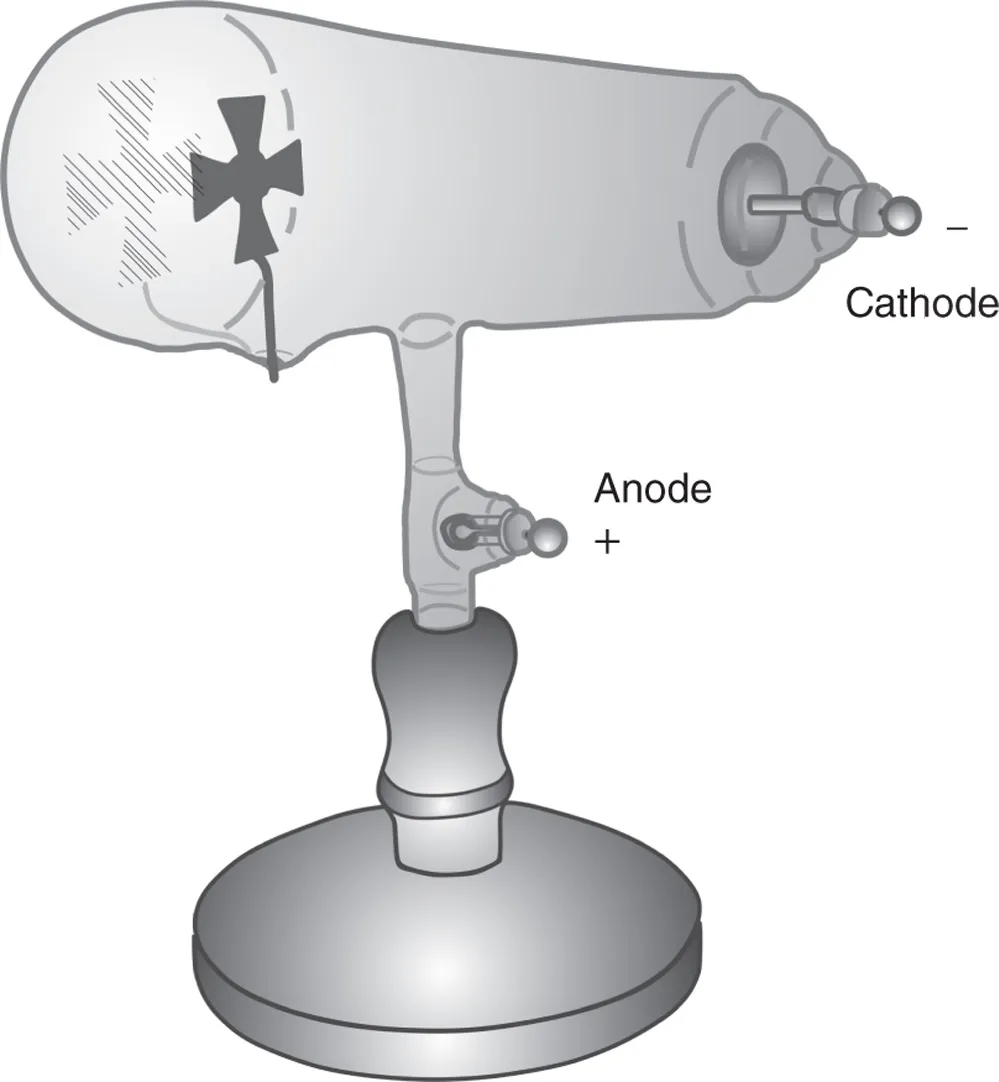
The systematic study of subatomic particles started with investigations by J. J. Thomson of electrical discharges in vacuum using the Crookes tube [2], which was an outgrowth of earlier gas‐filled Geisler tubes known to produce light with colors dependent on the gas species. The Crookes cathode ray tube, shown in Figure 1.1, was a high‐vacuum device enabled by the greatly improved vacuum pump technology of the time. It consists of a cold cathode and an anode in a glass envelope; a high‐voltage between the two electrodes leads to high‐field electron emission from the negative cathode. The electrons are then collected by the positive anode, but some continue toward a portion of the tube containing a target. Those electrons striking the glass envelope across from the cathode cause phosphorescence, forming a negative shadow in the shape of the target. It was soon determined that these “cathode rays” were, in fact, negatively charged particles, as they could be easily deflected by either an electric or magnetic field. With known magnetic and electric field strength, the speed and the charge to mass ratio (but not the absolute value of these last two parameters) of the then‐still‐unknown particles could be readily derived. Thomson found [3] that these particles had uniform mass and charge, regardless of the anode material or anode voltage. This work built on earlier theoretical work by Lorentz and Zeeman and led directly to the discovery of the electron by Thomson in 1897, which has since resulted in an amazing number and range of applications and in fundamental changes in human society. The charge‐to‐mass ratio puzzle was solved in 1910 by the American Robert Millikan, who determined the charge of the electron using UV light irradiated oil drops suspended between positively and negatively charged plates. The Crookes tube went on to evolve into the cathode ray tube, which dominated television and computer displays before its replacement by various flat‐screen technologies.
Picture of a Crookes cathode ray tube, depicting the cathode, anode, and cross-shaped target.
Figure 1.1 A Crookes cathode ray tube, showing the cathode, anode, and cross‐shaped target.
The end of the nineteenth century saw a period of intense radiation physics activity resulting in three breakthrough discoveries: X‐rays by Wilhelm Röntgen, radioactivity by Henri Becquerel, and the isolation of radioactive elements by Marie and Pierre Curie. Using apparatus similar to that used by Thomson with voltages to the order of 20 kV and a thin metal “window” to allow the then‐unknown “particles” to travel outside the tube, Röntgen somewhat accidentally discovered X‐rays in 1895 [4]. While conducting experiments with remotely located phosphorescent screens, Röntgen unintentionally left a protective cardboard cover over the X‐ray tube apparatus and found that the cover did not block the emitted radiation. He found these “unknown” (“X”) rays to be able to penetrate many substances, including the human body. A well‐known anecdot...

Table of contents

  1. Cover
  2. Table of Contents
  3. About the Authors
  4. Preface
  5. Acknowledgments
  6. Glossary of Terms
  7. 1 Introduction and Historical Perspective
  8. 2 Radiation Environments
  9. 3 Radiation Effects in Semiconductor Materials
  10. 4 Radiation‐Induced Single Events
  11. 5 Radiation Testing
  12. 6 Device Modeling and Simulation Techniques
  13. 7 Radiation Semiconductor Process and Layout Solutions
  14. 8 Single‐Event Upset Circuit Solutions
  15. 9 Latchup Circuit Solutions
  16. 10 Emerging Effects and Future Technology
  17. Index
  18. End User License Agreement

Frequently asked questions

Yes, you can cancel anytime from the Subscription tab in your account settings on the Perlego website. Your subscription will stay active until the end of your current billing period. Learn how to cancel your subscription
No, books cannot be downloaded as external files, such as PDFs, for use outside of Perlego. However, you can download books within the Perlego app for offline reading on mobile or tablet. Learn how to download books offline
Perlego offers two plans: Essential and Complete
  • Essential is ideal for learners and professionals who enjoy exploring a wide range of subjects. Access the Essential Library with 800,000+ trusted titles and best-sellers across business, personal growth, and the humanities. Includes unlimited reading time and Standard Read Aloud voice.
  • Complete: Perfect for advanced learners and researchers needing full, unrestricted access. Unlock 1.4M+ books across hundreds of subjects, including academic and specialized titles. The Complete Plan also includes advanced features like Premium Read Aloud and Research Assistant.
Both plans are available with monthly, semester, or annual billing cycles.
We are an online textbook subscription service, where you can get access to an entire online library for less than the price of a single book per month. With over 1 million books across 990+ topics, we’ve got you covered! Learn about our mission
Look out for the read-aloud symbol on your next book to see if you can listen to it. The read-aloud tool reads text aloud for you, highlighting the text as it is being read. You can pause it, speed it up and slow it down. Learn more about Read Aloud
Yes! You can use the Perlego app on both iOS and Android devices to read anytime, anywhere — even offline. Perfect for commutes or when you’re on the go.
Please note we cannot support devices running on iOS 13 and Android 7 or earlier. Learn more about using the app
Yes, you can access Integrated Circuit Design for Radiation Environments by Stephen J. Gaul,Nicolaas van Vonno,Steven H. Voldman,Wesley H. Morris in PDF and/or ePUB format, as well as other popular books in Technology & Engineering & Electrical Engineering & Telecommunications. We have over one million books available in our catalogue for you to explore.