Three-dimensional surface meshes are the most common discrete representation of the exterior of a virtual shape. Extracting relevant geometric or topological features from them can simplify the way objects are looked at, help with their recognition, and facilitate description and categorization according to specific criteria. This book adopts the point of view of discrete mathematics, the aim of which is to propose discrete counterparts to concepts mathematically defined in continuous terms. It explains how standard geometric and topological notions of surfaces can be calculated and computed on a 3D surface mesh, as well as their use for shape analysis. Several applications are also detailed, demonstrating that each of them requires specific adjustments to fit with generic approaches. The book is intended not only for students, researchers and engineers in computer science and shape analysis, but also numerical geologists, anthropologists, biologists and other scientists looking for practical solutions to their shape analysis, understanding or recognition problems.
In 1983, the authors of [HAR 83] proposed to use differential geometry (i.e. the mathematical analysis of the geometry of 3D curves and surfaces) to describe the shape of a discrete surface (in their case, defined as an elevation image). For this purpose, they introduced the topographic primal sketch, which is composed of feature points (as peaks, pits or saddles), feature lines (as ridges or ravines) and feature surface patches (which may be flat). Two years later, the authors of [BRA 85] described another differential geometry-based framework to analyze the shape of 3D surfaces and they applied it on several real examples. They also used feature lines (as curvature lines) and planar surface patches. During the same period, in his dissertation [BES 88a], Besl proposed to compute the differential parameters of a surface in order to create a HK-sign map that allows the segmention of a surface into homogeneous regions where some basic geometric primitives can be fitted.
Since then, extensive research has been done on the extraction and the application of geometric features based on differential geometry. In section 1.2, we propose an overview in a nutshell (but with the mathematical formulas) of the differential geometry of surfaces. In section 1.3, we present the main methods that allow us to efficiently compute the differential parameters on a discrete 3D mesh. In sections 1.4 and 1.5, we focus respectively on line and surface features.
1.2. Some mathematical reminders of the differential geometry of surfaces
The following reminders are essentially based on the book [HOS 92]. More details can be found in many mathematics books such as [WEA 55], [CAR 76], [SPI 99], [TOP 05] or [PAT 10].
1.2.1. Fundamental forms and normal curvature
Let 𝚺 be a surface of class Ck with k ≥ 3, which is parameterized by (u, v). 𝚺 is then defined by the set of points P (u, v) = {x(u, v), y(u, v), z (u,v)}.
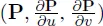
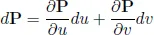
An infinitesimal displacement around the point P will be modeled as the vector dP, which will be in the tangent plane defined by the frame
:
The norm of this displacement can be computed as:
If we define the terms E, F and G as:
we get:
[1.1]
This expression is called the first fundamental form of the surface. Its coefficients E, F and G enable us to calculate dP that defines the lengths of local curves on the surface around P. They are also used to define the area of local regions.
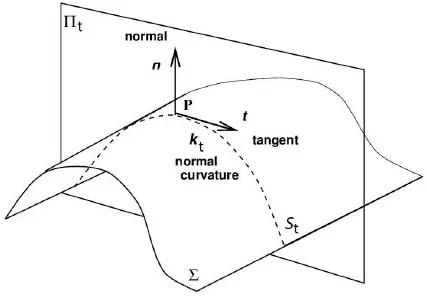
Let us now define n as the normal vector at P, i.e. the vector going through P and orthogonal to the tangent plane. For any unit vector t in the tangent plane, we can define the plane Пt that goes through P and contains n and t. Пt is called a normal plane to Σ and cuts Σ along the plane curve
, which is called the normal section along the direction t (see Figure 1.1).
Figure 1.1.At a pointP, the normal plane Пtis defined by the normal vectornand the tangent vector t. Пtcuts Σ along a p...
Table of contents
Cover
Table of Contents
Preface
Introduction
1 Geometric Features based on Curvatures
2 Topological Features
3 Applications
Conclusion
References
Index
End User License Agreement
Trusted by 375,005 students
Access to over 1.5 million titles for a fair monthly price.
Study more efficiently using our study tools.
Frequently asked questions
Yes, you can cancel anytime from the Subscription tab in your account settings on the Perlego website. Your subscription will stay active until the end of your current billing period. Learn how to cancel your subscription
No, books cannot be downloaded as external files, such as PDFs, for use outside of Perlego. However, you can download books within the Perlego app for offline reading on mobile or tablet. Learn how to download books offline
Perlego offers two plans: Essential and Complete
Essential is ideal for learners and professionals who enjoy exploring a wide range of subjects. Access the Essential Library with 800,000+ trusted titles and best-sellers across business, personal growth, and the humanities. Includes unlimited reading time and Standard Read Aloud voice.
Complete: Perfect for advanced learners and researchers needing full, unrestricted access. Unlock 1.5M+ books across hundreds of subjects, including academic and specialized titles. The Complete Plan also includes advanced features like Premium Read Aloud and Research Assistant.
Both plans are available with monthly, semester, or annual billing cycles.
We are an online textbook subscription service, where you can get access to an entire online library for less than the price of a single book per month. With over 1.5 million books across 990+ topics, we’ve got you covered! Learn about our mission
Look out for the read-aloud symbol on your next book to see if you can listen to it. The read-aloud tool reads text aloud for you, highlighting the text as it is being read. You can pause it, speed it up and slow it down. Learn more about Read Aloud
Yes! You can use the Perlego app on both iOS and Android devices to read anytime, anywhere — even offline. Perfect for commutes or when you’re on the go. Please note we cannot support devices running on iOS 13 and Android 7 or earlier. Learn more about using the app
Yes, you can access Geometric and Topological Mesh Feature Extraction for 3D Shape Analysis by Jean-Luc Mari,Franck Hétroy-Wheeler,Gérard Subsol in PDF and/or ePUB format, as well as other popular books in Mathematics & Mathematical Analysis. We have over 1.5 million books available in our catalogue for you to explore.