eBook - ePub
UNESCO Global Geoparks
Tension Between Territorial Development and Heritage Enhancement
- English
- ePUB (mobile friendly)
- Available on iOS & Android
eBook - ePub
About this book
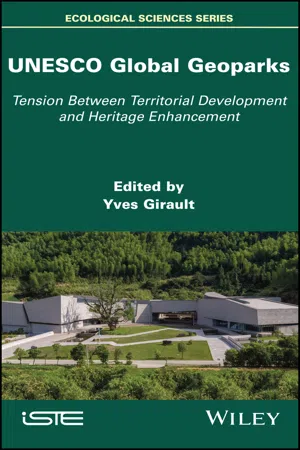
Recently, UNESCO has gradually started to recognize world geoparks ? territorial spaces with a geological heritage of international importance. This classification presents real challenges. Development strategies must align with the recommendations advocated by various non-governmental organizations. It is also necessary to involve the local actors, both in the preparation of application forms and in the implementation of a management plan that is suitable for sustainable global development. Managing the tensions and asymmetries that exist between the different groups of actors (politicians, managers, scientists, representatives of local populations) constitutes another major issue. It is in this context and through various case studies that this book questions the aims of the UNESCO global geoparks ? in terms of heritage inventory and conservation, the participation of local populations, the local development of a territory and its enhancement through heritage interpretation.
Information
PART 1
Objectives, Issues and Tensions Related to the Patrimonialization of Nature
1
Natural Heritage, Participatory Democracy and UNESCO: a Structure of Disillusionment?
1.1. Introduction
In the social sciences, or in the discourses of actors (texts of major international conventions, laws and decrees, methodological guides, etc.), there is a great diversity of terminology to describe the democratic “openness” of debates and decision-making processes to non-expert populations or non-governmental organizations. This openness is recommended when populations are concerned by a problem in their daily lives, typically scientific, technical, environmental or spatial planning. In most of its recommendations, and in particular in its texts defining geoparks, UNESCO intends to take into account “local communities” and stakeholders from a participatory perspective, all in a movement supposed to be driven by these communities (bottom-up). However, when conducting field research on participatory experiences in the context of World Heritage parks (the author of these words has conducted field research in Argentina and Reunion Island), there are serious differences between declarations of intent and what can be observed from field surveys. As for the survey carried out on the installation of the Lanzarote geopark in the Canary Islands (Spain), it did not reveal any dynamics of participation before and during its creation. The theme of “participation” is therefore, quite conventionally, in tension between declarations of intent and observable practices. This observation of a gap between discourse and practice is not an argument to denounce the duplicity of institutional actors. Rather, it is a matter of pointing out the paradoxes corresponding to the categories and mediations that structure environmental democracy.
This chapter will first present a brief overview of theoretical issues, including contemporary difficulties to clearly define participation. Then, we will analyze several problematic points that have emerged from observations made in Argentina and Reunion Island, before presenting several observations concerning the Lanzarote geopark, and then finishing on the theme of the necessary reflexivity in scientific and expert practices.
1.2. The participation in question
The “participatory” ambition is generally to complement the mechanisms of representative democracy and to compensate for the effects of a public affairs management considered technocratic and centralized by state institutions; the challenges are then to bring out new actors who bring new ideas and new knowledge, linked to more diversified attachments to territories. To quickly establish ideas on participatory mechanisms, one can take the classic example of “consensus conferences”, also called “citizens’ conferences” (Boy et al. 2000): in the case of these mechanisms, an organization that can be governmental brings together a panel representing a population around a problem requiring a political decision. This group consists of 15–30 people, and it is mobilized for a period of one month, mainly during weekends to ensure the availability of panel members. It is accompanied by a mediator and hears experts who are chosen to reflect the diversity of positions on the issue. The group may also request to hear from experts other than those presented to it. Then it deliberates and produces a report in which all opinions must be expressed: there is no vote, but a consensus decision that must set out even the most minority opinions in the final text. This report is then used to inform public policy decisions. The device described above is an ideal-typical version, because there are actually a series of variants that would be too long to describe here.
1.3. A brief history of participatory mechanisms and environmental democracy
The social and historical dynamics of the emergence of the participatory approach are complex to describe in a concise way because we are faced with a phenomenon of international scope, and a mixture of institutional voluntarism and democratic renewal acquired in the struggle by non-governmental actors. To these two fields of practice and discourse (that of institutional frameworks and that of public mobilization), we must add the scientific field (from the social sciences to the natural sciences) that plays an ambiguous role, caught between a display of neutrality and an active involvement in the implementation of participatory democracy mechanisms.
We can trace the emergence of environmental sensitivity and its support for citizen mobilization to influence public policy in the 19th Century, for example with the mobilization of painters from the Barbizon School, Victor Hugo, Georges Sand and various naturalists, to obtain the classification of the landscape of the Fontainebleau forest threatened by clear cutting. We can also mention the mobilization of scientists, in the United States and Europe, who emerged from their neutrality at the end of the 1940s to publicly denounce, in the media, the looting of the planet and the destruction of nature: the texts of Fairfield Osborn, in 1948 in the United States, or the statements of Roger Heim (former director of the MNHN) in the early 1950s were the starting points for citizen mobilizations that developed from the 1960s onwards around the associative world with famous “deals” well described by environmental sociology (stranding of the Torrey Canyon and oil spill in Brittany in 1967, then the case of safeguarding the Vanoise National Park in 1969). These cases have demonstrated the ability of the public to mobilize to build causes, to investigate and produce robust expertise and to win victories against powerful economic and political actors (Chateauraynaud 2011; Aspe and Jacqué 2012; Kalaora and Vlassopoulos 2013).
Alongside these mobilizations, institutions have gradually incorporated public participation and governance with stakeholders into political practices, while building the “environment” as a category of public action (Charvolin 2003). A first emergence can be identified as early as the 1960s in the United States with the Office of Technology Assessment of Congress (Sadowsky 2015), or with Community Action Programs working for community development, and to whom budgets and administrative assistance are provided to solve problems identified by the communities themselves. It was also in the early 1950s and 1960s that eco-anthropology became interested in local environmental knowledge in so-called “traditional” societies (Concklin 1957), although it was not until the late 1980s that this knowledge was recognized and taken into account in biodiversity management by major international NGOs such as WWF and IUCN (Gray et al. 1998; Bouet 2016). Finally, we can mention ecomuseums, which were very early in the implementation of local community participation in their management in the early 1970s (Le Marec 2007), followed by the establishment of the Danish Board of Technology, which organized the first consensus conferences in Europe on scientific and technical issues in 1985 in the Danish Parliament, drawing on the experience of the Congress in the United States (Joss and Durant 1995). This governance, particularly in contexts of management or crisis related to the environment, is now part of a global dimension. Jasanoff and Long Martello thus explain, on the basis of empirical surveys, that three highly interrelated issues emerge from the observations (Jasanoff and Long Martello 2004). First, the solutions adopted for global environmental governance cannot be thought of without, at the same time, seeking local expressions for them; second, the simultaneous construction of the local and the global and the understanding of environmental problems depend on the production of scientific knowledge and its interaction with power; finally, true governance requires constant translation and back and forth between formations composed of knowledge and power articulated between the global and the local (Jasanoff and Long Martello 2004, p. 5). These articulations become clear as soon as site monographs are drawn up for World Heritage registrations, insofar as the citizen mobilizations and institutional voluntarism observed at the local level cannot be detached from their articulations and translations with various organizations acting at the international level (Babou 2009, 2015). Hence the need for methods and attention distributed at various territorial scales, otherwise an essential part of the issues would be missed in the description of the actors’ games.
These mobilizations, as well as this institutional voluntarism, are part of a particular context, that of uncertainty (Callon et al. 2001), itself linked to the transformation processes of industrialized societies. In public policy as in social science research, the rise of the theme of uncertainty accompanies the consideration of the unintended consequences of action (Chalas and Soubeyran 2009). At the same time, this process has led to the implementation of the “precautionary principle” aimed at establishing new principles for living together in a society known as a “risk society” (Beck 2001) in which many observers agree that the influence of politics, science, technology and spatial planning is becoming particularly problematic. Between the 1950s and 1970s, the dominant discourse was that of planning. But in a society that thinks itself to be subject to uncertainty, the planning State becomes the driving State of the territories, and decision-makers can no longer calculate the effects of an action in advance, particularly because of the potential for public mobilization: the action of alert launchers, the emergence of a controversy and the production of citizen counterexpertise leading to a different framing of issues and problems can transform the meaning of a planning action and lead to unpredictable consequences. This is particularly true in the context of environmental issues. From these new contexts emerges a need for reflexivity for planners, consisting of considering the consequences of action in its definition, or even in the thread of planning action, which Soubeyran identifies as a principle of “improvization” (Soubeyran 2014), challenging in passing the com...
Table of contents
- Cover
- Table of Contents
- Introduction: The Geoheritage Structure Within the World’s Geoparks: Tension in a Multiplicity of Cultural, Economic and Scientific Contexts
- PART 1: Objectives, Issues and Tensions Related to the Patrimonialization of Nature
- PART 2: Heritage Inventory and Conservation
- PART 3: Geotourism and Education
- List of Authors
- Index
- End User License Agreement
Trusted by 375,005 students
Access to over 1.5 million titles for a fair monthly price.
Study more efficiently using our study tools.
Frequently asked questions
Yes, you can cancel anytime from the Subscription tab in your account settings on the Perlego website. Your subscription will stay active until the end of your current billing period. Learn how to cancel your subscription
No, books cannot be downloaded as external files, such as PDFs, for use outside of Perlego. However, you can download books within the Perlego app for offline reading on mobile or tablet. Learn how to download books offline
Perlego offers two plans: Essential and Complete
- Essential is ideal for learners and professionals who enjoy exploring a wide range of subjects. Access the Essential Library with 800,000+ trusted titles and best-sellers across business, personal growth, and the humanities. Includes unlimited reading time and Standard Read Aloud voice.
- Complete: Perfect for advanced learners and researchers needing full, unrestricted access. Unlock 1.5M+ books across hundreds of subjects, including academic and specialized titles. The Complete Plan also includes advanced features like Premium Read Aloud and Research Assistant.
We are an online textbook subscription service, where you can get access to an entire online library for less than the price of a single book per month. With over 1.5 million books across 990+ topics, we’ve got you covered! Learn about our mission
Look out for the read-aloud symbol on your next book to see if you can listen to it. The read-aloud tool reads text aloud for you, highlighting the text as it is being read. You can pause it, speed it up and slow it down. Learn more about Read Aloud
Yes! You can use the Perlego app on both iOS and Android devices to read anytime, anywhere — even offline. Perfect for commutes or when you’re on the go.
Please note we cannot support devices running on iOS 13 and Android 7 or earlier. Learn more about using the app
Please note we cannot support devices running on iOS 13 and Android 7 or earlier. Learn more about using the app
Yes, you can access UNESCO Global Geoparks by Yves Girault in PDF and/or ePUB format, as well as other popular books in Biological Sciences & Ecology. We have over 1.5 million books available in our catalogue for you to explore.