Despite being undoubtedly the most hated of all film genres, the biopic has endured since the very beginning of cinema. A review of the biopic of Alan Turing, The Imitation Game (dir. Morten Tyldum 2014), sums up the general contempt for the genre itself: ‘Sometimes it feels like a line is being crossed. I really wasn't sure which side I was on with the Turing movie – certainly knowing how much was wrong with it was damaging to my enjoyment of it, but did that make it bad art? In the end I think it did because it was all just so unnecessary and generic, and so persistent…Good acting, direction, sets etc.…though’ (‘Two NYRB Essays’ 2015). Biopics are routinely dismissed as bad art, shallow, formulaic, inauthentic, and disrespectful of history. Among the biopic's many decriers are film critics, literary scholars, historians, politicians, journalists, and anyone wedded to the notion that portraits of individuals should be ‘true’ to life. But as the reviewer of The Imitation Game begrudgingly admits, these films are often very watchable, essentially due to the performance of the lead actor.
The biographical film, or biopic, has become an obvious route to best actor and actress Oscars (Daniel Day Lewis for Lincoln, dir. Steven Spielberg, 2012; Meryl Streep for The Iron Lady, dir. Phyllida Lloyd, 2011; and Colin Firth for The King's Speech, dir. Tom Hooper, 2010) and an opportunity to capitalize on a star's appeal through the portrayal of a famous personality. Regardless of the biopic's unpopularity with both directors and academics, the remediation of a famous life on film was and continues to be commercially viable, perhaps due to the double effect of a fascination with famous people and the famous individuals playing them. This collection differs from previous monographs and collections as it promises to offer a historical, theoretical, and thematic approach to the biopic genre, from the beginnings of the twentieth century to the contemporary period.
The first full‐length study of the genre is George Custen's Bio/Pics: How Hollywood Constructed Public History (1992). Custen considers the biopic as a producer’s genre, fundamentally conservative and marketed through the films' ‘extensive research’, which he argues masks these films' ideological revisioning of historical portraiture as directed at contemporary audiences. Custen's study is the most comprehensive to date and begins in the sound era – the period in which the biopic, as we know it today, was born – and ends with the collapse of the Hollywood Studio system in 1960. Dennis Bingham’s Whose Lives Are They Anyway? The Biopic as Contemporary Film Genre (2010) tracks the early ‘biopic’ of the Studio Era as influenced by Lytton Strachey's mythmaking Eminent Victorians (1918). For example, the notion of a chosen one, so often featured in biopics, is traced to Strachey: ‘Destiny and vocation bestow the work of God upon certain people. They suggest powerful belief systems and explain why the biopic, and most literary biography too, is usually not palatable to sceptics’ (p. 37). In both Custen's and Bingham's work, this parallels with the central fixation of the biopic on ‘Great Men’ doing ‘Great Things’. For Bingham, Strachey's novelistic restructuring of the biographical subject, setting them against opposing forces such as bureaucracies, opposing families, or corrupt systems, easily lent itself to the Hollywood biopic. The selection of case studies in Bingham's book ranges from the 1930s to the new millennium and, while roughly organised chronologically and by topic, seems somewhat selective as do the case studies in the recently published ‘Short Cut’ book, Bio‐Pics: A Life in Pictures (2014), by Ellen Cheshire. Grouped around subjects, such as singers, musicians, and politicians, the case studies are all taken from the contemporary period, with no attempt to recount the history of the genre or define its characteristics.
There have been edited collections on the genre, such as special issues of Biography (vol. 23, no. 1, 2000) and a/b: Auto/Biography Studies, ‘Biopics and American National Identity’ (vol. 26, no. 1, 2011); Tom Brown and Belén Vidal's The Biopic in Contemporary Film Culture (2013); and Márta Minier and Maddalena Pennacchia's collection Adaptation, Intermediality and the British Celebrity Biopic (2014), again a series of case studies drawn from the contemporary period. Blackwell's Companion to the Historical Film, edited by Robert A. Rosenstone and Constantin Parvulescu (2013), also touches upon the biopic in four of its chapters, with only one chapter (by Dennis Bingham) offering a synoptic account of the genre. Russell Jackson, in Theatre on Film: How the Cinema Imagines the Stage (2013) devotes a chapter to theatrical biopics and through a reading of the scripts of films made in Hollywood's golden era describes the painstaking elisions that had to be made to the entertainers' lives in this period, such as the gambling and womanizing of the title character in The Great Ziegfeld (dir. Robert Z. Leonard, 1936). In more recent biopics, Jackson observes ‘a wayward love life is now a badge of honour and a guarantee of human sensibility’ (p. 87). The more complete historical overview of the genre in this volume supports Jackson's reading of this trajectory, as biopics have moved from a form of personal and especially national mythmaking in their early days to a method of demythologising and peeling back the layers of constructed identity as the twentieth century progressed. Although dealing exclusively with biopics of stage entertainers, Jackson reminds us of the theatricality of the genre as whole in which performances dominate. In response to Bingham's division of biopics by gender, Bronwyn Polaschek's The Postfeminist Biopic: Narrating the Lives of Plath, Kahlo, Woolf and Austen (2013) argues that recent biopics of women are not always constrained by a narrative of victimisation, as in the previous century, but offer challenges to both patriarchal frameworks and Second Wave Feminism. Polaschek writes that ‘the postfeminist biopic actively evokes the pleasure of interrogatation from its female spectators’ (p. 145). Like Jackson, she charts a move away from constructed identities in her analysis of more innovative examples of the genre. Two further collections are concerned with biopics' formation of national identities: Invented Lives, Imagined Communities: The Biopic and American National Identity, ed. William H. Epstein and R. Barton Palmer (2016), and Rule Britannia! The Biopic and British National Identity, ed. R. Barton Palmer and Homer Pettey (2018). Finally, Sonia Amalia Haiduc's review of books on biopics in Adaptation (2014) reveals a new willingness to take the genre seriously.
The number of recent studies provides evidence of a growing interest in the genre and this volume represents the most comprehensive treatment of the genre to date. Although the classification ‘biopic’ is useful insofar as it brings together films by highlighting recurring patterns and themes, the authors in this collection are mindful that, like the genre itself, it is more fiction than fact, a critical construct, not ‘a real thing’. The chapters are organised according to theoretical, historical, thematic, and performance‐based approaches. The volume provides accounts of the genre from its origins to the present day, including evolving attitudes and differing perspectives on the biopic genre.
Part I of this volume features approaches to the genre in relation to what constitutes ‘true stories’, media specificity, and the persistent disrespect for the genre articulated by film critics and historians. Whereas previous scholarly treatments of biopics have largely sought to limit and/or codify the genre, these varying approaches problematise it, making way for the greater diversity of theoretical models and case studies that follow in the collection. The biopic can be seen as a subsection of historical film and ‘docudrama’, the names of which announce that they contain a mixture of fiction and fact. In ‘Biopics and the Trembling Ethics of the Real’, Timothy Corrigan considers how certain auto/biopics grapple with what constitutes ‘the real’ by representing it as a phantom not to be trusted. His framework helps establish the distinction between reality and ‘the real’ and also between films that attempt, under the traditional biopic banner, to strip away falsity to show the real and films that explicitly address the impossibility of doing so. Sonia Amalia Haiduc connects the disparaged biopic genre with the equally despised genre of melodrama. She notes a natural kinship between them, as literary biopics in particular ‘encourage viewers to “read” the [externalization of writing] on screen melodramatically, as an external sign of an unfolding internal truth being made visible’. She considers ‘auteurist’ biopics, André Téchiné's Les Soeurs Brontë (1979) and François Ozon's Angel (2007), as examples of biopics' dependency on melodrama as a way of constructing ‘emotional truth’. In Chapter 4, Jonathan Bignell discusses television biographies and notes that ‘although there is no clearly identifiable television biopic genre, programmes resembling biopics can be identified in many television forms, formats or cycles of production’. These television forms tend to derive from nineteenth‐century novels and popular theatre, which tell the story of an individual's rise from adversity to fame.
Biopics tread a precarious line between telling the truth about a person and protecting their reputation; and an awareness of their audiences often dictates the course (or not) of a film about significant personages. Brian Hoyle's chapter looks at two unproduced biopic scripts of famous Scottish figures: Alexander Mackendrick's Mary Stuart and Alan Sharp's Burns, which he argues tackle the vexed problems surrounding screen depictions of national treasures. The failure of these scripts to reach the screen reminds us of the general rule that biopics are essentially producers' films, guided by money rather than aesthetic, social, or moral principles.
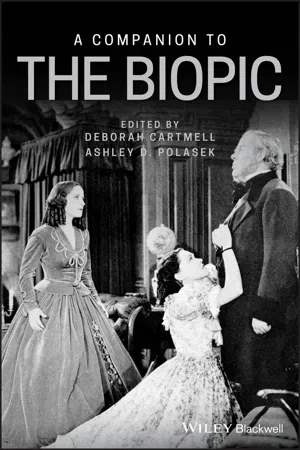
Part II provides an overview of biopics over the twentieth century through their formal evolution and in their changing representations of history. These chapters not only offer a reference for the technological, thematic, and aesthetic history of the production of biopics but also address the complex relationships between that history and the ‘real’ histories that the films themselves depict and fail to depict. Deborah Cartmell surveys twentieth‐century biopics and in grappling with the fraught question of defining the genre to begin with, she nonetheless notes the persistent dependency on stars for their appeal. Not so dependent on famous performances, silent biopics, at the end of the silent period, seem to promise much more. Gregory Robinson in Chapter 7 charts the development of the biographical film in the silent era, from the earliest films which sacrificed the narrative for spectacle to the last silent films which he argues tell stories with a visual sophistication comparable to cinema today. In the following chapter, Henrik Christensen looks at the biopic in early Russian cinema and its relation to national identity and the hostility towards genre cinema by Russian directors and film critics. In Russian cinema, Christensen argues the biopic becomes a ‘formidable ideological weapon’. Cartmell continues the historical narrative considering the evolution of the biopic from the beginning of the sound era to the 1950s in an analysis of two versions of a quintessential biopic, The Barretts of Wimpole Street (dir. Sidney Franklin, 1934 and 1957). These biopics merge historical narratives with Hollywood biographies and ultimately contribute to ...