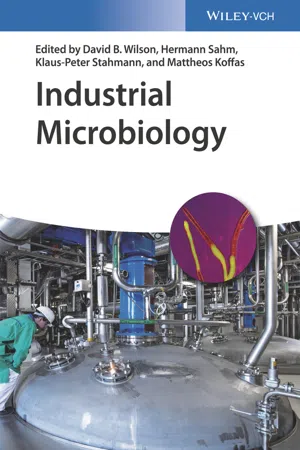
Focusing on current and future uses of microbes as production organisms, this practice-oriented textbook complements traditional texts on microbiology and biotechnology.
The editors have brought together leading researchers and professionals from the entire field of industrial microbiology and together they adopt a modern approach to a well-known subject. Following a brief introduction to the technology of microbial processes, the twelve most important application areas for microbial technology are described, from crude bulk chemicals to such highly refined biomolecules as enzymes and antibodies, to the use of microbes in the leaching of minerals and for the treatment of municipal and industrial waste. In line with their application-oriented topic, the authors focus on the "translation" of basic research into industrial processes and cite numerous successful examples. The result is a first-hand account of the state of the industry and the future potential for microbes in industrial processes.
Interested students of biotechnology, bioengineering, microbiology and related disciplines will find this a highly useful and much consulted companion, while instructors can use the case studies and examples to add value to their teaching.
eBook - ePub
Industrial Microbiology
- English
- ePUB (mobile friendly)
- Available on iOS & Android
eBook - ePub
Industrial Microbiology
About this book
Information
1
Historical Overview and Future Perspective
Bernhard Eikmanns1, Marcella Eikmanns2, and Christopher J. Paddon3
1University of Ulm, Microbiology and Biotechnology, Albert‐Einstein‐Allee 11, 89081 Ulm, Germany
2Ochsengasse 34, 89077 Ulm, Germany
3Amyris Inc., 5885 Hollis St, Suite 100, Emeryville, CA 94608, USA
CHAPTER MENU
- 1.1 Use of Fermentation Procedures Before the Discovery of Microorganisms (Neolithic Era = New Stone Age Until 1850)
- 1.2 Investigation of Microorganisms and Beginning of Industrial Microbiology (1850 Until 1940)
- 1.3 Development of New Products and Procedures: Antibiotics and Other Biomolecules (From 1940)
- 1.4 Genetic Engineering Is Introduced into Industrial Microbiology (From Roughly 1980)
- 1.5 Future Perspectives: Synthetic Microbiology
1.1 Use of Fermentation Procedures Before the Discovery of Microorganisms (Neolithic Era = New Stone Age Until 1850)
The origins of industrial microbiology go back to prehistoric times, as human beings began to learn more about food spoilage, preservation, and storage. Based on their experiences, they developed diverse methods for preserving and refining foods. As we now know, many of these procedures are based on chemical changes brought about by microorganisms. These methods were progressively refined over time and applied in larger scales. Empirical knowledge was initially passed on verbally and later in a written form. Artisans made use of the various fermentation properties of microorganisms, being unaware of the microorganisms involved and the (micro‐)biological and biochemical processes taking place. It was not possible to identify the microorganisms or explain the mechanisms of the chemical changes they caused until around 1850. Table 1.1 provides a historical summary of food manufacturing products and procedures as well as microbiological discoveries up to 1850.
Table 1.1 Microbiological procedures and important discoveries from prehistoric times (Neolithic Era) to 1850.
| Period/year | Procedures/products/discoveries |
| Prior to 4000 BC | Finds from Mesopotamia and from regions south of the Alps prove that flatbread was prepared from a grain pulp and then baked. It is likely that yeast dough is already unknowingly used, as it results in lighter, more flavorful bread. |
| From 4000 BC | The first sources show that the Sumerians in Mesopotamia and shortly thereafter the Egyptians, use grain pulp for beer production and sugary fruit juices for wine production. |
| From 3000 BC | In Mesopotamia and Egypt, sour dough bread and sour milk products (cheese) are produced. Vinegar is used as a preservative. |
| From 2000 BC | In Asia (China, Japan), soybeans are fermented with the help of fungi and bacteria (soy sauce) and rice wine is produced. In Egypt, beer brewing is “refined.” Babylon's King Hammurabi (1728–1686 BC) issues strict beer laws in the “Code of Hammurabi.” |
| From 1300 | Saltpeter production: throughout Europe, excrements were converted to potassium nitrate needed for gunpowder. It was unknown that microorganisms were the catalysts. |
| Around 1680 | Van Leeuwenhoek discovers and describes bacteria and yeasts by use of self‐prepared simple microscopes. |
| 1789 | Lavoisier identifies the products of alcoholic fermentation. |
| 1837/1838 | Cagniard‐Latour, Schwann, and Kützing attribute alcoholic fermentation to living yeasts, which divide themselves by means of budding. |
The beginning of the New Stone Age (Neolithic Era, Neolithic Revolution) is marked by the transition from a nomadic lifestyle, centered on collecting wild plants and hunting wild game, to a farming lifestyle based on food production (agriculture and livestock breeding) and storage. In the Fertile Crescent (a crescent‐shaped region in the Middle East, which includes parts of what is now Israel, Lebanon, Syria, Turkey, Iraq, and Iran), this radical change in subsistence occurred around 9000 BC. Goats, sheep, and cattle were domesticated, and barley, emmer wheat, and one‐grain wheat were bred from wild grasses. The wine grape was also cultivated in this area. In other parts of the world, agriculture and livestock breeding practices were not established until later on, and they were often based on different kinds of livestock and crops.
It can be assumed that as soon as human beings adopted a settled lifestyle in the Fertile Crescent, they began to experiment with producing alcoholic beverages. Here, it is important to distinguish between the production of wine and the production of beer. Wine is made from sugary liquids (fruit juices, but also diluted honey). When fruit gets smashed or fruit juice is left standing, fermentation sets in quite quickly. This is due to the fact that sugar‐consuming yeasts are naturally found on the skins of sweet fruits. With beer, on the other hand, the raw material is grain. Here, the fermentable sugar must first be released from the starch.
Grain was originally consumed in pulp form, prepared using water and crushed grains. Later, the pulp was formed into a flatbread and then baked. This advancement allowed the bread to be stored longer and made it easier to be transported. Microorganisms (yeast and lactic acid bacteria) were already being used in ancient Egypt (3000 BC – 395 AD) to prepare poriferous bread. The ancient Egyptians, also known in antiquity as “bread eaters,” observed that bread became lighter and more easily digestible when the bread dough was left standing for some time before it was baked. The process of making beer by means of fermentation of either liquid bread dough or bread that has been baked and then soaked in water has been in practice since approximately 5000 BC. The first records of beer production are about 5500 years old and come from the Sumerians, who resided in Mesopotamia, which is now Iraq, between 5000 and about 1800 BC. Clay tablets were found that show how grain (barley and emmer wheat) was shucked and ground and how the flour was transformed into a flatbread, which was then baked and used to produce beer (called “kasch” or “bread beer”). Clay vessels were used for the fermentation of the flour cakes, which were baked and then kept moist. The success of the fermentation was dependent on the randomly incorporated microorganisms and the conditions at hand for each given attempt. Honey, cinnamon, and other spices were added to the beer; it was therefore generally sweet and could certainly not be stored for a very long period of time.
In Egypt, beer was also being produced out of bread dough by 2500 BC (“henket”; Figure 1.1). It is unclear, however, whether the Egyptians adopted the brewing trade from the Sumerians or developed it themselves. In 1990, a 3300‐year‐old brewery belonging to King Echnaton (reign: 1351–1334 BC) was excavated. The findings included intact clay vessels, instruments, and ingredients preserved by the dry heat (malt, grain, and dates). From these findings, researchers were able to deduce that the Egyptians had mastered malt preparation (germination and initiation of enzyme formation) and mashing (enzymatic conversion of starch into sugar under optimized conditions) and that they had used these techniques in making beer.
In 1902, a pill...
Table of contents
- Cover
- Table of Contents
- Preface
- 1 Historical Overview and Future Perspective
- 2 Bioprocess Engineering
- 3 Food
- 4 Technical Alcohols and Ketones
- 5 Organic Acids
- 6 Amino Acids
- 7 Vitamins, Nucleotides, and Carotenoids
- 8 Antibiotics and Pharmacologically Active Compounds
- 9 Pharmaceutical Proteins
- 10 Enzymes
- 11 Microbial Polysaccharides
- 12 Steroids
- 13 Bioleaching
- 14 Wastewater Treatment Processes
- Index
- End User License Agreement
Trusted by 375,005 students
Access to over 1.5 million titles for a fair monthly price.
Study more efficiently using our study tools.
Frequently asked questions
Yes, you can cancel anytime from the Subscription tab in your account settings on the Perlego website. Your subscription will stay active until the end of your current billing period. Learn how to cancel your subscription
No, books cannot be downloaded as external files, such as PDFs, for use outside of Perlego. However, you can download books within the Perlego app for offline reading on mobile or tablet. Learn how to download books offline
Perlego offers two plans: Essential and Complete
- Essential is ideal for learners and professionals who enjoy exploring a wide range of subjects. Access the Essential Library with 800,000+ trusted titles and best-sellers across business, personal growth, and the humanities. Includes unlimited reading time and Standard Read Aloud voice.
- Complete: Perfect for advanced learners and researchers needing full, unrestricted access. Unlock 1.5M+ books across hundreds of subjects, including academic and specialized titles. The Complete Plan also includes advanced features like Premium Read Aloud and Research Assistant.
We are an online textbook subscription service, where you can get access to an entire online library for less than the price of a single book per month. With over 1.5 million books across 990+ topics, we’ve got you covered! Learn about our mission
Look out for the read-aloud symbol on your next book to see if you can listen to it. The read-aloud tool reads text aloud for you, highlighting the text as it is being read. You can pause it, speed it up and slow it down. Learn more about Read Aloud
Yes! You can use the Perlego app on both iOS and Android devices to read anytime, anywhere — even offline. Perfect for commutes or when you’re on the go.
Please note we cannot support devices running on iOS 13 and Android 7 or earlier. Learn more about using the app
Please note we cannot support devices running on iOS 13 and Android 7 or earlier. Learn more about using the app
Yes, you can access Industrial Microbiology by David B. Wilson, Hermann Sahm, Klaus-Peter Stahmann, Mattheos Koffas, David B. Wilson,Hermann Sahm,Klaus-Peter Stahmann,Mattheos Koffas in PDF and/or ePUB format, as well as other popular books in Biological Sciences & Biotechnology. We have over 1.5 million books available in our catalogue for you to explore.