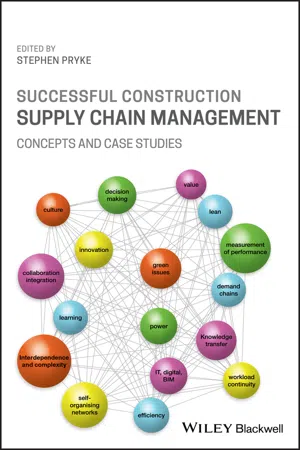
Successful Construction Supply Chain Management
eBook - ePub

Successful Construction Supply Chain Management

Concepts and Case Studies

  1. English
  2. ePUB (mobile friendly)
  3. Available on iOS & Android
eBook - ePub

Successful Construction Supply Chain Management

Concepts and Case Studies

About this book

Provides a unique overview of supply chain management (SCM) concepts, illustrating how the methodology can help enhance construction industry project success

This book provides a unique appraisal of supply chain management (SCM) concepts brought together with lessons from industry and analysis gathered from extensive research on how supply chains are managed in the construction industry. The research from leading international academics has been drawn together with the experience from some of the industry's foremost SCM practitioners to provide both the experienced researcher and the industry practitioner a thorough grounding in its principles, as well as an illustration of SCM as a methodology for enhancing construction industry project success.

The new edition of Successful Construction Supply Chain Management: Concepts and Case Studies incorporate chapters dealing with Building Information Modelling, sustainability, the 'Demand Chain' in projects, the link between self-organizing networks and supply chains, decision-making, 'Lean,' and mega-projects. Other chapters cover risk transfer and allocation, behaviors, innovation, trust, supply chain design, alliances, and knowledge transfer.

  • Supply Chain Management techniques have been used successfully in various industries, such as manufacturing and food processing, for decades
  • Fully updated with new chapters dealing with key construction industry topics such as BIM, sustainability, the 'Demand Chain' in projects, 'Lean,' mega-projects, and more
  • Includes contributions from well established academics and practitioners from Network Rail, mainstream construction, and consultancy
  • Illustrates how SCM methodologies can be used to enhance construction industry project success

Successful Construction Supply Chain Management: Concepts and Case Studies is an ideal book for postgraduate students at MSc and PhD level studying the topic and for all construction management practitioners.

Trusted by 375,005 students

Access to over 1.5 million titles for a fair monthly price.

Study more efficiently using our study tools.

Information

Year
2019
Print ISBN
9781119450689
Edition
2
eBook ISBN
9781119450542

1
Introduction

Stephen Pryke
The aim of the book is to present evidence in support of some innovative supply chain management theory and to present case study findings that might improve the practice of supply chain management in construction. In Part A of the book, the intention is to draw on a diverse range of theoretical perspectives on supply chain management and to demonstrate application for the industry. The chapters in Part B set out to apply supply chain management principles to practice and to present some applied and conceptual findings. It is not the intention in this book to explain first principles of supply chain management because the previous book in this series – Construction Supply Chain Management: Concepts and Case Studies (Pryke 2009) – deals with these principles in some detail. However, a very brief explanation follows.
Our increasingly technically (not to say, organisationally) complex projects require ever higher levels of very specialised knowledge and expertise to deliver. The Tier 1 or main contractor may respond to this by investing in training and continually developing new expertise. This is a model preferred by some of the very large mainland European contractors – Bouygues and Vinci, for example. However, the UK approach tends to respond to this need for increasing levels of knowledge and expertise by outsourcing. Therefore, either because the client requires subcontracting to a particular specialist subcontractor, or the Tier 1 contractor deems it necessary to manage the risk of some specialist work by appointing a specialist Tier 2 subcontractor, a large proportion of the work contracted to Tier 1 contractors (perhaps 70% or more), is subcontracted. Although many bemoan this as fragmentation, it is argued here that this is inevitable in any area of work where very high levels of specialist expertise are required. In some cases, the fragmentation is actually desirable. The reason for managing the supply chain is to harness the benefit of long‐term collaborative relationships and through these relationships create better value for clients and end‐users. Firms entering the markets are acutely aware of the way in which their supply chain relationships can harness increased value and improve competitiveness for the supply chain. Unfortunately, all too often, firms not entering new markets become complacent about supply chain matters – the pursuit of continuously improving value and lowering costs to improve services and profitability are simply not a focus. Supply chain management is therefore the mark of a firm behaving strategically rather than reactively in the market place.
The book is divided into two distinct but overlapping parts. Part A comprises chapters dealing with the theoretical aspects of supply chain management and its application to construction. It is an opportunity to introduce some innovative ideas to help us understand supply chain management and how it might be increasingly exploited. All chapters have clearly identifiable applications to practice. The second half of the book (Part B), in six chapters, provides a series of discussions that begin with a case study scenario and then explore the implications for supply chain management. It is hoped that in this way there is material for all interests: setting agendas for industry; exploring and challenging published theory; providing some innovative frameworks for discussion; stimulating further research and case study work by students and practitioners alike.

1.1 Overview: Part A

1.1.1 IT, Digital, and BIM

The book opens with Eleni Papadonikolaki's chapter – The Digital Supply Chain: Mobilising Supply Chain Management Philosophy to Reconceptualise Digital Technologies and Building Information Modelling (BIM). Papadonikolaki explores the way in which the transition from analogue to digital processes, or digitisation, affects construction. She reflects on the greatly improved computing infrastructure sitting alongside improving mobile devices and the fact that manufacturing has perhaps made an earlier start with leveraging what she describes as the ‘digital thread’. Ironically, construction, with its context of complex, ill‐defined and evolving information flows coupled with high levels of risk flowing from the business environment, has a greater need for rapid implementation of digitisation. Papadonikolaki looks at the advancements in other industries that might, in the future, have applications for construction and suggests that construction focuses too heavily on projects and places insufficient emphasis on products.
The synergies between supply chain management and digitisation are explored and she stresses the importance of using supply chain management strategically over the long term and within the context of real collaboration rather than simply adopting some of the terminology and classifying existing practices as supply chain management. BIM is discussed at some length, along with the importance of establishing appropriate standards in a digital built environment, through Industry Foundation Classes. Papadonikolaki reflects on the tension between ‘top‐down’ and ‘bottom‐up’ strategies in relation to the uptake of digital technologies and in particular BIM. She ponders how small and medium enterprises fare alongside the small number of very large organisations that the construction industry comprises. Finally, the chapter deals with the way in which digital technology might usefully address processual, technical and relationship complexities.

1.1.2 Self‐Organising Networks in Supply Chains

Papadonikolaki's discussion on digital technologies in construction links neatly to Huda Almadhoob's development of one particular aspect of technology and theory associated with social network analysis in the context of construction supply management. Almadhoob's chapter: At the Interface: When Social Network Analysis and Supply Chain Management Meet, builds some theory linking supply chains and networks based upon a large infrastructure case study stretching over a period of four years. Almadhoob explores the proposition that supply networks in construction are complex adaptative systems. She argues that a network perspective can be linked to complexity theory and refers to the nonlinear, self‐organising, and emergent properties that we can see in operation. The chapter moves on to look at the key elements of supply networks in construction. Attention is turned to the idea that an organisation has a formal visible form based upon contractual relationships, formal rules and relationships, and dealing with contract and remedies. This lies alongside the possibly larger informal organisation that is essentially self‐organising and, most fundamentally, is the part of the organisation that is delivering the project.
There is a little descriptive material dealing with social network analysis and a rationale for the use of network analysis in the context of construction supply chains. Part of this rationale rests upon the lack of rigour in some of the analysis that we have tried to perform in the construction sector. There has been a tendency towards descriptive rather than more structured analysis and communication of lessons learned from supply chains and projects. The importance of dealing with interdependence when studying construction supply chains is emphasised. The author finally reflects upon the need for the management of supply chain relationships to move away from a focus upon controlling and towards an emphasis on complexity and relationships. Almadhoob ends by noting that supply chain networks co‐evolve in a nonlinear and dynamic manner where autonomy of action is promoted.

1.1.3 Green Issues

Chapter 4 is written by Niamh Murtagh and Sulafa Badi and the subject matter moves to sustainability. Green Supply Chain Management in Construction: A Systematic Review makes the point that environmental sustainability in construction is a pressing concern for the industry worldwide. The authors propose green supply chain management as a potential solution to the problems. The chapter provides a systematic literature review of peer ‐ reviewed papers up to mid‐2017. It deals with the status of the research domain and covers research methods and the tools and techniques employed. The chapter then offers some practical recommendations based upon the findings of the literature review. Murtagh and Badi provide a comprehensive definition of green supply chain management as applied to construction. Some future areas of research are suggested, including end‐to‐end and subdomain specific studies, and perhaps comparative research by project type. Pragmatic tools for decision making are discussed. This chapter includes discussion about:
  • Green design. Limiting the impact on the natural world through consideration of material, production and resource consumption in use
  • Green manufacturing. Dealing with the processes behind the production of components for construction, which can be overlooked when considering sustainability in construction
  • Green transportation. At present there is very little consideration of the sustainably of transportation in relation to construction. This affects Tier 1, but the majority of the emissions occur in Tier 2 and lower tiers
  • Waste management. Others will also look at this and at Lean Construction elsewhere in the book.
  • Green operation. This is one of the areas that has recently received attention
  • End‐of‐life management. Reverse logistics and recycling of building components.
Continuing the theme of looking to the future in the first two chapters, Murtagh and Badi finish with a section considering the future direction of research in the area of green supply chain management. Among the areas that they put forward are:
  • Further work on complex decision making in practice
  • A need to find more pragmatic methods to bridge the gap between acade...

Table of contents

  1. Cover
  2. Table of Contents
  3. List of Contributors
  4. Preface
  5. Acknowledgements
  6. 1 Introduction
  7. Part I: Chapters that Principally, but not Exclusively, Deal with Concepts and the Development of Theory
  8. Part II: Chapters that Principally, but not Exclusively, Deal with Case Study Material
  9. Index
  10. End User License Agreement

Frequently asked questions

Yes, you can cancel anytime from the Subscription tab in your account settings on the Perlego website. Your subscription will stay active until the end of your current billing period. Learn how to cancel your subscription
No, books cannot be downloaded as external files, such as PDFs, for use outside of Perlego. However, you can download books within the Perlego app for offline reading on mobile or tablet. Learn how to download books offline
Perlego offers two plans: Essential and Complete
  • Essential is ideal for learners and professionals who enjoy exploring a wide range of subjects. Access the Essential Library with 800,000+ trusted titles and best-sellers across business, personal growth, and the humanities. Includes unlimited reading time and Standard Read Aloud voice.
  • Complete: Perfect for advanced learners and researchers needing full, unrestricted access. Unlock 1.5M+ books across hundreds of subjects, including academic and specialized titles. The Complete Plan also includes advanced features like Premium Read Aloud and Research Assistant.
Both plans are available with monthly, semester, or annual billing cycles.
We are an online textbook subscription service, where you can get access to an entire online library for less than the price of a single book per month. With over 1.5 million books across 990+ topics, we’ve got you covered! Learn about our mission
Look out for the read-aloud symbol on your next book to see if you can listen to it. The read-aloud tool reads text aloud for you, highlighting the text as it is being read. You can pause it, speed it up and slow it down. Learn more about Read Aloud
Yes! You can use the Perlego app on both iOS and Android devices to read anytime, anywhere — even offline. Perfect for commutes or when you’re on the go.
Please note we cannot support devices running on iOS 13 and Android 7 or earlier. Learn more about using the app
Yes, you can access Successful Construction Supply Chain Management by Stephen Pryke in PDF and/or ePUB format, as well as other popular books in Technology & Engineering & Construction & Architectural Engineering. We have over 1.5 million books available in our catalogue for you to explore.