Intertemporal Linguistics in International Law examines and offers an overdue solution to a specific problem central to the resolution of an ever increasing number of international legal disputes: how to interpret a treaty with terms that change in meaning over time.
A wide-ranging review of the relevant international case law and scholarship reveals that no rule, principle or authority of international law – including even the oft-cited evolutionary interpretation doctrine – provides international adjudicators with the firm and practical guidance on this specific question that contemporary international litigants demand.
Using an analytical approach inspired by the comparative method and drawing on specific concepts from external fields including private law, legal theory and, principally, modern-day linguistics, Intertemporal Linguistics in International Law restructures the most relevant international case law around a new conceptual framework that offers fresh insight into the process of treaty interpretation. It demonstrates that by distinguishing between resolving ambiguity and resolving vagueness, and by identifying the temporal sense-intention with which a treaty term is used, international adjudicators can avail themselves of a more predictable and appropriate method for solving this complex and practically important problem of international law.
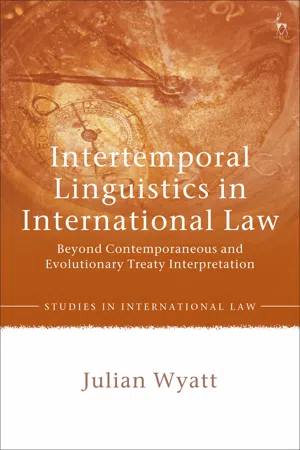
eBook - ePub
Intertemporal Linguistics in International Law
Beyond Contemporaneous and Evolutionary Treaty Interpretation
- 336 pages
- English
- ePUB (mobile friendly)
- Available on iOS & Android
eBook - ePub
Intertemporal Linguistics in International Law
Beyond Contemporaneous and Evolutionary Treaty Interpretation
About this book
Information
1
Introduction
In July 1969, with the ink barely dry on the landmark Vienna Convention of the Law of Treaties (‘VCLT’) that he had helped draft as a member of the International Law Commission (‘ILC’),1 Shabtai Rosenne set about returning his correspondence. On his desk, he found a series of questions posed by Max Sørensen, the Danish jurist with the daunting task of producing a report for the Institute of International Law on the abstruse topic of ‘[t]he problem called the intertemporal law in the international order’.2
One of these questions explored the relationship between the intertemporal law problem and the interpretation of treaties. It asked whether the difficulty arising when a treaty needed to be interpreted and applied long after its text had been finalised could be conceived of as a simple problem of conflict and ‘renvoi’, meaning that it would simply become a question of whether the treaty term should be taken to refer to earlier or later international law norms.3 Rosenne wrote in reply:
No. Leaving aside the question of development of language (intertemporal linguistics, a chapter in itself which cannot be ignored in the framework of ‘interpretation’), surely what has to be elucidated is the solution to the peculiar conflict created by the intertemporal law in the combined processes of interpretation and application. This requires, first a careful analysis of what time-conflict really is, on the basis on which the decision on the choice of the rule can be made. The US Nationals in Morocco Case cited in paragraph 36 of the ‘exposé préliminaire’ has always seemed to me to exemplify the problem of intertemporel [sic] linguistics, ie the meaning of words at the time used and when interpreted. It is a problem of interpretation not one of conflict or choice of law.4
As a reply to a question about which era’s international law norms should be applied, it is notable that Rosenne focused on the ‘development of language’ and changes in the meaning of words through time – rather than merely the development of international law through time. Rosenne’s brief but important observation sought to move the debate beyond the narrow question of which era’s rules should be considered ‘relevant rules of international law’ under what became VCLT Article 31(3)(c) to a concept that addresses all types of change that might affect the interpretation of a treaty through time – the broader issue he called ‘the problem of intertemporal linguistics’.5
It seems likely that Rosenne’s July 1969 insistence on this wider notion of the intertemporal interpretation problem was borne of frustration arising from the ILC’s and then the VCLT’s ultimately failure to take a position on both the narrower question of which era’s law should apply and the separate and at least equally intriguing question of how to respond to mere changes in the meaning of a treaty’s terms. Indeed, in comments made to the ILC in his capacity as a representative of his home State, he had, some four years earlier, already presented the concept of ‘inter-temporal linguistics’ to another rapporteur, the ILC’s Special Rapporteur on the Law of Treaties, Humphrey Waldock, only to have Waldock dismiss it on the basis that the introduction of this concept into the law of treaties ‘may unduly complicate matters’.6
For Rosenne, the problem of intertemporal linguistics could ‘not be ignored in the framework of “interpretation”’,7 so he must have hoped for – and indeed expected – countless studies to turn their attention to solving it. Fifty years later, and despite a quantity of international case law and legal scholarship on treaty interpretation that would have surpassed even his most optimistic expectations, this problem has been effectively ignored. Rosenne has since passed, but the present study makes an effort to ensure that his interest in the problem of intertemporal linguistics moves on, striving not only to analyse, but also to propose a solution to this challenging problem of international law.
I.THE PROBLEM OF INTERTEMPORAL LINGUISTICS
This book examines, in the international law context, the interrelation of two of the most vexed concepts of legal science: interpretation and time. It does so by focusing on one specific type of situation: when an adjudicator is required to interpret a term appearing on the face of a legal instrument and the meaning of that term has changed since the instrument came into being. This situation inherently poses a question: which of the earlier or later meaning should be used by the interpreter? In international law circles, this is precisely Rosenne’s problem of intertemporal linguistics (hereinafter also the ‘Problem’).
The issue raised by the problem of intertemporal linguistics occupies a space at the very core of legal decision-making processes and has been raised at different points in history in many different systems and branches of law. It has notably been examined by important schools of Western legal theory active around the turn of the twentieth century, including the French école évolutionniste, the German Freirechtsschule and the Anglo-American sociological school, with prominent authors of that era such as François Gény,8 Rudolf von Jhering,9 Eugen Ehrlich10 and Roscoe Pound11 devoting attention to the problem. Today, the issue is particularly prominent in its guise as part of the debate surrounding originalism in the constitutional law of the United States of America.12 Since the mid-1980s, it has also attracted substantial attention in relation to statutory interpretation in the same domestic legal system.13 There, as well as in various other legal systems, it has generated controversy for the interpretation of not only laws, but also instruments such as contracts.14 The present author has even encountered the same issue at the core of an international commercial arbitration, where the changing meaning of a geographical designation in long-term contracts for the provision of natural resources was at issue. Wherever law takes a written form and subsequently needs to be interpreted and applied, the problem of intertemporal linguistics may arise.
There are, broadly-speaking, two possible ways of solving a problem of intertemporal linguistics: (a) what this study will call the ‘static approach’ (which selects the meaning that a treaty term had at the time the treaty was concluded); and (b) the ‘dynamic approach’ (which selects the meaning of a treaty term prevailing at the time the treaty was applied).15
As a book dedicated to how the problem of intertemporal linguistics most commonly presents itself in the field of international law, this study enquires into how international courts and tribunals do and should solve the Problem when it arises in the specific context of interpreting treaties. The ultimate objective of the book is to set out a conceptually well-founded and workable method for international courts and tribunals confronted with interpreting a treaty term that has undergone a change in meaning through time such that they can appropriately and predictably choose between using a treaty term’s original meaning (the static approach) and later-emerging meaning (the dynamic approach).
However, the book is not intended merely to posit a solution to a practical problem arising at international courts and tribunals. It also seeks to generate insights into some of the most important cross-cutting questions of modern-day international law. By examining how an interpreter should choose between two distinct meanings of a treaty term and by assessing the doctrines regularly associated with this choice – including the much-discussed doctrine of evolutionary treaty interpretation, this book inherently explores the proper role of the contemporary international adjudicator at a time when that role has become both practically significant and increasingly controversial. Finally, by proposing the use of an analytical approach to framing practical legal problems and a linguistics-inspired solution to a problem ultimately left unresolved by the VCLT’s general and flexible interpretative rules, Intertemporal Linguistics in International Law also probes whether the central and very widely-used interpretative provisions of the now 50-year-old landmark convention on treaties are still fit for the purposes of modern-day international law.
II.SCOPE
The scope of this book is simultaneously both wide and narrow.
It is wide in the sense that it addresses an issue of interpretation across a broad range of fields of international law. In doing so, and without neglecting to take into account the specificities of each of the various fields, it takes a horizontal, cross-cutting approach in response to what Abi-Saab has called the ‘complexification’ of international law,16 rather than the vertical, specialised approach favoured by most contemporary studies of similar phenomena.17 Indeed, the much-lauded creation of specific courts and tribunals in functionally, politically and conceptually very distinct branches of international law has itself been one of the main drivers of the specialisation among international lawyers that has in turn generated well-known fears regarding the ‘fragmentation’ of international law.18 The examination of a truly cross-cutting issue of international law in the particular context of a sui generis field – such as international human rights law – runs the risk of concluding that a particular approach to that issue – here treaty interpretation – is generally justified, when it is in fact only justified by functional, political or conceptual features specific to that particular sub-field of international law. By examining the relevant practice of all major and truly international courts and tribunals, the present study avoids these potential pitfalls and opens a pathway toward a generally applicable approach as a sub-rule of the generally applicable rules of treaty interpretation. A welcome by-product of this broad-spectrum approach is that it allows the author to pursue his existing interest in comparative law within international law,19 and, with luck, to bring greater attention to this new and increasingly important but still neglected area of international legal study. Indeed, modern-day international lawyers can learn so much about the rules and principles of the discipline from how differently positioned international courts and tribunals apply these same rules to different types of law in different contexts.
Yet the book’s scope is, as a necessary corollary of its breadth in terms of the number of sub-fields of international law it engages with, also quite narrow in terms of how much of their practice it examines. Examining the treaty interpretation carried out by all these international courts and tribunals in general would now be a gargantuan task. This book accordingly restricts itself to the small sub-category of treaty interpretation that addresses the problem of intertemporal linguistics: that which occurs when the meaning of a contested treaty term has relevantly changed between the time of the treaty’s conclusion and the time at which the treaty falls to be applied. In most interpretations of a treaty, no such change in meaning will have occurred and newer fields whose international case law is dominated by more recent treaties – such as international criminal law – may not even have encountered cases falling within the scope of this study.
The result is that, as mentioned above, this book examines the problem of intertemporal linguistics uniquely in the context of (i) the most relevant type of international legal text, namely treaties, and (ii) the most important interpreters of modern-day international law with something to say on this issue, namely international courts and tribunals ranging from the International Court of Justice (‘ICJ’), the Permanent Court of International Justice (‘PCIJ’) and State-State arbitral bodies, to the European Court of Human Rights, the Inter-American Court of Human Rights, the WTO Appellate Body, WTO Panels and investment arbitration tribunals.
Of course, international law also involves the interpretation of other sources of norms including customary international law norms, unilateral declarations and the decisions of other courts and tribunals. In addition, international law is interpreted by actors other than international courts and tribunals, ranging from scholars to States and even the individuals bringing actions under international law against States in certain domestic and international courts and tribunals. However, it is only through an analysis of the combination of treaty interpretation by the above-named international courts and tribunals that this study can hope to identify practice capable of generating meaningful insights applicable across the whole spectrum of modern-day international law.
After all, sources of international law other than treaties are all more inherently positioned somewhere specific on the temporal continuum and thereby pre-judge the question posed by the problem of intertemporal linguistics. Customary international law, for example, is generally considered to be undergoing constant change, while the decisions of courts and tribunals occur at a particular moment in the past. Treaties, while plentiful and diverse, share common features and are governed by a set of fixed rules determining their operation and, crucially, interpretation. Focussing on treaties allows us to address the lion’s share of modern-day interpretation of international law norms while leaning on the common base of the VCLT rules with an eye to their specific role and ongoing suitability.
Equally, national courts have disparate modi operandi and sit within long-established, non-int...
Table of contents
- Cover
- Dedication
- Title Page
- Preface
- Contents
- Table of Cases
- Table of Figures
- 1. Introduction
- PART I: THE PROBLEM – DETACHING IT FROM THE DOCTRINES
- PART II: THE MISCONCEPTIONS – CASTING ASIDE THE CONVENTIONAL WISDOM
- PART III: THE SOLUTION – INNOVATING INSIDE INTERNATIONAL LAW
- Appendix – Formal Definitions of Approaches to the Problem
- Bibliography
- Index
- Copyright Page
Trusted by 375,005 students
Access to over 1.5 million titles for a fair monthly price.
Study more efficiently using our study tools.
Frequently asked questions
Yes, you can cancel anytime from the Subscription tab in your account settings on the Perlego website. Your subscription will stay active until the end of your current billing period. Learn how to cancel your subscription
No, books cannot be downloaded as external files, such as PDFs, for use outside of Perlego. However, you can download books within the Perlego app for offline reading on mobile or tablet. Learn how to download books offline
Perlego offers two plans: Essential and Complete
- Essential is ideal for learners and professionals who enjoy exploring a wide range of subjects. Access the Essential Library with 800,000+ trusted titles and best-sellers across business, personal growth, and the humanities. Includes unlimited reading time and Standard Read Aloud voice.
- Complete: Perfect for advanced learners and researchers needing full, unrestricted access. Unlock 1.5M+ books across hundreds of subjects, including academic and specialized titles. The Complete Plan also includes advanced features like Premium Read Aloud and Research Assistant.
We are an online textbook subscription service, where you can get access to an entire online library for less than the price of a single book per month. With over 1.5 million books across 990+ topics, we’ve got you covered! Learn about our mission
Look out for the read-aloud symbol on your next book to see if you can listen to it. The read-aloud tool reads text aloud for you, highlighting the text as it is being read. You can pause it, speed it up and slow it down. Learn more about Read Aloud
Yes! You can use the Perlego app on both iOS and Android devices to read anytime, anywhere — even offline. Perfect for commutes or when you’re on the go.
Please note we cannot support devices running on iOS 13 and Android 7 or earlier. Learn more about using the app
Please note we cannot support devices running on iOS 13 and Android 7 or earlier. Learn more about using the app
Yes, you can access Intertemporal Linguistics in International Law by Julian Wyatt in PDF and/or ePUB format, as well as other popular books in Law & International Law. We have over 1.5 million books available in our catalogue for you to explore.