Can we know what there is not? This book examines the historical development of the concept of the cognition of nonexistent objects in several major Buddhist philosophical schools.
Beginning with a study of the historical development of the concept in Mahasamghika, Darstantika, Yogacara and Sautrantika, it evaluates how successfully they have argued against the extreme view of their main opponent the Sarvastivadins and established their view that one can know what there is not. It also includes thematic studies on the epistemological issues of nonexistence, discussing making sense of empty terms, controversies over negative judgments, and a proper classification of the conceptions of nothing or nonexistence. Taking a comparative approach to these topics, this book considers contemporary Western philosophers such as Husserl, Heidegger, Meinong and Russell alongside representative figures of the Buddhist Pramana School.
Based on first-hand study of primary sources in Sanskrit, Chinese and Tibetan, Nonexistent Objects in Buddhist Philosophy makes available the rich discussions and debates on the epistemological issues of nonexistence in Buddhist philosophy to students and researchers in Asian and comparative philosophy.
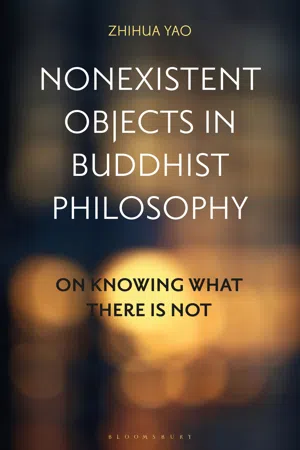
- 200 pages
- English
- ePUB (mobile friendly)
- Available on iOS & Android
eBook - ePub
About this book
Information
PART ONE
COGNITION OF NONEXISTENT OBJECTS: A HISTORICAL DEVELOPMENT
1
Mahāsāṃghika
The present chapter will explore some pre-Vaibhāṣika sources that are extant in Pāli and Chinese, including the Kathāvatthu, Samayabhedoparacanacakra, Śāriputrābhidharma, and Vijñānakāya. These scattered sources suggest an early origin of the concept of the cognition of nonexistent objects among the Mahāsāṃghikas and some Vibhajyavādins under their influence. They also indicate some different aspects of this theory from that held by the Dārṣṭāntika-Sautrāntikas. In particular, some Mahāsāṃghika arguments reveal how a soteriologically oriented concept of cognition without objects gradually develops into the sophisticated philosophical concept of the cognition of nonexistent objects. This again, to echo my conclusion on the study of self-cognition (svasaṃvedana) (Yao 2005), shows that the concept of the cognition of nonexistent objects has an origin in the soteriological discourse, and that many Mahāsāṃghika theories have great impact on the later development of Buddhist doctrinal systems.
1.1 Latent Defilements without Objects
The first Mahāsāṃghika argument for the cognition of nonexistent objects has to do with anuśaya, a generic term for defilements. But in its usage, it is more appropriate to translate it into “latent defilements.” It is well documented that the Mahāsāṃghikas disagreed with the Sarvāstivādins (and possibly other Sthaviravāda schools) on the relationship between anuśaya and paryavasthāna (the manifested defilements). In his Samayabhedoparacanacakra, Vasumitra lists the following statement as one of the main doctrines shared by the Mahāsāṃghikas and its sub-schools, including Ekavyavahārika, Lokottaravāda, and Kaukkuṭika: “Anuśaya is not a mind or mental activity, and it has no objects. Anuśaya is distinguished from paryavasthāna, and paryavasthāna is distinguished from anuśaya. It should be said that anuśaya is not associated with the mind, while paryavasthāna is associated with the mind.”1
The same statement is found among the shared doctrines of the Mahīśāsakas and its sub-school Dharmaguptaka.2 These schools are the major components of the so-called Vibhajyavādins.3 It is possible that the Vibhajyavādins were influenced by the Mahāsāṃghikas on this point, and this agreement between the two parties is the basis for their contributions to the development of the theory of cognition of nonexistent objects.
In contrast to the Mahāsāṃghika and Vibhajyavāda view on anuśaya and paryavasthāna, the Sarvāstivādins held the exactly opposite view: “All anuśayas are mental activities, associated with the mind, and have objects. All anuśayas are included in paryavasthāna, but not all paryavasthānas are included in anuśaya.”4 Similar views are found in a more elaborate form in Sarvāstivāda Abhidharma works such as Mahāvibhāṣā, Nyāyānusāra, and Abhidharmakośabhāṣya.5
This debate involves some issues with great soteriological implications. Liberation, the goal of Buddhist practice, is meant to be free from defilements (anuśaya). Therefore, anuśaya undoubtedly occupies a central position in the Buddhist soteriology, and the understanding and analysis of defilements constitute the essential part of the Buddhist doctrinal system. Schools such as Mahāsāṃghika and Mahīśāsaka held that a finer analysis should be made to distinguish between anuśaya and paryavasthāna, the latent and manifested defilements. This distinction is applicable to many soteriological issues, including the possibility of retrogression, an issue hotly debated among sectarian Buddhists.6 As I am not mainly concerned with soteriological issues in the current study, I am not going to further discuss how this distinction between latent and manifested defilements is applied to solve or evoke various soteriological problems. Instead, I am interested in how this distinction is made. It is suggested that the Mahāsāṃghikas and Mahīśāsakas made this distinction on the following ground: Anuśaya is not associated with the mind, while paryavasthāna is. In other words, anuśaya or the latent defilement that is disjoined from the mind is not a mental activity. In contrast, paryavasthāna or the manifested defilement that is conjoined with the mind is a mental activity. So the line is clear: anuśaya is not a mental activity, but paryavasthāna is.
In his commentary on the Samayabhedoparacanacakra, Kuiji (窺基) explains the reason for the Mahāsāṃghika view that anuśaya is not a mental activity. First of all, anuśaya consists of ten types of defilements: desire (rāga), enmity (pratigha), ignorance (avidyā), conceit (māna), doubt (vicikitsā), self-view (satkāyadṛṣṭi), extreme view (antagrāhadṛṣṭi), false view (mithyādṛṣṭi), adherence to one’s own views (dṛṣṭi-parāmarśa), and adherence to abstentions and vows (śīla-vrata-parāmarśa).7 It accompanies the ordinary person (pṛthagjana) all the time, even in her state of mindless meditation (asaṃjñi-samāpatti) or in her mental state that is morally good.8 The state of mindless meditation is especially important for the Mahāsāṃghikas to develop their view on anuśaya. It is believed to be a state in which all the mind and mental activities cease to function. The fact that the mind and mental activities can resume after the state of mindless meditation contributed greatly to the development of the concept of store consciousness (ālaya-vijñāna) later among the Yogācāras. The Mahāsāṃghikas, however, are more concerned with what happens in the state of mindless meditation. As it is a state accessible to an ordinary person through proper training, there must be defilements in it. Otherwise, those who are in the state of mindless meditation would be the liberated persons (arhat) rather than ordinary ones. As we know, according to the Buddhist soteriology, the key difference between the liberated persons and the ordinary person is whether they are accompanied by defilements. So the Mahāsāṃghikas admit that the defilements that pertain through mindless meditation must not be mental activities. As a result, we have to distinguish between paryavasthāna, the manifested defilements that are associated with the mind, and anuśaya, the latent defilements that are not mental activities.
Believing in a nonmental latent defilement is a view shared by the Mahāsāṃghikas and its sub-schools (including Ekavyavahārika, Lokottaravāda, and Kaukkuṭika), the Mahīśāsakas and its sub-school Dharmaguptaka, and the Saṃmatīyas.9 For some, especially the Sarvāstivādins, this view is unacceptable. How can desire and so on, which are usually considered to be typical mental activities, be nonmental? They hold firmly that “all the latent defilements (anuśaya) are mental activities and associated with the mind.”10 Meanwhile, they do not make a sharp distinction between anuśaya and paryavasthāna, and consider both to be the epithets of kleśa (defilements).
Anuśaya, either mental or nonmental, is understood to be a human disposition with the characteristic of increasing or decreasing along with its objects. For instance, one’s desire may increase when encountering a favorable object and decrease when meeting with an unfavorable one. Understanding the interaction between defilements and their objects is a very important aspect of Buddhist practice that aims to eliminate these defilements. And the practice consists of internally calming down the defilements and externally avoiding objects that help the growth of defilements. Now the Mahāsāṃghikas have to face a serious challenge: If anuśaya is nonmental, how can it have an object? If it has no objects, how can it maintain its growth? Again, it is well documented that the Mahāsāṃghikas and its sub-schools, including Ekavyavahārika, Lokottaravāda, and Kaukkuṭika, exclaimed that “[anuśaya] has no objects either.”11 The Mahīśāsakas and its sub-school Dharmaguptaka adopted the same view, and the Sarvāstivādins, accordingly, went against such a view by insisting that “[anuśaya] has objects.”12
It is evident that the Theravādins also argued against this view. As a matter of fact, their debate with the Andhakas and some Uttarāpathakas on the subject, as found in Kathāvatthu IX.4, constitutes the most substantial material for the current discussion.13 First of all, this text indicates that seven types of anuśaya (Pāli: anusaya) are under discussion: sensual desire (kāmarāga), enmity (paṭigha), conceit (māna), erroneous opinion (diṭṭha), doubt (vicikicchā), desire of life (bhavarāga), and ignorance (avijjā). On the view of the Andhakas, the anuśaya of desire (latent desire) is distinguished from manifested desire, the desire as outburst (kāmarāgapariyuṭṭhāna), bond (kāmarāgasaññojana), flood (kāmogha), fetter (kāmayoga), or obstacle (kāmacchandanīvaraṇa), all of which are the manifestations of desire in different degrees. The latent desire has no objects, while the rest have. The reason for this is not that anuśaya belongs to material form, sense organs, or sense objects, all of which are part of the material realm and certainly possess no objects. Nor is it because anuśaya belongs to nirvāṇa, the unconditioned state that goes beyond material and mental factors, and the division between subject and object. Instead, anuśaya is associated with conditioning force (saṅkhāra, saṃskāra).
The text then discusses more extensively how anuśaya is associated with conditioning force. On the one hand, if the latent desire belongs to saṅkhāra, then saṅkhāra should also be without objects. On the other hand, however, the manifested desire itself also belongs to saṅkhāra, and this desire certainly possesses objects, and therefore saṅkhāra should have objects. The Andhakas are forced into a self-contradiction by admitting saṅkhāra to be both with and without objects. Their solution to this contradiction is to admit “a portion of saṅkhāra being with objects and the other portion without objects.”14 Buddhaghosa ...
Table of contents
- Cover
- Half-title Page
- Also Available from Bloomsbury
- Title Page
- CONTENTS
- ACKNOWLEDGMENTS
- Introduction
- PART ONE COGNITION OF NONEXISTENT OBJECTS: A HISTORICAL DEVELOPMENT
- PART TWO EPISTEMOLOGICAL APPROACHES TO NONEXISTENCE
- NOTES
- REFERENCES
- INDEX
- Copyright Page
Trusted by 375,005 students
Access to over 1.5 million titles for a fair monthly price.
Study more efficiently using our study tools.
Frequently asked questions
Yes, you can cancel anytime from the Subscription tab in your account settings on the Perlego website. Your subscription will stay active until the end of your current billing period. Learn how to cancel your subscription
No, books cannot be downloaded as external files, such as PDFs, for use outside of Perlego. However, you can download books within the Perlego app for offline reading on mobile or tablet. Learn how to download books offline
Perlego offers two plans: Essential and Complete
- Essential is ideal for learners and professionals who enjoy exploring a wide range of subjects. Access the Essential Library with 800,000+ trusted titles and best-sellers across business, personal growth, and the humanities. Includes unlimited reading time and Standard Read Aloud voice.
- Complete: Perfect for advanced learners and researchers needing full, unrestricted access. Unlock 1.5M+ books across hundreds of subjects, including academic and specialized titles. The Complete Plan also includes advanced features like Premium Read Aloud and Research Assistant.
We are an online textbook subscription service, where you can get access to an entire online library for less than the price of a single book per month. With over 1.5 million books across 990+ topics, we’ve got you covered! Learn about our mission
Look out for the read-aloud symbol on your next book to see if you can listen to it. The read-aloud tool reads text aloud for you, highlighting the text as it is being read. You can pause it, speed it up and slow it down. Learn more about Read Aloud
Yes! You can use the Perlego app on both iOS and Android devices to read anytime, anywhere — even offline. Perfect for commutes or when you’re on the go.
Please note we cannot support devices running on iOS 13 and Android 7 or earlier. Learn more about using the app
Please note we cannot support devices running on iOS 13 and Android 7 or earlier. Learn more about using the app
Yes, you can access Nonexistent Objects in Buddhist Philosophy by Zhihua Yao in PDF and/or ePUB format, as well as other popular books in Philosophy & Eastern Philosophy. We have over 1.5 million books available in our catalogue for you to explore.