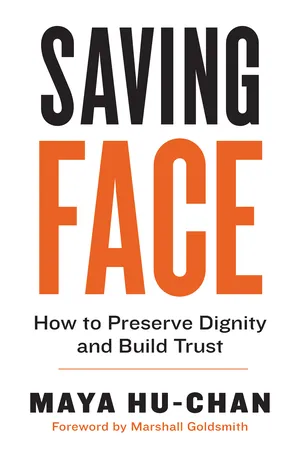
"Maya Hu-Chan shares a blueprint for becoming a more empathetic, self-aware, and inclusive leader. Saving Face guides us to consider different perspectives, to think first and speak last, and to respect others above all else."
—Frances Hesselbein, former CEO, Girl Scouts of the USA, and Presidential Medal of Freedom recipient Organizations now need to attract, retain, and motivate teams and employees across distance, time zones, and cultural differences. Building authentic and lasting human relations may be the most important calling for leaders in this century. According to management and global leadership specialist Maya Hu-Chan, the concept of "saving face" can help any leader preserve dignity and create more empathetic cross-cultural relationships. "Face" represents one's self-esteem, self-worth, identity, reputation, status, pride, and dignity. Saving face is often understood as saving someone from embarrassment, but it's also about developing an understanding of the background and motivations of others to discover the unique facets we all possess. Without that understanding, we risk causing others to lose face without even knowing it. Hu-Chan explains saving face through anecdotes and practical tools, such as her BUILD leadership model (Benevolence, Understanding, Interacting, Learning, and Delivery). This book illustrates how we can give face to create positive first impressions, avoid causing others to lose face, and, most importantly, build trust and lasting relationships inside and outside the workplace.
- 224 pages
- English
- ePUB (mobile friendly)
- Available on iOS & Android
eBook - ePub
About this book
Information
CHAPTER 1
Saving Face as Social Currency
WHEN YOU HEAR THE WORDS “save face,” what do you think of? You might imagine someone trying to recover after saying something embarrassing. Maybe they made a misstep in the workplace and now need to repair their reputation. Egos get hurt and somehow must be mended.
The concept of “face” in many cultures extends to something far deeper. It speaks to a deeper need for dignity and acceptance, and the ways we convey that dignity to one another. The ability of people to successfully apply concepts of face as a type of social currency might be the single most integral part of establishing successful business partnerships.
Many have heard the term “face” as in “losing face.” But not many understand how complex and widespread the concept is in Asia and in other cultures. Face represents a person’s status and reputation in business and politics, among family and friends, in local communities—even the nation at large. The concept of face has influenced nearly every aspect of life and culture for 2,500 years.
The concept of face (miàn zi, in Chinese) is difficult to define because there is no English word that is a direct equivalent. “Respect” or “dignity” come close, but do not fully encapsulate all its nuance. In the historical Chinese perspective, face represents a person’s reputation, credibility, and level of prestige within the family, among personal friends, and in society at large. Whatever word or phrase is used for it, in Chinese, English, or any other language, the importance of face is universal within just about every culture.
The influence of face in Asian culture typically affects three parts of society—self, community, and action.
Self relates to how an individual perceives the level of prestige they believe they’ve earned through their accomplishments or status within the community.
Community represents the level of respect and courtesy that should be bestowed upon someone based on their status within a business, family, or other social network.
Action corresponds to the behavior or deeds that can cause someone else to either lose or gain face.
To put it all together in terms of face, self is how you see yourself, community is how you see others, and action is what each of us does to each other that impacts face positively or negatively.
From a business perspective, the Chinese perception of face is very apparent in all levels of communications and relationships. Adherence to company hierarchy is ever present and plays a much more important role than in many Western countries. Leaders and senior managers are placed on a pedestal, and the distinction between various levels of management is clearly defined. Many leaders expect their orders to be followed without question, and when someone does not follow the intent of their leader, they are perceived as not giving the necessary prestige that the leader is owed.
While our objective here isn’t to duplicate that model of business hierarchy, the concept of face is just as important in the West, and we’ll be looking at how that is so throughout this book.
“THROW AWAY THE FACE”
The concept of face is so entrenched globally that common phrases about face are a normal part of everyday conversation. The Chinese phrase diulian translates as “throw away the face”—that is, to be so ashamed or embarrassed you feel as though you have removed your face and tossed it away. And let’s not forget the Western phrase “putting your best face forward”—another way of presenting yourself with respect and honor.
The idea of saving face isn’t just some theoretical concept that affects communication between groups in far-flung locations. As the following story shows, issues about face can just as easily happen in the same building.
As you go through this book, you may notice that I sprinkle a lot of anecdotes about what I’ve observed in my interactions with clients. It’s intentional! Instead of reciting abstract theories in a vacuum, I want to show how the concept of face actually has an impact on people through real-life experiences.
Here’s a terrific example of how the chief operating officer (COO) of a major corporation helped to preserve face for one of his managers when something negative happened.
The COO had saved the manager’s face and did so authentically.
- He was firm but kind. Saving face requires having the other person’s best interest in mind, understanding their perspective, and delivering constructive feedback. The COO considered the circumstances before making decisions. Humanity is key. Ego is the enemy.
- It’s important to point out that saving face isn’t the same as just letting someone off the hook. When a mistake is made, there still needs to be accountability. In this case, the COO communicated directly and clearly about his expectations and trusted that the financial director would see to it that the problem was fixed.
- He employed emotional intelligence. When he walked in the room, the COO was aware of the finance director’s stress level. He “raised his antenna” and reacted with empathy. He was respectful, choosing his words carefully. He didn’t make assumptions. He treated the finance director with decency.
- He was intentional. When having emotionally delicate conversations, start with the end goal in mind. Ask, “What is my intention? What do we want to achieve?” Stating your intention creates openness and breaks down barriers.
- He made the finance director feel worthy. The COO didn’t demean or embarrass him. Instead, he did the opposite—he recognized, in front of Dan, the work the finance director had been doing to improve security measures. He acknowledged the finance director’s self-worth and affirmed it.
- He helped the finance director overcome shame and embarrassment quickly and refocus his energy on solving the problem and moving forward. He showed the finance director that he trusted him and had confidence that he would do the right thing.
Saving face is done authentically when you are intentional, respectful, and sensitive. Act with empathy and leave ego and judgment at the door. When you help someone save face in this way, you not only inspire loyalty—you also bring out the best in others, having made them feel appreciated and valued.
The act of saving face can take many forms. It may be very subtle or overt depending on the culture and environment, but it is always there.
THE BANK OF FACE
When we are attuned to face, we begin to use it as social currency. In this sense, it is possible to imagine how we build a supply of face with someone by continuously making deposits, just like a bank account. The more we deposit, the more we build trust. We express gratitude and appreciation. We compliment others and recognize them for their contributions, in public and in private. Or we empathize, putting ourselves in their place to understand their challenges. We give them and their voice equal time and weight. This is how we make a deposit.
When we need to make a withdrawal, we’re careful not to “tear the face apart.” We provide criticism or feedback in a way that saves face and preserves dignity. If we mistakenly cause someone to lose face, the relationship can still be saved if there are enough deposits to cover the withdrawal.
Face is also traded as currency. Global business leaders use face as a commodity, trading and borrowing face to strike mutual deals or to gain entry into one another’s markets or networks. A global business leader’s success depends on how he or she understands face and its crucial role in cross-cultural communication.
The more “face” you have, the easier and quicker it is to get things done.
Face as a social currency isn’t solely focused on business. It matters in every interaction you have, whether it’s professional or personal. Here are a couple of examples of how face works on a personal level.
Table of contents
- Cover
- Title Page
- Copyright Page
- Dedication
- Contents
- Foreword
- Preface
- Introduction: Honoring Face, Losing Face, and Saving Face
- Chapter 1. Saving Face as Social Currency
- Chapter 2. How to Avoid Losing Face
- Chapter 3. Authentic Acts of Saving and Honoring Face
- Chapter 4. Saving Face for the Wrong Reason
- Chapter 5. Psychological Safety, Innovation, . . . and Face
- Chapter 6. How to BUILD Relationships Using Face
- Chapter 7. Relearning How to Drive
- Chapter 8. Cultural Agility
- Chapter 9. Seeing beyond the Glass Ceiling
- Chapter 10. Face and the Value of Feedback
- Chapter 11. Facetime
- The Toolkit
- Notes
- Acknowledgments
- Index
- About the Author
Trusted by 375,005 students
Access to over 1.5 million titles for a fair monthly price.
Study more efficiently using our study tools.
Frequently asked questions
Yes, you can cancel anytime from the Subscription tab in your account settings on the Perlego website. Your subscription will stay active until the end of your current billing period. Learn how to cancel your subscription
No, books cannot be downloaded as external files, such as PDFs, for use outside of Perlego. However, you can download books within the Perlego app for offline reading on mobile or tablet. Learn how to download books offline
Perlego offers two plans: Essential and Complete
- Essential is ideal for learners and professionals who enjoy exploring a wide range of subjects. Access the Essential Library with 800,000+ trusted titles and best-sellers across business, personal growth, and the humanities. Includes unlimited reading time and Standard Read Aloud voice.
- Complete: Perfect for advanced learners and researchers needing full, unrestricted access. Unlock 1.5M+ books across hundreds of subjects, including academic and specialized titles. The Complete Plan also includes advanced features like Premium Read Aloud and Research Assistant.
We are an online textbook subscription service, where you can get access to an entire online library for less than the price of a single book per month. With over 1.5 million books across 990+ topics, we’ve got you covered! Learn about our mission
Look out for the read-aloud symbol on your next book to see if you can listen to it. The read-aloud tool reads text aloud for you, highlighting the text as it is being read. You can pause it, speed it up and slow it down. Learn more about Read Aloud
Yes! You can use the Perlego app on both iOS and Android devices to read anytime, anywhere — even offline. Perfect for commutes or when you’re on the go.
Please note we cannot support devices running on iOS 13 and Android 7 or earlier. Learn more about using the app
Please note we cannot support devices running on iOS 13 and Android 7 or earlier. Learn more about using the app
Yes, you can access Saving Face by Maya Hu-Chan in PDF and/or ePUB format, as well as other popular books in Business & Art Techniques. We have over 1.5 million books available in our catalogue for you to explore.