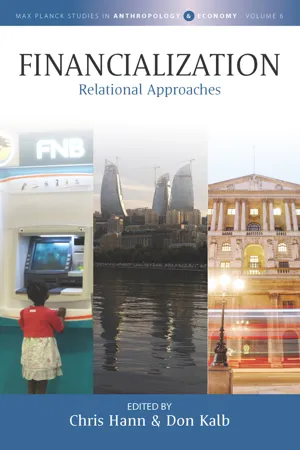
Beginning with an original historical vision of financialization in human history, this volume then continues with a rich set of contemporary ethnographic case studies from Europe, Asia and Africa. Authors explore the ways in which finance inserts itself into relationships of class and kinship, how it adapts to non-Western religious traditions, and how it reconfigures legal and ecological dimensions of social organization, and urban social relations in general. Central themes include the indebtedness of individuals and households, the impact of digital technologies, the struggle for housing, financial education, and political contestation.
Financialization, Plutocracy, and the Debtor’s Economy
Consequences and Limits
RICHARD H. ROBBINS
It is our belief that if forecasts of slower real GDP growth come to pass, then it is highly likely that future real returns to capital will likewise be significantly below past historical averages.
—Dean Baker, J. Bradford DeLong, and Paul Krugman,“Asset Returns and Economic Growth”
Beyond war, inflation, the end of the technology/productivity wave, and financial collapse, we think the most potent and short-term threat [to investors] would be societies demanding a more “equitable” share of wealth.
—Citigroup Memo, 2006
When financial advisors at investment bank Citigroup (Kapor et al 2006: 7), in their now notorious Plutonomy Memos, counseled their clients to maximize their rate of return on capital by investing in products and services purchased by the most wealthy, they made it plain that the financial community not only recognized the plutocratic nature of Western society but was fully willing to take advantage. At the same time, they apparently feared a rebellion by the bottom 90 percent over the continued expropriation by the 1 percent of an increasing share of the national wealth—a warning later echoed by Thomas Piketty (2014: 263).
This document was a celebration of the financialization of the global economy, where profits accrue through financial channels rather than through trade and commodity production (Arrighi 1994: 371; Krippner 2005: 174–75; 2012: 27–28). This chapter explores the origins and prerequisites of financialization—and also its consequences, notably the growth in economic inequality. I also want to examine how and why the field of economics has failed to understand the plutocratic consequences of financialization, and what sort of changes are necessary to ward off economic collapse or popular revolt.
I begin with the fact that creditors, which are banks, private investors, and debt and equity holders in general, are demanding an ever-increasing share of the world’s economic output. Their power is guaranteed by the prime directive that creditors always come first; that is, before money can be spent on anything—children’s welfare, public health, education, environmental preservation, poverty reduction, and so on—creditors have priority.1 Presently, it seems nothing can change this rule: not democratic politics, not public demonstrations, not large-scale educational campaigns, and not even violent resistance. The rule has various corollaries, among them the requirement that the economy must grow perpetually and exponentially, and the requirement that more and more of daily life and its accouterments must be transformed into monetary streams to service the ever-increasing demands of creditors and investors. How this situation and creditor rule came about is a story about the history of money creation, the domination of public policy by classical economics, some linguistic legerdemain, and a cultural framework that normalizes what would otherwise be considered intolerable.
Origins and Prerequisites
To understand financialization, it is convenient to begin with the creation of the Bank of England in 1694. This is, of course, a somewhat arbitrary choice, since much went on before that time (see, e.g., Arrighi 1994). But without the financial innovation that this Bank represented, what followed could not have occurred (Kalb 2013: 261; Di Muzio and Robbins 2016). The Grand Bargain, as I’ll refer to it, achieved the following:
First, it institutionalized a means of money creation in which privately owned institutions, largely banks, create money as interest-bearing debt.
Second, because banks create only the principle and not the interest, it locked the modern economy into exponential growth.
Third, it ensured a steady flow of monetary resources to those who own interest-bearing financial instruments.
Fourth, it financialized the national debt, creating a stream of payments to bond holders based primarily on the requirement that states must borrow money to operate, backed by its power to tax its citizens.
Fifth, it set a benchmark for the expected rate of return on capital of 4 to 8 percent and served as a model for the creation of thousands more debt-based monetary streams.
Finally, the Grand Bargain locked financial institutions and the nation–state into a partnership dedicated to maintaining economic growth at any cost.
These innovations spread to virtually all modern economies and helped fuel an unprecedented accumulation of wealth over the past three centuries. However, there are signs that they are now doing more harm than good. Each follows a relatively steady historical trajectory, but each development created problems that at this point seem insurmountable. However, understanding the history and dynamics of these developments suggest a way to counter the growing power of the plutocracy.
Money Creation as Private, Interest-Bearing Debt
The Bank of England, of course, wasn’t the first bank. The origins of banking extend to antiquity. The sixteenth- and seventeenth-century Dutch were masters of finance (de Vries and van der Woude 1997). But while the Dutch brought finance to the brink of modernity, it was the English who took the final decisive step. Paper money representing metallic currency provided the essential ingredient. The scarcity of gold and silver in the sixteenth and seventeenth centuries put England at a disadvantage with its rival Spain, which was transporting boatloads of gold and silver from colonies in South America. England’s coal endowment, and its pioneering of the technology to harness it, offered the potential for great increases in production. So long as money was limited to metallic coins, this potential could hardly be realized (Wennerlind 2011: 62).
Alchemy—the conversion of base metal into gold—was seen as one possible solution to the money problem. Sir Isaac Newton practiced the art with a passion. After his death in 1727, the Royal Society deemed some of his papers “not fit to be printed.” Rediscovered in the middle of the twentieth century, some scholars concluded that Newton was first and foremost an alchemist (Wennerlind 2011: 44ff; Newman 2018).
Paper money provided a more practical solution. Paper had been used as a representation of gold or silver for centuries. By the thirteenth century, China was issuing cotton money that could be exchanged for gold or silver. Italians pioneered the bill of exchange, which enabled a buyer to pay a seller at another time and place in the seller’s home currency. But bills of exchange or promissory notes in general were not legally transferable until the late seventeenth century, because the recipient would not be legally entitled to sue for payment. To address this problem, governments passed legislation making personal debts transferable. Consequently, like a personal check today, the debt represented by the promissory note could circulate as money.
The next ingredient in the story of debt-money involved war. Governments had always borrowed money, especially for military purposes. But in 1694, William III of England, in order to continue to conduct war against Louis the XIV of France, borrowed £1.2 million from a group of London merchants paid in notes or sealed bills rather than coins. In exchange, the King granted to the merchants a charter to found the Bank of England. The government agreed to repay the loan with £140,000 a year, an interest rate of 8 percent on the loan, plus £4,000 in management fees. It would raise the money to pay the interest through taxes. Finally, the Bank, in addition to issuing an interest-bearing debt of £1.2 million to the government, issued another £887,000 interest-bearing debt to private customers. It maintained until 1998 the exclusive right in England and Wales to issue notes as interest-bearing debt. The notes, which circulated as money, were initially supposed to be redeemable on demand for gold. Thus, the Bank of England had, in its reserves, the interest received on their loan by the government, plus a fractional reserve of coin to meet demands for an exchange of paper for coins. The creation of the Bank of England essentially completed the foundation of finance and the modern economy (Wennerlind 2011: 109).
Debt is the bedrock on which financialization rests. In 2018, including government, household, corporate, and financial debt, global debt reached $250 trillion (Dobbs et al 2015: 1; Tanzi 2018)—fueled partially by an increase in government debt, it had more than doubled over the previous fifteen years. The first problem bequeathed by the Grand Bargain is the rise of debt and the question of whether the economy can grow sufficiently to pay it off.
The Requirement for Exponential Economic Growth
Since financial institutions create only the principal of the loan, without economic growth, the interest, yield, or return on the loans, government securities, bonds, and so forth can never be realized (Werner 2014; Di Muzio and Robbins 2017). Over the long term, but particularly over the past two centuries, the growth of GDP in the global economy, especially in European offshoots (e.g., the United States and Australia) and Japan, has been spectacular: a three-hundred-fold increase in the amount of goods consumed, the number of goods produced, and the fortunes that have been made. A global citizen of today is almost nine times as wealthy as his or her counterpart some two hundred years ago; in some parts of the world, the average citizen has increased his or her wealth almost twenty-five times over the same period (see Maddison 2003). But given the explosion of global debt over the past two decades, can sufficient growth be maintained? In 2018, the ratio of global debt to economic growth was over 300 percent. In the United States, it almost doubled between 2000 and 2018 (going from 57 percent to 104 percent).
One might expect, given economists’ commitment to numbers, that one of the most important pieces of data would be the rate of economic growth necessary to maintain debt-based monetary streams. However, in the economics literature, other than a paper by Dean Baker, J. Bradford DeLong, and Paul Krugman (2005) showing that the rate of return on capital depends on the rate of economic growth, there is virtual silence on the issue. A 2015 report by the global consulting agency McKinsey (Dobbs et al 2015) provides an exception by calculating necessary growth rates for selected countries to begin to pay down their sovereign debt (other categories of debt-consumer, corporate, municipal, financial were excluded from the exercise).2 Averaging the growth rates of a group of European countries, the United States, and Japan, they found that the actual average growth rate was 1.67 percent, while the countries would have had to grow at an average rate of 3.46 percent just to begin paying back only their sovereign debts.
Since government debt constitutes less than one-third of all global debt, it is not unreasonable to suppose that to service all outstanding debts would require growth rates approaching 15 percent a year. Yet virtually all estimates of national and global growth predict a slowing of the rates of growth at the same time as global debt is increasing (see, e.g., IMF 2016; Piketty 2014: 206). Larry Summers, chief architect of United States economic policy under Presidents Clinton and Obama, has predicted a long period of “secular stagnation” (see Streeck 2014: 57). United States GDP, which averaged 4.4 percent from 1960 to 1989, declined to 1.9 percent between 1990 and 2019. And it was the projected decline in growth by the Trustees of the United States Social Security Trust Fund (2005) that prompted Dean Baker, Bradford DeLong, and Paul Krugman (2005) to predict lower rates of return on global investments.
Before returning to the question of why economists have failed to appreciate why growth cannot be sufficient to pay off existing debt and the social, environmental, and political consequences of that failure, let us consider who benefits from the creation of debt-based monetary streams.
A Steady Flow of Monetary Resources to the Plutocracy
As might be expected, these debts generate monetary streams that flow overwhelmingly to those who have the most interest-bearing assets at their disposal (Creutz 2010: 4). Edward N. Wolff (2012, 2013, 2017) has documented the extent of this wealth transfer (see Table 1.1). As of 2016, the top 1 percent has over 50 percent of interest-bearing assets (55.6 percent), and a significantly lower amount of debt (6.7 percent) than the bottom 90 percent (9.2 percent and 72.4 percent respectively). While numerous factors have contributed to the massive growth in inequality within countries over the past four decades (see, e.g., Piketty 2014; Milanovic 2016; Scheidel 2017), the role of financialization, particularly the control of debt-based monetary streams, has been largely neglected.
Clearly, one crucial legacy of the Grand Bargain of 1694 is a financial system in which wealth is systematically channeled from the bottom to the top. While there have been brief periods that threatened the plutocracy, these have been short-lived. When the Gra...
Table of contents
Cover
Title Page
Copyright Page
Contents
Illustrations, Figures and Tables
Preface
Introduction. Transitions to What? On the Social Relations of Financialization in Anthropology and History
Chapter 1. Financialization, Plutocracy, and the Debtor’s Economy: Consequences and Limits
Chapter 2. Accumulation by Saturation: Infrastructures of Financial Inclusion, Cash Transfers, and Financial Flows in India
Chapter 3. Green Infrastructure as Financialized Utopia: Carbon Offset Forests in China
Chapter 4. Altering the Trajectory of Finance: Meaning-Making and Control in Malaysian Islamic Investment Banks
Chapter 5. Financialization and Reproduction in Baku, Azerbaijan
Chapter 6. Financialization and the Norwegian State: Constraints, Contestations, and Custodial Finance in the World’s Largest Sovereign Wealth Fund
Chapter 7. Capital’s Fidelity: Financialization in the German Social Market Economy
Chapter 8. Redistribution and Indebtedness: A Tale of Two Settings
Chapter 9. Retail Finance and the Moral Dimension of Class: Debt Advice on an English Housing Estate
Chapter 10. Making Debt Work: Devising and Debating Debt Collection in Croatia
Chapter 11. Financialized Kinship and Challenges for the Greek Oikos
Chapter 12. Financialized Landscapes and Transport Infrastructure: The Case of Ciudad Valdeluz
Chapter 13. Housing Financialization in Majorcan Holiday Rentals
Afterword. Financialization Beyond Crisis
Index
Frequently asked questions
Yes, you can cancel anytime from the Subscription tab in your account settings on the Perlego website. Your subscription will stay active until the end of your current billing period. Learn how to cancel your subscription
No, books cannot be downloaded as external files, such as PDFs, for use outside of Perlego. However, you can download books within the Perlego app for offline reading on mobile or tablet. Learn how to download books offline
Perlego offers two plans: Essential and Complete
Essential is ideal for learners and professionals who enjoy exploring a wide range of subjects. Access the Essential Library with 800,000+ trusted titles and best-sellers across business, personal growth, and the humanities. Includes unlimited reading time and Standard Read Aloud voice.
Complete: Perfect for advanced learners and researchers needing full, unrestricted access. Unlock 1.4M+ books across hundreds of subjects, including academic and specialized titles. The Complete Plan also includes advanced features like Premium Read Aloud and Research Assistant.
Both plans are available with monthly, semester, or annual billing cycles.
We are an online textbook subscription service, where you can get access to an entire online library for less than the price of a single book per month. With over 1 million books across 990+ topics, we’ve got you covered! Learn about our mission
Look out for the read-aloud symbol on your next book to see if you can listen to it. The read-aloud tool reads text aloud for you, highlighting the text as it is being read. You can pause it, speed it up and slow it down. Learn more about Read Aloud
Yes! You can use the Perlego app on both iOS and Android devices to read anytime, anywhere — even offline. Perfect for commutes or when you’re on the go. Please note we cannot support devices running on iOS 13 and Android 7 or earlier. Learn more about using the app
Yes, you can access Financialization by Chris Hann, Don Kalb, Chris Hann,Don Kalb in PDF and/or ePUB format, as well as other popular books in Business & Finance. We have over one million books available in our catalogue for you to explore.