As was the case in many other countries, it was only in the early years of this century that Greek and Turkish labour historians began to systematically look beyond national borders to investigate their intricately interrelated histories. The studies in Working in Greece and Turkey provide an overdue exploration of labour history on both sides of the Aegean, before as well as after the fall of the Ottoman Empire. Deploying the approaches of global labour history as a framework, this volume presents transnational, transcontinental, and diachronic comparisons that illuminate the shared history of Greece and Turkey.
eBook - ePub
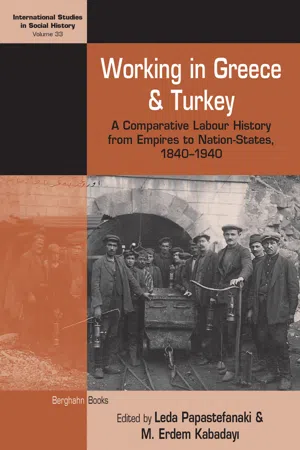
Working in Greece and Turkey
A Comparative Labour History from Empires to Nation-States, 1840–1940
- 584 pages
- English
- ePUB (mobile friendly)
- Available on iOS & Android
eBook - ePub
Working in Greece and Turkey
A Comparative Labour History from Empires to Nation-States, 1840–1940
About this book
Trusted by 375,005 students
Access to over 1.5 million titles for a fair monthly price.
Study more efficiently using our study tools.
Information
PART I
AGRARIAN PROPERTY AND LABOUR RELATIONS, RURAL AND URBAN ORGANIZATION OF WORK
CHAPTER 1
WERE PEASANTS BOUND TO THE SOIL IN THE NINETEENTH-CENTURY BALKANS?
A Reappraisal of the Question of the New/Second Serfdom in Ottoman Historiography
Alp Yücel Kaya
In his magnum opus La Méditerranée et le monde méditerranéen à l’époque de Philippe II, Fernand Braudel observed (in the first edition of 1949) that starting from the seventeenth century, the condition of the serfs in the Ottoman Balkans deteriorated, and a re-enserfment process took place, which he called the ‘new serfdom’ (see the second edition of 1966 and the English translation of 1972–73), in the large estates called çiftliks:
As a rule, the çiftlik converted the low-lying lands of the plains, the marshes between Larissa and Volos for example, along the muddy banks of Lake Jezero or the wet river-valleys. It was a conqueror’s type of farming. The çiftliks produced cereals, first and foremost. And cereal-growing, in Turkey as in the Danube provinces or in Poland, when linked to a huge export trade, created from the first the conditions leading to the ‘new serfdom’ observable in Turkey. These large estates everywhere debased the peasantry and took advantage of its debasement. … As in the West, large proprietors put to use the depopulated land whose possibilities had never been fully explored by previous generations of nobles and peasants. The price of progress, here as elsewhere, was clearly social oppression. Only the poor gained nothing, could hope for nothing from this progress.1
His argument concerning the ‘new serfdom’ referred, on theoretical grounds, to George I. Bratianu’s comparative study on the re-establishment of real serfdom (servage de la glèbe) in sixteenth-century Eastern and Southeastern Europe2 and, on factual grounds, to Richard Busch-Zantner’s study on the historical geography of the agrarian structure in the Balkans in general, and in nineteenth-century Thessaly in particular.3
On the theoretical level, Bratianu contrasted real serfdom to personal serfdom from a historical perspective. While the latter builds on subjection or bondage to the landlord, the former is based on subjection or bondage to the estate’s land by means of restrictions imposed on cultivators’ mobility.4 This argument, in fact, followed Marc Bloch’s critical elucidation on relations of dependence in medieval agrarian regimes:5
The serf of early times was, in the full sense of the word, an homme de corps. Whatever he did, wherever he went, whatever land he cultivated, he remained attached to his lord by a bond that was indissoluble by anything less than manumission, that was hereditary, nearly physical; it was a bond, … that stuck ‘to flesh and bones’. He remained always under the jurisdiction of his lord for certain misdemeanors, and he remained always indebted to him for the duties of his station. On the other hand, a free man who acquired a field from the possession of a serf did not on that account cease to be free. There were servile people, or rather servile families; there were no servile landholdings. Thus composed, serfdom did not appear as an anomaly. Nearly the entire social structure was founded upon analogous conceptions. Nothing seemed so strong as the bonds between man and man. But this system of personal relations broke down very quickly, because the collective ideas that supported them were worn away. We hesitate to give dates in such a matter, but we can say that from the beginning of the thirteenth century, in northern France, society had begun to change its appearance. Now, serfdom did not disappear along with the whole of the customs and juridical notions from which it had been born. It survived in many French provinces until the sixteenth century, and in some, until 1789; but it was slowly and deeply transformed. After that the servile ‘stain’ adhered less to the man than to the earth. Whoever inhabited a certain contaminated holding became a serf, while whoever left it became free. Real serfdom slowly superseded serfdom ‘de corps’.6
As for the genealogy of the term ‘new serfdom’, economic historians would immediately link it to the term ‘second serfdom’, whose imposition by estate owners in Eastern Europe during the sixteenth century was a tricky point, especially for the historiography of the ‘transition debate’, in the discussion of its causes ranging from export-oriented production to political conflict.7 Frederick Engels, in fact, first used the term in a letter written to Karl Marx dated 15 December 1882, while presenting his short paper on the history of collective land ownership practice, called the ‘mark’ in German history.8 Engels’ argument on the dynamics of the second serfdom balanced considerations of commercial orientation and political struggle. Bratianu’s argument, however, did not follow that of Engels.9 Indeed, in his comparative research, following and referring directly to the arguments of Henri Pirenne and Henri Sée, Bratianu correlated the resurrection of serfdom in Eastern Europe (Poland and the Baltic countries) with the increase of the export trade to Western Europe.10 As for the revival of serfdom in Russia and Southeastern Europe (Danubian principalities), he argued based on his own research on Byzantine history that it was fiscal necessities and the subsequent fiscal system of the central states that resulted in real serfdom. What he underlined in the article referred to by Braudel was that different causes resulted in the same phenomenon, which was real serfdom. Braudel, who in the first edition of La Méditerranée was perplexed by these two competing causalities, in the second edition forcefully enlarged the geography of the ‘new serfdom’ argument to the Ottoman Balkans, following the argument of Henri Pirenne and Henri Sée which stressed the impact of the export trade on the resurrection of serfdom.11
As for the factual level of Braudel’s argument, Busch-Zantner’s account of Thessaly was based on his own field research undertaken in the 1930s, after the postwar agrarian reforms, and the studies of the geographer Alfred Philippson carried out in the 1890s.12 In fact, Busch-Zantner’s book was severely criticized by Marc Bloch for using ambiguous terminology, especially with respect to his discussion on feudalism.13 Braudel, who was well aware of the criticism of this ‘erudition’,14 gave credit, although conditional, to the book:
[Richard Busch-Zantner’s] stimulating book met with a cool and perhaps undeserved response from the world of scholarship. … He has … been criticized for imprecise terminology, but this is something which seems to me unavoidable. For any western historian approaching the world of the East, all the words at his disposal are ambiguous and past definitions … or general explanations (such as those of J. Cvijic) are not the best guide. The increasing use of original Turkish sources will in any case lead to the re-statement of these problems and inevitably to a total revision of our ideas on Turkish history.15
In fact, such a call for research in the Ottoman archives, published in the second edition of La Méditerranée, had already been made by Ömer Lütfi Barkan to historians of the Ottoman Empire in the review of La Méditerranée in the Annales in 1954:
In conclusion, this magnificent book represents an important work program for Turkish historians. They, by posing similar problems identically, will be able to renew them thanks to the materials contained in the Turkish archives – which Professor Braudel lacked greatly; our historians will thus make their contribution not only to the history of their country, but also to the general history of the Mediterranean States.16
This chapter will take this call seriously and revisit the question of real serfdom or bondage to the land, with a special emphasis on its evolution in the nineteenth-century Ottoman Balkans. Indeed, Ottoman historiography has addressed the question quite indirectly, except for articles written by Barkan17 and Halil İnalcık.18 Scholars generally limited themselves to discussing the competing sources and causes of the origins of large estates called çiftliks, in which the ‘new serfdom’, according to Braudel, took place.19 Servile or serfdom-like labour relations were such natural and evident outcomes, within the context of çiftliks, that they rarely attracted the interest of researchers. In this chapter, however, we shall be concerned exclusively with the labour relations found in the çiftliks. By doing so, instead of focusing on the competing sources and causes of çiftliks, this chapter will propose a fresh perspective from which to analyse the economic and social transformation in the Ottoman Balkans: the evolution of labour bondage to the land and its place within çiftlik agriculture in the nineteenth century. To do so, however, we will first reappraise the question of bondage to the soil or real serfdom in Ottoman and Balkan historiography. We will start the discussion by using the gate opened by Braudel, through which have passed those scholars emphasizing peasant bondage to the soil, on the one hand (Traian Stoianovich, Deena Ruth Sadat, Immanuel Wallerstein, Huri İslamoğlu, Çağlar Keyder), and, on the other, those scholars underlining the mobility of the peasantry (Ömer Lütfi Barkan, Suraiya Faroqhi, Gilles Veinstein, Fikret Adanır). We will then present research that depicts the conditions of Balkan peasant units as oscillations between, or the simultaneous survival of, mobility and bondage to the soil (Halil İnalcık, Bruce McGowan, Şevket Pamuk). In this first section we finally review the historiography (Vera P. Mutafcieva, Bistra A. Cvetkova, Aleksandar Matkovski, Halil Berktay) favouring, instead of a ‘new serfdom’, the rather conflictual evolution of feudal and serfdom dynamics in the Ottoman Balkans, from the fifteenth century up to the nineteenth century.
The factual basis of Braudel’s argument on ‘new serfdom’ was based on the example of nineteenth-century Thessaly, corresponding to the Tırhala (Trikala today) district in the Ottoman provincial administration. After a reappraisal of the historiography on bondage to the soil in the second section, we will concentrate in the third section on Tırhala, using as a basis Ion Ionescu de la Brad’s articles published in the Journal de Constantinople during the 1850s. We will then discuss the bylaw of 1862, which regulated sharecropping relations in Tırhala, based on documentation found in the Ottoman archives. A comparative analysis with the bylaws of other Balkan provinces will follow, in order to question the survival of bondage to the soil in the nineteenth-century Balkans. We propose that the nature of social and economic transformation during the nineteenth century could be better understood by focusing on conflict in agrarian labour relations. As we argue in the second section of the chapter, cultivators’ desire to be mobile for subsistence needs and landlords’ desire to bind them to the soil for higher profits constituted one of the essential knots of such conflicts in Tırhala in particular, and in the Balkans in general.20

Figure 1.1 Historiographical exchanges between studies on serfdom, new/second serfdom and free peasantry. Figure created by the author.
A Reappraisal of the Historiography on Bondage to the Soil
The ‘New/Second Serfdom’ in the Balkans
Traian Stoianovich, who wrote his Ph.D. dissertation under the supervision of Fernand Braudel in the 1950s, further explored the idea of the ‘new serfdom’ in the Ottoman Balkans.21 He first argued that because peasants were ‘legally although not always practically tied to the land’, during the sixteenth and seventeenth centuries they fled to the cities or mountains, and the countryside became depopulated.22 On the other hand, several factors resulted in the rise of çiftlik agriculture: the decline of the urban population, manufacturing and commerce in the sixteenth century oriented urban investment towards rural investment; the growing provisioning requirements of Istanbul resulted in an additional impulse for rural colonization; and rural demographic decline led to the expansion of manorial reserves. These dynamics contributed, within the context of labour shortage, to ‘the subjection of the peasantry to the glèbe’. Bondage to the land was reinforced in the eighteenth century by the foreign demand for agricultural goods and subsequently by agricultural product specialization (cotton, maize, etc.).23
The ultimate result of the evolutionary pattern we have described is the transformation of the seigneur from a Grundherr, frequently having a military rather than economic orientation and receiving rent in kind with few if any labor services, to a Gutsherr, conscious of his economic functions, converting his benefice or conditional property into private or quasi-private property: allodium, ciftlik, waqf, malikane, vocina (termed pomestye), or métaire.24
Stoianovich referred extensively to a long article by the Marxist historian Branislav Djurdjev on Ottoman feudalism25 and, as his maître, once again to the book of Richard Busch-Zantner in or...
Table of contents
- Cover
- Title Page
- Copyright Page
- Contents
- List of Illustrations
- Acknowledgements
- Introduction and Historiographical Essay. Greek and Turkish Economic and Social History, and Labour History
- Part I. Agrarian Property and Labour Relations, Rural and Urban Organization of Work
- Part II. Political Change, Migration and Nationalisms
- Part III. Labour Market and Emotions in the Twentieth Century
- Epilogue
- Index
Frequently asked questions
Yes, you can cancel anytime from the Subscription tab in your account settings on the Perlego website. Your subscription will stay active until the end of your current billing period. Learn how to cancel your subscription
No, books cannot be downloaded as external files, such as PDFs, for use outside of Perlego. However, you can download books within the Perlego app for offline reading on mobile or tablet. Learn how to download books offline
Perlego offers two plans: Essential and Complete
- Essential is ideal for learners and professionals who enjoy exploring a wide range of subjects. Access the Essential Library with 800,000+ trusted titles and best-sellers across business, personal growth, and the humanities. Includes unlimited reading time and Standard Read Aloud voice.
- Complete: Perfect for advanced learners and researchers needing full, unrestricted access. Unlock 1.5M+ books across hundreds of subjects, including academic and specialized titles. The Complete Plan also includes advanced features like Premium Read Aloud and Research Assistant.
We are an online textbook subscription service, where you can get access to an entire online library for less than the price of a single book per month. With over 1.5 million books across 990+ topics, we’ve got you covered! Learn about our mission
Look out for the read-aloud symbol on your next book to see if you can listen to it. The read-aloud tool reads text aloud for you, highlighting the text as it is being read. You can pause it, speed it up and slow it down. Learn more about Read Aloud
Yes! You can use the Perlego app on both iOS and Android devices to read anytime, anywhere — even offline. Perfect for commutes or when you’re on the go.
Please note we cannot support devices running on iOS 13 and Android 7 or earlier. Learn more about using the app
Please note we cannot support devices running on iOS 13 and Android 7 or earlier. Learn more about using the app
Yes, you can access Working in Greece and Turkey by Leda Papastefanaki, M. Erdem Kabadayı, Leda Papastefanaki,M. Erdem Kabadayı in PDF and/or ePUB format, as well as other popular books in History & European History. We have over 1.5 million books available in our catalogue for you to explore.