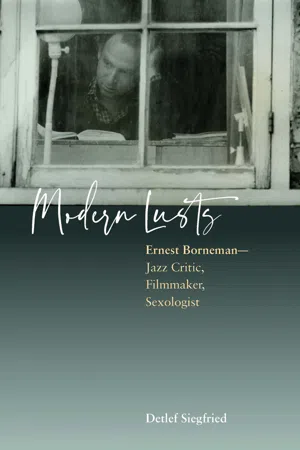
As a jazz musician, filmmaker, anthropologist, sexologist, and crime novelist, the boundlessly curious German autodidact Ernest Borneman exemplified the conflicting cultural and intellectual currents of the twentieth century. In this long-awaited English translation, acclaimed historian Detlef Siegfried chronicles Borneman's journey from a young Jewish Communist in Nazi Berlin to his emergence as a celebrated (and reliably controversial) transatlantic polymath. Through an innovative structure organized around the human senses, this biography memorably portrays a figure whose far-flung obsessions comprised a microcosm of postwar intellectual life.
- 458 pages
- English
- ePUB (mobile friendly)
- Available on iOS & Android
eBook - ePub
About this book
Trusted by 375,005 students
Access to over 1.5 million titles for a fair monthly price.
Study more efficiently using our study tools.
Information
Chapter 1
“IN ME YOU HAVE SOMEONE ON WHOM THERE IS NO RELYING”
CONSTANTS AND CONSTRUCTS
Ernest Borneman (born Ernst Bornemann) began writing at a young age. His first manuscript, drafted at the age of seventeen, still exists—at 264 pages long, it is surprisingly well written for such a young author.1 Fahrt ohne Ziel (A Trip without a Destination) chronicles the author’s trip to Sweden in the summer of 1932 with Herbert Louis Steinthal, a friend and the son of the Berlin correspondent for Copenhagen’s left-liberal daily newspaper Politiken. The book begins by introducing the protagonists, giving an indication of the author’s self-perception as a young man: “We—that is Louis, seventeen years old, a Danish national who has been living for more than ten years in Berlin, medium height, slim, unbelievably polite . . . and me, Ernst Bornemann, called Mac, Mackie, or—using my scout name—Schlentiger. I am sixteen years old, a German national, and I live sometimes (when I am not traveling) in the great city of Berlin. I have two passions: traipsing about and singing Negro songs.” The self-assigned nickname reveals an affinity for Brecht, while travel and jazz would remain lifelong passions. As the novel progresses, the picture emerges of a young mind marked by an interest in modern movements in architecture, music, and film that matures as the protagonist travels from Norrköping to Stockholm, Göteborg, and Copenhagen, absorbing Scandinavian functionalism on the way. Upon encountering this architectural style he writes, for example, of having found “at long last, New Objectivity [Neue Sachlichkeit] expressed in bricks, something I have been trying to find for so long; the Chilehaus in Hamburg was really just a temporary solution.” “Nowhere,” Borneman continues, “does the decorative ornamentation of the fin-de-siècle style offend the eye of the beholder.” For him, Stockholm was “the real manifestation of a Metropolis fantasy à la Fritz Lang,” and he praised the “Americanized touch” of the city’s urban landscape. This trip was also much like a “farewell to his youth”—his parents were under the impression they would have to give up their children’s clothing store at Kaiserdamm 116 in the Charlottenburg neighborhood of Berlin for financial reasons. Ernst was supposed to leave school and earn money by working for a printer in Stettin. Things turned out differently.
Ernst Bornemann, born 12 April 1915 in Berlin as the only child of Curt and Hertha Bornemann (née Blochert), attended the Karl Marx School until the summer of 1933. Led by Fritz Karsen, the reformed school was coed, nondenominational, and socially integrative in its approach; its experiments with new pedagogical methods included project-based learning, polytechnic instruction, and flexible age groupings. Young Ernst loved the school, which proved to be his saving grace, as he had already twice been expelled from other schools for his political activities.2 He was a member of the Socialist High School Students Association (Sozialistischer Schülerbund, SSB), which held close ties to the German Communist Party (KPD) and whose newspaper, Schulkampf, he edited.3 The Karl Marx School was a bastion of the SSB, with a teaching staff that included leftist theoreticians such as Karl Korsch, Siegfried Bernfeld, and KPD education policy maker Edwin Hoernle.4 In retrospect, Borneman saw his socialization in the SSB as the decisive factor in the development of his own political views. The discussions between the different Socialist-Communist camps, he noted, “were among the most interesting, most lively, and most informative experiences of my youth.”5 Later in life, he would say of himself and his friends that “we had matured early: sexually at 14, politically at 15, and intellectually between 14 and 16.”6

Figure 1.1. Art class during Carnival celebrations at the Karl Marx School. Borneman is in the back row, third from right. Courtesy AdK.
Just weeks before completing his Abitur (akin to a high-school graduation exam) Ernst Bornemann (upon emigrating to England he dropped the second “n” from his family name and added an “e” to his given name) left Germany on 5 July 1933, making his way to London as part of a youth transport. In his 1977 autobiography he gives the reason for his flight as the risk posed by the seizure of “membership lists” from Wilhelm Reich’s sexual clinics by the paramilitary wing of the Nazi Party (Sturmabteilung, or SA).7 Earlier sources from the immediate postwar period pertaining to the possibility of material restitution, however, do not mention this but instead offer a less specific account: “If my memory serves, what happened was this: I received warning that I was already on the Gestapo’s list, and I tried to get out of Germany through a school exchange program, because the civil servant in charge of the list of selected students was a Social Democrat and he added my name to the list at the last minute.”8 Wilhelm Reich is not mentioned at all in a correspondence between Borneman and his father weighing possible arguments, although there is talk of a general threat. His father wrote:
I can testify that you were subject to persecution. You often came home late because you were ambushed by the upper school students from other schools and the older Hitler Youth boys who tried to beat you up. But the most important argument proving that the Gestapo had already set its sights on you was this: in the fall of 1933 . . . two huge Gestapo men came into our shop to arrest you. Because fortunately you were not there at the time but already in London, they asked about everything you had been doing for the last few years in detail, and they actually took the chance to claim that you were in Soviet Russia. A half year later, another civil servant came to find out where you were.9
His parents’ letters from the summer of 1933 also clearly show that they tried to encourage their son to return home. His mother wrote him: “After all, you don’t necessarily have to flee Germany as so many others do now.”10 His father thought that he could probably find an internship at a newspaper without having his Abitur, but that he would have to make concessions in light of the political situation: “You would just have to learn how to write apolitically.”11 Although the eighteen-year-old felt at home in London, there were points at which he toyed with the idea of moving on—New York and Brazil were mentioned—but he never considered returning to Berlin.12 Whether this was all actually motivated by political considerations, a desire for adventure, or some combination of the two is difficult to say. When he briefly considered returning to Germany in spring 1934, his parents urgently advised him against it—especially his mother, who viewed the situation more realistically than his father. When one of his relatives, Ernst Levinsohn, left Berlin in 1938, Borneman’s Aunt Erna told him about Levinsohn’s interrogation by the Gestapo, which had found Borneman’s address in Levinsohn’s notebook. “Hopefully this won’t cause you trouble,” she wrote. “He had to go down to the Gestapo station and let them interrogate him up and down for four hours, then finally he had to sign an agreement to leave Germany by the fall. They told him very clearly that you had attended the Karl Marx School, and they wanted to know how often he had met with you; I’m told he said as often as relatives usually meet up.”13
When Borneman received orders to report for enlistment in the German army in 1935, he did not show up.14 In 1936 he signed up at the German consulate “to fulfill his active service and work service requirements” and was transferred to the Ersatzreserve II, a military reserve unit. The document bore the signature of the consul, but the field where Borneman had to sign was left blank. Nor did he turn up for duty, upon which his German citizenship was rescinded.15 He was not naturalized in Great Britain before the war, and after receiving Canadian citizenship in 1945 Borneman regularly switched his country of residence, but also his nationality. He finally became a British subject in 1959; in 1961 the West German authorities recognized his German citizenship; in 1976 he was naturalized in Austria. Regardless, it was emigration that saved him. As he soberly wrote to his girlfriend Eva in 1942, in the middle of the war, “If I had stayed home nine years ago I’d have a fair chance of being in my grave now.”16
Eva
Eva Geisel was born into a Jewish family on 16 June 1912 in Barnes, England, making her three years older than Ernest.17 Her mother was English, her father German. After completing her Abitur in Berlin in 1931, she pursued university courses in German, English, and journalism in Freiburg and Berlin. She then moved to London in 1933, where she worked as a film and theater critic at the New Statesman and at Fenner Brockway’s New Leader. In 1937 she began working in the press department at Columbia Pictures.18 After the antisemitic pogroms of 1938, her parents followed in her steps, immigrating to England. Eva Geisel was politically active during the war; she supported Jewish refugees, lent her voice to the BBC propaganda broadcasts directed at German women, worked for the Free German Youth organization (Freie Deutsche Jugend, or FDJ), and applied to the Political Intelligence Service of the Foreign Office (although it is unclear whether she was actually hired).19 In 1943 she relocated to Canada, where she married Ernest that same year. The couple’s only child, Stephen, was born on 16 July 1947. In Ottawa she worked, like her husband, first at the National Film Board in the information department, before moving on to the Information Service of the Canadian government in 1946. After returning to London in 1950, she again found work at various publishing houses, eventually becoming the head of the public relations department of Oxford University Press in 1960.20 Eva Borneman’s German-English parentage meant she had grown up bilingual, and shortly after moving to Frankfurt in 1962 she took up as a freelance translator from English to German and vice versa. In 1964 she took over for several years as editor of Übersetzer, the monthly magazine of the Association of Germa...
Table of contents
- Cover
- Title Page
- Copyright Page
- Dedication
- Contents
- List of Illustrations
- List of Abbreviations
- Introduction
- Chapter 1. “In Me You Have Someone on Whom There Is No Relying”: Constants and Constructs
- Chapter 2. Hearing: The Ethnology of Jazz
- Chapter 3. Seeing: Life on the Big Screen
- Chapter 4. Touching: Sex and Society
- Conclusion. Bodies along the Roadside
- Bibliography
- Index
Frequently asked questions
Yes, you can cancel anytime from the Subscription tab in your account settings on the Perlego website. Your subscription will stay active until the end of your current billing period. Learn how to cancel your subscription
No, books cannot be downloaded as external files, such as PDFs, for use outside of Perlego. However, you can download books within the Perlego app for offline reading on mobile or tablet. Learn how to download books offline
Perlego offers two plans: Essential and Complete
- Essential is ideal for learners and professionals who enjoy exploring a wide range of subjects. Access the Essential Library with 800,000+ trusted titles and best-sellers across business, personal growth, and the humanities. Includes unlimited reading time and Standard Read Aloud voice.
- Complete: Perfect for advanced learners and researchers needing full, unrestricted access. Unlock 1.5M+ books across hundreds of subjects, including academic and specialized titles. The Complete Plan also includes advanced features like Premium Read Aloud and Research Assistant.
We are an online textbook subscription service, where you can get access to an entire online library for less than the price of a single book per month. With over 1.5 million books across 990+ topics, we’ve got you covered! Learn about our mission
Look out for the read-aloud symbol on your next book to see if you can listen to it. The read-aloud tool reads text aloud for you, highlighting the text as it is being read. You can pause it, speed it up and slow it down. Learn more about Read Aloud
Yes! You can use the Perlego app on both iOS and Android devices to read anytime, anywhere — even offline. Perfect for commutes or when you’re on the go.
Please note we cannot support devices running on iOS 13 and Android 7 or earlier. Learn more about using the app
Please note we cannot support devices running on iOS 13 and Android 7 or earlier. Learn more about using the app
Yes, you can access Modern Lusts by Detlef Siegfried in PDF and/or ePUB format, as well as other popular books in History & Historical Biographies. We have over 1.5 million books available in our catalogue for you to explore.