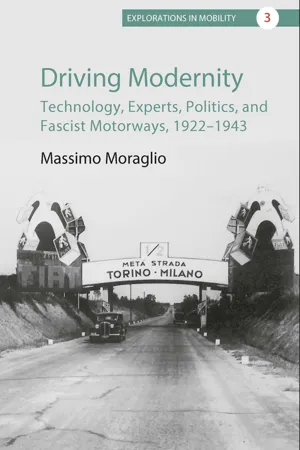
On March 26th, 1923, in a formal ceremony, construction of the Milan–Alpine Lakes autostrada officially began, the preliminary step toward what would become the first European motorway. That Benito Mussolini himself participated in the festivities indicates just how important the project was to Italian Fascism. Driving Modernity recounts the twisting fortunes of the autostrada, which—alongside railways, aviation, and other forms of mobility—Italian authorities hoped would spread an ideology of technological nationalism. It explains how Italy ultimately failed to realize its mammoth infrastructural vision, addressing the political and social conditions that made a coherent plan of development impossible.
eBook - ePub
Driving Modernity
Technology, Experts, Politics, and Fascist Motorways, 1922-1943
- 208 pages
- English
- ePUB (mobile friendly)
- Available on iOS & Android
eBook - ePub
About this book
Information
CHAPTER 1

The Roads before the Motorways
Road Policies in Italy in the Second Half of the 1800s
When compared with other European nations, mid-1800s Italy had a noticeable deficit in its roads network, which was accentuated by the peninsula’s complex orography. It was a country that had achieved national unity late, in 1861. Even more, the development of a coherent roads network program was prevented by the contemporary railway frenzy, and by the scarcity of resources.1
The lack of a systematic project of road growth and improvement did not mean there was a lack of initiatives: The political establishment of the time saw the theme of transport as one of the fundamental aspects of nation building, but efforts were disjointed, without a precise policy, and too often had no real effects. Naturally, the political and administrative difficulties caused by unification also significantly impacted the roads sector. A few years after unification, in 1865, the country had new national laws on the Italian administrative system, which had a double impact on the roads field. First, there was a new systemic framework for the public works sector, including a precise listing of the roads, which would be categorized as state, provincial, and municipal roads (in its turn derived from the eighteenth-century French model). Second, there was a clear definition of the activities of the local authorities for the whole country: in particular, the provinces acquired a broad administrative autonomy.2
The 1865 roads classification took a long time to complete. It was a multifaceted operation that involved municipalities (although not all would prepare the lists), provincial councils, and the ministry of public works.3 The results varied according to the different regions: Lombardy and Veneto had a dense roads network; Piedmont and Emilia-Romagna had a reasonable provision. Elsewhere, from Liguria to the south of the country, the roads network was mostly limited to several major road axes, and almost completely lacked local roads.4
The national government undertook several initiatives to improve the situation, promoting road construction, particularly at a local level. The first example of this was the 1868 law no. 4613, on the “Compulsory construction and renewal of municipal roads.” The intention of the legislature was to rectify the lack of resources and willingness that characterized the roads sector at its weakest administrative level (weak both in resources and technical competence), that is, the municipalities. The law instated state and provincial subsidies, a special municipal tax to raise funds, the re-establishment of feudal corvée obligations, and army deployment to defend construction sites (or to control the workers?), even requiring the soldiers to provide manual labor for building. The compulsory roads law was designed to reproduce the effects of France’s 1836 law “sur les chemins vicinaux,” which had allowed the transalpine country to endow its entire territory with an efficient roads network.5
In 1869 another law was approved, for the “construction of national and provincial roads in the southern mainland provinces,” to fortify the provincial and national roads in the Italian south and make those areas accessible: an answer to the peasant riots against unification, which lasted for a decade.6 In 1875 and again in 1881, further interventions were approved to construct a substantial number of provincial roads. The “Law 30 May 1875 for the construction of roads in the provinces most lacking” approved state spending of 47 million lire (about USD 220 million today), to be used for the construction of sixty-two provincial roads. Almost this entire sum was destined for the south, and the construction was entrusted directly to the state, with responsibility passing to the provinces once the necessary works were completed. The subsequent “Law 23 July 1881 authorizing spending of 225,126,704 lire (about USD 1 billion today) for the construction of new special roads and hydraulic works in the fifteen years from 1881 to 1895” abundantly added to the amounts dedicated to provincial road construction outlined in the 1869 and 1875 laws. In addition, it raised the annual amount destined for compulsory municipal roads from 3 to 4 million (USD 13 and 17 million respectively) and detailed a hefty list of road works.
Despite the severity of the laws, the broad substitutive powers, and even the direct assumption by the Ministry of Public Works of the territorial works, the road sectors could not change the state of things merely through decree. The inertia of the various actors involved in the road construction program—starting with the municipalities and provinces—could in fact slow down the projects discussed in Rome beyond measure.
Beyond the historical hypotheses that we can advance, we should not forget that despite the action and even energy displayed by the legislators with the various laws, an inherent contradiction within the sector weakened their fervor. As in the pre-unity regulations, the 1865 law of administrative unification stated that if a railway ran parallel to a national road, the latter would be officially downgraded to a provincial one. Given that in the second half of the 1800s, Italy was in the grip of railway fever, it is obvious that the state was continually ceding tracts of national road to the provincial administrations—unbalancing the scales—and progressively reducing its own commitment in the roads sector. At the same time, while the number of national roads decreased as they were assigned to local authorities, the state, using the savings obtained, was financing the same provinces now responsible for the devolved roads. So on the one hand, the state assigned the fundamental function of long distance transport to the trains, but at the same time, through new laws and regulations (which were as draconian as they were unrealizable), it recognized that the roads were an essential element for national cohesion.
In other words, blinded by the railway myth but obliged to act upon roads, the national ruling class oscillated visibly between the desire to abandon the entire sector to local authorities tout court and the firm desire to finally open the territory to mobility (and control). The single—ambiguous—way out was to involve the municipalities and the provinces in the roads sector even more dramatically. This explains the abundance of regulations, the redundancy of the laws, and the increase in roads listed as needing specific interventions. It also explains the state subsidies to the provinces and municipalities, which were necessary to stimulate local authorities that were either reticent or lacking in means.
The Roads Problem between the 1800s and the 1900s
While the first decades after national unity in 1861 can be seen as the height of state action in the roads sector, 1894 saw the approval of law 338. This law indefinitely suspended the application of regulations for compulsory roads, defaulting on any support for local roadways. This did not mean that the minor municipal and rural roads were in good condition, or that the municipalities were able to find the resources to carry out the minimal works that everyone hoped would be completed. Rather, the push for works and the support of the provincial and municipal authorities that had persisted through the unification phase had abated. In addition, the law on compulsory municipal roads “had been a semi-failure, despite the pressure exercised by the specifically created intricate bureaucratic organization. Between 1869 and 1904, only 22,158 kilometers of these roads were realized: very few, if you think that . . . calculations indicated that to match France and England they needed to construct 257,000 kilometers, and just to raise all of Italy to the Lombardian level, 121,000.”7
The vast implementation difficulties that faced the 1868 law on compulsory roads—and that made the results so tenuous—were already evident at the time.8 But the needs at the base of the law, that is, the insufficient quantity and quality of the Italian roads network, still had not been satisfied.
Overcoming the political crisis at the end of the century, in 1903 parliament approved a new tool to support municipal roads. It enacted a law for the construction of roads connecting inhabited centers with the railway stations,9 a support that was more precise and specific in its aims. The objective of the law was not the generic construction of local roads, and certainly not rural ones, which were the focus of the first attention of journalists and deputies,10 but rather the realization of roads between the principal inhabited centers and the closest railway stations. It was an apparently modest objective, somewhat defeatist regarding the more generous intentions of the 1860s and 1870s laws, but in reality it contained precise motives of realism: as Carlo Cattaneo—one of the most brilliant (and critical) observers of the Italian public works initiatives—had indicated as early as the 1840s, the existence of feed roads to the railway stations was one of the conditions of success of the railway.11 The 1903 law on access roads to the railway stations “established that the municipalities that within eight years built roads or parts of roads to access their namesake railway stations would have the right to a subsidy from the state, equal to half of the effective costs sustained, and a subsidy from the province, equal to a quarter. . . . Equal subsidies would be granted to municipalities that constructed access roads to the nearest railway station, as long as the road was not longer than 25 kilometers in length, and comprised the existing roads for an eventual connection.”12
The more modest objectives, with their precisely defined ambitions and procedures, did not however mean that brilliant results were achieved. As in the past, the intentions were tied up in a thousand operative difficulties, such as the traditional diffidence of the local authorities to activate state contributions, the customary reluctance by the central authorities and their agents to enact the substitutive procedures, and the lengthy realization times. The disagreements between ministry, provincial councils, and municipal administrations over the various aspects of the law multiplied, muddying a mechanism that was supposed to be rapid and efficient.
The data shows that between 1904 and 1911 the increase in the roads network was, in total, little over 10,000 kilometers, of which 1,600 were in the south.13 The situation, in general difficult, was untenable in the south of Italy, where the municipalities could not contribute even a quarter of the total costs of road construction, as the law required. To try to offer solutions for the problem, in 1904, 1906, 1908, and again in 1910, special laws were approved for Basilicata and Calabria, the regions with the biggest problems. The laws for aid were intended to be temporary and limited, but the disastrous conditions of the infrastructure and the multiple difficulties of the plans inevitably prolonged the period of help.14
Although the Italian road system referred to the classical French model of three-tier networks (e.g., state, province, and municipality), in the first years of the 1900s the national political debate moved toward radical modifications of the administrative mechanisms. The constant and gradual reduction of the roads managed by the state (between 1866 and 1910 the length of national roads went from 14,000 to a little over 8,000 kilometers)15 was matched by the equally constant and gradual increase of the provincial roads (which went from just under 10,000 to more than 40,000 kilometers in the same period). This led to the idea that the best configuration could have been to delegate all care of the roads to the provinces.
After an inconclusive governmental attempt in 1902, it was Giolitti’s ministries that took on the first research aimed at reform: in 1909 the Minister of Public Works, Pietro Bertolini, promoted a commission and “a dedicated administrative study” on the management of the public roads network.16 For the first time, a broad technical and political debate was opened on how to manage the roads network and it strongly advocated the idea that the state could completely abandon the sector. In 1911 a law was proposed (but not approved) to delegate the responsibility for all extra-urban roads to their respective provinces. The provinces would have received a state contribution of 1,200 lire (about USD 4,500 today) for every kilometer of road they took responsibility for, while the municipalities would have paid a contribution of 200 lire (i.e., USD 700).17
Partly due to the pressure from the Unione delle province—the association of Italian provincial administrations—the reform project involved the national government even more deeply, with three new commissions announced for 1912 by the new minister of public works, Ettore Sacchi.
Regarding road management, the board of directors [of the Union] advises, if not the realization of immediate reform, then at least a display of conviction by the government regarding the necessity of reforming the legislative system governing roads. Three ministerial commissions have been created with the relative official participation by Union r...
Table of contents
- Cover
- Title Page
- Copyright Page
- Dedication
- Contents
- Acknowledgments
- List of Figures and Tables
- List of Acronyms
- Introduction.
- Chapter 1. The Roads before the Motorways
- Chapter 2. 1922: The Motorway from Milan to the Prealpine Lakes
- Chapter 3. Motorway Mania in Italy in the 1920s
- Chapter 4. The Ordinary Roads Problem
- Chapter 5. From the Pedemontana Project to the Construction Suspension
- Chapter 6. A Case Study: The Turin–Milan Motorway
- Chapter 7. The 1930s: The European Utopia and the Nationalist Fulfillment
- Chapter 8. The Bankruptcy and Legacy of the Motorways
- Conclusion.
- Bibliography
- Index
Trusted by 375,005 students
Access to over 1.5 million titles for a fair monthly price.
Study more efficiently using our study tools.
Frequently asked questions
Yes, you can cancel anytime from the Subscription tab in your account settings on the Perlego website. Your subscription will stay active until the end of your current billing period. Learn how to cancel your subscription
No, books cannot be downloaded as external files, such as PDFs, for use outside of Perlego. However, you can download books within the Perlego app for offline reading on mobile or tablet. Learn how to download books offline
Perlego offers two plans: Essential and Complete
- Essential is ideal for learners and professionals who enjoy exploring a wide range of subjects. Access the Essential Library with 800,000+ trusted titles and best-sellers across business, personal growth, and the humanities. Includes unlimited reading time and Standard Read Aloud voice.
- Complete: Perfect for advanced learners and researchers needing full, unrestricted access. Unlock 1.5M+ books across hundreds of subjects, including academic and specialized titles. The Complete Plan also includes advanced features like Premium Read Aloud and Research Assistant.
We are an online textbook subscription service, where you can get access to an entire online library for less than the price of a single book per month. With over 1.5 million books across 990+ topics, we’ve got you covered! Learn about our mission
Look out for the read-aloud symbol on your next book to see if you can listen to it. The read-aloud tool reads text aloud for you, highlighting the text as it is being read. You can pause it, speed it up and slow it down. Learn more about Read Aloud
Yes! You can use the Perlego app on both iOS and Android devices to read anytime, anywhere — even offline. Perfect for commutes or when you’re on the go.
Please note we cannot support devices running on iOS 13 and Android 7 or earlier. Learn more about using the app
Please note we cannot support devices running on iOS 13 and Android 7 or earlier. Learn more about using the app
Yes, you can access Driving Modernity by Massimo Moraglio in PDF and/or ePUB format, as well as other popular books in History & Italian History. We have over 1.5 million books available in our catalogue for you to explore.