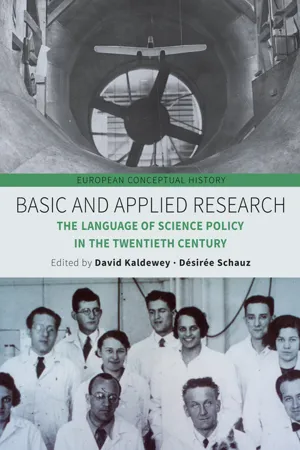
The distinction between basic and applied research was central to twentieth-century science and policymaking, and if this framework has been contested in recent years, it nonetheless remains ubiquitous in both scientific and public discourse. Employing a transnational, diachronic perspective informed by historical semantics, this volume traces the conceptual history of the basic–applied distinction from the nineteenth century to today, taking stock of European developments alongside comparative case studies from the United States and China. It shows how an older dichotomy of pure and applied science was reconceived in response to rapid scientific progress and then further transformed by the geopolitical circumstances of the postwar era.
eBook - ePub
Basic and Applied Research
The Language of Science Policy in the Twentieth Century
- 312 pages
- English
- ePUB (mobile friendly)
- Available on iOS & Android
eBook - ePub
Basic and Applied Research
The Language of Science Policy in the Twentieth Century
About this book
Information
Part I
Genealogies of Science Policy Discourses

Chapter 1
Categorizing Science in Nineteenth and Early Twentieth-Century Britain
Britain had no policy for science during the nineteenth and early twentieth centuries. Science was, however, called upon to address fears, problems, and incomplete narratives shared widely by government and people. Its study in schools and universities was a matter of perennial anxiety. Though the annual government grants given for research in the mid-nineteenth century were small, projects related to pressing government concerns received substantial support (Macleod 1971a, b). In the 1870s, the state funded the four-year round-the-world expedition by the naval vessel the Challenger, costing £100,000 ($500,000 or two million Reich Marks—hereafter RM). The mission to map and explore the deep sea and seabed was sustained both by the practical needs of laying an imperial telegraph network and by the scientific controversy over life and natural selection in such environments. The expedition resulted in fifty volumes of scientific reports, which set the stage for oceanography in the future (Burstyn 1972).
As the Challenger was finally returning to Britain in May 1876, London’s South Kensington Museum was responding to a call for a boost to scientific culture in industry and education by opening an exhibition of “scientific apparatus” that had cost £15,000 ($75,000 or RM 300,000) to mount (Committee of Public Accounts 1878: ix; de Clerq 2003; Bud 2014b). Ranging from the Stephenson’s pioneering Rocket locomotive to the Magdeburg hemispheres of von Guericke, this huge exhibition was visited by three hundred thousand people in just six months. The cost, hidden in the budget of the Science and Art Department (responsible for technical education), was equivalent to the entire recurrent budget of Berlin’s famous Physikalisch-Technische Reichsanstalt, founded a decade later in Charlottenburg (Pfetsch 1970: 575). Such major investments drew upon both the enthusiasm of a few influential intellectuals and civil servants and the wider engagement of military men, journalists, businessmen, and politicians. We need, therefore, to take seriously their commitment to the projects themselves, to the categories that made them possible—including, for instance, the inclusion of both “pure science” and “applied science” in the South Kensington exhibition—and to the concerns that underpinned them. Often seen as either so natural, or, alternatively, so misguided, as not to deserve historical attention, the use of these categories will be the concern of this chapter.
The classification of science into the categories of “applied” and “pure” (and closely related terms, such as “fundamental”) became conventional from the late nineteenth century, and remained so for a hundred years. In his classic study, The Organisation of Science in England, D. S. L. Cardwell (1957: 1) suggested that it was “applied science” for which policy was made in the period of his interest from the mid-nineteenth century to the beginning of World War I. When he was writing, now six decades ago, Cardwell’s priority was to look at policies, and less attention was paid to “pure” and “applied” science as concepts in themselves. In part, that was because these were still widely treated as realities, needing only precise definition. Furthermore, the context in which they were invoked was often the disconcertingly vague, and at that time often hard to recover, discourses between scientists and the general public, and the political rhetoric of competition and crisis.
Today, categories are no longer taken for granted, and historians have been enabled to deal with the public sphere more substantially by the availability of digitized newspapers. These are particularly interesting because the politically-aligned newspaper of the nineteenth century was closely interdependent with the political platform; speeches were widely reproduced verbatim in the national press and copied regionally; the texts of books and their reviews and advertisements were similarly already intermingled by canny publishers. Effectively, therefore, the discourses of news, marketing, and politics came to be interfused on the newspaper page.
The history of such concepts as “pure” and “applied” science is not just the history of specific phrases in the public sphere, but also of terms whose multiple meanings were reconfigured by new means of mass communication and discussion and of political debate.1 I shall argue, first, that talk about science and its categories did work that went beyond the conventional categories of epistemology. Second, in the public sphere, “applied science” came to be the key category, not dependent on “pure science.” Third, it was in the contexts particularly of educational debate that these categories first became significant.
The chapter begins with a focus on the development of language and the work it was expected to do. It deals with the nineteenth-century emergence of the concept of applied science to describe a form of knowledge particularly with an educational significance, and with the cognate terms “pure science” and “technology,” whose meanings were also shaped in educational contexts. It then treats two periods: first, the two decades spanning the end of the nineteenth century and the first years of the twentieth century, and, second, the years from World War I to the end of World War II. These periods differed not only in the issues that dominated their concerns but also in the technology of media spaces: the earlier period was limited to the printed word; in the later period, the wireless became important. They shared characteristics too—above all, perhaps, the exposure to overseas influence. During each of these periods, interaction with Germany, France, and the United States was profoundly important. The shared use of the English language meant a close interpenetration of British and American discourses. Many British scientists, and indeed other professionals, had studied in Germany, and knowledge of French was a requirement for the educated person. So, Britain acted as a key node in the international circulation of concepts about the structure of science.
The Nineteenth Century: Emergence of Terminology and the Educational Context
The familiar terminology of pure and applied science cannot simply be read back in time, or even straightforwardly translated into an older classification system. We can see the tortured difficulties in producing a 1783 English edition of Torbern Bergman’s Essay on the Usefulness of Chemistry. This was translated from Swedish into poor English (“lingua Franca”) by the Austrian Franz Swediauer, and then rendered into good English by the renowned philosopher Jeremy Bentham. The result was that the German term “philosophische Chemie” came to be rendered as “pure chemistry” (rather than “philosophical chemistry,” which might also have been acceptable). Perhaps surprisingly, the term “angewandte Chemie” became not “applied chemistry” but “(chemia applicata), mixt, particular or popular chemistry,” which Bentham subsequently referred to simply as “popular chemistry” (Bergman 1779: 10, 12; 1783: 16, 20; Linder and Smeaton 1968). To Bentham therefore, writing in 1783, “applied chemistry” was not an option.2
Instead of simply inheriting old categories, the nineteenth century saw a reconstruction. The concept of “applied science” that emerged in the second half of the nineteenth century was a hybrid of three ancestors: “applied sciences” (quickly corrupted to applied science), “science applied to the arts,” and “practical science.” Let us look at each of these.
It was the Germanophile poet, polymath, and religious conservative Samuel Taylor Coleridge who introduced the term “applied sciences” to the English language at the beginning of the nineteenth century. In 1817, a time of social unrest and economic depression in the wake of the Napoleonic Wars, Coleridge sought to stabilize thought through an encyclopedia that would provide a rational structure for all knowledge in opposition to the alphabetically organized, and thus epistemologically haphazard, Chambers Encyclopaedia (Link 1948). In his proposal for the Encyclopaedia Metropolitana, Coleridge proposed a classification based on absolute truth value. This drew upon the differentiation of pure sciences and applied sciences developed in Germany and inspired by the work of Immanuel Kant. The first category, science based on the synthetic a priori, was necessarily and immutably “true” and therefore labeled as “pure” (see chapter 2). The second category, “mixed and applied sciences,” more dependent also on empirical evidence, was necessarily contingent.3 Here Coleridge drew upon the German term “angewandte Wissenschaft,” which had been derived from Kant’s “angewandte Vernunfterkenntnis” (Kant 1786: vi; Bud 2013a). As for Kant, the knowledge of this kind was less certain than its “pure” partner. Coleridge’s structured encyclopedia, a form new to Britain, drew on a German tradition of Kantian compilers of knowledge, as exemplified for instance by Jena-based Carl Schmid, author of the 1810 Allgemeine Encylopädie und Methodologie der Wissenschaften (“Encyklopädie” 1895: 755; Snyder 1934: xxii). Although Coleridge argued with the publisher and eventually withdrew from the project, the encyclopedia nonetheless went ahead. It was completed over a period of twenty years and in twenty-eight volumes, thanks to a succession of three editors who shared both Coleridge’s religious and philosophical position. A section of more than five thousand pages on “Mixed and Applied Sciences” subsumed subjects ranging from the fine and useful arts to medical sciences.
The articles in the encyclopedia were no-snippet length sound bites. Many were the length of entire books and were published separately. Charles Babbage’s 1832 book On the Economy of Machinery and Manufactures was based on an entry he had contributed. This volume is itself credited by the Oxford English Dictionary as the first source of the phrase “applied science.” The attribution of priority is incorrect, but it does highlight the influence of the work that Coleridge had instigated. The names of its structuring concepts were promoted through the advertisements for the work as a whole and the influence of its essays. A search of the numerous digitized newspapers of the nineteenth century makes it clear that the term “applied sciences” first appeared in the press during the 1820s (and until 1836 exclusively) within advertisements for the encyclopedia. And even in these advertisements, the plural form was sometimes corrupted to the singular “applied science.”
A complementary origin lay in the phrase “science applied to the arts,” which is an import from the French “science appliquée aux arts.” This term grew out of a formulation systematized by the Conservatoire National des Arts et Métiers, an institution in Paris that was redefined in 1819 as dedicated to teaching “l’application des sciences aux arts industriels.” In 1848, for example, the professors were charged with formulating a “système général pour l’enseignement des sciences appliquées aux arts industriels” (Marchand 2005). The author of this term seems to have been Charles Dupin, previously trained at the fabled Ecole Polytechnique. He had been influenced by the elite thinking during his youth, the practical achievements of French savants under the pressure of the revolutionary wars, and then by his explanation for the staggering British industrial achievements during the time the two countries had been at war (Dupin 1825; Alder 1997; Bret 2002; Christen and Vatin 2009; Bud 2014a).
Finally, there was also a long-established English term, “practical science,” that often connoted empirical science, related to—but not derivative from—so-called “abstract science.” In his studies on the history of brewing, James Sumner (2015) has highlighted the tensions between experts with a claim to “practical” expertise and those whose knowledge was more abstract or theoretical. The term had been used occasionally in the eighteenth century, but its use grew in the nineteenth, only giving way to “applied science” in the 1860s. Thus, in 1865, the University of Cambridge introduced a new course whose designation had changed from practical science in preliminary discussions to applied science in the published announcement.4 These terms with rather different origins came to be used interchangeably, as they were hybridized to be useful in a new world.
Notwithstanding the efforts of Coleridge and his successors, the first occasion for the widespread journalistic use of the term “applied science” was coverage of the activities of the well-known and self-promoting chemist, J. F. W. Johnston and the campaign to cope with the elimination of tariffs on imported wheat. Applied science was proposed, for the first (but not the last) time as a substitute for “protection.” In the early 1840s, Johnston, professor at the new University of Durham, purveyor of soil analyses, and founder of the British Association, having originally espoused the term “science applied to the arts,” changed his linguistic allegiance. He argued that the model of “applied science” could be seen in the coherent body of techniques of navigation based on astronomy that had permitted sailors to sail the oceans. Across the country, the press, including the Economist, which led the campaign against tariff protection, endorsed Johnston’s views that British agriculture could be saved through the careful assembly of techniques of soil analysis and “applied science” (Bud 2014a).
In the aftermath of the Great Exhibition of 1851, usages of “applied science” came to be even more common, but increasingly they were redirected to promoting the needs of educational innovation. While there were no clear definitions, there were illustrative stories that served as illuminating metaphors in making sense of the concept. The “romances” of the great inventors, James Watt and Robert Stephenson, both heroes of the nation as a whole and of specific regions, were incorporated within allegorical narratives about the nation’s rise to greatness and the needs of its renewal. In 1867, the chemist George Gore was allowed two columns to lecture readers of the Birmingham Post on the importance of applied science to local industries, one quarter of which was devoted to the scientific heritage on which James Watt had drawn. In the region of North East England, centered on Newcastle-on-Tyne, Robert Stephenson, son of George and himself father of the railway system, was the scientific hero. The lives of both Watt and Stephenson could be read in terms of their arduous pursuit of a scientific education leading to brilliant achievements. These narratives communicated the truly local and national ancestry of applied science, belied any assertion it was an alien concept, and laid out a path for Britain’s educational development in the future (Bud 2014a).
Just as Watt was destined, however unjustly, to be a hero of applied science, so Michael Faraday, perhaps equally unjustly, became the hero of that category’s destined counterpart, “pure science.” This, too, was a hybrid of native, imported, and pragmatic conceptions. There was a rich tradition of the practice of science for the sake of curiosity, sanctified by religion and validated by its interest and results. Often called “abstract science,” it was, however, not sustained by a long domestic philosophical tradition. It is true that the term “pure science” is deeply rooted in the English language and appears in the writings of Samuel Johnson (1750) in the eighteenth century, but it was historically rarely used. It was to German sources that Coleridge had turned when he formulated his classification. Studying in Göttingen in the 1790s, Coleridge had been a pioneer in the English journey to German universities, which in the mid-nineteenth century became, for the British man ...
Table of contents
- Cover
- Title Page
- Copyright Page
- Contents
- List of Figures
- Preface
- List of Abbreviations
- Introduction Why Do Concepts Matter in Science Policy?
- Part I. Genealogies of Science Policy Discourses
- Part II. Conceptual Synchronization and Cultural Variation
- Part III. Outlook
- Indexes
Trusted by 375,005 students
Access to over 1.5 million titles for a fair monthly price.
Study more efficiently using our study tools.
Frequently asked questions
Yes, you can cancel anytime from the Subscription tab in your account settings on the Perlego website. Your subscription will stay active until the end of your current billing period. Learn how to cancel your subscription
No, books cannot be downloaded as external files, such as PDFs, for use outside of Perlego. However, you can download books within the Perlego app for offline reading on mobile or tablet. Learn how to download books offline
Perlego offers two plans: Essential and Complete
- Essential is ideal for learners and professionals who enjoy exploring a wide range of subjects. Access the Essential Library with 800,000+ trusted titles and best-sellers across business, personal growth, and the humanities. Includes unlimited reading time and Standard Read Aloud voice.
- Complete: Perfect for advanced learners and researchers needing full, unrestricted access. Unlock 1.5M+ books across hundreds of subjects, including academic and specialized titles. The Complete Plan also includes advanced features like Premium Read Aloud and Research Assistant.
We are an online textbook subscription service, where you can get access to an entire online library for less than the price of a single book per month. With over 1.5 million books across 990+ topics, we’ve got you covered! Learn about our mission
Look out for the read-aloud symbol on your next book to see if you can listen to it. The read-aloud tool reads text aloud for you, highlighting the text as it is being read. You can pause it, speed it up and slow it down. Learn more about Read Aloud
Yes! You can use the Perlego app on both iOS and Android devices to read anytime, anywhere — even offline. Perfect for commutes or when you’re on the go.
Please note we cannot support devices running on iOS 13 and Android 7 or earlier. Learn more about using the app
Please note we cannot support devices running on iOS 13 and Android 7 or earlier. Learn more about using the app
Yes, you can access Basic and Applied Research by David Kaldewey, Désirée Schauz, David Kaldewey,Désirée Schauz in PDF and/or ePUB format, as well as other popular books in Storia & Storia del XX secolo. We have over 1.5 million books available in our catalogue for you to explore.