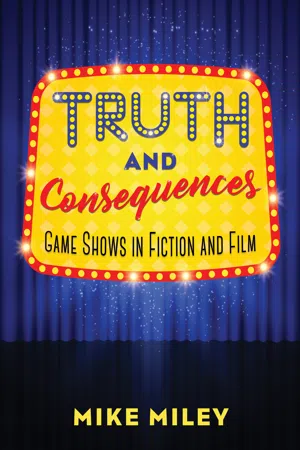
Although nearly every other television form or genre has undergone a massive critical and popular reassessment or resurgence in the past twenty years, the game show's reputation has remained both remarkably stagnant and remarkably low. Scholarship on game shows concerns itself primarily with the history and aesthetics of the form, and few works assess the influence the format has had on American society or how the aesthetics and rhythms of contemporary life model themselves on the aesthetics and rhythms of game shows. In Truth and Consequences: Game Shows in Fiction and Film, author Mike Miley seeks to broaden the conversation about game shows by studying how they are represented in fiction and film. Writers and filmmakers find the game show to be the ideal metaphor for life in a media-saturated era, from selfhood to love to family to state power. The book is divided into "rounds, " each chapter looking at different themes that books and movies explore via the game show. By studying over two dozen works of fiction and film—bestsellers, blockbusters, disasters, modern legends, forgotten gems, award winners, self-published curios, and everything in between— Truth and Consequences argues that game shows offer a deeper understanding of modern-day America, a land of high-stakes spectacle where a game-show host can become president of the United States.
- 262 pages
- English
- ePUB (mobile friendly)
- Available on iOS & Android
eBook - ePub
About this book
Information
Subtopic
Film & VideoRound One
WHAT’S MY LINE?
Game Shows and the Quest for an Authentic Self
IF ONE MUST BEGIN A DISCUSSION OF GAME SHOWS BY REviewing how much scholars and critics revile them, the next topic one must address is the only aspect of the game show’s identity and history that has merited sustained scholarly attention: the quiz-show scandals of the late 1950s. The big-money quiz show’s ability to spark water-cooler conversation and anticipation for the next broadcast fueled the rising popularity of live television. Their success would not have been possible without the 1954 Supreme Court case The Federal Communications Commission v. American Broadcasting Co., Inc., which legalized game shows by ruling that jackpot prizes did not constitute gambling. Networks capitalized on this ruling instantly: the $64 grand prize question on CBS radio’s Take It or Leave It mushroomed into CBS television’s The $64,000 Question. The audience for quiz shows increased proportionate to the size of the jackpots. At the quiz show’s height, during the 1957–1958 season, viewers had twenty-two game shows to choose from across the three networks, with quiz shows alone constituting 18 percent of NBC’s entire slate of programming (Anderson 104–5).
Facing pressure from their sponsors to garner higher ratings from an ever-growing television audience in an increasingly competitive field, the producers of The $64,000 Question, Tic-Tac-Dough, Twenty-One, and other quiz shows kept audiences hooked on their programs by rigging the outcomes of their contests, usually by giving contestants the questions and answers in advance and arranging for a contestant’s defeat when their ratings stagnated. Allegations of fixing surfaced as early as 1957 but did not garner traction until a year later when contestants from several shows came forward with similar allegations. While a congressional subcommittee would not investigate quiz shows until 1959, the networks responded promptly and began cancelling shows after the allegations, assisted by a glut of too-similar programming, decimated ratings. By the end of 1958, quiz shows occupied just three hours of airtime across all three networks, making “quiz,” as Time suggested, “television’s own four-letter word” (Anderson 132, 133).
The effect that these scandals had on game shows is easy enough to see. For starters, quiz shows were renamed “game shows” to distance the new programming from that other four-letter word that smacked of scandal, and game shows moved out of the networks’ primetime lineups to daytime slots, where they generally remain today. However, more substantive changes fell into place as well: prize money on a television show could not exceed $75,000, and the FCC made it a crime to broadcast a contest with intent to deceive the audience (Holmes 49). But the fallout from the quiz show scandals was not limited to the game show format: it molded the history and identity of television itself. As Kent Anderson puts it in his history of the quiz-show scandals, networks, especially CBS, “attempted to institutionalize honesty” in an attempt to regain the public’s trust, going so far as to prohibit laugh tracks or fake applause from all shows and to announce to the audience whenever any material had been previously recorded or scripted (159–160). The most significant change to television that the scandals aided in was the end of “sponsor-controlled programming” (Hoerschelmann 70). Rather than one company sponsoring an entire program and thus having a disproportionate influence over that program’s content (e.g., Geritol’s sponsorship of Twenty-One), several sponsors bought time during specifically scheduled blocks of the broadcast called commercial breaks (Holmes 49). Thus, the scandals contributed greatly to the identity broadcast television enjoyed until the arrival of cable.
Television’s transition from its pre-scandal identity of uninterrupted, single-sponsor programming to its fragmented, multiple-sponsor programming identity post-scandal resembles the shift in American culture’s understanding and presentation of the self from the modern to the postmodern era. Douglas Kellner outlines this shift in “Popular Culture and the Construction of Postmodern Identities,” arguing that although identity in the modern era becomes more pliable and fluid, its boundaries remain relatively fixed, dependent on a person’s social roles (mother, worker, etc.) and what aspects of one’s identity society deems worthy of recognition (141). This situation produces the modernist senses of self-consciousness, anxiety, and alienation: once one becomes aware of possessing a self, “one can choose and make—and then remake—one’s identity”; however, “one is never certain that one has made the right choice” or discovered one’s “true” self, and even if one were, one can become anxious over or alienated by that identity not being “socially validated” (142). As modernity gives way to postmodernity and social relations become faster and increasingly complicated and ambiguous, the self becomes more “fragmented and disconnected” and “no longer possesses the depth, substantiality, and coherence that was the ideal and occasional achievement of the modern self” (144). In the face of such instability, “the postmodern self accepts and affirms multiple and shifting identities” in what amounts to “a theatrical presentation” of an ambiguous self that is constantly in flux, dependent less on one’s social role than on one’s idealized conception of their identity at any given moment (158, 156). The postmodern self embraces the notion that identity is artificial, “a game that one plays” wherein players adopt and shed identities at will as they jockey for the “admiration and respect of other players” (153; emphasis added). For Kellner, the postmodern sense of self serves as “a function of leisure and is grounded in play, in gamesmanship” and “center[s] on looks, images, and consumption,” with players turning to popular culture, especially the visual rhetoric of advertising and television, to provide the looks they choose from to construct their identities (153). The postmodern self that Kellner describes is but another, smaller-scale spectacle in an age of media megaspectacle.
Like Kellner, Jean-François Lyotard sees the presentation of the self as a game one plays within the postmodern social realm, alleging that “no self is an island,” stable, autonomous, and unmoving, but rather a “post” or “nodal point” in “a fabric of relations … through which various kinds of message pass” (15). The transfer of these messages back and forth occurs at the level of language, which, for Kellner, includes the language of images and media as a whole. Lyotard modifies Wittgenstein’s concept of “language games” to describe these transfers of information, stating, “Each of the various categories of evidence can be defined in terms of rules specifying their properties and the uses to which they can be put” (10). Given that it constitutes a structured social interaction with rules that declare only certain moves, answers, and behaviors acceptable, a game show is but another language “game of inquiry”; however, Lyotard explains that performativity (or play) in social relationships “contributes to elevating all language games to self-knowledge … jolt[ing] everyday discourse into a kind of metadiscourse,” with “ordinary statements” increasingly indulging in “self-citation” (62). Each “ordinary statement” of inquiry eventually winds up addressing the self, making the language games of social interaction, even those on a game show, into quests for greater self-awareness and presentation. Therefore, while all these images, narratives, and games that make up the social bond appear concerned solely with things outside the self, engagement in and among these elements of culture winds up increasingly illuminating one’s interior, as players use these artifacts to discover, construct, and present a self in the hope that their self will be rewarded, that they will not be isolated from the social bond but rather become prominent “nodal points” in the network of social relationships.

Twenty-One’s isolation booth.
The intermedial texts that incorporate game shows into their narratives position the game show and its scandalous origins as a metaphor for how individuals construct, manipulate, and broadcast a self to others in a media age. The rigged quiz show Twenty-One featured a production element that illustrates this postmodern sense of self: the isolation booth. Contestants stood in these soundproof booths for the length of the game, unable to see the other contestant’s score or hear their answers. The players were totally alone, yet fully on display. These isolation booths, along with the questions locked in a Manhattan bank vault until moments before broadcast, sold audiences on the show’s authenticity, isolating and displaying integrity as prominently as the contestants’ bodies. Of course, that sense of authenticity turned out to be a façade, part of a rigged and scripted spectacle. What a contestant can or cannot hear through their studio headphones becomes irrelevant when that contestant already knows all the questions and the answers they will be asked. In the place of actual authenticity and knowledge, Twenty-One delivered the performance of authenticity and knowledge; as Kent Anderson put it, “showmanship would have to take precedence over honesty” (46).
The fact that both the display of integrity and the contestants’ display of knowledge were all part of a rigged performance aligns with the transition from a modernist concern with authenticity to a postmodernist preference for performativity. Like the reality shows that followed in the Land of the Game Show, the big-money quiz shows were “all about the simulation rather than the representation” of identity (Morreale 104). The films and books that use the game show intermedially as a metaphor for the self follow suit, depicting American life as a rigged game in which one must betray themselves in order to succeed, making themselves over into a ready-for-primetime persona, an inauthentic self in a rigged world. In doing so, these works “make visible the ways that identity is created through rehearsal and performance of already fabricated images. It naturalizes the idea that identity is fluid and mobile, a commodity sign that we circulate in an endless attempt to make meaning” (Morreale 104).
Works such as Robert Redford’s Quiz Show and Chuck Barris’s Confessions of a Dangerous Mind (and George Clooney’s film adaptation) declare “there is no coherent core, no deep interior behind the surface appearance of a social self” because media culture cannot represent it, comprehend it, or sell it (Morreale 104). The deeper, more authentic self touted by modernists and Romantics cannot be broadcast or reduced to an image commodity, which makes it a casualty in a hypermediated consumer society. In entering the “community” of television, players must change something about themselves, which could be as innocuous as capping their teeth or as monumental as denying what they know or where they come from—their identity. However, in the world of these works, contrary to Kellner’s assessment of postmodern identity, authors portray these alterations to identity as betrayals. Just like the isolation of single-sponsored programming gives way to the fragmented chorus of commercial breaks, these works show how television ushers in a postmodern sense of identity for the individual: players betray the fixed self of the modernists for a fluid postmodern identity in order to escape isolation and join the “community” of the televisual landscape.
The works in this round use the isolation booth metaphorically to represent how the self functions in a mediated world where people are simultaneously isolated and visible. Isolation booths of all stripes, both literal and figurative, appear in fiction and films that use the game show as a narrative device, be it the literal isolation booth on a game show set, the isolation booth of a police interrogation room, the isolation of social class, ethnicity, and nationality, or the isolation that comes from one who hides who they are from the world at large, even from themselves. In presenting the illusion of authenticity, the game show isolates the self from itself in favor of a more telegenic, performative persona.
Past writers and thinkers endorse an unmediated self as the more authentic, coherent, and desirable self, but writers and filmmakers in the Land of the Game Show, after Kellner, concede that such a self no longer exists because one either exists inside the sphere of media or does not exist at all. After all, as Kellner shows, one cannot construct a self if one does not play the game. The bulk of this round on authenticity and the self deals with works that view the self through a lens of deception and subterfuge: rigged games, false testimony, duplicitous identities, from the quiz show scandals to Chuck Barris’s alleged double life as a CIA hitman to racially and economically motivated exploitation and discrimination. In their depiction of liars, cheaters, and killers masquerading as average Americans, these works illustrate the number of different selves and masks citizens have on hand to present to others.
While one might expect American stories and films to result in triumph for the individual, instead these works present a world with everyone’s roles and outcomes already defined. These works illuminate how the logic of game shows and consumer culture at large promise a ticket out of the trappings of one’s social class but actually keep players trapped in their social position by imposing limits on what a person can know—and how much they can achieve—based on socioeconomic standing and ethnicity. The American meritocratic narrative holds up one’s knowledge as a method to transcend the confines of race- and class-based stereotypes and limitations; these works call knowledge’s power to topple prejudice and oppression into question and, by extension, the American narrative of achievement itself. Any advancements outside one’s position in the rigged game of American life constitutes an infraction of the social order, and these gains must be repossessed by the dominant culture. The game show becomes more than a willing tool in this process but an instigator, co-conspirator, or microcosm, transforming the presentation of self into a spectacle for audience consumption. The mechanics of television become the arbiter of the true self, deciding what will “play” as a marketable identity. As such, the game show as depicted in these texts becomes a totalizing entity that comes to represent the totalizing entity of media culture at large, with the spectacle becoming the only thing that is real, stable, and true. Fiction and films featuring successful depictions of resistance to television’s postmodernist conception of the self eschew realism in favor of fantasy-based happy endings, coincidences, and musical numbers that tacitly acknowledge the impossibility of a return to a modernist or even Romantic sense of self occurring in reality, or at least not in a reality that media can imagine.

CATEGORY
TO TELL THE TRUTH
“An educated man, then, and a quiz show contestant are moving rather rapidly in opposite directions. The world of the educated man is full of mysteries. It is foggy and dark; with lots of unlighted passages leading off to no one knows where. The more educated he is the more passages he discovers.… Opposed to the dim uncertainty of the world of the educated man is the bright little circle of light in which the quiz show contestant basks in his isolation booth. All is certainty there. One need not worry or be distressed. Only those questions are asked which have answers. And then only if the answers are available, on a card held in the M.C.’s hand. Probably fireflies, flitting about in the spring twilight, are as sure of their little circles of luminescence as the contestant is of his.”
—CHARLES VAN DOREN (QUOTED IN ANDERSON 100)
Columbia University professor Charles Van Doren wrote this seemingly humble and self-effacing passage in Life Magazine in 1957, shortly after his success as a contestant on the quiz show Twenty-One had catapulted him to a level of stardom that earned him comparisons to Elvis Presley (Anderson 70). Van Doren, approaching his new status as a national role model with the utmost gravity, sought to steer his many admirers toward the “dim uncertainty” a meaningful education provides rather than the “bright little circle” of big money and fame that television promises. Less than two years later, his assertion that “all is certainty” in the isolation booth would acquire a bitter irony after he testified to a congressional subcommittee that his quiz-show success resulted from the producers of Twenty-One feeding him his questions and their answers in advance. However, rather than damning Van Doren as a charlatan, his statement predicts the televisual reality that big-money quiz shows inaugurated. The world is now the “bright little circle” of television, and viewers the “fireflies” avoiding the “unlighted passages” outside its “little circle of luminescence.”
Dieter Hoffmann-Axthelm describes identity as “one of the grand promises of the modern,… the paradise of a secularized promise” where “one need not be torn apart, or identify with any rival power—but could remain true to oneself” (200). Robert Redford’s 1994 film Quiz Show, which dramatizes the rigging of Twenty-One, challenges Hoffmann-Axthelm’s assertion. In Quiz Show, the arrival of the age of mass media, best represented by television, constitutes a “rival power” that threatens to tear apart the “educated man” or woman naïve enough to refuse to “identify with” television and attempt to “remain true to oneself” in the “bright little circle” of one’s isolation booth.
The film wastes little time in establishing the menace of broadcasting. The opening scene contains the first appearance of mass media in the film, when protagonist Richard Goodwin (Rob Morrow) flips on the radio of an immaculate Chrysler in a car dealership. The car’s shiny chrome antenna rises gracefully upward, only to pick up the signal of a far more significant launch: Sputnik. While this scene’s juxtaposition of the Chrysler with Sputnik may appear to correspond with the big-money quiz show’s endorsement of “knowledge and education” as “an important counterbalance to consumerism,” the opening credits montage that follows the car dealership scene shows how such notions are like the Chrysler’s chrome antenna: shiny luxury objects that distract from the threat lurking in the airwaves (Hoerschelmann 73). In a cruel twist of irony, one needs the appurtenances of mass media to pick up the media’s nefarious signal, and by then it is too late. Overtures to intellectual advancement over consumption are just that in Quiz Show: camouflage for media’s (and its sponsors’) infiltration of every aspect of American life. While everything look...
Table of contents
- Cover
- Title Page
- Copyright
- Dedication
- Contents
- Toss Up: Trivial Pursuit
- Round One: What’s My Line? Game Shows and the Quest for an Authentic Self
- Round Two: Love Connection: The Game Show’s Erogenous Zones
- Round Three: Family Feud: The Game-Show Families of Salinger, Wallace, and Anderson
- Round Four: Fear Factor: Game Shows, State Power, and Death
- Final Jeopardy
- Acknowledgments
- Bibliography
- About the Author
Trusted by 375,005 students
Access to over 1.5 million titles for a fair monthly price.
Study more efficiently using our study tools.
Frequently asked questions
Yes, you can cancel anytime from the Subscription tab in your account settings on the Perlego website. Your subscription will stay active until the end of your current billing period. Learn how to cancel your subscription
No, books cannot be downloaded as external files, such as PDFs, for use outside of Perlego. However, you can download books within the Perlego app for offline reading on mobile or tablet. Learn how to download books offline
Perlego offers two plans: Essential and Complete
- Essential is ideal for learners and professionals who enjoy exploring a wide range of subjects. Access the Essential Library with 800,000+ trusted titles and best-sellers across business, personal growth, and the humanities. Includes unlimited reading time and Standard Read Aloud voice.
- Complete: Perfect for advanced learners and researchers needing full, unrestricted access. Unlock 1.5M+ books across hundreds of subjects, including academic and specialized titles. The Complete Plan also includes advanced features like Premium Read Aloud and Research Assistant.
We are an online textbook subscription service, where you can get access to an entire online library for less than the price of a single book per month. With over 1.5 million books across 990+ topics, we’ve got you covered! Learn about our mission
Look out for the read-aloud symbol on your next book to see if you can listen to it. The read-aloud tool reads text aloud for you, highlighting the text as it is being read. You can pause it, speed it up and slow it down. Learn more about Read Aloud
Yes! You can use the Perlego app on both iOS and Android devices to read anytime, anywhere — even offline. Perfect for commutes or when you’re on the go.
Please note we cannot support devices running on iOS 13 and Android 7 or earlier. Learn more about using the app
Please note we cannot support devices running on iOS 13 and Android 7 or earlier. Learn more about using the app
Yes, you can access Truth and Consequences by Mike Miley in PDF and/or ePUB format, as well as other popular books in Media & Performing Arts & Film & Video. We have over 1.5 million books available in our catalogue for you to explore.