Juan Francisco Manzano and Gabriel de la Concepción Valdés (Plácido) were perhaps the most important and innovative Cuban writers of African descent during the Spanish colonial era. Both nineteenth-century authors used Catholicism as a symbolic language for African-inspired spirituality. Likewise, Plácido and Manzano subverted the popular imagery of neoclassicism and Romanticism in order to envision black freedom in the tradition of the Haitian Revolution.
Plácido and Manzano envisioned emancipation through the lens of African spirituality, a transformative moment in the history of Cuban letters. Matthew Pettway examines how the portrayal of African ideas of spirit and cosmos in otherwise conventional texts recur throughout early Cuban literature and became the basis for Manzano and Plácido's antislavery philosophy. The portrayal of African-Atlantic religious ideas spurned the elite rationale that literature ought to be a barometer of highbrow cultural progress.
Cuban debates about freedom and selfhood were never the exclusive domain of the white Creole elite. Pettway's emphasis on African-inspired spirituality as a source of knowledge and a means to sacred authority for black Cuban writers deepens our understanding of Manzano and Plácido not as mere imitators but as aesthetic and political pioneers. As Pettway suggests, black Latin American authors did not abandon their African religious heritage to assimilate wholesale to the Catholic Church. By recognizing the wisdom of African ancestors, they procured power in the struggle for black liberation.
eBook - ePub
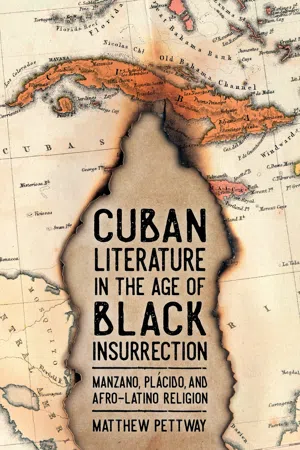
Cuban Literature in the Age of Black Insurrection
Manzano, Plácido, and Afro-Latino Religion
- 344 pages
- English
- ePUB (mobile friendly)
- Available on iOS & Android
eBook - ePub
Cuban Literature in the Age of Black Insurrection
Manzano, Plácido, and Afro-Latino Religion
About this book
Information
Publisher
University Press of MississippiYear
2019Print ISBN
9781496825018
9781496824967
eBook ISBN
9781496824981
CHAPTER ONE
The Introduction
On August 16, 1844, a Spanish newspaper rejoiced in the “peace and tranquility” of the American continent whose “virgin and innocent country” had defeated a dangerous conspiracy against the queen. El Laberinto named one conspirator: Gabriel de la Concepción Valdés, a Cuban poet known as Plácido. Plácido was portrayed as “a celebrated poet, a sublime genius in whose veins flow both African and European blood.”1 The exposé aroused emotion in its Madrid readership, referring to the “vast continent where our brothers of America [reside],” and it depicted Spanish readers as sympathizers whose hearts were torn to pieces by “the most crushing pain.” Furthermore, the newspaper exclaimed, “the tears well up in our eyes and the soul empathizes when speaking of that unhappy scene.” The “unhappy scene” was a euphemism for antislavery insurgencies that threatened to abolish the slave regime in Cuba and deprive Her Majesty of extraordinary wealth.2 This was the conspiracy in which Plácido was implicated. Although the author of the article didn’t doubt Plácido’s culpability, he approached his subject with a grave sense of ambivalence, not unlike other contemporaries. He observed that readers might condemn Plácido to death on the one hand, even as they unlocked his prison cell on the other.
Curiously, the author did not name the charges brought against Plácido, rather he described a litany of poems that his “brilliant and audacious imagination” had conjured up. Among these was the sonnet “El juramento” (The Oath), wherein Plácido swore to defile his vestments with the blood of queen.
In the shadow of a towering tree
That stands at the end of an ample valley
There is a fount that bids you
Drink its pure and silvery water
There I went by my duty called
And making an altar of the hardened earth
Before the sacred code of life,
My hands extended, I have sworn an oath.
To be the eternal enemy of the tyrant,
If it is possible, to tarnish my vestments,
With his detestable blood, by my hand
Shedding it with repeated blows
And dying at the hands of an executioner,
If need be, to break the yoke (Plácido qtd. in Cué, Plácido: El poeta 87–88)
Plácido’s power resided in his pen. “El juramento” was a counterhegemonic poem for three reasons: it swore an oath of secrecy among blacks, it professed a sacred code of life, and it prophesied the execution of the queen. Plácido believed in the intrinsic power of language, the power of words to transform the outcome of events and to prophesy against empire. He produced Janus-faced poetry that affirmed loyalty to the Catholic Church even while undermining its doctrinal premises with African-inspired ideas of spirit and cosmos. In “El juramento,” Plácido resignified religious tropes steeped in Spanish Catholic history: the altar, the divine calling, and the oath of fidelity. In the first two stanzas, the prospective insurgent is invited to a shaded area beneath a tree, where he proceeds to make an altar of “the hardened earth.” Plácido constructed an altar of his own; a ritual object he fashioned outside the cathedral walls and without the interference of Catholic priests. Plácido’s altar did not sanctify the Eucharist; instead, his altar revered the sacredness of the natural world. In contradistinction to Catholicism, the African-inspired altar is “sacred space” (Dodson 62), an edifice for remembering the dead that is consecrated for sacrifice to African divine spirits and ancestors (Millet 7; Cabrera 287).
But the meanings, contours, and function of the altar are determined by the religious tradition in question. Plácido’s altar of “hardened earth” is reminiscent of a Bakongo Cuban conception of the natural world, particularly the forested wilderness as a sanctuary for communion with African divine spirits and ancestors. Lydia Cabrera affirmed that forests possess everything black Cubans require for their “magic … and their well-being” (15). Cabrera’s informants expounded on that theme explaining, “The ceiba tree is an altar to palo monte practitioners” that deposit sacred items beneath the tree to absorb “the virtue of its shadow” (166). In Plácido’s poem, the tree is not an altar per se, but its sacred silhouette creates space for insurgents to swear oaths of vengeance against slave society. Plácido’s altar beckoned a religio-political order where African descendants might reject Spanish colonialism and subvert the political authority of the Spanish Catholic Church. The nature metaphors—the tree and hardened earth—are important because they establish Cuba, not Spain, as Plácido’s fatherland.
Oaths inhabit the intersection between religion and politics (Prodi qtd. in Agamben 1); they constitute a social and political covenant between diverse interlocutors within a given polity. Giorgio Agamben points out that political crises arise when either party disregards or dishonors the oath they have sworn (Philo qtd. in Agamben 21). Plácido’s oath “to tarnish, my vestments / With his detestable blood” was a revolutionary speech act articulated in a subtle but formidable African-Cuban religious discourse. The emerging antislavery aesthetic in Plácido’s poetry constituted what Edward Said described as “a systematic conversion of the power relationship between the controller and the controlled” (16). But Plácido was not the only Cuban writer to incorporate an African spiritual subtext in literature, nor was he the only one to provoke the queen’s wrath with seditious writings.
In May 1844 Plácido and his accomplice Manzano sat in dark and dreadful prisons awaiting trial for their alleged involvement in what the Spanish government described as “the conspiracy devised by people of color … to exterminate … the white population.”3 Plácido and Juan Francisco Manzano did not enjoy the anonymity that may have protected their spoken-word counterparts from political persecution and arrest. Forty years following the triumph of the only revolution engineered by enslaved persons, the Spanish dreaded that Cuba, too, might become black and African, in a word Haitian. The military government scoured the free population of color in search of the movement’s intellectual leaders, and a small, though culturally significant, African-descended artisan and professional class fell under suspicion as agents and agitators of conspiracy. The authorities charged Manzano with aiding and abetting a conspiracy to abolish slavery and depose the regime. But the charges levied against Plácido were far more severe. Gabriel de la Concepción Valdés was convicted of being the president, mastermind, and recruiter of an insidious plot to exterminate the white inhabitants and to institute a republic of blacks and mulattoes on the island. Though Manzano would survive the gruesome ordeal on June 28, 1844, colonial authorities executed Plácido on charges of treason, having him shot in the back.
The authorities not only questioned Plácido and Manzano’s secretive meetings, hidden communiqués, and travel plans but also interrogated them about writing seditious literature. The government inquest about a “pohetica alusiva a planes contrarios a la tranquilidad y seguridad de esta Isla” (poetics alluding to plans contrary to the tranquility and security of the Island) (Friol 207) bespoke a concerted effort to define the poetics of conspiracy. The Spanish government’s suspicions about seditious literature reflect the pervasive abolitionist atmosphere of the 1830s. In 1833 Britain abolished slavery in the Anglophone Caribbean and in 1835 pressured Spain to consent to yet another antislave-trade treaty (Paquette 92, 132). Perhaps of even greater consequence, slave insurrections throughout Cuba had become frequent roughly ten years prior to the detention of Manzano and Plácido in 1844 (Midlo Hall 56).4 The Spanish government employed all manner of surveillance, interrogation, and torture to discover who had instigated “the conspiracy of the people of color” and, perhaps more importantly, to determine the intellectual character of an emerging black Cuban literary tradition.
The charges levied against Plácido and Manzano were indicative of white anxieties about African-descended writers as the architects of discourse. How could writers with no formal humanistic training, no military expertise to speak of, and no experience in the diplomatic corps pose a political threat to one of the greatest empires in the world? What subversive writing practices did Plácido and Manzano employ in their poetry and prose? What role did religious discourse play in the creation of anticolonial literature? And what did they hope to accomplish by writing against the Spanish Empire? This book analyzes what Eugene Genovese termed a “revolution in consciousness” that the Haitian Revolution ignited. Blacks throughout the African Diaspora encrypted antislavery ideology in literature, in their quotidian behaviors, and even in plantation uprisings.5
My central claim is that Manzano and Plácido portrayed African-inspired spirituality beneath the surface of Hispano-Catholic aesthetics, which, in effect, transformed early Cuban literature into an instrument of black liberation. I argue that Manzano and Plácido seized upon images of the Virgin Mary and Catholic saints, and resignified Neoclassical and Romantic tropes to conceal the African-inspired ritual subtext they had relied upon to procure myriad modalities of freedom. Although much of their writing touched upon uncontroversial motifs, including the pastoral idyll, unrequited love, and celebratory verse in honor of a wealthy patronage, their politically motivated portrayal of religion often subverted the Catholic traditions they claimed to represent. Plácido and Manzano did not envision emancipation through the lens of a Catholic doctrine that extolled redemptive suffering as a means to salvation. Rather, they relied on a spirituality of African inspiration in order to procure the power necessary to liberate themselves. Their depiction of African-inspired spirituality masqueraded as folk Catholicism. Because the government censored all literature, and black poets relied on the social legitimacy that the Church afforded them, Manzano and Plácido could not set the terms of debate. Yet, for all its power over language and liturgy, the Church could neither define nor control the African-Cuban cultural lens, nor could it govern African-descended sensibilities about spirit presence, revelation, and ritual powers. I define the African-Cuban cultural lens as a dichromatic paradigm, an inclusive worldview where multiple religious epistemologies coexist and intermingle in the colonial environment.
Plácido and Manzano introduced African ideas of spirit and cosmos into a nascent Cuban literary tradition in the early nineteenth century. In a manner consistent with Michel Foucault’s theory on discourse analysis, they incorporated African-inspired spirituality within the official religious discourse (216). Manzano and Plácido managed, on occasion, to avert the censorship regime, because their transculturated colonial literature affirmed and negated religious meanings at the same time. Consequently, they eluded Spanish censorship of religious writings that contradicted the Holy Faith. But the censorship administration and the Catholic Church were not the only threats to their literary imagination. Plácido and Manzano relied on tightknit units of white Cuban writers to publish their literature. Domingo del Monte was the leading Cuban humanist and he exerted considerable influence over the direction of early Cuban literature. Del Monte was a reformer who feared that the growing African population in Cuba might foment rebellion and, eventually, imperil his dream of white Creole self-governance (Fernández de Castro ed. 144–145). Del Monte endorsed reformist literature that critiqued Cuban slavery in hopes of abolishing the Atlantic slave trade. And he collaborated with Manzano and Plácido in furtherance of his political project, but they did not always share similar objectives. Despite what some critics have claimed, del Monte was not an abolitionist. In fact, del Monte dreaded the abolition of slavery, because he assumed abolition would imperil his person and his profits, and eventually threaten “the existence of my race” (M. Miller 426; Branche, Colonialism 129). Del Monte’s literary coterie produced black characters as romanticized victims of slavery, never rebellious maroons that defied their subjugation (Barreda 44–45). Anselmo Suárez y Romero’s novel Francisco and Félix Tanco y Bosmeniel’s Petrona y Rosalía promoted a form of Catholicism that neither emancipated the slaves nor empowered them to liberate themselves.6 In the main, white intelligentsia precluded African spiritual practices from their construction of Cuban national culture. As Cuban scholar Eduardo Torres Cuevas writes, “Catholicism became the ideological expression and the unifying factor of Creole identity” (90). Domingo del Monte was an avowed Catholic who was unsympathetic to the cultural values within African-inspired religious culture. Del Monte struggled to wrest creative control from Plácido and Manzano in order to yield propaganda that might further the interests of white society.
Manzano and Plácido’s writings alluding to African ideas of spirit and cosmos constitute what I have termed transculturated colonial literature, that is, intercultural texts that emerged as an aesthetic response to the discursive prohibitions of the Catholic Church, the censorship administration, and del Monte’s literary circle. I posit transculturated colonial literature as a theoretical lens for probing self-dissembling texts existing within an intervening space, situated on the periphery yet palatable to a metropolitan readership. (I will expound on this theory later in the chapter.) Plácido and Manzano portrayed Bakongo and Yoruba cosmologies (West Central and West African belief systems respectively) in euphemisms that subverted Catholic doctrine and at the same time created space for continuous revelation from the spirit world. Manzano and Plácido’s literature questioned the authority of the Catholic Church, even though they had pledged loyalty to the one true religion. Furthermore, Manzano produced the only known slave autobiography in Spanish American cultural history, and he published the earliest example of black Cuban theatrical work. Manzano ultimately became an antislavery intellectual comparable to his counterpart Plácido. Plácido published revolutionary poetry that defined liberty as the divine right of Cubans, and he assailed the queen as an illegitimate ruler on the throne.
Juan Francisco Manzano and Gabriel de la Concepción Valdés were the most radical poets of African descent in nineteenth-century Cuba, producing an extensive body of work even as the slave aristocracy reached the height of its power.7 Manzano was born into slavery in Havana in 1797 and didn’t achieve emancipation until 1836; but his contemporary Plácido was born free in Havana in 1809. Plácido and Manzano published more than seven hundred poems between 1821 and 1844.8 Though much of their poetry appeared in the white Cuban press, they also circulated unpublished manuscripts within clandestine dissident networks.
Both poets gained recognition from white literati; but they also affirmed a sense of cultural belonging within black and mulatto communities, whose antislavery worldview was informed by African-inspired spiritual practices and beliefs. Plácido and Manzano negotiated an ostensible contradiction of values and political loyalties because they wrote about Catholicism—the official religion of the Spanish Empire—even though their literature engaged its supposed antithesis: African spirituality. The Spanish government promoted Catholic doctrines to delegitimize African spirituality and to malign its power, so that no black political project would emerge as an alternative to the system of white supremacy. Plácido’s and Manzano’s transculturated representations of the sacred occupied a radical political terrain that critiqued slave labor and undermined Church authority while working within its strictures.
To summarize the findings of Joan Bristol, enslaved Africans and other colonial Spanish Americans did not draw a firm line of demarcation between different religious practices (“Church, Africans” 203). In the Spanish Caribbean, there was no black clergy comparable to the array of Protestant preachers in the United States in the second half of the eighteenth century. And Spanish authorities forbade blacks to be priests in the Spanish Caribbean with precious few exceptions (S. C. Drake 28; Andrews, Afro-Latin America 12, 44; Pettway, “The Altar, the Oath” 20).9 The Catholic Church in nineteenth-century Cuba lacked evangelical zeal, and priests made fewer efforts to convert enslaved Africans than earlier generations had done with indigenous Mesoamericans (Madden 104–106; Rivera Pagán 25). Consequently, an Afro-Latino Creole culture emerged throughout Latin America and the Caribbean that revered Catholic clerics and African priests and priestesses alike (S.C. Drake 20).
Free blacks and mulattoes that aspired to leadership in their communities had to acquire sacred authority within the parameters of the Church, but they also accessed African-inspired spiritual power that held sway among a black Cuban counterpublic. Historian Vincent Brown defines “sacred authority” as the appropriation of African or European symbolic practices that contain social and spiritual power and may be harnessed to achieve political might (24, 34). This did not mean that Afro-Latino Caribbean elites rejected Catholicism, but rather that they negotiated their relationship to the local clergy even as they preserved a belief in African-inspired spirituality. African Americans’ cultural and political relationship to Protestantism, however, was vastly different. This was especially true for a small literate Christian elite in the antebellum United States for whom the Bible was critical to the articulation of an emancipation theology.
The Christian redemptive narrative was at the core of African American Protestantism in the antebellum period. Black Protestant intellectuals—some in favor of antislavery revolts and some opposed to such uprisings—crafted a theology based on the Protestant “open Bible” tradition, where congregants and clergy alike exercised their right to interpret sacred text for themselves (S. C. Drake 48). African American exegesis emboldened prominent thinkers such as David Walker—who in 1829 wrote his incendiary Appeal to the Colored Citizens of the World, Particular and Very Expressly, to Those of the United States of America—to defy derogatory white interpretations of the Bible (S. C. Drake 44–45, 48). Comparable to Barbadian freemason Prince Hall, Walker linked biblical prophecy about ...
Table of contents
- Cover
- Title Page
- Copyright
- Dedication
- Contents
- Acknowledgments
- Prefatory Note on Racial Terminology
- Chapter One: The Introduction
- Chapter Two: Católico a mi manera: Christianizing Juan Francisco Manzano
- Chapter Three: Myth of the Christian Poet: The Death, Resurrection, and Redemption of Plácido
- Chapter Four: Present but Unseen: African-Cuban Spirituality and Emancipation in the Literature of Juan Francisco Manzano
- Chapter Five: Carnival, the Virgin, and the Saints: Reading the African-Cuban Spirit World in the Poetry of Plácido
- Chapter Six: Black Cuban Literati in the Age of Revolution: Gabriel de la Concepción Valdés and Juan Francisco Manzano
- Epilogue
- Notes
- Works Cited
- About the Author
Trusted by 375,005 students
Access to over 1.5 million titles for a fair monthly price.
Study more efficiently using our study tools.
Frequently asked questions
Yes, you can cancel anytime from the Subscription tab in your account settings on the Perlego website. Your subscription will stay active until the end of your current billing period. Learn how to cancel your subscription
No, books cannot be downloaded as external files, such as PDFs, for use outside of Perlego. However, you can download books within the Perlego app for offline reading on mobile or tablet. Learn how to download books offline
Perlego offers two plans: Essential and Complete
- Essential is ideal for learners and professionals who enjoy exploring a wide range of subjects. Access the Essential Library with 800,000+ trusted titles and best-sellers across business, personal growth, and the humanities. Includes unlimited reading time and Standard Read Aloud voice.
- Complete: Perfect for advanced learners and researchers needing full, unrestricted access. Unlock 1.5M+ books across hundreds of subjects, including academic and specialized titles. The Complete Plan also includes advanced features like Premium Read Aloud and Research Assistant.
We are an online textbook subscription service, where you can get access to an entire online library for less than the price of a single book per month. With over 1.5 million books across 990+ topics, we’ve got you covered! Learn about our mission
Look out for the read-aloud symbol on your next book to see if you can listen to it. The read-aloud tool reads text aloud for you, highlighting the text as it is being read. You can pause it, speed it up and slow it down. Learn more about Read Aloud
Yes! You can use the Perlego app on both iOS and Android devices to read anytime, anywhere — even offline. Perfect for commutes or when you’re on the go.
Please note we cannot support devices running on iOS 13 and Android 7 or earlier. Learn more about using the app
Please note we cannot support devices running on iOS 13 and Android 7 or earlier. Learn more about using the app
Yes, you can access Cuban Literature in the Age of Black Insurrection by Matthew Pettway in PDF and/or ePUB format, as well as other popular books in Literature & Latin American & Caribbean History. We have over 1.5 million books available in our catalogue for you to explore.