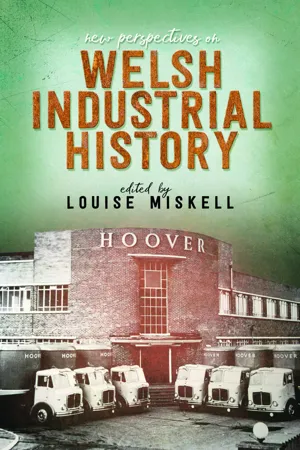
- English
- ePUB (mobile friendly)
- Available on iOS & Android
eBook - ePub
New Perspectives on Welsh Industrial History
About this book
The aim of this volume is to tell a story of Welsh industrial history different from the one traditionally dominated by the coal and iron communities of Victorian and Edwardian Wales. Extending their chronological scope from the early eighteenth- to the late twentieth-century, and encompassing a wider range of industries, the essays in this book combine studies of the internal organisation of workplace and production with outward-facing perspectives of Welsh industry in the context of the global economy. Chapter authors offer some important new insights into the companies, the employers, the markets and the money behind some of the key sectors of the Welsh economy, from coal to copper and from steel to manufacturing. By acknowledging the numerical significance, but often unsung importance, of the thousands who worked in domestic service, it challenges us also to reconsider what we think of as constituting `industry' in Wales.
Information
WELSH COPPER: WHAT, WHEN AND WHERE?
CHRIS EVANS
COPPER was one of the great success stories of industrial Wales – perhaps the greatest. Coal looms far larger in the popular imagination and iron smelting has proved more enduring (the blast furnaces that still loom over Port Talbot stand testimony to that), but neither coal nor iron achieved quite the global eminence of Welsh copper. In the early decades of the nineteenth century Wales may have turned out half the world’s smelted copper. To be more precise, the best part of the world’s copper was produced within a ten-mile radius of ‘Copperopolis’, the town of Swansea. That, at least, is the story told in popular accounts of the Swansea district, in which high, sometimes extravagant, proportions of world output are attributed to south-west Wales.1 In actual fact, Swansea’s dominance was not quite as pronounced as is sometimes thought. Even so, between the 1770s and the 1850s Welsh copper was a genuine global hegemon.
The story of Welsh copper rings with superlatives. Yet it is also a story that is difficult to grapple with. There is no authoritative history of Welsh copper nor, indeed, of British non-ferrous metals more generally. Henry Hamilton’s The British Brass and Copper Industry to 1800 (1926) appeared in a golden age for British economic history, one that saw the publication of classic works on Yorkshire woollens and worsteds, iron and steel, and Lancashire cotton.2 Yet its achievement was not built upon in subsequent decades. Besides, Hamilton’s Brass and Copper was a history that ended somewhat arbitrarily in 1800, at a moment when the history of Welsh copper was but half done. That is not to say that work on Swansea lapsed. On the contrary, Swansea’s industrial history found its doyen in R. O. Roberts, whose work, published between the 1950s and 1980s, remains a key resource for understanding Welsh copper. Roberts had an unrivalled knowledge of the locality and he is still an indispensable guide to the labyrinthine partnerships that governed Swansea’s copper sector, but he was not given to bold overarching statements, still less to construing the place of Welsh copper within a wider landscape of economic change.3
It is time, perhaps, to take a more panoramic view. This essay endeavours to do so, synthesising our existing knowledge and drawing upon the new wave of research on Swansea copper that has emerged in the last decade.4 It asks some very simple definitional questions: what was Welsh copper? When was Welsh copper? And where was Welsh copper?
WHAT WAS WELSH COPPER?
The answer to the ‘what’ question may seem obvious. Welsh copper had a distinguishing feature – it was smelted using mineral coal at a time when copper smelters everywhere else, from Chile to China, relied on vegetable fuel, whether firewood or charcoal, as they had for long centuries. The use of reverberatory furnaces in which the fuel and the ore on which it acted were kept separate was transformational. Smelters had always spurned the use of coal because of the sulphurous impurities it tended to contain. In standard furnaces, in which fuel and ore were intermingled, those impurities would impair the final product. The adoption of the reverberatory furnace resolved that problem: a low brick partition divided the grate in which the coal was burnt from the furnace bowl containing the ore. A fierce draught generated by the tall chimney that rose from the furthest end of the furnace bowl drew flames across the partition, while the low, downward-sloping roof of the furnace reflected (‘reverberated’) heat onto the charge of ore.5
The coal-fuelled reverberatory became Wales’s signature technology. It paved the way for a major expansion of production, expansion that was historically unexampled. It could only have been achieved on the basis of fossil fuel. Vegetable fuel was finite, in the sense that the acreage given over to woodland was necessarily limited. Land that was devoted to coppice woods, after all, was land that could not be used to grow food crops or to pasture animals. Nor could vegetable energy reserves be easily renewed. Coppices would re-sprout after felling but regrowth took fifteen to twenty years. Tapping subterranean energy reserves evaded those difficulties. Coal reserves, to the eighteenth-century eye, seemed inexhaustible. From the vantage point of the twenty-first century, of course, humankind’s resort to fossil fuels appears a fateful bargain, one that brought environmental squalor and anthropogenic climate change in its wake. But for early modern people the use of coal was liberating; it brought release from cramping energy shortages.6
Welsh copper represented then a radical technological departure, but there was more at stake than the substitution of one source of heat energy for another. The use of mineral coal brought about new organisational and spatial arrangements as well. Firstly, there was a concentration of production in larger and larger units. Copper smelting that was reliant on vegetable fuel was necessarily dispersed for fear of overstraining local woodlands. Coal-fired furnaces could be multiplied and massed on a single site, giving rise to the long arcade-like smelting halls that were a feature of Welsh copper. Each of these could house dozens of reverberatories. By 1780, there were sixty furnaces at Freeman & Co.’s White Rock works in the Swansea valley, a further fifty at Lockwood & Morris’s Llangyfelach works, and forty more at the Middle Bank works of George Pengree & Co. In all, there were 310 reverberatories at work in the Swansea district.7 These works were clustered near the southern edge of the coal seams that cut across the Swansea and Neath valleys.
There were no local ore bodies to exploit, however. That absence was one of the most singular features of Welsh copper. Since prehistory, the smelting of ores had always taken place in close proximity to the mines from which they were raised, drawing upon forest resources that were immediately circumjacent. The production of fuel, the mining of ore and its smelting coincided in space. The Welsh model of copper smelting was revolutionary because the extraction of ore and its reduction were spatially distinct. Instead of fuel being carried a relatively short distance to the ore, the ore was brought to the fuel – and brought over a substantial distance because the major source of copper ore in eighteenth-century Britain was Cornwall. It was economically viable to do so because Cornish mines were located within striking distance of the coast, enabling ore to be shipped across the Bristol channel to Swansea bay with the bare minimum of land carriage. The ore was brought to Wales rather than Welsh coal being taken to Cornwall because the reverberatory was so voracious a consumer of coal: 18 tons of coal, so Matthew Boulton reckoned, were required to produce a single ton of copper.8 It was an arrangement that made Swansea – the smelting centre without any ore of its own to smelt – an industrial town that broke with every precedent.
WHERE WAS WELSH COPPER?
So close was the association between Swansea and coal-fired technologies that copper smelting using the reverberatory furnace became known as the ‘Welsh’ process. The Welsh process was not Welsh in origin, however. It was pioneered elsewhere and was slow to be domesticated in south Wales. The reverberatory furnace seems to have evolved out of the melting furnaces used by late medieval bell and cannon founders in central Europe. It is spoken of in the British Isles by the early seventeenth century but its actual use in industrial production is hard to document before the 1670s. Even then, the reverberatory was applied to the smelting of lead ores, not copper, and the earliest experimental furnaces had no particular Welsh associations. Indeed, the first generation of reverberatories was scattered far and wide. Examples could be found at: ‘White-Haven in Cumberland: near Ashburton, in the Peak [District]: near Auderly Edge, Cheshire: near Dizart in Flintshire: at Neath in Glamorganshire: near St Austils, in Cornwall: near the Saw-Mill, in Southwark: [and] at Fox-Hall [i.e. Vauxhall]’.9 Moreover, when the smelting of copper with reverberatories began to coalesce around a single centre in the late seventeenth century, it was Bristol, not Swansea, that came to the fore.
The advantages of Bristol were plain enough to the early copper masters. It was England’s second city, with a rich merchant class and a burgeoning international trade. Bristol could therefore furnish both capital and markets for the nascent industry. Critically, the city could also offer coal: the Kingswood coalfield lay just to the east, while the Forest of Dean coal measures were close by on the other side of the Severn. Bristol’s centrality for the new copper industry began to flag as the eighteenth century wore on, however. Cornish ore had a long way to come, and when the ore barques arrived they had to contend with a harbour that was crowded and subject to heavy charges. The Swansea district offered abundant coal at a cheaper rate and – decisively – a much shorter passage from Cornish ports. Because of that, the Swansea and Neath valleys began to exert a gravitational pull. Copper production continued in the Bristol region but it was no longer the locus of dynamic growth. That was now found much further to the west.
The first copper works in the Swansea valley was opened at Llangyfelach in 1717. Dedicated copper making in the Neath valley began in 1732, when the Costers, a Bristol-based family with established interests in smelting and Cornish mining, took over the Melincryddan works, previously used for lead production. Within five years the Costers had moved to a new, purpose-built plant in the Swansea valley at White Rock. The age of Welsh copper was under way. Welsh smelting did not yet loom large on the national landscape, however. The locational logic that underwrote growth in the Swansea district took time to unfold. The long-established works of the Bristol region were substantial and represented a massive quantity of sunk capital; they were also, as we shall see, well integrated with local brass making. There was little to be gained and much to be lost by writing them off. In the 1740s, Bristol was still the single largest centre of copper production in the British Isles. From the 1750s, though, investment surged into the Swansea district. At mid-century there were only three operational copper works in the Swansea and Neath valleys. By 1800 there were fourteen.10
The uplift began in the early 1750s and accelerated over the course of the Seven Years’ War. Copper output in Britain fluctuated around the 1,000-ton mark in the 1740s; in 1760 it breached 2,000 tons annually for the first time. Further growth led to the 3,000-ton mark being passed in 1768. The 1770s and 1780s saw output lurch upwards again and with tectonic violence: 4,000 tons of metal was turned out in 1775, well over 5,000 tons in 1779, and 7,000 tons in 1783. This is as dramatic a story as the Industrial Revolution has to tell. The Swansea district was not unique, though, in exhibiting rapid growth. Indeed, the eighteenth century was a time of expanding production globally, especially on the frontiers of the great Eurasian empires. Growth in the Russian empire, which had no copper industry to speak of at the start of the eighteenth century, was stupendous. A series of huge smelting works were created from 1720s, firstly in the Urals and then the Altai mountains (where the modern republics of Russia, Kazakhstan, China and Mongolia meet); by the 1760s they were capable of producing 3,500 tons of smelted copper annually, a volume in excess of contemporary British production.11 There were even more dramatic developments on the south-west border of the Chinese empire, with the imperial authorities ploughing resources into remote but copper-rich Yunnan province.12 The results were startling: close on 9,000 tons of copper was shipped out of Yunnan annually in the 1770s.13 There were, however, two vital points of difference between Wales and the new spaces of mineral exploitation in Russia and China. First, timber-dependent Chinese and Russian producers could not sustain such vertiginous growth over the long term in the way that coal-fuelled Swansea could. Secondly, there is the question of the uses to which all this additional copper was put. Most Russian and Chinese copper was struck into coin and put into domestic circulation. The fate of Welsh copper was quite different: much of it was destined for external markets.
One answer to the question ‘Where was Welsh Copper?’ might be the West Indies, for colonial consumption played a vital role. The Caribbean sugar sector absorbed very large amounts of copper. It was embodied in the suite of boiling pans – ‘coppers’ – which every plantation required to process the freshly harvested cane. Nuala Zahedieh has estimated that the 115,000 captive labourers on the English islands in 1700 ‘would have needed around 8,517 copper boilers, weighing an estimated 1,123 tons, almost twice the weight of England’s copper coinage at the time’.14 And as sugar production in the islands grew, so did the volume of copper consumed. By 1770, when there were 434,000 enslaved workers in the British Caribbean, the total weight of embodied copper – taking in boilers, coolers and boiling house implements – would have come to over 4,240 tons.15
Copper and cupreous goods also played a major role in the procurement of enslaved labour in Africa. Lengths of copper (‘Guinea Rods’) acted as a currency in many slave marts, as did manillas (bracelets formed from brass or a copper-lead alloy). These were churned out in large quantities from the very early days of Welsh copper. The pioneering works at White Rock, Swansea, featured a ‘manilla house’, while the processing mill at Holywell in Flintshire was dedicated almost entirely to ‘drawing down copper to rods for the Guinea trade’, turning out 40 tons a year. The manufacturing process was specially designed to impart extra ductility to the metal because Africans ‘use the rods as ornaments and wind them around arms and legs’.16 The rods were forwarded to Liverpool for loading onto ships like the Quixote, which sailed for the Bight of Biafra in 1783 with 5,000 copper rods, twenty boxes of brass rods and 800 manillas in its hold.17 In all, the Quixote carried trade goods that embodied 2.4 tons of copper. There was nothing unusual in this. The invoice of the Africa, which cleared Bristol for the Bight in 1774, told the same story: its cargo included 4,000 copper rods, 200 ‘Neptunes’ (shallow brass bowls over a metre across), and sixteen casks of manillas. There was well over 4 tons of copper here, either in pure or alloyed form.18
The African market was fundamental, or so the Anglesey copper magnate Thomas Williams claimed in 1788. Without it, he and his associates would never have been persuaded to lay out money at the Parys mountain mine, on works in the Swansea district, or at Holywell. The articles he manufactured were ‘entirely for the African market and not saleable for any other’.19 This was a considerable exaggeration, made for political purposes (Williams was railing against the proposed abolition of the slave trade). The world of Atlantic slavery absorbed a good portion of British copper output – well over half of total copper/brass exports at mid-century – but from the 1760s the most important overseas market was to be found in the east, not the west. When the East India Company exported copper to Indian Ocean markets in the 1730s and 1740s, it usually sent out modest quantities. On those occasions when the company felt the need to export very large quantities, as it did in the early 1740s, it must surely have relied on continental suppliers. From the 1760s, however, with the company established as a territorial power in Bengal, its exports picked up sharply and the contract to supply it with copper became a matter of obsessive interest to Welsh smelters. It is not hard to see why. Between 1760 and 1799 annual exports by the East India Company averaged 26.6 per cent of smelted copper production in the British Isles – an astonishing proportion.20
Few British industries were as export-orientated, but the volume of copper consumed within the metropolitan economy should not be overlooked. Much, it seems certain, was devoted to traditional products sold on traditional markets, but there were also new applications for copper. Some were related to the success of the Atlantic plantation system. Distilling, which made use of enormous copper vessels, boomed, as did sugar refining.21 London became a major centre for both over the course of the eighteenth century. The city reportedly had eighty sugar refineries in the 1750s, with twenty more in Bristol.22 Other new uses of copper were related to the navigation of colonial waters. The sheathing of ships’ hulls stands out in this respect. Wood-boring marine organisms represented a major problem for ship owners. Teredo navalis, ...
Table of contents
- Cover
- Title Page
- Contents
- Acknowledgements
- List of Abbreviations
- List of Tables and Figures
- Notes on Contributors
- Introduction Industrial Wales: Historical Traditions and Approaches Louise Miskell
- 1. Welsh Copper: What, When and Where? Chris Evans
- 2. Enumerating the Welsh-French Coal Trade, c.1833‒1913: Opening Pandora’s Box Trevor Boyns
- 3. Hidden Labours: The Domestic Service Industry in South Wales, 1871–1921 Carys Howells
- 4. From Paternalism to Industrial Partnership: The Evolution of Industrial Welfare Capitalism in South Wales, c.1840–1939 Steven Thompson
- 5. The Affluent Striker: Industrial Disputes in the Port Talbot Steelworks, 1945–1979 Bleddyn Penny
- 6. From Margam to Mauritania: The Steel Company of Wales and the Globalisation of Iron Ore Supplies, 1952–1960 Louise Miskell
- 7. The Age of Factories: The Rise and Fall of Manufacturing in South Wales, 1945–1985 Leon Gooberman and Ben Curtis
- 8. The Welsh Development Agency: Activities and Impact, 1976–2006 Leon Gooberman and Trevor Boyns
- Bibliography
Trusted by 375,005 students
Access to over 1.5 million titles for a fair monthly price.
Study more efficiently using our study tools.
Frequently asked questions
Yes, you can cancel anytime from the Subscription tab in your account settings on the Perlego website. Your subscription will stay active until the end of your current billing period. Learn how to cancel your subscription
No, books cannot be downloaded as external files, such as PDFs, for use outside of Perlego. However, you can download books within the Perlego app for offline reading on mobile or tablet. Learn how to download books offline
Perlego offers two plans: Essential and Complete
- Essential is ideal for learners and professionals who enjoy exploring a wide range of subjects. Access the Essential Library with 800,000+ trusted titles and best-sellers across business, personal growth, and the humanities. Includes unlimited reading time and Standard Read Aloud voice.
- Complete: Perfect for advanced learners and researchers needing full, unrestricted access. Unlock 1.5M+ books across hundreds of subjects, including academic and specialized titles. The Complete Plan also includes advanced features like Premium Read Aloud and Research Assistant.
We are an online textbook subscription service, where you can get access to an entire online library for less than the price of a single book per month. With over 1.5 million books across 990+ topics, we’ve got you covered! Learn about our mission
Look out for the read-aloud symbol on your next book to see if you can listen to it. The read-aloud tool reads text aloud for you, highlighting the text as it is being read. You can pause it, speed it up and slow it down. Learn more about Read Aloud
Yes! You can use the Perlego app on both iOS and Android devices to read anytime, anywhere — even offline. Perfect for commutes or when you’re on the go.
Please note we cannot support devices running on iOS 13 and Android 7 or earlier. Learn more about using the app
Please note we cannot support devices running on iOS 13 and Android 7 or earlier. Learn more about using the app
Yes, you can access New Perspectives on Welsh Industrial History by Louise Miskell in PDF and/or ePUB format, as well as other popular books in History & Business General. We have over 1.5 million books available in our catalogue for you to explore.