A conversation between Elie Wiesel and Jorge Semprún about what they experienced and observed during their time in the Buchenwald concentration camp.
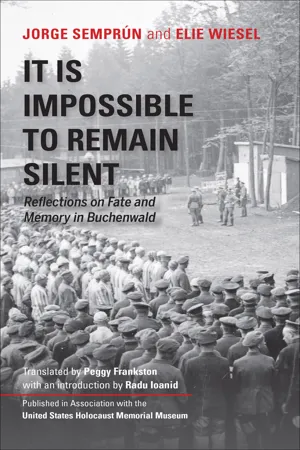
On March 1, 1995, at the time of the fiftieth anniversary of the liberation of the Nazi concentration camps, ARTE—a French-German state-funded television network—proposed an encounter between two highly regarded figures of our time: Elie Wiesel and Jorge Semprún. These two men had probably crossed paths—without ever meeting—in the Nazi concentration camp Buchenwald in 1945. This short book, published in association with the United States Holocaust Memorial Museum, is the entire transcription of their recorded conversation.
During World War II, Buchenwald was the center of a major network of sub-camps and an important source of forced labor. Most of the internees were German political prisoners, but the camp also held a total of ten thousand Jews, Roma, Sinti, Jehovah's Witnesses, and German military deserters. In these pages, Wiesel and Semprún poignantly discuss the human condition under catastrophic circumstances. They review the categories of inmate at Buchenwald and agree on the tragic reason for the fate of the victims of Nazism—as well as why this fate was largely ignored for so long after the end of the war. Both men offer riveting testimony and pay vibrant homage to the Jewish victims of the Holocaust. Today, seventy-five years after the liberation of the Nazi camps, this book could not be more timely for its confrontation with ultra-nationalism and antisemitism.
eBook - ePub
It Is Impossible to Remain Silent
Reflections on Fate and Memory in Buchenwald
- 62 pages
- English
- ePUB (mobile friendly)
- Available on iOS & Android
eBook - ePub
It Is Impossible to Remain Silent
Reflections on Fate and Memory in Buchenwald
About this book
Information
Publisher
Indiana University PressYear
2019Print ISBN
9780253045287
9780253045287
eBook ISBN
9780253045300
IT IS IMPOSSIBLE TO REMAIN SILENT
Jorge Semprún At a certain point in your Memoirs, when you evoke the shock of your arrival in Buchenwald after the evacuation of Auschwitz, you say—citing me, and in reference to conversations that we had later on, much later on—that our experiences in the camp were not at all the same. Which is absolutely true. Perhaps, to get us started, we can emphasize this diversity—not just the diversity of our personal experiences in this particular camp, which was Buchenwald, in January, February, and March 1945, but also the more global, more general diversity among the different camps. In the archipelago of the Nazi concentration camp system, there were many differences. I would like to start our conversation here, from this diversity of experience.
Elie Wiesel All right, first there is Auschwitz. Death camp. Camp full of the dead. And Buchenwald, as you well know, was something quite different—more politicized, more political in nature—in the beginning. Therefore, for us, Buchenwald was supposed to be a different type of camp. But for us, the Little Camp,1 inside the main camp, was almost like Auschwitz, except there was no gas chamber. Of course, in the complex of concentration camps, some camps were a little better than others, different from others. We knew all the names; I remember that, even at Auschwitz, I heard the names of Sachsenhausen, Ravensbrück, Bergen-Belsen. We knew a little bit about that universe. But Buchenwald, seen from Auschwitz, was supposed to be a better camp. But that was not the case.
J. S. In the Nazi system, there were bureaucratic specificities for each camp. It is really incredible to read these documents. The classifications they themselves created. The Nazi hierarchy ranked the camps according to whether a detainee could be reeducated or not. Of course, Jews were not to be “reeducated.” They were to be exterminated. So already there was that category.
E. W. Nonetheless, there were indeed people who were to be reeducated at Auschwitz—the homosexuals. But Buchenwald, that was a camp for political prisoners. So, in the beginning, they were supposed to reeducate the deportees, the prisoners. We Jews were there to die.
J. S. Absolutely.
E. W. Just as they were there to kill us, we were there to die. And Buchenwald, our camp, was made for this. Every time we have gotten together, over the years, I have wondered what it was that you saw, what it was that I saw there. And of course, it was not the same thing.
J. S. Because in Buchenwald there were two camps, the main camp and the quarantine camp or Little Camp, which remained in place until just about the autumn of 1944, when the Germans had practically lost the war. At that point, conditions deteriorated in all the camps—even in the forced labor camps, not just the extermination camps. This Little Camp was a transit camp, a quarantine camp; people went through it to be integrated into the Buchenwald system to produce weapons of war—factories, et cetera—or they were sent to other Kommandos, other camps. From that time on, the Little Camp became a permanent camp. People remained there.
E. W. People remained there.
J. S. They were there to die.
E. W. To die.
J. S. And so, from then on, in fact, and especially after the arrival of the surviving Jews from Auschwitz—if you take away the gas chamber—the living conditions, the conditions of brutality and lack of hygiene, the overcrowding resembled certain camps in the Auschwitz-Birkenau complex. And for us [the political prisoners], that was a decisive moment, because when you arrived, and those from other camps in [occupied] Poland arrived, we had—we had had a vague notion that the camps in Poland were worse—but all of a sudden, we had concrete proof. Listening to your stories, and through the discussions we had with some of you, we saw what it was. And we saw that another, deeper circle existed, worse than Hell.
E. W. We did have our own circle. In fact, for us it started a little bit earlier. It started in August for Buchenwald. We were evacuated on the eighteenth [of January 1945]. On the nineteenth, we were herded into a train, meaning open freight cars; it was snowing. It took us several days. That particular trip, I cannot forget. I remember, just before we arrived, it was afternoon in Weimar. We had no idea where we were. It was snowing. Already there were deaths. Many dead in the open cars. I was with my father. And all of a sudden, we went mad. Each one of us had three blankets, and we had lost all hope. We went mad. And we started to shout out a prayer—the prayer that is usually read at the end of Yom Kippur, the Day of Atonement, “The Lord is God.” When I think about it now, I still can’t believe it. It was a sort of farewell to life, a farewell to the world. And we were going to die. Everyone knew it. We were going to die. Each one of us knew it. Each one had convinced himself. So then, we all started swaying back and forth together, as we had at the synagogue when I was a kid “The Lord is God.” We had all gone mad. Then the train stopped at Weimar. And all of a sudden, we heard several deportees tell us that Buchenwald had refused to bring us in. Because the camp was already overcrowded. We did not pay any attention. The Lord is God. We shouted, “The Lord is God.” They did bring us in. I remember night had already fallen. At long last, a shower. You describe that in your book; I describe it in mine. And then, there we were in the Little Camp. And in the beginning, the Little Camp was almost worse for me, worse than Auschwitz.
J. S. During the fall of 1944, I had gotten into the habit of going into the Little Camp to visit certain friends, certain people who were, for example, in barrack 56—the infirmary. [Maurice] Halbwachs, who was my professor at the Sorbonne, and [Henri] Maspero, the father of François Maspero, who was a well-respected specialist in Oriental studies.2 And we saw what the conditions were like in the Little Camp. But all of a sudden, conditions deteriorated radically.
E. W. Late January. I remember that, to keep us away from the large quarantine barrack, they sprayed us with water. With freezing water in front of the barrack. We turned into blocks of ice. And I was with my father. But then again, the father I knew was no longer there. That father was dead. And then, in fact, I was no longer conscious of Buchenwald. I was no longer alive. From that day on until the Liberation, I was simply no longer there.
J. S. Yes, you talk about that in your book. All those weeks, where mechanically, almost without being conscious of what you were doing, you accomplished a number of tasks, and sometimes you even played chess without realizing what you were doing at the same time. You were already …
E. W. I was no longer there. I had stayed alive only for my father. Because I knew that my little ...
Table of contents
- Cover
- Title Page
- Copyright
- Contents
- Publisher’s Note
- Introduction
- Gallery of Photographs
- It Is Impossible to Remain Silent
- Notes
- Selected Bibliographies of Jorge Semprún and Elie Wiesel
Trusted by 375,005 students
Access to over 1.5 million titles for a fair monthly price.
Study more efficiently using our study tools.
Frequently asked questions
Yes, you can cancel anytime from the Subscription tab in your account settings on the Perlego website. Your subscription will stay active until the end of your current billing period. Learn how to cancel your subscription
No, books cannot be downloaded as external files, such as PDFs, for use outside of Perlego. However, you can download books within the Perlego app for offline reading on mobile or tablet. Learn how to download books offline
Perlego offers two plans: Essential and Complete
- Essential is ideal for learners and professionals who enjoy exploring a wide range of subjects. Access the Essential Library with 800,000+ trusted titles and best-sellers across business, personal growth, and the humanities. Includes unlimited reading time and Standard Read Aloud voice.
- Complete: Perfect for advanced learners and researchers needing full, unrestricted access. Unlock 1.5M+ books across hundreds of subjects, including academic and specialized titles. The Complete Plan also includes advanced features like Premium Read Aloud and Research Assistant.
We are an online textbook subscription service, where you can get access to an entire online library for less than the price of a single book per month. With over 1.5 million books across 990+ topics, we’ve got you covered! Learn about our mission
Look out for the read-aloud symbol on your next book to see if you can listen to it. The read-aloud tool reads text aloud for you, highlighting the text as it is being read. You can pause it, speed it up and slow it down. Learn more about Read Aloud
Yes! You can use the Perlego app on both iOS and Android devices to read anytime, anywhere — even offline. Perfect for commutes or when you’re on the go.
Please note we cannot support devices running on iOS 13 and Android 7 or earlier. Learn more about using the app
Please note we cannot support devices running on iOS 13 and Android 7 or earlier. Learn more about using the app
Yes, you can access It Is Impossible to Remain Silent by Jorge Semprun,Elie Wiesel,Jorge Semprún, Peggy Frankston in PDF and/or ePUB format, as well as other popular books in History & Holocaust History. We have over 1.5 million books available in our catalogue for you to explore.