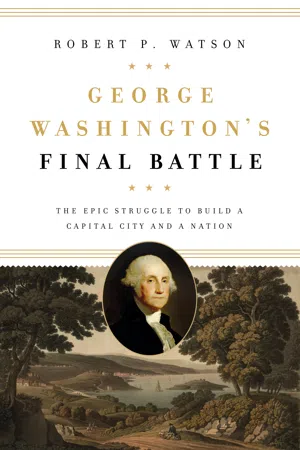
George Washington's Final Battle tells the little-known story of how the country's first president tirelessly advocated for a capital on the shores of the Potomac. Although Washington died just months before the federal government's relocation, his vision and influence live on in the city that bears his name.
eBook - ePub
George Washington's Final Battle
The Epic Struggle to Build a Capital City and a Nation
- 400 pages
- English
- ePUB (mobile friendly)
- Available on iOS & Android
eBook - ePub
George Washington's Final Battle
The Epic Struggle to Build a Capital City and a Nation
About this book
Information
PART I
GEORGE WASHINGTON’S EARLY LIFE AND AMERICAN VISION
CHAPTER 1
Surveying a Future
Wisdom is the principal thing; therefore get wisdom: and with all thy getting get understanding.
Proverbs 4:7
In 1792 an English nobleman approached George Washington and inquired about his ancestry. For a man as sensitive about his image and appearance as Washington, the answer he gave was surprisingly flippant: “I confess I have paid very little attention,” responded the president. He went on to explain, “My time has been so much occupied in the busy and active scenes of life from an early period of it that but a small portion of it could have been devoted to researches of this nature.”1
It may be that Washington’s response was simply his way of sidestepping the fact that, although he was the product of a family that enjoyed a degree of prosperity, the Washingtons had not commanded the upper echelons of either English or colonial society. Yet perhaps this seeming indifference to his lineage by the “Father of His Nation” was not surprising at all. America was a new experiment, one that held the promise of new ways of thinking and new ways of organizing society. In the social order that was forming, a person’s status would have less to do with pedigree than with merit. What is apparent is that the spirit of adventure and entrepreneurship along with a commitment to justice and public service coursed through the bloodline of the Washington family.
These traits date to at least Washington’s great-great-grandfather Lawrence, an Oxford-educated Anglican minister from Oxfordshire. The Reverend Washington enjoyed a degree of notoriety; however, he was forced from his pulpit when puritanical passions reigned in England under Oliver Cromwell. It was his son John, likely motivated by his father’s predicament and the English Civil War, which began in 1642, who came to America in search of a better life. Like many other young men in England, he was probably attracted to the many and varied opportunities Britain’s North American colonies offered. Thus, in 1656 John crossed the Atlantic to trade tobacco.
During one voyage the ship on which he was sailing, the Sea Horse, ran aground in the Chesapeake Bay. John simply decided to stay. A brother named Lawrence joined him in Virginia, and both Washingtons settled in Westmoreland County near the Potomac River.2
John Washington did well for himself. He married Anne Pope, the daughter of a wealthy planter, and accumulated vast tracts of land for his tobacco farms. Later, the act of hiring indentured servants from England to work his lands provided him the opportunity to pursue public service as both a politician and military officer. In this capacity he participated in the various military campaigns along the frontier against the native inhabitants. The first Washington to live in the New World ended up burying two wives and marrying three times. By the time of his passing in 1677, at the age of forty-six, John Washington had become part of Virginia’s “second-tier gentry” and had amassed thousands of acres of land.3
Both John Washington’s son and grandson would follow his example, accumulating land, raising tobacco, owning slaves, prospering as traders, pursuing political office, and marrying well. John had a son named Lawrence (both “John” and “Lawrence” were popular family names) who returned to England to be educated. Back in Virginia he married into money, wedding Mildred Warner, whose father served on the King’s Council. Like other Washington men, Lawrence was a planter and served in public office. He too would die young. His second son, who was just a boy at the time of Lawrence’s passing, was named Augustine and would one day have a son who would lead the colonies to independence.
Lawrence’s widow remarried—to an English shipping captain—and returned to England with Augustine and her other children. The historical record is thin, but it appears she died in childbirth and her son Augustine sailed back to Virginia. It would have been a difficult and lonely time for the boy, sailing across the ocean with a stepfather he barely knew and who spent most of his time away at sea.
Unfortunately, there is little we know about George Washington’s father other than that he was a tall and strong man. One historical claim suggests that he could “raise up and place in a wagon a mass of iron that two ordinary men could barely raise from the ground.” Such stories match those that would later be told about his strapping son.4 Augustine Washington was also said to be a disciplinarian. Like his predecessors, he married well—to Jane Butler—acquired even more land along the Potomac River, held local public office, and was a trader who did business in England. Augustine Washington and Jane Butler had two boys, Lawrence and a son named for the father, as well as a daughter named for the mother.
Upon his arrival back in Virginia after another business trip to England, Augustine received devastating news. His wife of several years had died. As was the custom of the time, the thirty-seven-year-old widower remarried and did so rather quickly—in 1731—to Mary Ball, who was fourteen years his junior. Yet at twenty-three Mary was considered rather old by eighteenth-century standards to be a first-time bride. A number of descriptions remain about the woman who would be George Washington’s mother, but nearly all of them describe her as headstrong, pious, bothersome, and dour. She might be forgiven any personality kinks, however, given her tumultuous upbringing.
Mary’s own father, Joseph Ball, was a successful trader from England who died when she was only three. Mary and her mother—Mary Johnson—struggled financially (as did many widows at the time) and socially from an embarrassing family scandal. Joseph, it seems, was a ripe fifty-eight when he married his much younger, illiterate mistress. Mary’s mother also died. The orphaned child ended up being placed in the care of George Eskridge, a family friend.5
Augustine Washington and Mary Ball lived in a large farmhouse on a few thousand acres near Pope’s Creek in eastern Virginia’s Westmoreland County.6 The land was worked by roughly fifty slaves, and despite what appears to have been a strained marriage, the family prospered and had six children—two girls and four boys—of which George was the eldest.7 Life was precarious in the New World in the eighteenth century, and a younger sister died in infancy. None of George’s three older half siblings would reach an advanced age. However, four of George’s siblings lived to maturity: Betty, Samuel, Charles, and John Augustine, whose son Bushrod would one day become George’s favorite nephew and a member of the US Supreme Court.
George Washington was born on February 11, 1732, a date that would later be altered to February 22, 1732, in the new calendar (in 1752, Britain adopted the Gregorian calendar in order to more accurately reflect the length of a year). Yet Washington always celebrated the former as the date of his birth.8
Taking after his father, young George was an exceptionally large baby and was named by his mother in honor of the man who had adopted her when she had been orphaned. When George was three his father moved the family sixty miles to another comfortable plantation at Little Hunting Creek near the Potomac. Little else is known about the young boy’s upbringing except that it was marked by hard work and little interaction with his father, who frequently traveled to find markets for his tobacco and produce. Nevertheless, as the son of a family considered “lower Virginia gentry,” the burly youth had good prospects. He could count on a formal education, including the possibility of travel to England, and would likely stand to one day inherit several slaves and a sizable plot of land. Fate intervened.
Augustine passed on April 12, 1743, at the age of forty-nine. George was only eleven at the time. As the future president would later describe, “Tho’ I was blessed with a good constitution, I was of a short-lived family.”9 The event would dramatically change the boy’s life and possibly the course of American history. It was also not the only loss young Washington experienced—his older half sister, Jane, and an infant sister named Mildred also passed away at around the same time.
The sons from Augustine’s first marriage inherited the Mount Vernon estate and the Pope’s Creek farm, leaving the widow and her children with little. Mary was forced to move to Ferry Farm, a smaller home by the Rappahannock and Potomac Rivers in nearby Fredericksburg. Despite having a large family in her care, Mary Ball Washington never remarried, which was quite uncommon for the time. One consequence of this was that young George had responsibility thrust on him at a tender age in the form of caring for his younger siblings and overseeing the farm. The boy’s future prospects were further derailed because of Mary’s marginal education and frugality; she did not prioritize her son’s education or support new opportunities for him. Whereas Augustine’s two sons from his first marriage were educated in England and well traveled, George had only passing instruction that allowed him to learn basic reading, writing, and mathematics. Unlike most of the other Founders, he never attended college and was poorly traveled.
The prudish and private widow also avoided social events. The result was that her son grew up with very limited exposure to the world beyond the farm and their relationship would never be affectionate or close; rather, with the son overly sensitive to criticism and the mother quite prone to offering it, their rapport was always strained. Not surprisingly, as an adult Washington would become somewhat emotionally detached from his overbearing mother.
Mary Ball Washington, like her late husband, was also a disciplinarian. George’s childhood contained little in the way of frivolities or amusements. Stern lessons about honesty and hard work were ingrained in her son, traits that would define the man in the years to come. Despite her frugality—or perhaps because of it—in her later years Mary Ball Washington would make constant, unreasonable requests of her eldest son. Although he provided for her financially, she publicly embarrassed him by claiming throughout her eighty-two years that he did not.
Aside from his father’s passing, one of the earliest profound influences on the young boy was his half brother Lawrence, fourteen years George’s senior, who stepped into the role of surrogate father. Lawrence inspired the teen with stories of his adventures as a naval officer serving under Adm. Edward Vernon. His head filled with swashbuckling tales of honor, naval battles, and faraway lands, George longed to run away and join the navy, but his mother forbade it. Ever dutiful, the fourteen-year-old honored his mother’s request that he stay home. It would be milking cows, rather than sailing the seven seas, for young Washington—for the time being. However, a spark had been lit inside the boy. His adolescent yearning for adventure would grow into a burning ambition as a young man.
There was another key influence on the restless teen forced to spend long days working his mother’s farm. Her name was Sally Cary Fairfax, and she was two years George’s senior.10 Washington longed for something more, and likely his first glimpse of a better life came courtesy of the wife of George William Fairfax, one of the colony’s leading aristocrats.
The Fairfax home—the impressive Belvoir estate—was located not far from Washington’s home geographically, but a world apart socially. Young George’s luck changed in 1747, when Lord Fairfax employed his teenage neighbor on a survey mission to the unexplored wilderness of the Virginia frontier. The event gave Washington a new occupation. One year later, he was working as the county surveyor for Culpeper County, courtesy of a referral from Fairfax. But the expedition also brought Washington into contact with Sally.
Attractive, witty, social, traveled, well-read, and flirtatious, the daughter of two of Virginia’s most prominent families was clearly an unattainable object of young Washington’s admiration. Surviving accounts strongly suggest that he was captivated by her beauty and intellect, just as she seemed keen on her young neighbor’s charisma and potential.11 It was Sally, the wealthy, sophisticated socialite, who introduced the brawny and guileless teen to literature, theater, and the art of social discourse. Sitting by her side as she hosted the region’s most popular salons, young Washington met and observed the Tidewater’s leading citizens and began to visualize new possibilities. Thanks to Sally, he was exposed to the kind of people he would later need to know in order to rise in status.
It was also around this time that the sixteen-year-old surveyor’s assistant copied 110 “rules of civility” from a well-known book on etiquette. The maxims, which dated to the sixteenth century, were a great influence on the studious and ambitious teen in terms of honing the development of his character and aiding in his desire to pass himself off as a gentleman who knew how to behave when in good company.12 One can see the makings of Washington’s fondness for etiquette, social ambition, and entry into the ruling class in his time with Mrs. Fairfax. A new door of possibilities had been opened.13
Perhaps inspired by Sally’s beauty, wealth, and social standing, the young man attempted to court women from the Tidewater who resided well above his social position. He was unsuccessful—initially—and even put pen to paper to express his frustrations:
Ah! Woe’s me, that I should love and conceal,
Long have I wish’d, but never dare reveal,
Even though severely Loves Pains I feel.14
The other side of history’s courageous, indomitable, and seemingly unflappable hero was that Washington had become keenly aware of the clothing he wore, his image, and the fact that he possessed stature and was graced with a natural charisma. George Washington would grow up to be an excellent dancer and a natural in the saddle; a hard worker with a fondness for social events, salted cod, exotic pineapples and Brazil nuts, and madeira; and a leader who was surprisingly guarded and thrifty. Thanks to the Fairfax family, the young surveyor began to survey a better future.15
CHAPTER 2
Western Adventures
A rising nation, spread over a wide and fruitful Land, traversing all the seas with the rich production of their Industry.
Thomas Jefferson
In so many ways Washington’s life as a planter, his relentless pursuit to acquire more land, and his time spent in the westernmost edge of the colonies—first as a teenage surveyor, then as a soldier fighting on Britain’s westernmost possessions, and eventually as an investor—shaped his character. But the future president’s passion for developing the American West and his vision for the future of the new nation were also forged during his youth.1
The socialite Sally Fairfax exposed the young Washington to high society and nurtured hi...
Table of contents
- Cover
- Half title
- Title
- Copyright
- Contents
- Preface
- Acknowledgments
- Chronology
- Introduction: The “Other” Founding Debates
- Part I. George Washington’s Early Life and American Vision
- Part II. The Question of a Capital
- Part III. The Great Debate
- Part IV. Conflict and Compromise
- Part V. Building the Capital
- Part VI. Legacy
- Epilogue: The Building Is in a State to Be Habitable
- Appendix A. Chronological List of Temporary Capitals
- Appendix B. List of Possible Locations for the Capital
- Notes
- Bibliography
- Index
- About the Author
Trusted by 375,005 students
Access to over 1.5 million titles for a fair monthly price.
Study more efficiently using our study tools.
Frequently asked questions
Yes, you can cancel anytime from the Subscription tab in your account settings on the Perlego website. Your subscription will stay active until the end of your current billing period. Learn how to cancel your subscription
No, books cannot be downloaded as external files, such as PDFs, for use outside of Perlego. However, you can download books within the Perlego app for offline reading on mobile or tablet. Learn how to download books offline
Perlego offers two plans: Essential and Complete
- Essential is ideal for learners and professionals who enjoy exploring a wide range of subjects. Access the Essential Library with 800,000+ trusted titles and best-sellers across business, personal growth, and the humanities. Includes unlimited reading time and Standard Read Aloud voice.
- Complete: Perfect for advanced learners and researchers needing full, unrestricted access. Unlock 1.5M+ books across hundreds of subjects, including academic and specialized titles. The Complete Plan also includes advanced features like Premium Read Aloud and Research Assistant.
We are an online textbook subscription service, where you can get access to an entire online library for less than the price of a single book per month. With over 1.5 million books across 990+ topics, we’ve got you covered! Learn about our mission
Look out for the read-aloud symbol on your next book to see if you can listen to it. The read-aloud tool reads text aloud for you, highlighting the text as it is being read. You can pause it, speed it up and slow it down. Learn more about Read Aloud
Yes! You can use the Perlego app on both iOS and Android devices to read anytime, anywhere — even offline. Perfect for commutes or when you’re on the go.
Please note we cannot support devices running on iOS 13 and Android 7 or earlier. Learn more about using the app
Please note we cannot support devices running on iOS 13 and Android 7 or earlier. Learn more about using the app
Yes, you can access George Washington's Final Battle by Robert P. Watson in PDF and/or ePUB format, as well as other popular books in History & Early American History. We have over 1.5 million books available in our catalogue for you to explore.