Based on interviews with experts in the field, this booklet offers real-world examples of how educators can become active players in the procurement decision-making process. Frontline educators have a unique and invaluable perspective on adoption of edtech solutions that no other stakeholders have. They know what learning goals are difficult to achieve, have "on-the-ground" knowledge of what is age- and task-appropriate and know what tools students are more or less likely to use. Educators also have their own requirements for edtech solutions, for example, ease of use and accessible data to help them make informed decisions.However, too often, educators are left out of the evaluation and purchasing process that occurs at the district level. And even when they are involved, educators might not know what questions to ask or may not feel empowered to raise issues or point out potential problems. To take on a greater role in edtech decision-making, educators need to better understand the process and become more informed about the options available. That's where this guide comes in.Topics include:
Supporting educators as critical consumers to help their school or district make informed decisions.
Alignment with learning and teaching goals, with emphasis on solving real problems for students and teachers.
Implementation and ongoing support to ensure that edtech solutions work in the classroom and that teachers feel supported in implementing them.
Data interoperability and student privacy.
Research and evidence that demonstrates a product's potential.
This guide highlights ways educators can contribute to their district's purchasing and identifies key areas where educator insight can help others become more informed, critical consumers of edtech.
Frequently asked questions
Yes, you can cancel anytime from the Subscription tab in your account settings on the Perlego website. Your subscription will stay active until the end of your current billing period. Learn how to cancel your subscription.
At the moment all of our mobile-responsive ePub books are available to download via the app. Most of our PDFs are also available to download and we're working on making the final remaining ones downloadable now. Learn more here.
Perlego offers two plans: Essential and Complete
Essential is ideal for learners and professionals who enjoy exploring a wide range of subjects. Access the Essential Library with 800,000+ trusted titles and best-sellers across business, personal growth, and the humanities. Includes unlimited reading time and Standard Read Aloud voice.
Complete: Perfect for advanced learners and researchers needing full, unrestricted access. Unlock 1.4M+ books across hundreds of subjects, including academic and specialized titles. The Complete Plan also includes advanced features like Premium Read Aloud and Research Assistant.
Both plans are available with monthly, semester, or annual billing cycles.
We are an online textbook subscription service, where you can get access to an entire online library for less than the price of a single book per month. With over 1 million books across 1000+ topics, we’ve got you covered! Learn more here.
Look out for the read-aloud symbol on your next book to see if you can listen to it. The read-aloud tool reads text aloud for you, highlighting the text as it is being read. You can pause it, speed it up and slow it down. Learn more here.
Yes! You can use the Perlego app on both iOS or Android devices to read anytime, anywhere — even offline. Perfect for commutes or when you’re on the go. Please note we cannot support devices running on iOS 13 and Android 7 or earlier. Learn more about using the app.
Yes, you can access Better Edtech Buying for Educators by ISTE Staff in PDF and/or ePUB format, as well as other popular books in Pedagogía & Educación general. We have over one million books available in our catalogue for you to explore.
Alignment With Student Learning Goals and Standards
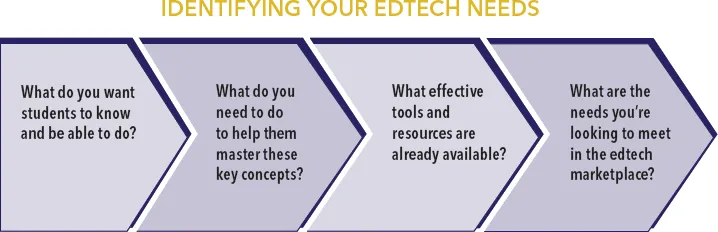
What do our students need to know and be able to do?
TECHNOLOGY IS NEVER A GOAL unto itself. Any thoughtful adoption of resources begins with the same question, “What do our students need to know and be able to do?” Whether you call it backward design or something else, you know effective teaching and learning starts with this question. Some of these goals are based on state-level content standards. Others are a thoughtful fusion bringing together curriculum standards and local guidelines with professional standards, such as the ISTE Standards for Students1 and Educators2. Whatever the standards, you know the best way to guide student learning pathways is by beginning with a clear destination in mind.
Once you’ve established these larger goals, you’re able to identify what needs to be done to reach those goals through a system of formative and summative assessments. You’re charting the pathways your students might take to show their mastery of identified skills and content. Oftentimes, this is where teachers begin to inventory the tools and resources at their disposal for supporting student learning.
In effective, thoughtful classrooms, it is only after educators identify learning goals, assess student needs and take stock of available resources that they begin to ask what technological solutions they might leverage to improve student learning. Just like when you plan a trip, you’re unlikely to begin with the decision of what mode of transportation you’ll be using before knowing where you’re going, what experiences you are seeking along the way or the route you’d like to take. An airplane isn’t going to satisfy your yearning for a road trip, and it would be an exorbitant cost to visit friends a few towns over. In this same vein, if an edtech solution doesn’t address identified goals and needs, student learning can plummet while educator and student frustration skyrocket.
Only after considering student needs and goals, learning pathways and taking stock of what is currently available does it make sense to start asking what the marketplace has to offer regarding additional tools. Otherwise, technology becomes a solution in search of a problem.
The Value Add of ISTE Standards
Solutions designed with the ISTE Standards in mind are uniquely positioned to support the development of digital age learning skills, capacities and knowledge. They are quickly becoming the beacon by which curriculum and technology staff navigate the often complex world of selecting, evaluating and implementing edtech solutions.
Alignment with the ISTE Standards is different than alignment to content standards, such as Next Generation Science Standards or state content-area standards. Whereas curriculum standards describe what content and discipline-specific skills students need to learn, the ISTE Standards describe the way technology might help students and teachers address specific learning goals and amplify learning regardless of content area or grade level.
Alignment With Content-Area Standards
Alignment with content-area standards indicates that a solution:
• Covers targeted content.
• Addresses specific learning goals.
• Promotes accepted pedagogies and pedagogical approaches.
Alignment to the ISTE Standards
Alignment to the ISTE Standards communicates that a solution:
• Takes advantage of digital resources for instruction.
• Uses technology effectively and appropriately.
• Promotes digital age learning skills.
• Prepares students for digital age work and life.
• Encourages technology-powered pedagogy.
When districts and educators apply the ISTE Standards, they design technology selection, integration and application solutions based on pedagogical best practices and guide the adoption of digital resources based on global technology learning standards. One service ISTE provides to assist with this process is a list of solutions vetted and aligned to the ISTE Standards. While you still need to be sure they align to your specific goals and needs, it can be a good place to start. Read about the ISTE Seal of Alignment3 to learn more in the Resources section.
Understanding the ISTE Standards
The ISTE Standards map out a blueprint for re-engineering schools and classrooms to support digital age learning. Educators and education leaders worldwide can use them to create innovative learning environments no matter where they are on their tech integration journey. The standards include:
• ISTE Standards for Students.
• ISTE Standards for Educators.
• ISTE Standards for Education Leaders.
• ISTE Standards for Coaches.
• ISTE Standards for CS Educators.
• ISTE Computational Thinking Competencies for Educators.
Supporting Best Practices With SAMR
The SAMR Model4 provides guidance and a technique for moving through four degrees of technology adoption: substitution, augmentation, modification and redefinition (SAMR). While the model includes guidance that can help educators use edtech to accomplish traditional tasks, it is also a call to action for solutions at the modification and redefinition levels. At these levels, technology is used in transformative ways to redesign or create new learning experiences. When this model for identifying how a product supports best practices and student learning is combined with content and ISTE Standards, they together provide a robust framework that raises the bar on both content and pedagogical requirements for any technological tools under consideration.
Recommendations
Tremendous power exists in bringing district- and school-level stakeholders to the table to identify the goals, needs and possible challenges of technology deployments. Fortunately, there are roles each can play to increase the likelihood of successful partnerships:
Educators Can:
Develop statements of need. Few people in education systems have a better or more nuanced understanding of student needs than classroom educators. By documenting those needs, teachers can paint a clearer picture for district-level staff.
Ask administrators in. By inviting administrators to join them for lessons highlighting identified needs, teachers can build bridges between district policy and practice.
Leaders Can:
Identify where teachers aren’t and invite them. District-level leaders can look across regularly occurring meetings and adoption cycles and identify where teachers aren’t part of the process. Where teachers are absent from the conversations, districts can ask, “How might we make this more inclusive?”
Visit classrooms. Many administrators used to be teachers. As such, they have memories of their own classrooms, but perhaps not clear pictures of the ins and outs of modern classrooms. By visiting classrooms and even co-teaching lessons, district leaders will gain a detailed understanding of those in their charge.
Educators and Leaders Can:
Examine available data to surface areas of need. While district leaders might bring summative data to the table to discuss student standard mastery, classroom educators can uncover data that provide more nuanced portrayals of student progress.
Develop a shared inventory of existing tools and resources. This inventory can identify available tools not necessarily known to all parties.
Design the process. While some components of procurement will be set by law or local policy, many aspects are in the hands of educators. By co-designing the negotiable pieces of procurement, district- and school-level educators c...
Table of contents
Cover
About ISTE
Contents
Introduction
SECTION 1: Alignment With Student Learning Goals and Standards
SECTION 2: Importance of Research and Evidence
SECTION 3: Data Interoperability and Student Privacy
SECTION 4: Challenges of Implementation, Use and Ongoing Support