At first glance, Barbara Kalish fit the stereotype of a 1950s wife and mother. Married at eighteen, Barbara lived with her husband and two daughters in a California suburb, where she was president of the Parent-Teacher Association. At a PTA training conference in San Francisco, Barbara met Pearl, another PTA president who also had two children and happened to live only a few blocks away from her. To Barbara, Pearl was "the most gorgeous woman in the world," and the two began an affair that lasted over a decade.
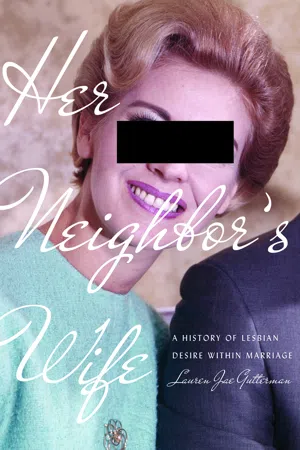
Through interviews, diaries, memoirs, and letters, Her Neighbor's Wife traces the stories of hundreds of women, like Barbara Kalish, who struggled to balance marriage and same-sex desire in the postwar United States. In doing so, Lauren Jae Gutterman draws our attention away from the postwar landscape of urban gay bars and into the homes of married women, who tended to engage in affairs with wives and mothers they met in the context of their daily lives: through work, at church, or in their neighborhoods.
In the late 1960s and 1970s, the lesbian feminist movement and the no-fault divorce revolution transformed the lives of wives who desired women. Women could now choose to divorce their husbands in order to lead openly lesbian or bisexual lives; increasingly, however, these women were confronted by hostile state discrimination, typically in legal battles over child custody. Well into the 1980s, many women remained ambivalent about divorce and resistant to labeling themselves as lesbian, therefore complicating a simple interpretation of their lives and relationship choices. By revealing the extent to which marriage has historically permitted space for wives' relationships with other women, Her Neighbor's Wife calls into question the presumed straightness of traditional American marriage.
- 328 pages
- English
- ePUB (mobile friendly)
- Available on iOS & Android
eBook - ePub
About this book
Information
Publisher
University of Pennsylvania PressYear
2019Print ISBN
9780812251746
9780812251746
eBook ISBN
9780812296570
Topic
StoriaSubtopic
Storia nordamericanaPART I
Elastic Institutions and Illicit Affairs, 1945–1969
CHAPTER 1
A “Normal” Life
IN THE WINTER OF 1950, Adrienne Rich pondered the question of women’s role in society. Then a junior at Radcliffe College, Adrienne aspired to be a poet, but her greatest desire was to marry and start a family. “The women who demand ‘equality’ of the sexes … are an unhappy lot,” she wrote in her journal. “What a woman most deeply wants is simply to subordinate herself to some man that she can stand in awe of, laugh at, comfort, and adore.”1 Soon Adrienne met and fell in love with a man she considered worthy of such devotion: Alfred Haskell Conrad, an economist and teacher at Harvard University who was several years her senior. By the time she began a relationship with Alfred, she had already embarked on a promising career. The famed poet W. H. Auden had selected her poetry for the Yale Series of Younger Poets and had written the introduction for her collection, A Change of World, published in 1951. Then, in 1952, Adrienne won a Guggenheim Fellowship to fund a year of study at Oxford University. Despite these accomplishments and her intention to continue her career after marriage, she continued to believe that her happiness depended on subordinating herself within the private sphere to “a strong and sensitive man.”2
Marriage promised Adrienne, as it did so many other women at this time, a path to adulthood, a home of her own, and fulfillment as a woman through the roles of wife and mother. These were things a lesbian relationship could not offer, and Adrienne never considered the possibility. She did, however, privately acknowledge that her feelings for one female friend had an erotic component. Over and over again in letters to her family, she gushed about her friend Eleanor, whom she met at Radcliffe. “Eleanor is intensely stimulating, and we are equals in emotional and intellectual things,” she wrote in one letter.3 The pair debated philosophical questions for hours and ran into each other’s rooms in the middle of the night with passages for the other to read.4 Their relationship continued for years, but it fell apart in early 1952. It was then that Adrienne admitted their friendship had bordered on something more. Referencing the infamous line from the 1894 poem of Oscar Wilde’s lover, Lord Alfred Douglas, she wrote in her journal, “I loved my friend with a deeper intensity than I knew while still we were friends; only now, only admitting the end, I know what gave the anger its edge was the frustrated and despairing love that could never rightly be told—never so as to reach its object.”5 Adrienne believed there could be no future in her unspeakable love for Eleanor, and she did not mention it in her journal again. She and Alfred married the following year.
Despite her elite education, early recognition as an artist, and exceedingly high hopes for married life, Adrienne typifies the women in this study who married and started families in the 1940s, 1950s, and 1960s. These women came of age at a moment when Americans were building nuclear families as never before, and they faced intense pressure to marry and devote themselves to caring for their husbands and children full-time. After World War II, the median age for women at the time of their first marriage fell from age twenty-two earlier in the century to a low of 20.1 in 1956.6 Between 1940 and 1960, the birth rate for third children doubled, while the rate for fourth children tripled.7 One 1961 survey of young women found that the vast majority expected to be married by age twenty-two, and most wanted to have four children.8 Women who were still unmarried by their mid-twenties were typically blamed for their own misfortune, as it was their responsibility to “catch” a man. One 1948 advice book, Win Your Man and Keep Him, informed single women in their thirties that all hope was not lost, so long as they strictly adhered to the advice laid out in the text. “Don’t resign yourself to spinsterhood,” the authors reassured their readers. “It is more likely you, rather than men in general, who are at fault.”9 Psychiatrists and the mass media meanwhile painted women who rejected or resisted their “natural” roles as wives and mothers as psychologically maladjusted, or “sterile,” in a young Adrienne Rich’s words.10 While Playboy magazine glamorized the life of the urban bachelor beginning in 1953, women who remained unmarried past their early twenties were the objects of pity rather than envy.11
Economic as well as cultural forces propelled women to marry. While single men earned a “family wage,” whether supporting a dependent wife and children or not, unmarried women were at a distinct economic disadvantage. World War II brought more women than ever before into well-paid, unionized, industrial jobs, and even drew some attention to sexual discrimination in the workplace, but these gains were short-lived. After the war was over, wartime employers fired women workers—often terminating older women and African American women first—to create jobs for male veterans. Public sentiment turned against employed mothers of young children. Though rates of women’s labor force participation remained higher than prewar levels through the 1960s, employers relegated female workers into “pink-collar” jobs, part-time or poorly paid positions with little opportunity for upward advancement. Growing needs for clerical and service sector employees, for example, provided women with roughly three million new jobs between 1950 and 1960.12 In 1956, fully employed women earned just 63 percent of what men did, and this disparity only widened over time: by 1970, women’s earnings had fallen to 59 percent of men’s.13
Women who came of age in the postwar era also encountered a world in which homosexuality was simultaneously becoming more visible and more stigmatized. According to one historian, World War II served as “something of a nationwide coming-out experience” as many young people began to recognize their same-sex desires and to encounter a broader gay and lesbian community while serving in the armed forces or participating in wartime industries.14 Following the war, gay and lesbian communities in coastal cities such as San Francisco and New York increased in size and visibility as young people choose to build new lives rather than return to the families and communities in which they had been raised. But as gay and lesbian communities grew after World War II, so too did the discrimination that they encountered. While officials in the armed forces had been willing to overlook homosexual sex among men and women for much of the war when the need for soldiers was high, by the end of the war, the army and navy had given an “undesirable discharge” to approximately nine thousand men and women because of their sexuality, thereby depriving them of the educational, mortgage, and healthcare benefits the GI Bill promised.15 And in 1950, the Senate issued a report titled Employment of Homosexuals and Other Sex Perverts in Government, alleging that homosexuals lacked “emotional stability” and “moral fiber,” and could, like communists, contaminate a government office.16 Following the federal government’s lead, state and local governments, as well as private companies, began to investigate the sexual behavior of their employees and fire suspected homosexuals.17
At an historical moment when marriage seemed inescapable and building a life with a woman nearly impossible, the fact that the women I describe in this work married men tells us very little about their sexuality.18 Only a few of the women discussed in this chapter considered themselves to be homosexual before they married. Many, like Adrienne, had some awareness of being attracted to women. Still others had engaged in samesex sexual relationships. Such experiences can, in hindsight, take on great importance as early signs of a coherent, internal lesbian sexuality that would inevitably emerge.19 And for most of the women described here, their desires for women did come to define a fundamental—if not the fundamental—truth of their deepest selves. Yet it is important to remember that this was not the case throughout the entire course of their lives. In their youth, when the expectation that they would marry was so powerful and the likelihood of their taking any other life course was so small, a kiss with a childhood friend or even a same-sex affair in adolescence could seem relatively insignificant, easily written off as a phase, an experiment, or an expression of female friendship in no way indicative of fundamental sexual difference. In fact, it was not until well into adulthood that most of these women gave significant thought to their sexual “identities” at all.
Taking marriage as evidence of women’s heterosexuality not only erases the wide range of sexual desires and experiences married women had, it also makes women’s sexual desires for men seem more important to marriage than they actually were. While popular culture depicted getting married as the culmination of mutual romantic and passionate love, in reality it often fell far short of this ideal. “I didn’t know him that well…. It was just one of those things that happened. Don’t ask me how,” one woman recalled of her decision to marry after becoming pregnant at age seventeen in 1959.20 Such an account of getting married, rather than those depicted in television shows or movies of this era, comes much closer to the experiences of the women described here. For most of these women, feelings of sexual desire for and emotional intimacy with their husbands did not play a significant part in either their decisions to marry or their later married lives. Even as marriage was a prerequisite of sexual and social normality at midcentury, it did not necessarily reflect women’s attraction to men.
A Sexual Education
Many wives who desired women received little to no information about homosexuality while growing up. One woman who was raised by a single mother in a working-class Norwegian community in Minnesota recalled that, before marrying at age twenty in 1957, she was not “conscious of the possibility of lesbianism” and had not “heard the word.”21 While it may seem unlikely that a young woman could have so little awareness of homosexuality, many girls likely had little concrete information about sexuality at all. One 1960 study of working-class couples in Cincinnati and Chicago in the late 1940s and 1950s found that many women knew very little about contraception or even the process of reproduction itself when they married. What they did know about sex they learned after marrying, from their husbands and female relatives.22 Likewise, in her more recent study of high school sex-education programs at midcentury, historian Susan Freeman found that classroom discussions “hardly invoked sexual intercourse at all” and focused instead on dating, getting married, and becoming parents. Only “occasionally” were topics such as single motherhood or homosexuality discussed.23
The taboo around homosexuality may have made it particularly difficult for parents to discuss this issue openly with their children. Parents who did attempt to communicate with their daughters about homosexuality often had trouble doing so clearly, sometimes with humorous results. Sandy Warshaw, who grew up in a Jewish family in a wealthy suburb of New York City, recalled that when she went to a girls’ summer camp in the 1940s, her mother warned her to “be careful of those lesbians.” But Sandy did not understand what “lesbian” meant, and she did not hear the word again. When she received a report at the end of the summer complimenting her on her performance in the camp’s musical production and on becoming a “wonderful thespian,” she fearfully recalled her mother’s admonishment.24 The warnings Marjory Nelson’s mother provided her in the late 1940s in New Jersey were only slightly less opaque. When Marjory reached her teens, her mom warned that if she hung around with other girls too much, she could “get queer.”25 Although her mother failed to define the meaning of “queer,” Marjory understood, unlike Sandy, that she needed to spend more of her time and energy on boys.
The ambiguous warnings or even stark silence most girls received about lesbianism while growing up may have been due to the fact that postwar anxieties about homosexuality among children focused primarily on boys. In the midst of the Cold War, maintaining the masculinity, physical strength, and sexual virility of American men was a cause for national concern. During these decades, a range of cultural commentators stoked fears that overbearing mothers were emasculating their sons, perverting their sexual development, and thereby weakening the nation in the face of the communist threat. The most famous of these commentators was Philip Wylie, who coined the term “momism” in 1942 to describe what he considered to be the smothering behavior of an entire generation of American mothers.26 Yet it was not only misogynistic thinkers eager to delimit women’s power within the household who propagated these ideas. Feminists who believed women should be able to balance motherhood with careers outside the home deployed arguments about the harmful impact unfulfilled housewives could have on their sons as well.27 In her 1963 best seller, The Feminine Mystique, for example, Betty Friedan linked the apparent increase in homosexuality among American men to “excessive mother-son love.”28
Girls were not entirely insulated from postwar concerns about homosexuality, but the fact that they were not the focus of the same anxiety that beset their male peers may have allowed girls more room to engage in same-sex sexual contact. According to Alfred Kinsey’s groundbreaking 1953 study, Sexual Behavior in the Human Female, preadolescent “homosexual play” was quite common among girls, and by age thirteen more than 30 percent of the women in his study recalled having engaged in homosexual “play.”29 The experiences of wives who desired women echo Kinsey’s findings. Around the age of ten, for instance, Ruth Debra, who grew up in a middle-class Jewish family in Long Island in the 1950s...
Table of contents
- Cover
- Title Page
- Copyright
- Contents
- Introduction
- Part I. Elastic Institutions and Illicit Affairs, 1945–1969
- Part II. Sexual Borders and Legible Threats, 1970–1989
- Epilogue
- List of Abbreviations
- Notes
- Index
- Acknowledgments
Trusted by 375,005 students
Access to over 1.5 million titles for a fair monthly price.
Study more efficiently using our study tools.
Frequently asked questions
Yes, you can cancel anytime from the Subscription tab in your account settings on the Perlego website. Your subscription will stay active until the end of your current billing period. Learn how to cancel your subscription
No, books cannot be downloaded as external files, such as PDFs, for use outside of Perlego. However, you can download books within the Perlego app for offline reading on mobile or tablet. Learn how to download books offline
Perlego offers two plans: Essential and Complete
- Essential is ideal for learners and professionals who enjoy exploring a wide range of subjects. Access the Essential Library with 800,000+ trusted titles and best-sellers across business, personal growth, and the humanities. Includes unlimited reading time and Standard Read Aloud voice.
- Complete: Perfect for advanced learners and researchers needing full, unrestricted access. Unlock 1.5M+ books across hundreds of subjects, including academic and specialized titles. The Complete Plan also includes advanced features like Premium Read Aloud and Research Assistant.
We are an online textbook subscription service, where you can get access to an entire online library for less than the price of a single book per month. With over 1.5 million books across 990+ topics, we’ve got you covered! Learn about our mission
Look out for the read-aloud symbol on your next book to see if you can listen to it. The read-aloud tool reads text aloud for you, highlighting the text as it is being read. You can pause it, speed it up and slow it down. Learn more about Read Aloud
Yes! You can use the Perlego app on both iOS and Android devices to read anytime, anywhere — even offline. Perfect for commutes or when you’re on the go.
Please note we cannot support devices running on iOS 13 and Android 7 or earlier. Learn more about using the app
Please note we cannot support devices running on iOS 13 and Android 7 or earlier. Learn more about using the app
Yes, you can access Her Neighbor's Wife by Lauren Jae Gutterman in PDF and/or ePUB format, as well as other popular books in Storia & Storia nordamericana. We have over 1.5 million books available in our catalogue for you to explore.