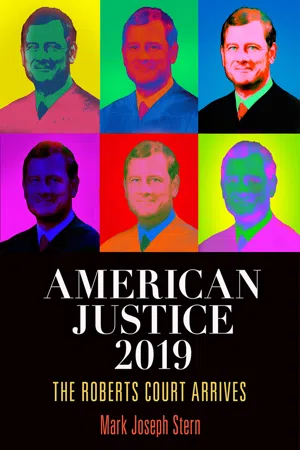
Following the retirement of Justice Anthony Kennedy and the controversial confirmation of Justice Brett Kavanaugh, the Supreme Court plunged into a contentious term that featured divisive cases involving abortion, immigration, capital punishment, and voting rights on the court's docket. In American Justice 2019, Mark Joseph Stern examines the term's most controversial opinions and highlights the consequences of Chief Justice John Roberts stepping into a new role as the court's swing vote.
No longer bound by Kennedy's erratic moderation, Roberts has begun doling out victories to both Democrats and Republicans, albeit with a clear rightward tilt. Early in the term, Roberts delivered a public rebuke to Trump's attacks on the judiciary, foreshadowing his refusal to tolerate some of the president's most extreme contortions of the law. Stern tracks the chief justice's evolution from staunch conservative to part-time centrist. Along the way, he details the term's blockbusters and surprises, including an unlikely alliance between Justices Neil Gorsuch and Sonia Sotomayor on criminal justice, and an especially radical ruling on the death penalty that overturned decades of precedent. Stern's account depicts a court sharply divided over its role in American democracy, with the man at its center striving to stay above the political fray without abandoning his conservative instincts.
- 184 pages
- English
- ePUB (mobile friendly)
- Available on iOS & Android
eBook - ePub
About this book
Information
Publisher
University of Pennsylvania PressYear
2019Print ISBN
9780812252132
9780812252132
eBook ISBN
9780812296839
Chapter 1
Death Matters
Domineque Ray was prepared to die, with one caveat: he wanted his imam by his side when the moment came. Sentenced to death by an Alabama jury in 1999 for the rape and murder of a teenage girl, Ray converted to Islam behind bars. He was by all accounts a devout practitioner of the faith. But the prison where he sat on death row for thirty years, Alabama’s Holman Correctional Facility, provided only a Christian chaplain in the execution chamber to comfort inmates as they died. When Ray learned of this policy he sought an accommodation, asking the prison to let his imam accompany him instead. The prison refused, telling Ray his options were a Christian chaplain or nothing.
Five days later, Ray filed a lawsuit alleging a violation of his rights under federal law and the U.S. Constitution. By doing so, he set in motion a chain of events that would lead the justices of the U.S. Supreme Court to feud, bitterly and publicly, about capital punishment and religious liberty. This squabble consumed the court across four separate cases, dividing the justices into warring camps over the jurisprudence of death.
By the time Ray’s case landed at the Supreme Court, he had received a reprieve: the U.S. Court of Appeals for the Eleventh Circuit stayed his execution, finding a probable violation of his constitutional rights. On the night of February 7, however, the Supreme Court’s conservative bloc reversed the Eleventh Circuit in an unsigned one-paragraph order. The majority alleged that Ray had waited too long to file his lawsuit, forfeiting his ability to litigate Alabama’s policy. The Supreme Court allowed his execution to move forward, and he was administered a lethal injection shortly thereafter.
In response, Justice Elena Kagan penned an outraged dissent joined by her liberal colleagues. The majority’s decision, she wrote, was “profoundly wrong.” Kagan explained that Alabama’s chaplain-only policy likely ran afoul of the First Amendment’s Establishment Clause, which bars the government from “respecting an establishment of religion.” The Supreme Court has held that the “clearest command of the Establishment Clause is that one religious denomination cannot be officially preferred over another.” But, Kagan wrote, “the State’s policy does just that. Under that policy, a Christian prisoner may have a minister of his own faith accompany him into the execution chamber to say his last rites. But if an inmate practices a different religion—whether Islam, Judaism, or any other—he may not die with a minister of his own faith by his side.”
Kagan also noted that Ray hadn’t actually filed his lawsuit at the “last minute,” as the majority claimed. In reality, Alabama law states that an inmate’s spiritual adviser of choice “may be present at an execution.” Unbeknownst to Ray, his prison had a secret regulation that distinguishes between advisers who can be in the death chamber (a Christian chaplain) and those who can watch from the viewing room (everyone else). But the prison “refused to give Ray a copy of its own practices and procedures” laying out this rule. So, he could not have known that his imam would be excluded until he asked, about two weeks before his execution. And just five days after he learned of the rule, he filed his lawsuit. How is that “last minute”?
By the time many court watchers read Kagan’s dissent the next morning, Ray had been executed. She lost the battle, but the high court’s internal war over Domineque Ray was just beginning. The majority’s late-night order drew widespread condemnation from both progressives and conservatives. Describing Ray’s imam-free execution as a “grave injustice,” National Review’s David French scorned the majority for failing to respect the First Amendment’s protections “at the moment of his death.” Liberal critics such as Amir H. Ali of the MacArthur Justice Center pointed out that the decision was especially troubling in light of the Supreme Court’s 2018 decision upholding President Donald Trump’s executive order banning travel to the United States from several Muslim-majority countries. “If that was a gut punch to the Muslim community,” Ali told the Washington Post, “this will be seen as a follow-up kidney shot.”
Kagan didn’t accuse the majority of anti-Muslim hypocrisy. But she hit them where it hurts. The Supreme Court’s conservatives pride themselves on their self-proclaimed solicitude toward religious liberty. In 2014’s Greece v. Galloway, they allowed a town board to continue opening its meetings with almost exclusively Christian prayers. That same year in Burwell v. Hobby Lobby, the conservatives blocked President Barack Obama’s administration from applying the contraceptive mandate to for-profit corporations whose Christian owners oppose birth control, citing a federal law protecting religious freedom. In 2018’s Masterpiece Cakeshop v. Colorado Civil Rights Commission, they held that government officials had expressed impermissible animus when penalizing a Christian baker for turning away a same-sex couple.
True, the court had occasionally ruled in favor of Muslims too, protecting their rights to grow beards in prison (2015’s Holt v. Hobbs) and wear a headscarf at work (2015’s EEOC v. Abercrombie). But the court’s 5–4 decision in 2018’s Trump v. Hawaii—upholding the president’s travel ban in the face of evidence that he intended it to function as a “Muslim ban”—was still fresh. Now a Muslim inmate was requesting a fairly minor accommodation, and the majority turned him away. Do the conservative justices simply care more about Christians than Muslims and other religious minorities?
The next month, it appeared that this grisly drama was bound to repeat itself. That March a second case with similar facts, Murphy v. Coller, made its way to the court: Texas planned to execute Patrick Henry Murphy, a Buddhist. The state provided either a Christian or a Muslim spiritual adviser to inmates in the execution room but refused to let Murphy bring his Buddhist adviser into the death chamber. Murphy, like Ray before him, asked the Supreme Court to block his lethal injection due to this unequal treatment of minority faiths. Pretty much everyone expected the court’s conservative justices to turn him away, but they did not.
The Ray majority fractured: Justice Brett Kavanaugh peeled off, voting with the liberals to stay Murphy’s execution. “In my view,” Kavanaugh wrote, “the Constitution prohibits [the] denominational discrimination” that Texas wished to impose. In order to remedy this violation, the state must either allow Murphy’s adviser to enter the execution chamber or prohibit all spiritual advisers from comforting inmates in their final moments. A few days later Texas issued a new rule taking up Kavanaugh’s second offer, denying all inmates access to clergy in the death chamber.
Why did Kavanaugh spare Murphy but not Ray? In a footnote, Kavanaugh wrote that Murphy (unlike Ray) had challenged his prison’s policy in “a sufficiently timely manner.” But that cannot be right. If anything, Murphy waited much longer than Ray. Recall that Ray didn’t learn about Alabama’s (secret) policy until about two weeks before his scheduled execution. Murphy, by contrast, had notice of Texas’s (public) regulation since at least 2012, when it was first issued. The simplest explanation for Kavanaugh’s sudden swing left in Murphy, then, is that he changed his mind following the crush of bipartisan criticism that greeted the court’s decision in Ray.
This didn’t mean, though, that Kavanaugh or the other conservatives had formally retreated from their vote in Ray and embraced Kagan’s dissent—quite the opposite. Four days after Kavanaugh’s flip in Murphy, he joined an opinion doubling down on Ray.
That opinion—the third skirmish in this ongoing battle—was Bucklew v. Precythe, a death penalty case that, on the surface, had nothing to do with Ray or Murphy. It was not about religion but instead was about pain. Missouri planned to execute Russell Bucklew using lethal injection, but he asserted that this method of death would constitute “cruel and unusual punishment” in violation of the Eighth Amendment. Bucklew suffered from cavernous hemangioma, a rare medical condition that covered his neck, throat, lips, and uvula with large blood-filled tumors. A medical expert testified that a lethal injection would cause these fragile tumors to rupture and fill his mouth with blood, leading him to suffocate to death in horrific pain. Bucklew therefore proposed death by nitrogen gas, which was authorized by state law but had not yet been implemented.
This case provided another early test of Justice Brett Kavanaugh’s approach to capital punishment. Kavanaugh’s predecessor, Justice Anthony Kennedy, had voted to block Bucklew’s execution in 2018—a 5–4 decision from which the remaining conservatives dissented. Kennedy obviously believed that Bucklew had presented a serious Eighth Amendment claim. Would his successor agree? He would not.
Days after his liberal vote in Murphy, Kavanaugh joined with his fellow conservatives to let Missouri execute Bucklew by lethal injection. And Justice Neil Gorsuch’s opinion for the court treated his claims with startling indifference, surveying the history of executions in America as if to say that Bucklew was lucky he didn’t face an even more gruesome demise. So long as the state’s method of execution does not inflict “gratuitous” pain, Gorsuch wrote, it is constitutional. And because Missouri did not intend to make Bucklew’s death unnecessarily painful, it could execute him by lethal injection.
This holding marked a radical shift in Eighth Amendment jurisprudence. Gorsuch’s test—forcing death row inmates to prove that the state intended to add gratuitous agony—had never before gained majority support. It was favored by Justices Antonin Scalia and Clarence Thomas, but Kennedy never signed onto it. Here, then, is an instance where Kavanaugh’s elevation to the court made a marked difference. His vote allowed Gorsuch to crack down on challenges to executions, imposing a standard that few if any inmates will ever meet.
In Bucklew, Gorsuch didn’t just change the court’s interpretation of the Eighth Amendment. He also seized the opportunity to respond to Kagan’s dissent in Ray. In an extraneous section at the end of his opinion, Gorsuch wrote that “last-minute” stays of execution “should be the extreme exception,” meaning the courts should almost never block executions in the days or hours before they’re scheduled to occur. He implied that attorneys for capital inmates were gaming the system, clogging up dockets with frivolous claims just to keep their clients alive. As an example he cited Ray, suggesting that Domineque Ray had waited “until just 10 days before his scheduled execution” to file his lawsuit merely so he could avoid imminent death.
In separate dissents, Justices Stephen Breyer and Sonia Sotomayor both wrote rejoinders to Gorsuch’s assertion. Breyer reiterated that Ray “brought his claim only five days after he was notified of the policy he sought to challenge” and “raised a serious constitutional question.” And Sotomayor tore into Gorsuch’s “belated explanation” of the Ray decision, debunking his “mistaken premise that Domineque Ray could have figured out sooner that Alabama planned to deny his imam access to the execution chamber.” This “skewed view of the facts” led the majority to “misuse” its powers and let Alabama kill Ray.
Once Bucklew came down, it seemed that both sides of the debate had aired their grievances and moved on. The conservatives felt certain that they had done the right thing in Ray; the liberals were convinced that their colleagues had erred disastrously. Kavanaugh had staked out a middle ground in Murphy, crafting a Kennedy-esque compromise. Case closed? Not even close.
On May 13—well over two months after the stay in Murphy—Justice Samuel Alito issued a dissent responding to Kavanaugh’s concurrence in that case and Kagan’s dissent in Ray. This move was, to say the least, unusual. Opinions relating to these kinds of orders are typically released all at once when they are relevant.
But Alito, it turns out, had fumed for weeks over the events in Murphy and Ray and chose to release a fourteen-page opinion well after the fact rebutting Kavanaugh and Kagan. The court’s decision to stay Murphy’s execution, Alito wrote, was “seriously wrong” because prisons have a preeminent interest “in tightly controlling access to an execution room”—one that may apparently outweigh the constitutional guarantee of religious liberty. Besides, Murphy “egregiously delayed in raising his claims,” deploying underhanded “tactics” to spare his life. Those “tactics” were “just as unjustified” as Ray’s, and the court should have let both men die.
Gorsuch and Justice Clarence Thomas joined Alito’s opinion. Incredibly, Kavanaugh decided to respond to Alito, as if trapped in a never-ending game of phone tag with human lives in the balance. Joined by Chief Justice John Roberts, Kavanaugh pointed out that to comply with Alito’s Murphy concurrence, Texas barred all spiritual advisers from the execution chamber. Thus, his opinion “facilitat[ed] a prompt fix to the religious equality problem in Texas’ execution protocol,” and this “resolution” should “alleviate any future litigation delays or disruptions.”
Then as if to defend his split vote in Murphy and Ray, Kavanaugh reiterated his (incorrect) belief that Ray waited too long to sue, while Murphy did not. And Kavanaugh wrote that Ray had not presented a First Amendment “equal-treatment argument” as explicitly as Murphy had, if at all. Kavanaugh concluded by reminding “counsel for inmates facing execution” to “raise any potentially meritorious claims in a timely manner.” In other words, don’t expect Kavanaugh to swing left on any future “last-minute” requests to stay an execution.
What does this contretemps tell us about the post-Kennedy court’s approach to death? The main takeaway here is that the conservative justices are tired of dramatic appeals from death row inmates facing the needle in a matter of hours. With Kennedy on the court these appeals stood some chance of success, as he would sometimes spare prisoners while the court mulled their claims. If we take Kavanaugh at his word, those days are over. The new conservative majority thinks that these appeals are part of what Alito once described as “a guerilla war against the death penalty,” wherein opponents of capital punishment use every tool at their disposal to gunk up the machinery of death. And the conservative justices will not reward this putative crusade with stays of execution.
These justices made that much clear in the term’s fourth and last death penalty skirmish, Dunn v. Price. Christopher Lee Price, another Alabama death row inmate, asked the Supreme Court to block his impending execution because the state planned to use midazolam. That drug is supposed to render inmates unconscious before they are injected with chemicals that paralyze them then stop their heart. But some inmates have stayed conscious after they were given midazolam, leading to excruciatingly painful botched lethal injections. Price asked to be killed by nitrogen gas instead. The conservative majority rejected his appeal, alleging that he hadn’t filed his claim quickly enough.
In response, Justice Stephen Breyer issued an extraordinary dissent that pulled the curtain back to reveal the magnitude of the inner turmoil at the court. He disclosed that he had asked his colleagues to “take no action until tomorrow, when the matter could be discussed at Conference.” They refused, “preventing full discussion among the Court’s Members.” (This disclosure was a shocking departure from protocol, as the justices never divulge information about their secretive conferences.)
“Should anyone doubt that death sentences in the United States can be carried out in an arbitrary way,” Breyer wrote, “let that person review the following circumstances as they have been presented to our Court this evening.”
A full month later in an attachment to orders unrelated to the court’s decision in Price, Thomas issued a retort joined by Alito and Gorsuch. (Again, it is acutely odd for a justice to release an opinion so long after the initial order came down.) In it, Thomas all but accused Breyer of lying. Thomas asserted that Price’s only goal was “to delay his execution,” and the justice expressed disgust that “four Members of the Court would have countenanced his tactics without a shred of legal support.” And Thomas admonished Breyer for supporting these “tactics” by writing a dissent that prevented the court from denying Price’s appeal until the middle of the night—after Alabama’s execution warrant had expired. The dissent, Thomas wrote, “got its way by default.”
On May 30, Price once again asked the court to block his execution. This time, the court turned him away before his execution warrant expired. The vote, once again, was 5–4, and Breyer wrote another short dissent repeating his objections. Alabama promptly executed Price. It appears possible that as Price feared, midazolam did not put him fully to sleep. During the execution he blinked, raised his head, coughed, heaved, and clenched his fist—well after he should have been unconscious.
There is a second lesson to be taken away from all this: Despite the conservatives’ all- in approach to Bucklew,...
Table of contents
- Cover
- Title Page
- Copyright
- Contents
- Introduction. The Chief Takes Charge
- 1. Death Matters
- 2. The Establishment Reversal
- 3. Abortion Access Denied
- 4. The Libertarian Court? Shifting Views on Criminal Justice
- 5. Huddled Masses: Immigration, ICE, and Asylum
- 6. Big Business Before the Bar
- 7. Gunning for the Administrative State
- 8. Democracy Imperiled: The Gerrymandering Case
- 9. Drawing the Line on Lies: The Census Case
- Epilogue. The Man in the Middle
- Appendix. Biographies of Current Justices of the Supreme Court
- Acknowledgments
Trusted by 375,005 students
Access to over 1.5 million titles for a fair monthly price.
Study more efficiently using our study tools.
Frequently asked questions
Yes, you can cancel anytime from the Subscription tab in your account settings on the Perlego website. Your subscription will stay active until the end of your current billing period. Learn how to cancel your subscription
No, books cannot be downloaded as external files, such as PDFs, for use outside of Perlego. However, you can download books within the Perlego app for offline reading on mobile or tablet. Learn how to download books offline
Perlego offers two plans: Essential and Complete
- Essential is ideal for learners and professionals who enjoy exploring a wide range of subjects. Access the Essential Library with 800,000+ trusted titles and best-sellers across business, personal growth, and the humanities. Includes unlimited reading time and Standard Read Aloud voice.
- Complete: Perfect for advanced learners and researchers needing full, unrestricted access. Unlock 1.5M+ books across hundreds of subjects, including academic and specialized titles. The Complete Plan also includes advanced features like Premium Read Aloud and Research Assistant.
We are an online textbook subscription service, where you can get access to an entire online library for less than the price of a single book per month. With over 1.5 million books across 990+ topics, we’ve got you covered! Learn about our mission
Look out for the read-aloud symbol on your next book to see if you can listen to it. The read-aloud tool reads text aloud for you, highlighting the text as it is being read. You can pause it, speed it up and slow it down. Learn more about Read Aloud
Yes! You can use the Perlego app on both iOS and Android devices to read anytime, anywhere — even offline. Perfect for commutes or when you’re on the go.
Please note we cannot support devices running on iOS 13 and Android 7 or earlier. Learn more about using the app
Please note we cannot support devices running on iOS 13 and Android 7 or earlier. Learn more about using the app
Yes, you can access American Justice 2019 by Mark Joseph Stern in PDF and/or ePUB format, as well as other popular books in Law & Public Law. We have over 1.5 million books available in our catalogue for you to explore.