"Proud, defiant, brave, these are the Muslim women of America. Hear them roar!"
—Asma Gull Hasan, author of Why I Am a Muslim
For years, the image of the Muslim woman in America has been as mysterious as the face behind the veil. Is she garbed in the traditional hijab and chador? Is she subservient to a male-dominated culture and religion? Does she grocery shop, do her nails, go to the gym?
"A superb attempt at helping us to discover the emerging identity of American Muslim women."
—Dr. Sayyid M. Syeed, Islamic Society of North America
In this moving book, journalist Donna Gehrke-White provides a rare, revealing look into the hearts, minds, and everyday lives of Muslim women in America. Here, in their own words, are the many different voices of doctors, soccer moms, rebels, reformers, former political prisoners, survivors, and activists—women of faith, courage, hope, and change—all Muslims, all Americans.
"Enlightening. . . . In their diversity, forthrightness, and honesty, the voices of these women ultimately sound more American than anything else—and therein lies the strength of this book."
—Library Journal
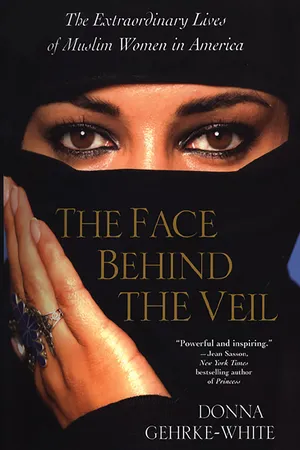
eBook - ePub
The Face Behind the Veil
The Extraordinary Lives of Muslim Women in America
- 320 pages
- English
- ePUB (mobile friendly)
- Available on iOS & Android
eBook - ePub
About this book
Trusted by 375,005 students
Access to over 1.5 million titles for a fair monthly price.
Study more efficiently using our study tools.
Information
Topic
Theology & ReligionSubtopic
Islamic TheologyPART I
The New Traditionalists
Ask Sahar Shaikh about her hijab and the twenty-something says it’s all about identity. By wearing it, she says, “I found out who I am.”
More and more American Muslimah are donning some sort of covering as part of their spiritual journey, from a head scarf to a veil that covers most of the face. Unlike others in the West, they don’t see the covering as a symbol of female inferiority. Indeed, many hijab-wearing American women are highly educated: They practice law, teach at universities, develop software, or treat the ill.
As a social worker, Sahar wears a hijab and long gown when she sees elderly clients. She wants to clear up what she says is a common misperception. Muslim women wear a hijab because they want to, not because their husbands or fathers force them. “It makes me feel more at peace with God,” Sahar says. “It also makes me aware of time management: I ask what should I be doing, what is His purpose?”
Sahar grew up in suburban Miami with blue jeans, Girl Scouts, and rock and roll. But she felt something was missing in her life. She found it on a tennis court in her freshman year at the University of Florida in Gainesville, surrounded by her Muslim friends. They were wearing their hijabs, even while running to lob the ball and then having to pat their head covering back in place. She was the only one bareheaded. “Look who is the outcast now,” they gently teased her.
“It was a revelation to me,” Sahar says. “I was trying so hard to fit in with the rest of the world.” So despite being afraid of being labeled “different” from the other university students, Sahar donned a hijab. And she says she discovered the warm intimacy of such a shared culture.
Mohiaddin Mesbahi, an associate professor of international relations at Florida International University, offered some insights on this developing trend among American Muslim women while I was working on a Miami Herald story. “They are returning to their identities, to spirituality, but they are feminists,” Mesbahi said. “It’s difficult for Western people to understand, but a woman putting on a hijab is not a sign of repression, like what they see on television with the women in Afghanistan. Although there is no data available, a significant number of American women are doing so.”
These veiled feminists believe Islamic traditions have benefited women. Passages in the Quran, for example, promote educating women, emphasizing education over physical looks, says Stephen Sapp, chairman of the Department of Religious Studies at the University of Miami. “Islam, from the very beginning, emphasized the importance of having women be economically secure in their own right,” he adds. “The Quran gives them the right to own and manage their own property. That is spelled out in great detail.”
Indeed, the veil, or some sort of head covering for a woman, predates Islam. Ancient Greeks, Jews, and early Christians included head coverings as part of a woman’s wardrobe. In some ancient societies it was a status symbol: Only slaves and prostitutes didn’t wear them.
Today, it is true, many women wearing their Islamic covering believe they pay a heavy price for their spirituality. Many of the youngest feel lonely as the only girls to wear head scarves in middle or high school. (More Muslimah tend to wear some sort of covering in college.) Meanwhile, many older women who wear the hijab feel they are discriminated against at their work place. Others say they are singled out for harassment on the streets or in the mall, in misguided retaliation for the terrorists who kill in the name of Islam. As a result, some avoid going out in public, except to go to work or the mosque.
Still, most say such harassment could be much worse—and is—in other countries. France, for example, bans school girls from wearing a hijab. For the most part, Muslimah say Americans are accommodating, even curious about Islam.
Sakeena Mirza found that she is more comfortable in the United States than her father’s native Pakistan. She now lives in Las Vegas. Meanwhile, her older sister, Haseena Mirza, discovered that she could wear her hijab while working at a predominantly Orthodox Jewish facility and be accepted. The American Muslimah feel so at home that they have developed their own couture with a “Western feel,” says designer Michaela Corning of Seattle who caters to the growing number of women wearing the hijab and other traditional Muslim women’s clothing. Indeed, if you look beyond the exotic apparel, you’ll find the New Traditionalists, profiled in the following pages, could be your next-door neighbor, your doctor, or your lawyer.
1
ZARINAH: AN ISLAMIC-STYLE HIGH SCHOOL QUEEN
WE ALL HAVE FELT the terror of being alone in a crowded school hallway, of somehow being different. We’ve felt the humiliation of not fitting into the tribe, of being uncool, whether it was for a few hours or our whole school career.
Imagine the plight of Zarinah Nadir, a second-generation Muslim who wore the hijab in school when no one else did. Zarinah was one of the relatively few African Americans in the overwhelmingly white state of Arizona. In addition, she had to wear an odd-looking scarf—years before 9/11 at a time when there wasn’t much awareness of Muslims in America.
Now twenty-four years old, she recalls, “I was the only one in my elementary school through high school to wear the hijab. I have worn the hijab since sixth grade. I knew I looked different.”
Other Muslim girls have bewailed this kind of experience. Zarinah’s mother, Aneesah Nadir, for her doctoral dissertation, interviewed some girls who were traumatized during their public school years when their parents, many of them immigrants and unfamiliar with American customs, sent them to school wearing the required scarf, a symbol of Muslim female modesty. “I had a very difficult time,” one girl told Aneesha. “I was the oldest in my family so I didn’t have anyone to show me around. I didn’t know what to expect. My parents didn’t know what it was like for me. They’re from a different culture. They’ve never been in my situation. They had sympathy but not empathy.”
Zarinah didn’t have an easy time, either. She didn’t want to be the only one wearing a hijab. Occasionally, she was called names and singled out for being “different.” On the other hand, though, she didn’t want to turn her back on her faith. She could not wear her scarf. Naturally outgoing, and proud that her parents converted to Islam, she decided to tough it out. She concentrated on what she had in common with the other kids at school. “I wore jeans like everyone else,” she says. Plus, everyone wants to have fun, right? To have loyal friends? “I saw it as an opportunity. I didn’t walk around with my head held down. I had lots of non-Muslim friends and we had common ground. I enjoyed having fun with them. We went to the movies. I wasn’t able to do all the things they did—I didn’t drink, I wasn’t able to go to parties where there would be both boys and girls present. They respected that.
“But, to be honest,” she adds, “there sometimes were difficult times.” Some guy would make a dumb remark. A girl would stare at her.
In response, Zarinah and some other Muslim girls from the mosque started their own group. “For example, we started our own graduation party,” Zarinah says. “Our philosophy is: We can do it—but in an Islamic way. I have my kicks, my fun. I didn’t go to the high school prom or to pool parties or barbeques. I did, though, go to the homecoming football game—just not the prom.”
Then she corrects herself. She did, indeed, go to a high school dance. Once.
It turns out that some of her friends nominated her as a candidate to be Junior Class Coronation Queen. Coronation was the last big dance before prom. Zarinah was touched but asked her friends to nominate someone who attends dances.
“But,” she says, “they wouldn’t hear of it, and a couple of days later I heard my name mentioned among other nominees. I wound up participating in the Coronation assembly during school hours.”
The assembly turned out to be a highlight for Zarinah, who acknowledges she “was not the slender, blond cheerleader type.” Then she had to grapple with whether she would be allowed to go to the dance. She and her mother came to the same conclusion: She could, but only to hear the election results. Still, what would she wear?
“I often dressed up in prom-like gowns for our ladies-only parties, but I never attended a mixed-gender formal. This was one of the hardest shopping trips I had ever taken!”
She ended up finding a cool—but modest—evening gown.
Zarinah asked her older brother to escort her to the dance, as Muslim boys and girls do not date. He had graduated from the same high school a year before, and thought it would be fun to return to his alma matter and see old friends.
“But, this being high school,” Zarinah adds drolly, “the inevitable was bound to happen. The rumor spread that I would be going to the dance with my older brother. When friends came to me to check out what they heard, I confirmed it without hesitation.”
So Zarinah went serenely to her first high school dance—with hijab and brother. Unusual to say the least but, then, Zarinah had adapted to being different.
It was almost an anticlimax when Zarinah was announced Coronation Queen, the school’s first hijab-wearing queen—and, no doubt, its first to wear a gown buttoned to the neck.
“I believe that this event serves as a testament to my life and what I stand for. While there were some days, as the only ‘hijabbed’ Muslim girl in school, I felt noticeably different, for the most part I used it as an opportunity to build bridges and form bonds—from cheerleaders and football players and those in the band to all students in between.”
In retrospect, she feels her experiences forced her to mature, to tough out difficult situations. She now attributes her poise and confidence to overcoming the fear of being different.
“I had, fortunately, what other girls didn’t have: a focus.”
Some years later, Zarinah was accepted as a law student at Arizona State University, where she started the Muslim Law Students Association as an anchor for young Muslims trying to make it through law school. She has since worked in a family law office and wants to work as an intern in immigration court. She’s not timid about trying out various legal areas until she finds her niche.
She feels her other Muslimah friends are equally strong and goal-oriented. One, she predicts, will break into broadcast journalism—hijab and all—and anchor a newscast. Another, she feels, could become a United States senator.
“The sky is the limit,” she says. “We are coming of age. I see good things. I see hope.” She believes there has been a disconnect between how Muslim women are treated in predominantly Muslim countries and how they once were. “Muslim women were once teachers, scholars, leaders on the battleground, and naval commanders. I feel our generation and the next generation will be reclaiming that history,” Zarinah says.
Living in the United States, Zarinah feels she has enjoyed the best of both worlds. She’s an American woman—with all the freedom that permits—and she’s part of a closely knit Muslim community.
“I love this sense of community that Islam gives,” she says. “Everyone is included. We address each other as brother or sister. If they are elders, they are aunties or uncles. We have this strong bond as a family. My extended family doesn’t live in the same area I do. That’s kind of hard. But we have built kind of an adopted family through our being Muslims—our own aunties and uncles who have seen me grow up and who have been to all of my special events.
“I appreciate the boundaries that Islam sets,” she adds. “I beli...
Table of contents
- Cover
- Contents
- Copyright
- Preface
- Acknowledgments
- Introduction
- PART I: THE NEW TRADITIONALISTS
- PART II: THE BLENDERS
- PART III: THE CONVERTS
- PART IV: THE PERSECUTED
- PART V: THE CHANGERS
- Glossary
- Resources
Frequently asked questions
Yes, you can cancel anytime from the Subscription tab in your account settings on the Perlego website. Your subscription will stay active until the end of your current billing period. Learn how to cancel your subscription
No, books cannot be downloaded as external files, such as PDFs, for use outside of Perlego. However, you can download books within the Perlego app for offline reading on mobile or tablet. Learn how to download books offline
Perlego offers two plans: Essential and Complete
- Essential is ideal for learners and professionals who enjoy exploring a wide range of subjects. Access the Essential Library with 800,000+ trusted titles and best-sellers across business, personal growth, and the humanities. Includes unlimited reading time and Standard Read Aloud voice.
- Complete: Perfect for advanced learners and researchers needing full, unrestricted access. Unlock 1.5M+ books across hundreds of subjects, including academic and specialized titles. The Complete Plan also includes advanced features like Premium Read Aloud and Research Assistant.
We are an online textbook subscription service, where you can get access to an entire online library for less than the price of a single book per month. With over 1.5 million books across 990+ topics, we’ve got you covered! Learn about our mission
Look out for the read-aloud symbol on your next book to see if you can listen to it. The read-aloud tool reads text aloud for you, highlighting the text as it is being read. You can pause it, speed it up and slow it down. Learn more about Read Aloud
Yes! You can use the Perlego app on both iOS and Android devices to read anytime, anywhere — even offline. Perfect for commutes or when you’re on the go.
Please note we cannot support devices running on iOS 13 and Android 7 or earlier. Learn more about using the app
Please note we cannot support devices running on iOS 13 and Android 7 or earlier. Learn more about using the app
Yes, you can access The Face Behind the Veil by Donna Gehrke - White in PDF and/or ePUB format, as well as other popular books in Theology & Religion & Islamic Theology. We have over 1.5 million books available in our catalogue for you to explore.