What Is Their Secret And What Are They Hiding?
Step inside the secret world of the Masons and discover:
How such pivotal American documents as the Declaration of Independence and the Bill of Rights reflect Masonic principles and influence.
How Freemasons became the world's oldest and largest fraternal organization.
If Freemasons rule the world--or want to.
Why Masonic symbolism appears on American currency.
Why the opposition groups, from conspiracists to the Catholic Church, fear Freemasons.
Why Texas has been called "the Masonic Republic."
How to recognize Masonic rings, pins, and other symbols.
From George Washington to Dan Brown's The Da Vinci Code, the Freemasons have influenced the United States in many surprising ways. With nearly half the world's six million Freemasons--some twenty-five U.S. presidents and thirty-five Supreme Court justices among them--America has felt the group's impact more deeply and broadly than any other country.
Using historical anecdotes and incisive analysis, this timely and insightful portrait separates the myths surrounding Freemasonry from the facts, offering a unique insider's view into what American Freemasonry was, is, and will be tomorrow.
H. Paul Jeffers has published more than 50 works of fiction and nonfiction, including Freemasons: Inside the World's Oldest Secret Society, biographies of presidents Theodore Roosevelt and Grover Cleveland, New York mayor Fiorello LaGuardia, Diamond Jim Brady, and others. He lives in Manhattan.
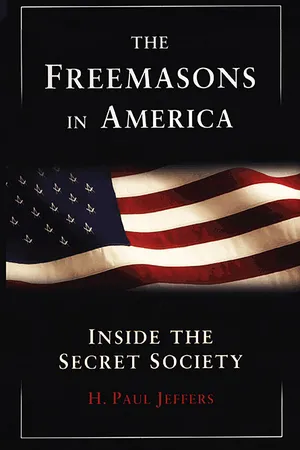
- 240 pages
- English
- ePUB (mobile friendly)
- Available on iOS & Android
eBook - ePub
About this book
Information
Chapter 1
Godfather: Lord Jeffrey Amherst and American Military Masonry
Lord Jeffrey Amherst was a soldier of the king
And he came from across the sea;
To the Frenchmen and the Indians he didn’t do a thing
In the wilds of this wild country,
But for his Royal Majesty he fought with all his might
For he was a soldier brave and true;
He conquered all his enemies whenever they came in sight
And he looked around for more when he was through.
WHEN STUDENTS AND FACULTY OF AMHERST COLLEGE IN MASSACHUSETTS join in their school’s song, it is a tribute to its namesake, a British army officer who arrived in America to command soldiers in a world war with France. Born in Riverhead, Sevenoaks, England, he was the son of another Jeffery Amherst, a prosperous lawyer whose family had lived in Kent for centuries. At the age of twelve, young Jeffery became a page in the house of Lionel Cranfield Sackville, the First Duke of Dorset. Circumstances of his early military career are obscure. It has been noted that he entered the First Foot Guards as an ensign. A list of officers in the regimental history shows him doing so in November 1735. Made a lieutenant in Sir John Ligonier’s Regiment of Horse, which was based in Ireland, he became a protégé of Ligonier, who called him his “dear pupil.”
Amherst saw his first active service as Ligonier’s aide-de-camp in Germany during the War of the Austrian Succession and was present at the battles of Dettingen in Germany in 1743 and Fontenoy (Belgium) in 1745. The First Foot Guards’ records show that in December 1745 he was appointed captain in that regiment, a commission carrying with it the rank of lieutenant-colonel in the army at large. In 1747, the Duke of Cumberland, as commander in chief of the allied forces in Europe, made him one of his aides-de-camp. He served during the Battle of Laffeldt (Belgium).
In a period of peace following the Treaty of Aix-la-Chapelle (1748), he was in England. His first responsibility in the Seven Years’ War with France was as “commissary” in charge of the administration of 8,000 Hessian troops taken into British pay at the beginning of 1756. He went to Germany in February to undertake a duty that seems to have been largely financial. He returned to England in May with part of the Hessian force to guard against a possible invasion by the French. Soon after his return, he was appointed colonel of the Fifteenth Foot. This commission did not involve active command of the regiment, so he returned to Germany with the Hessian detachment in March 1757. He was at the victorious battle of Hastenbeck on July 26, 1757. In October, Ligonier succeeded as commander in chief with command of the army in Great Britain and direction over all British troops serving in North America.
After deciding on an assault on Louisbourg Île Royale (Cape Breton Island), in French Canada in 1757, Ligonier placed Amherst in command. This was remarkable, not merely because Amherst was very junior in the army, but because he had never commanded troops in action. With a royal sanction for the grant of the local rank of “Major General in America,” Amherst sailed for America on March 16, 1758, with detailed orders for the expedition against Louisbourg. When the British fleet of warships and transports met Amherst just outside the harbor at Gabarus Bay, west of Louisbourg, Amherst studied the shoreline with two brigadiers. He chose to attack from the east. After his force landed, he made a systematic European-style siege operation against the town. The French surrendered.
Leaving a garrison at Louisbourg, Amherst sailed for Boston. When its grateful citizens attempted to get his men drunk, he withdrew his five battalions and marched north to Albany. Because of an earlier British defeat in that region, he discovered that the Louisbourg victory had made him commander in chief in America. He went to New York, where he spent the winter making plans and logistic arrangements for the campaign of 1759, which included another attack on Canada based on orders from London stating that it was “the great and essential object.” He was told that “according as you shall, from your knowledge of the Countries, thro’ which the War is to be carried, and from emergent circumstances not to be known here, judge the same to be most expedient.” He discerned that the French defenders of Montreal were vulnerable because the Canadian militia had largely deserted and the defenders had shrunk to little more than 2,000 men. The British forces amounted to 17,000. Rather than surrender their colors, the French battalions burned them. Montreal, and with it Canada, was surrendered to him on September 8, 1760. Although the fighting with France in North America was virtually over, the war was not.
As commander in chief, Amherst was concerned with organizing expeditions against Dominica and Martinique in 1761. In 1762, he sent a contingent to take part in an attack on the city of Havana, Cuba. In August 1762, he dispatched his younger brother, William, with a hastily assembled force to take St. John’s, Newfoundland. In 1763, when word of peace in Europe arrived, Amherst received reports from the west of Indian attacks. They were the opening shots of an uprising by Indians under Chief Pontiac, aided by the French, that was soon named the French and Indian War. Amherst wrote to Sir William Johnson in London, “When Men of What race soever, behave ill they must be punished.”
Wherever the British army went, Freemasonry accompanied it in the form of regimental filed lodges. They were mobile and carried their Masonic regalia in trunks along with their regimental colors, silver, and other purely military equipment. In The Temple and the Lodge, Michael Baigent and Richard Leigh note that often the colonel commanding would preside as the lodge’s original master and then be succeeded by other officers. These regimental field lodges were to have a profound effect on the army as a whole and on Americans who fought beside their homeland cousins.
The first British army lodge was the First Foot Guards to which Amherst was assigned as an aide-de-camp for General Ligonier. Although his full Masonic history is not known, the single most important British commander of the period was a known Mason as early as 1732. At that time there were five regimental lodges, including the Royal Scot Fusiliers, the Gloucester Regiment, the Duke of Wellington’s Fusiliers, and the Royal Northumberland Fusiliers, best known to the readers of Sherlock Holmes stories as the regiment in which Dr. John H. Watson served and was wounded in Britain’s second war in Afghanistan.
Americans who served British contingents and received military training and instructions in strategy and tactics were also introduced to the rites and rituals of a branch of Freemasonry that was not charted by the Grand Lodge of England, but by the Irish Grand Lodge. The York Rite offered higher degrees (up to thirty-two) and other recognitions of Masonic achievement. The civilian rite that would flourish in the United States was called “Scottish,” despite the fact that it was formed in France by English expatriates and had made its way to the American continent through the West Indies.
In a speech titled “American Masonic Roots in British Military Lodges,” James R. Case, a master in the American Lodge of Research in New York City, explained that the existence and broad popularity of military Freemasonry resulted from British troops being garrisoned in winter, “For obvious reasons when the army is in the field, there is no opportunity for work or festivity by the Craft.”
Although Amherst brought military Freemasonry to the colonies, he was not the first English Mason to set foot on American soil. The pioneer was John Skene. Born in Newtyle, England, around 1649, he, his family, and other daring venturers into the New World sailed up the Delaware River aboard the Golden Lion in 1682. Settling at Mount Holly, New Jersey, on a plantation that he named Peachland, he went on to become the deputy colonial governor of West Jersey. He died in 1690. The first Freemason born in America, Andrew Belcher, was the son of Jonathan Belcher, a former governor of Massachusetts and New Hampshire who had been made a Mason in 1704. Andrew was admitted in 1733. Three years earlier (June 1730), the Grand Master of England had appointed Daniel Coxe of New Jersey to be the first Grand Master of the New World, but Coxe was apparently not much interested in vigorously promoting the brotherhood in the colonies. Under “General History of Freemasonry” in the authoritative Dictionary of Freemasonry by Robert Macoy, it is stated that if “Bro. Coxe exercised any of the powers delegated to him we are not informed, nor has any evidence of action on his part been discovered.” The entry also recorded, “The first authentic information that we have is that a convention of Masons in the State was held at the city of New Brunswick, December 18, 1786.”
By that year, Americans who had learned about Freemasonry and how to fight a war from Amherst had been free of British rule for ten years and at peace for three. After more than five years in North America, Amherst had returned to England and wrote a friend, “I may tell you for your own information only, that I have no thought of returning to America.” Historians of his role in the French and Indian War assign him the questionable distinction of being the first to conduct biological warfare. In a series of letters to Colonel Henry Bouquet, a subordinate, he discussed the possibility of sending gifts of blankets infected with smallpox to the Indians. What they did not know was that the commander of Fort Pitt had already attempted the brutal tactic. Because Amherst was the overall commander, and on the evidence of the letters, the blame for this act has been assigned to him.
This stain on his reputation notwithstanding, he was made a knight of the Bath. After the death of his elder brother, Sackville, in 1763, he built a new country house, which he named Montreal, on the family estate near Sevenoaks. But in 1768 a growing colonial discontent led King George III to the conclusion that Amherst should be governor in Virginia. Amherst did not accept. Seven years later, with worse trouble brewing in the American colonies, the king pressed him to take the command in North America. For reasons that remain uncertain, he declined. In 1778, with the American Revolution two years old, the king named him Baron Amherst of Holmesdale, thereby making him Lord Amherst. As the urging of his ministers in 1778, the king again asked him to take command in America, and again he refused. Later that year, he was appointed in effect the commander in chief of the British army, and in June 1780 he had the task of restoring order when London was ravaged by riots. At the beginning of 1793 as another war with France was approaching, the seventy-six-year-old Amherst was officially appointed commander in chief with a seat in the cabinet. He retired again two years later. He was promoted to field marshal on July 30, 1796, and he died on August 3, 1797.
As he was being buried in the parish church of Sevenoaks, Americans who had learned about Freemasonry and how to fight a guerrilla-type war while serving in his army were engaged in the writing of a constitution for the United States of America, whose birth they’d proclaimed in 1776 in a Declaration of Independence signed by several men who counted themselves in the “brotherhood” of Freemasonry.
When nonmilitary Masonic lodges were established in New Jersey, New York, and Pennsylvania, they were “irregular,” meaning that they had not been chartered by the Grand Lodge of England. The first to be given a grant of “warrant” from England’s Grand Master (Lord Montague) was in Boston, Massachusetts. It was presented to Henry Price on July 30, 1733. At a meeting on that day in the Bunch of Grapes Tavern, he and several now formally recognized “brethren” claimed the title “first Lodge in Boston” and named it “St. John’s Grand Lodge.” None of the members of the Boston lodge had ever been employed in stone working. They were attracted to Freemasonry by its intellectual, philosophical, and religious aspects and by the opportunities membership afforded for convivial social intercourse. These sentiments of Masonic fraternity among members of St. John’s Lodge would be tested in 1752 in the form of a rival lodge that was sanctioned by the Grand Lodge of Scotland.
Macoy notes that “the prayer of the petitioners being granted, they received a dispensation, dated Nov. 30, 1752, from Sholto Charles Douglas, Lord Aberdour, then Grand Master. It constituted them a regular Lodge under the title of ‘St. Andrew’s Lodge, No. 82,’ to be holden in the province of Massachusetts Bay.” Installed as grand master of the new lodge was Dr. Joseph Warren. Among the members were Boston silversmith Paul Revere, attorney-at-law John Hancock, and other figures who would be recorded and venerated in the history of the United States and called the Founding Fathers.
Chapter 2
The Knights Templar of America
TO SOME MUSLIMS AND ISLAMIC FUNDAMENTALIST FOLLOWERS, terrorists, members of Al Qaeda, and other “jihadist” groups at the start of the twenty-first century, it’s as if the period of Crusaders battling for control of the Holy Land in the Middle Ages happened yesterday.
Since the destruction of King Solomon’s Temple by the Babylonians in 486 B.C., the city of Jerusalem had been conquered and ruled by the Persians, Greeks, Romans, and the Christian Byzantine Empire until A.D. 638. In that year, a new power swept through the gates of the Holy City to take it over in the name of a new religion that had already claimed Arabia for its God, Allah. Led by Caliph Omar, the forces of Islam had defeated troops of the emperor Heraclitus in the Battle of Yarmuk on August 20, 636, and marched on to lay siege to the city until it surrendered in February 638. Because Mohammed, the founding prophet of Islam, had been miraculously taken into heaven from the city and returned to earth to promulgate the faith, the city was regarded as holy by Muslims. To venerate the prophet’s journey, they built two sacred structures, the Dome of the Rock and the Al-Aqsa Mosque, on the ruins of Solomon’s Temple and its successor that had been restored by King Herod and destroyed by the Romans in A.D. 70.
During two centuries of Islamic rule, relations between Muslims and Christians were amiable. This mutual toleration between the two religions ended in 1000, when the Christians of Europe heard reports from Jerusalem that Christian pilgrims and holy places were suffering at the hands of Muslims. Disturbed by these accounts and concerned about a growing threat to the Byzantine Empire by the westward spread of Islam, Pope Urban II, in a speech at the Council of Clermont in the spring of 1096, called on European powers to set aside internal disputes and rivalries to unite in a holy war to liberate the Holy City from the “...
Table of contents
- Cover
- Contents
- Introduction: Codes, Secrets, and Mysterious Masons
- 1 Godfather: Lord Jeffrey Amherst and American Military Masonry
- 2 The Knights Templar of America
- 3 Fraternity of Arms
- 4 Brother Washington
- 5 Cornerstones of Government
- 6 Little Lodge on the Prairie
- 7 Backlash
- 8 The Masonic Republic of Texas
- 9 Blood Brothers: Rebs and Yankees
- 10 Equality of Moral Men
- 11 From Brother Washington to Grand Master Harry
- 12 The Business of America
- 13 Warrior Masons
- 14 Sons of the Templars
- 15 Only to Serve and Help
- 16 Freemasons and the Frat House
- 17 Fun-Loving Guys
- 18 The Rev. Robertson Takes On the Masons
- 19 Vanishing Knights
- Chronology of American Freemasonry
- Famous American Freemasons
- Masonic FAQs
- Further Reading
- Index
- About the Author
- Copyright
Trusted by 375,005 students
Access to over 1.5 million titles for a fair monthly price.
Study more efficiently using our study tools.
Frequently asked questions
Yes, you can cancel anytime from the Subscription tab in your account settings on the Perlego website. Your subscription will stay active until the end of your current billing period. Learn how to cancel your subscription
No, books cannot be downloaded as external files, such as PDFs, for use outside of Perlego. However, you can download books within the Perlego app for offline reading on mobile or tablet. Learn how to download books offline
Perlego offers two plans: Essential and Complete
- Essential is ideal for learners and professionals who enjoy exploring a wide range of subjects. Access the Essential Library with 800,000+ trusted titles and best-sellers across business, personal growth, and the humanities. Includes unlimited reading time and Standard Read Aloud voice.
- Complete: Perfect for advanced learners and researchers needing full, unrestricted access. Unlock 1.5M+ books across hundreds of subjects, including academic and specialized titles. The Complete Plan also includes advanced features like Premium Read Aloud and Research Assistant.
We are an online textbook subscription service, where you can get access to an entire online library for less than the price of a single book per month. With over 1.5 million books across 990+ topics, we’ve got you covered! Learn about our mission
Look out for the read-aloud symbol on your next book to see if you can listen to it. The read-aloud tool reads text aloud for you, highlighting the text as it is being read. You can pause it, speed it up and slow it down. Learn more about Read Aloud
Yes! You can use the Perlego app on both iOS and Android devices to read anytime, anywhere — even offline. Perfect for commutes or when you’re on the go.
Please note we cannot support devices running on iOS 13 and Android 7 or earlier. Learn more about using the app
Please note we cannot support devices running on iOS 13 and Android 7 or earlier. Learn more about using the app
Yes, you can access The Freemasons In America: by H. Paul Jeffers in PDF and/or ePUB format, as well as other popular books in History & World History. We have over 1.5 million books available in our catalogue for you to explore.