Recent research on all aspects of the Old Kingdom in Egypt is presented in this volume, ranging through the Pyramid Texts, tomb architecture, ceramics, scene choice and layout, field reports, cemetery layout, tomb and temple statuary. The contributions also show how Egyptology is not stuck in its venerable traditions but that newer forms of technology are being used to great effect by Egyptologists. For example, two papers show how GIS technology can shed light on cemetery arrangement and how 3D scanners can be employed in the process of producing facsimile drawings of reliefs and inscriptions.
The authors cover a wide range of sites and monuments. A large part of the work presented deals with material from the great cemeteries of Saqqara and Giza of the Old Kingdom capital city of Memphis but all the smaller sites are discussed. The book also includes a paper on the architecture of mastabas from the lesser-known site of Abu Roasch. The provinces are by no means overlooked, with articles on material from Deir el-Bersha, el-Sheikh Said and Akhmim. Between them, the authors discuss material from the milieu of the king right down to that which concerned the tomb workmen and those who supplied their basic needs, such as bakers, brewers and potters. Containing papers presented at a conference at the Fitzwilliam Museum, Cambridge in May 2009, this book continues a series of publications of the latest research presented at previous meetings in Paris, Berlin and Prague. Much new material is published here and the papers are fully illustrated, with over 200 photographs and drawings.
eBook - ePub
Old Kingdom, New Perspectives
Egyptian Art and Archaeology 2750-2150 BC
- 344 pages
- English
- ePUB (mobile friendly)
- Available on iOS & Android
eBook - ePub
Old Kingdom, New Perspectives
Egyptian Art and Archaeology 2750-2150 BC
About this book
Information
Subtopic
Egyptian Ancient HistoryIndex
Social Sciences1
Recent work in the tomb of Nebkauhor at Saqqara
The tomb of Nebkauhor (Idu)1 is located in Saqqara, in the area north of the causeway of Unas and south of the enclosure wall of the Step Pyramid of king Djoser, west of the tomb of Niankhba, the east of the rock-cut tomb of Hermeru. This tomb is dated to the end of the fifth dynasty and the beginning of the sixth dynasty.2
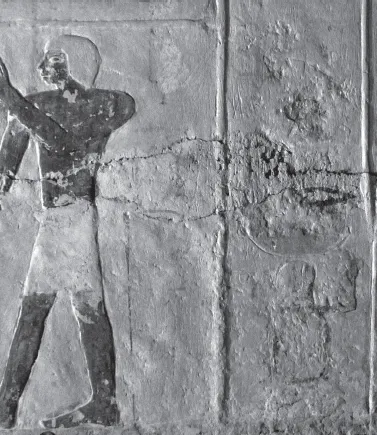
Fig. 1: The northern wall in the offering room
The history of the tomb's discovery and first publication
The tomb of Nebkauhor was excavated by Selim Hassan in mid-October 1937, during the 1937–1938 excavation season at Saqqara of the Egyptian Antiquities Service. A brief report about the main results of the excavation was published by Selim Hassan and re-edited by Zaki Iskander in 1975.3
Reasons for re-publishing the tomb of Nebkauhor
It is important to state why I chose the tomb of Nebkauhor for intensive study instead of one of the other tombs in Saqqara, such as Khentika, Ty, or Neferherenptah. The following are some answers to this question.
- There is a severe lack of detailed information in the original publication of the tomb of Nebkauhor. In his description of the northern wall in the pillared hall, Hassan4 failed to describe several scenes and texts which I shall evaluate in my future study on the tomb of Nebkauhor.
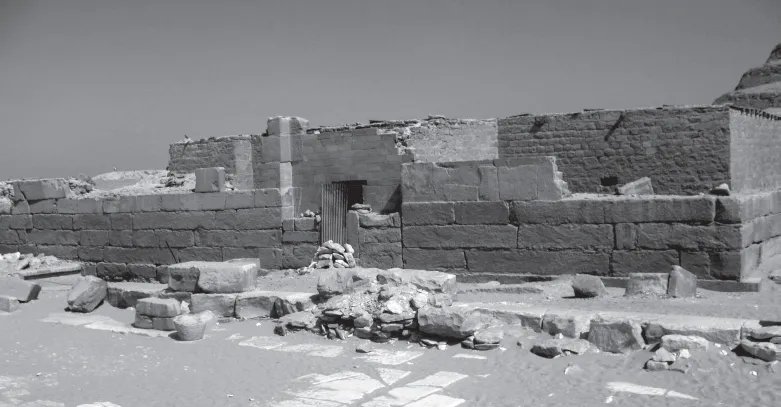 Fig. 2: The façade
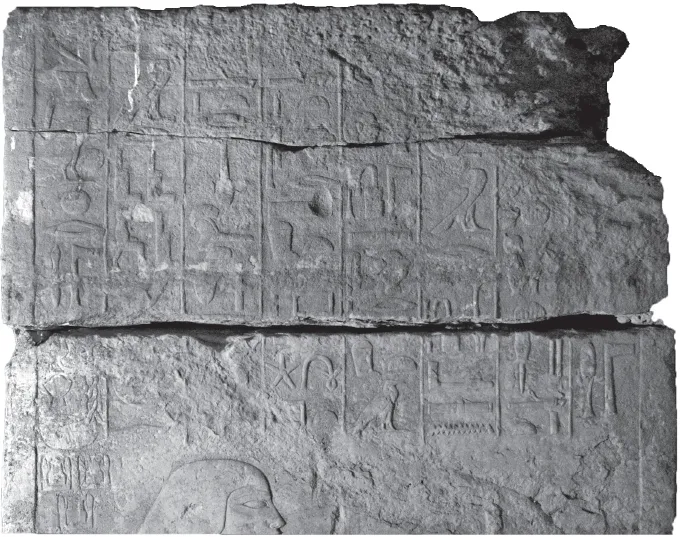 Fig. 3: The first pillar
 - The tomb owner was the king's eldest son of his body, and a vizier; therefore he was a man of considerable importance.
- The tomb is also one of the last major tombs at Saqqara still to be researched and to be published thoroughly.
- There are many errors in the original publication of the tomb. Moreover, there are many errors in Hassan's translation of the hieroglyphic texts, especially the biography.5
- The tomb occupies a special place in the history of Old Kingdom politics, and its art and architecture dates to the transitional period between the end of the fifth dynasty and the beginning of the Sixth. Akhethotep6 (the original owner, and also the one for whom most of the tomb's decoration was carved) post-dates well-known tomb owners such as Ptahshepses at Abusir, and Ty, as well as Niankhkhnum and Khnumhotep, at Saqqara. He also predates well-known sixth dynasty tomb owners such as Kagemni, Mereruka and Ankhmahor.
Tomb owner
Nebkauhor (Idu)'s titles included those of king's eldest son of his body,7 hereditary prince,8 count,9 overseer of the Scribes of the kings documents,10 chief justice and vizier,11 inspector of priests of the pyramid of Unas12 and scribe of a phyle,13 amongst others. It is interesting to point out that the original tomb owner, Akhethotep (Hemi), apparently held the same titles as Nebkauhor (Idu), with the exception of the title of ‘king's eldest son of his body’.
The architecture of the superstructure and substructure
The tomb is a very large one measuring 34.0 × 18.60 m. The existing height is 4.20 m. The tomb consists of: a court; a pillared hall; a serdab; an ante-chamber; a mortuary chapel; an offering room; a burial chamber; and storerooms.
The decoration
1. The façade
The original facade faces south, and still shows reliefs representing the first owner of the mastaba. Akhethotep is standing and facing east. Most of his figure is missing. Only the right hand, holding a handkerchief, and parts of his trunk and feet are still apparent. In front of the feet, only a few fragmentary signs remain of the horizontal row of hieroglyphs (Fig. 2).
2. The removal of the name of the original tomb owner and its substitution with the name Nebkauhor
The tomb shows several examples of Nebkauhor erasing the name and the titles of the original tomb owner Akhethotep and substituting it with his own name.
- The first pillar: we can observe clearly how Nebkauhor removed the name of Akhethotep, and substituted it with his name14 (Fig. 3).
- The northern wall in the offering room: we n...
Table of contents
- Cover Page
- Title Page
- Copyright
- Contents
- Foreword
- Introduction
- 1: Recent work in the tomb of Nebkauhor at Saqqara
- 2: A new Old Kingdom rock-cut tomb from Abusir and its Abusir-Saqqara context
- 3: Mastaba core structure: new data from fourth dynasty elite tombs at Abu Rawash
- 4: The art of Egyptian hieroglyphs as seen by the Akhmim painters
- 5: Two cemeteries for one provincial capital? Deir el-Bersha and el-Sheikh Said in the fifteenth Upper Egyptian nome during the Old Kingdom
- 6: Blocks from the Unas causeway recorded in Černý's notebooks at the Griffith Institute, Oxford
- 7: A spatial metaphor for chronology in the secondary cemeteries at Giza
- 8: The decorative programmes of the pyramid complexes of Khufu and Khafre at Giza
- 9: Reading the Menkaure Triads: Part II (Multi-directionality)
- 10: The death of the Democratisation of the Afterlife
- 11: A new specific tomb type in Abusir?
- 12: An afterworld for Netjerykhet
- 13: Re-examining the Khentkaues Town
- 14: Searching for an undistorted template (digital epigraphy in action)
- 15: The ‘Reserve Heads’: some remarks on their function and meaning
- 16: The evidence of images: art and working techniques in the mastaba of Mereruka
- 17: The concept of in Old Kingdom religious texts
- 18: Twisted Kilts: variations in aspective representation in Old Kingdom mastaba chapels
- 19: And where are the viscera…? Reassessing the function of Old Kingdom canopic recesses and pits
- 20: Fixed rules or personal choice? On the composition and arrangement of daily life scenes in Old Kingdom elite tombs
- 21: Village, town and barracks: a fourth dynasty settlement at Heit el-Ghurab, Giza
- 22: An Old Kingdom bakery at Sheikh Said South: preliminary report on the pottery corpus
- 23: Why was the Fifth Dynasty cemetery founded at Abusir?
- 24: The economic connection between the royal cult in the pyramid temples and the sun temples in Abusir
- 25: The Ancient Egypt Research Associates settlement site at Giza: the Old Kingdom ceramic distribution
- 26: scenes of the Old Kingdom revisited
- Addresses of authors
- Plates
Trusted by 375,005 students
Access to over 1.5 million titles for a fair monthly price.
Study more efficiently using our study tools.
Frequently asked questions
Yes, you can cancel anytime from the Subscription tab in your account settings on the Perlego website. Your subscription will stay active until the end of your current billing period. Learn how to cancel your subscription
No, books cannot be downloaded as external files, such as PDFs, for use outside of Perlego. However, you can download books within the Perlego app for offline reading on mobile or tablet. Learn how to download books offline
Perlego offers two plans: Essential and Complete
- Essential is ideal for learners and professionals who enjoy exploring a wide range of subjects. Access the Essential Library with 800,000+ trusted titles and best-sellers across business, personal growth, and the humanities. Includes unlimited reading time and Standard Read Aloud voice.
- Complete: Perfect for advanced learners and researchers needing full, unrestricted access. Unlock 1.5M+ books across hundreds of subjects, including academic and specialized titles. The Complete Plan also includes advanced features like Premium Read Aloud and Research Assistant.
We are an online textbook subscription service, where you can get access to an entire online library for less than the price of a single book per month. With over 1.5 million books across 990+ topics, we’ve got you covered! Learn about our mission
Look out for the read-aloud symbol on your next book to see if you can listen to it. The read-aloud tool reads text aloud for you, highlighting the text as it is being read. You can pause it, speed it up and slow it down. Learn more about Read Aloud
Yes! You can use the Perlego app on both iOS and Android devices to read anytime, anywhere — even offline. Perfect for commutes or when you’re on the go.
Please note we cannot support devices running on iOS 13 and Android 7 or earlier. Learn more about using the app
Please note we cannot support devices running on iOS 13 and Android 7 or earlier. Learn more about using the app
Yes, you can access Old Kingdom, New Perspectives by Nigel Strudwick, Helen Strudwick, Nigel Strudwick,Helen Strudwick in PDF and/or ePUB format, as well as other popular books in Social Sciences & Egyptian Ancient History. We have over 1.5 million books available in our catalogue for you to explore.