The men and women who shaped our world—in their own words.
The Wisdom Library invites you on a journey through the lives and works of the world's greatest thinkers and leaders. Compiled by scholars, this series presents excerpts from the most important and revealing writings of the most remarkable minds of all time.
THE WISDOM OF ABRAHAM LINCOLN
"A house divided against itself cannot stand."
—Abraham Lincoln
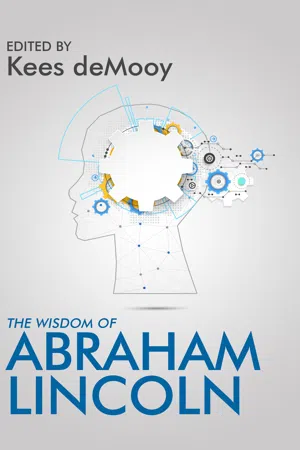
Politician. Statesman. Civil rights leader. Literary craftsman. For a century and a half, the life—and words—of 16th president, Abraham Lincoln, have been praised as a shining example of American leadership. But Lincoln's path to greatness was a humble one. The son of a frontier farmer, Lincoln was largely self-educated. When he took the national stage as a politician, his simple, straightforward prose was revolutionary for its time—resonating with men and women from all walks of life. In fact, with his "jogtrot prose, compacted of words and phrases still with the bark on," Lincoln almost single-handedly changed the way the English language is spoken in America. And while he will always be remembered as the man dedicated to restoring a shattered Union, and—with the Thirteenth Amendment—freeing slaves, Lincoln was also one of the greatest communicators this country has ever seen. Now, in this one essential volume, excerpts have been collected from all of Lincoln's finest documents, letters, and, of course, speeches like his famous Gettysburg Address. The Wisdom of Abraham Lincoln pays tribute to the president and patriot who, through both his words and deeds, changed the course of history.
- 256 pages
- English
- ePUB (mobile friendly)
- Available on iOS & Android
eBook - ePub
The Wisdom of Abraham Lincoln
About this book
Information
PART I
Politics
Political Beliefs
Abraham Lincoln was first and foremost a politician. Handicapped by his humble origins and a meager education, yet blessed with tremendous rhetorical ability and boundless patriotism, Lincoln led the Republican Party to national prominence during the most tumultuous period of American history. His ungainly appearance made a poor first impression, but he won support by his passionate speeches that could go on for three hours or longer. He shot to national prominence in a series of debates with political foe Stephen Douglas. In countless letters to political allies and enemies alike, Lincoln distinguished himself as a tireless proponent for those issues that he held most dearly, which he summed up as “gratitude to our fathers, justice to ourselves, duty to posterity.”
July 1832
From Lincoln’s reputed first political speech, delivered in Pappsville, Illinois.
I presume you all know who I am. I am humble Abraham Lincoln. I have been solicited by many friends to become a candidate for the Legislature. My politics are short and sweet, like the old woman’s dance. I am in favor of a national bank. I am in favor of the internal improvement system, and a high protective tariff. These are my sentiments and political principles. If elected, I shall be thankful; if not it will all be the same.
(NH XI, 97)
June 13, 1836
A letter to the editor of the Sangamo Journal, written during Lincoln’s campaign for a second term in the Illinois legislature.
I go for all sharing the privileges of the government, who assist in bearing its burthens. Consequently I go for admitting all whites to the right of suffrage who pay taxes or bear arms (by no means excluding females).
If elected, I shall consider the whole people of Sangamon my constituents, as well those that oppose, as those that support me.
While acting as their representative, I shall be governed by their will, on all subjects upon which I have the means of knowing what their will is; and upon all others, I shall do what my own judgment teaches me will best advance their interests. Whether elected or not, I go for distributing the proceeds of the sales of the public lands to the several states, to enable our state, in common with others, to dig canals and construct railroads, without borrowing money and paying interest on it.
(CW I, 48)
January 27, 1838
Young Men’s Lyceum speech, delivered in Springfield, Illinois. (See Appendix A for complete text)
In the great journal of things happening under the sun, we, the American people, find . . . ourselves in the peaceful possession of the fairest portion of the earth as regards extent of territory, fertility of soil, and salubrity of climate. We find ourselves under the government of a system of political institutions conducing more essentially to the ends of civil and religious liberty than any of which the history of former times tells us. We, when mounting the stage of existence, found ourselves the legal inheritors of these fundamental blessings. We toiled not in the acquirement or establishment of them; they are a legacy bequeathed us by a once hardy, brave, and patriotic, but now lamented and departed, race of ancestors. Theirs was the task (and nobly they performed it) to possess themselves, and through themselves us, of this goodly land, and to uprear upon its hills and its valleys a political edifice of liberty and equal rights; ’tis ours only to transmit these—the former unprofaned by the foot of an invader, the latter undecayed by the lapse of time and untorn by usurpation—to the latest generation that fate shall permit the world to know. This task of gratitude to our fathers, justice to ourselves, duty to posterity, and love for our species in general, all imperatively require us faithfully to perform.
(NH I, 35-36)
January 27, 1838
Young Men’s Lyceum speech.
Young Men’s Lyceum speech.
Let every American, every lover of liberty, every well-wisher to his posterity swear by the blood of the Revolution never to violate in the least particular the laws of the country, and never to tolerate their violation by others. As the patriots of ’76 did to the support of the Declaration of Independence, so to the support of the Constitution and laws let every American pledge his life, his property, and his sacred honor—let every man remember that to violate the law is to trample on the blood of his father, and to tear the charter of his own and his children’s liberty. Let reverence for the laws be breathed by every American mother to the lisping babe that prattles on her lap; let it be taught in schools, in seminaries, and in colleges; let it be written in primers, spelling-books, and in almanacs; let it be preached from the pulpit, proclaimed in legislative halls, and enforced in courts of justice. And, in short, let it become the political religion of the nation; and let the old and the young, the rich and the poor, the grave and the gay of all sexes and tongues and colors and conditions, sacrifice unceasingly upon its altars.
(NH I, 42-43)
January 27, 1838
Young Men’s Lyceum speech.
Young Men’s Lyceum speech.
Reason—cold, calculating, unimpassioned reason—must furnish all the materials for our future support and defense. Let those materials be molded into general intelligence, sound morality, and, in particular, a reverence for the Constitution and laws; and that we improved to the last, that we remained free to the last, that we revered his name to the last, that during his long sleep we permitted no hostile foot to pass over or desecrate his resting place, shall be that which to learn the last trump shall awaken our Washington.
(NH I, 50)
January 28, 1838
From the Young Men’s Lyceum Address, Lincoln’s view on the current danger to American government.
That our government should have been maintained in its original form, from its establishment until now, is not much to be wondered at. It had many props to support it through that period, which now are decayed and crumbled away. Through that period it was felt by all to be an undecided experiment; now it is understood to be a successful one. Then, all that sought celebrity and fame and distinction expected to find them in the success of that experiment. Their all was staked upon it; their destiny was inseparably linked with it. Their ambition aspired to display before an admiring world a practical demonstration of the truth of a proposition which had hitherto been considered at best no better than problematical—namely, the capability of a people to govern themselves. If they succeeded they were to be immortalized; their names were to be transferred to counties, and cities, and rivers, and mountains; and to be revered and sung, toasted through all time. If they failed, they were to be called knaves, and fools, and fanatics for a fleeting hour; then to sink and be forgotten. They succeeded. The experiment is successful, and thousands have won their deathless names in making it so. But the game is caught; and I believe it is true that with the catching end the pleasures of the chase.
(NH I, 45-46)
December 20, 1839
From a speech in the Illinois House of Representatives.
From a speech in the Illinois House of Representatives.
Many countries have lost their liberty, and ours may lose hers; but if she shall, be it my proudest plume, not that I was the last to desert, but that I never deserted her.
(NH I, 137)
December 20, 1839
From a speech in the Illinois House of Representatives.
From a speech in the Illinois House of Representatives.
If ever I feel the soul within me elevate and expand to those dimensions not wholly unworthy of its almighty Architect, it is when I contemplate the cause of my country, deserted by all the world beside, and I standing up boldly and alone, and hurling defiance at her victorious oppressors. Here, without contemplating consequences, before high heaven and in the face of the world, I swear eternal fidelity to the just cause, as I deem it, of the land of my life, my liberty, and my love.
(NH I,138)
February 22, 1842
Comment to a friend regarding a speech he had just delivered to a temperance society on the anniversary of George Washington’s birth.
I have just told the folks here in Springfield on this 110th anniversary of the birth of him whose name, mightiest in the cause of civil liberty, still mightiest in the cause of moral reformation, we mention in solemn awe, in naked, deathless splendor, that the one victory we can claim is that there is not one slave or one drunkard on the face of God’s green earth.
(NH I, 191-92)
February 15, 1845
Lincoln’s opinion on Executive’s right to declare war without the consent of Congress.
The provision of the Constitution giving war-making power to Congress was dictated, as I understand it, by the following reasons. Kings had always been involving and impoverishing their people in wars, pretending generally, if not always, that the good of the people was the object. This our convention understood to be the most oppressive of all kingly oppressions; and they resolved to so frame the Constitution that no one man should hold the power of bringing this oppression upon us. But your view destroys the whole matter, and places our president where kings have always stood.
(CW I, 451-52)
December 1, 1847
During a tariff discussion, prior to taking his seat in Congress.
During a tariff discussion, prior to taking his seat in Congress.
It seems to be an opinion very generally entertained that the condition of a nation is best whenever it can buy cheapest; but this is not necessarily true, because if at the same time and by the same cause, it is compelled to sell correspondingly cheap, nothing is gained. Then it is said the best condition is when we can buy cheapest and sell dearest; but this again is not necessarily true, because with both these we might have scarcely anything to sell, or, which is the same thing, to buy with.
(NH I, 304)
January 12, 1848
Lincoln argued that President James K. Polk’s invasion and seizure of lands in the Mexican War was unconstitutional.
When the war began, it was my opinion that all those who, because of knowing too little, or because of knowing too much, could not conscientiously approve the conduct of the president, in the beginning of it, should, nevertheless, as good citizens and patriots, remain silent on that point, at least till the war should be ended......
Table of contents
- Title Page
- Copyright Page
- Table of Contents
- Epigraph
- Preface
- Timeline of Abraham Lincoln’s Life, with Significant Historical Events
- PART I - Politics
- PART II - Civil War
- PART III - Slavery and Emancipation
- PART IV - Prívate Life
- Appendixes
- Sources
Trusted by 375,005 students
Access to over 1.5 million titles for a fair monthly price.
Study more efficiently using our study tools.
Frequently asked questions
Yes, you can cancel anytime from the Subscription tab in your account settings on the Perlego website. Your subscription will stay active until the end of your current billing period. Learn how to cancel your subscription
No, books cannot be downloaded as external files, such as PDFs, for use outside of Perlego. However, you can download books within the Perlego app for offline reading on mobile or tablet. Learn how to download books offline
Perlego offers two plans: Essential and Complete
- Essential is ideal for learners and professionals who enjoy exploring a wide range of subjects. Access the Essential Library with 800,000+ trusted titles and best-sellers across business, personal growth, and the humanities. Includes unlimited reading time and Standard Read Aloud voice.
- Complete: Perfect for advanced learners and researchers needing full, unrestricted access. Unlock 1.5M+ books across hundreds of subjects, including academic and specialized titles. The Complete Plan also includes advanced features like Premium Read Aloud and Research Assistant.
We are an online textbook subscription service, where you can get access to an entire online library for less than the price of a single book per month. With over 1.5 million books across 990+ topics, we’ve got you covered! Learn about our mission
Look out for the read-aloud symbol on your next book to see if you can listen to it. The read-aloud tool reads text aloud for you, highlighting the text as it is being read. You can pause it, speed it up and slow it down. Learn more about Read Aloud
Yes! You can use the Perlego app on both iOS and Android devices to read anytime, anywhere — even offline. Perfect for commutes or when you’re on the go.
Please note we cannot support devices running on iOS 13 and Android 7 or earlier. Learn more about using the app
Please note we cannot support devices running on iOS 13 and Android 7 or earlier. Learn more about using the app
Yes, you can access The Wisdom of Abraham Lincoln by Kees de Mooy in PDF and/or ePUB format, as well as other popular books in History & Historical Biographies. We have over 1.5 million books available in our catalogue for you to explore.