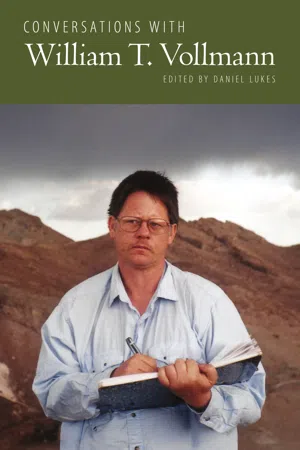
Across fiction, journalism, ethnography, and history, William T. Vollmann's oeuvre—which includes a "prostitution trilogy, " a septology ( Seven Dreams ) about encounters between first North Americans and European colonists, and a more-than-three-thousand-page philosophical treatise on violence—is as ambitious as it is dazzling. Conversations with William T. Vollmann collects twenty-nine interviews, from early press coverage in Britain where his career first took flight, to in-depth visits to his writing and art studio in Sacramento, California. Throughout these conversations, Vollmann (b. 1959) speaks with candor and wit on such subjects as grief and guilt in his work, his love of guns and his experience of war, the responsibilities of the artist as witness, the benefits of looking out into the world beyond the confines of one's horizon, the limitations of what literature can achieve, and how we can speak to the future. Bringing to the fore several expanded, unpublished, and hard-to-find interviews, this volume offers a valuable set of perspectives on a uniquely rewarding and sometimes overwhelming writer. On the road promoting his books or in a domestic setting, Vollmann comes across as reflective and humane, humble in his craft despite deep dedication to his uncompromising vision, and ever armed with a spirit of mischief and capacity to shock and unsettle the reader.
- 252 pages
- English
- ePUB (mobile friendly)
- Available on iOS & Android
eBook - ePub
Conversations with William T. Vollmann
About this book
Information
Topic
LittératureSubtopic
Biographies littérairesVollmann’s Vision
From Image, Sunday August 22, 1993. © The San Francisco Examiner. Reprinted by permission.
“Bill’s got guns hidden all over his house,” confides William T. Vollmann’s close friend and personal photographer Ken Miller. “Careful, Tom. He’s even got a flame thrower.”
These reassuring tidbits of information, combined with the rumors about Vollmann’s drinking, womanizing, and paranoia about letting people know where he lives, have me feeling in need of a drink myself as the city bus Vollmann has instructed me to take splashes its way through the labyrinthine streets of Sacramento.
Paranoiac fantasies drift through my brain. Is it possible that the author some critics consider one of the most gifted novelists of his generation has succumbed to madness at the tender age of thirty-three? He seemed like such a nice person over the phone. Will he pull a gun on me if I ask the wrong question?
The bus slows to a halt, delivering me just a few yards from Vollmann’s house, a large two-story structure nestled comfortably, and for those who know Vollmann’s work, incongruously, in the middle of the suburbs.
The bland suburban setting is especially surprising because Vollmann has built his literary reputation presenting characters and situations that often are riddled with uncertainty and danger. And, unlike most writers, he not only writes about life’s extremes, he lives them—fighting with the mujahadeen in Afghanistan, hanging out with prostitutes and addicts, risking his life in the most terrifying war zones in the world. A few weeks earlier, Vollmann had returned from a two-way junket-to Hell, touring the ravaged landscapes of Bosnia and Somalia to research an upcoming nonfiction book about “the nature of force and when violence is (and isn’t) justified.” These are the kinds of subjects that fuel Vollmann’s literary imagination.
Just a few years after graduating with honors from Cornell University and relocating to San Francisco, Vollmann exploded upon the literary scene in 1987 with the publication of his first book, You Bright and Risen Angels, an allegorical comic novel that is narrated by a computer and features a bizarre power struggle over electricity between a group of insects and human revolutionaries. Its frenzied, hallucinogenic imagery led many critics to declare it the most stylistically ambitious first novel since Thomas Pynchon’s.
Vollmann’s next work, The Rainbow Stories, a jarring collection of “journalistic fictions,” was a complete departure. While Angels was an exaggerated, self-described “comic book” that provided a platform for the outer reaches of Vollmann’s imagination, most of The Rainbow Stories focus on a motley group of “lost souls” who roam the streets of America’s inner cities. Most of the action takes place in the depressed neighborhoods of San Francisco, exploring the harrowing, sometimes hilarious worlds of street alcoholics, prostitutes, Nazi skinheads, drug addicts, and electroshock patients. (There is also a portrait of the legendary San Francisco-based underground machine-art collective Survival Research Labs.) Vollmann’s prose reflects the change of theme: the book is written in a gritty, direct style that has more in common with the blunt lyricism of Hemingway than Pynchon’s pyrotechnics.
And the protean author wasn’t through with his transformations. In 1992 alone, he published three new books: Whores For Gloria, a novel focusing on the subculture of Tenderloin prostitutes; Fathers and Crows, the second book of a proposed seven-volume cycle of novels tracing Western civilization’s colonial relationship with the indigenous cultures of the Americas; and finally, An Afghanistan Picture Show, an autobiographical essay that reconstructs his political awakening in the early 1980s, when he reported on—and ultimately fought with—the Afghani rebels fighting the Soviet army.
Judged against this prodigious output, 1993 has been a slow year for Vollmann. He “only” has two new books coming out. The first, Thirteen Stories and Thirteen Epitaphs, a dazzlingly unclassifiable collection of lyrical and nightmarish tales, was recently published by Pantheon Books, while the upcoming Butterfly Stories is scheduled for release by Grove Press in October.
Vollmann appears very ordinary, the kind of person who could walk down a crowded street in virtually any part of the world without making himself conspicuous. Brown hair cut in uneven bangs frames his relatively nondescript features. The thick, watery lenses of his glasses make his eyes look a bit larger than they actually are.
His manner is friendly, although at times he’s somewhat detached. After I entered his home, he offered me a beer and led me into his living room, where our conversation took place. He himself sipped a soft drink during the interview, thoughtfully pausing before answering my questions.
Our conversation, on literature, war, prostitution, and a variety of other matters, follows below:
TOM MCINTYRE: What was your life like while writing You Bright and Risen Angels?
WILLIAM VOLLMANN: I was a computer programmer—not a very highpowered one. I don’t drive, so I was commuting to Silicon Valley with this other guy who worked at Versatec. Sometimes he’d take a week off and he would drive down on a Monday with me and then I’d have to stay down there until Friday. And sometimes I’d drive down on a Friday with him and spend the weekend there so I could write. There was nothing to do, no place to go. You’re completely helpless in Silicon Valley if you don’t have a car. There were freeways three sides of me. The place I worked at was like this big square fishbowl; it just glowed very spookily at night; all full of computers. I would sleep under my desk. I had my sleeping bag there. I would put a wastebasket in front of my head so people couldn’t see me sleeping there. The janitors got to know about it, and they were pretty nice. I lived on candy bars from candy machines. I used to get Three Musketeers because there was an extra half ounce for your money. (Laughter.) It was a pretty crummy life; nothing really to do except work on the computer.
TM: A brief statement you wrote at the time it was published says: “The kind of reading and writing that I value is a dying art. While it lasts and while I last, I intend to write sentences that are beautiful in their own right, to write paragraphs that respect those sentences while conveying thought: and to arrange those paragraphs in works that promote love and understanding for people whom others with my background may despise or fail to know.” How do you “arrange (your) paragraphs” to achieve this aim?
WV: I try to describe people without sentimentalizing. Often they’re ugly or they smell bad or they have mental problems or they’re racist or they’re full of other kinds of hate. Usually, those kinds of signals are enough for other people to say, “Okay, I don’t want anything more to do with this person.” My job is to say, “Okay, here it is; you have to see this; I’m going to rub your nose in it. But then, if you go beyond this a little bit, then here’s what the rest of the person is like.” And I believe that no person is completely bad. Even Hitler must have had his good points. And if Jesus was a human being, if there was such a person, I’m sure he wasn’t completely good either. That’s just how life is.
TM: Many authors—Hemingway, for instance—developed a unique style that’s instantly recognizable, but they rarely, if ever, strayed from it. You write many different kinds of novels. Is it a natural offshoot for you to write “journalistic fictions,” as in Rainbow Stories and Thirteen Stories and Thirteen Epitaphs, as well as other, more allegorical novels, like You Bright and Risen Angels?
WV: I just want to understand what life is and what life is about. And that can’t be done in just one way. You have to listen to all of the different people out there and hear how they speak and try to understand how they think. At the same time, you have to listen to what’s inside you and try to understand how you think and the best way for you to speak to present those thoughts well.
TM: What do you think your limitations as a writer are, at this point?
WV: I’d like to continue to improve in my depiction of character. My ability to create plot has improved somewhat. I would like to create incidents better as opposed to having to go to real life. It would be nice if I could sit down and come up with a stream of coherent and interconnected incidents. It’s something I do now but it takes a lot of work. It would nice if that got to be second nature.
TM: Describe your creative experience …
WV: What I have to do before anything else is massive doses of reading about the subject I’m concerned with. Then, if possible, visit the historic sites and take lots and lots of notes. I’m looking for connections, things that interest me.
Once I feel like have some understanding of my characters, then it’s a great deal of labor coming up with the details. In Fathers and Crows, I wanted to imagine this Indian lady who’s born underwater. I was trying to figure out how she got her magic power. In the first or second or third draft, I said, “Well, all right. Maybe she goes to a shaman and talks with him and makes friends with him or gives him some sort of present and finally, he helps her out.” Well, an anthropologist who worked very closely with Mic Mac sources and knows quite a bit about the culture told me that was just preposterous. She would never do anything of the kind; she was a girl, the shaman was this old man. He would have nothing to do with her. They would never have anything to do with each other. So this whole scene was completely worthless, and I had to start over again.
After you figure out what’s actually possible, according to the laws of fact, then, finally, you can start constructing. You have the building blocks of your world and you’re free to arrange them the way you want. Finally, when the story starts to really build up, I can sort of close my eyes and I can walk around inside, in this case, seventeenth-century Canada. It may not, in fact, have been the real seventeenth-century Canada, but it’s as close as I can make it.
TM: How about You Bright and Risen Angels?
WV: There, it’s just a question of sitting in front of the computer screen and waiting for the feeling of excitement, the feeling of power in my fingertips from all the words that are coming out of my brain and flowing down my shoulders and into my arms and down my wrists into my fingers. All those words, just waiting to come out. The faster I type, the more words come out and the more beautiful they are. Then, after that’s over, I can go back and edit the thing a little bit.
Something like Thirteen Stories is a little bit like Rainbow Stories. There are a number of stories there where I had to go out and gather the facts. Of course, that’s what life is: a process of gathering the facts. That’s why a newborn baby really can’t write anything.
TM: Which of your books was most difficult?
WV: Fathers and Crows—the research was massive and I wasn’t quite sure what I was looking for when I started. I knew basically what the subject was, but I didn’t know what about the subject interested me. In the end, that proved to my benefit because I didn’t have any particular axe to grind. I was able to describe an entire half-century in Canada—which I feel I did quite well—but the research was extremely difficult. I filled up notebooks with all kinds of things. I got very discouraged for a long time … It just seemed like it would be impossible for me to bring these people to life.
I was also in New York for much of the time, which was very good for research, because I was able to use the New York Public Library. The research facilities on the West Coast are really not that great. You can go to UC Berkeley and page books, but, unless you have a lot of money, you can’t check the books out. And when you page the books, sometimes it’s hard to get what you want. You have to wait and wait, and they don’t have everything. So that was good, but I was working on that so much that I got carpal tunnel (syndrome) in my hands. Actually, they hurt right now: they hurt all the time. I was putting in many sixteen, seventeen, eighteen-hour days of typing on that book.
Once the book was finished, I was very excited about it. All of my editors hated it—they thought it was long-winded, sloppy. They just didn’t get it. They were bored by it. They probably didn’t finish it. They gave me ultimatums. They sat on it. They wanted me to cut it by half. I just refused to do it. It took a long time to get that book published; it sat around for a couple of years. When the book came out, I expected the thing to sink like a stone, and basically end my publishing career, because it was so expensive and they...
Table of contents
- Cover
- Title Page
- Copyright
- Contents
- Introduction
- Chronology
- Under the Rainbow
- Parallel Lives
- Night Writer: Leading Readers to the Darkness at the Edge of Town
- William T. Vollmann: The Prolific Young Author Takes a Walk on the Wild Side—of Life and History
- In Parkman’s Footsteps
- An American Aboriginal
- Pimps, Alcoholics, Crackheads, Pushers, Runaways, All the Forsaken …
- Young Novelist Undertakes Bizarre Magazine Assignment
- Vollmann’s Vision
- Conversation with William Vollmann
- Lovesick
- A Nerd in Action
- Vollmann Ventures beyond the Edge
- An Interview with William T. Vollmann
- William T. Vollmann
- Interview: William T. Vollmann
- Creating “Many, Many Osamas”
- William T. Vollmann
- If You Really Want Radical
- L’Américain Tranquille (The Quiet American)
- Long-Term Visitor: An Interview with William T. Vollmann
- Art and Freedom in Time of War: A Conversation with William T. Vollmann
- Interview with William T. Vollmann
- Boxcars, Shostakovich, and the Poor: William T. Vollmann Talks with Bookforum
- William T. Vollmann: The Powells.com Interview
- She Who Is So Lovely Is Drinking in That Loveliness I’ve Drunk
- William T. Vollmann: The Self Images of a Cross-Dresser
- Standing Up in Our Small Way: An Interview with William T. Vollmann
- Could You Do Any Better Than We Did?
- About the Editor
Trusted by 375,005 students
Access to over 1.5 million titles for a fair monthly price.
Study more efficiently using our study tools.
Frequently asked questions
Yes, you can cancel anytime from the Subscription tab in your account settings on the Perlego website. Your subscription will stay active until the end of your current billing period. Learn how to cancel your subscription
No, books cannot be downloaded as external files, such as PDFs, for use outside of Perlego. However, you can download books within the Perlego app for offline reading on mobile or tablet. Learn how to download books offline
Perlego offers two plans: Essential and Complete
- Essential is ideal for learners and professionals who enjoy exploring a wide range of subjects. Access the Essential Library with 800,000+ trusted titles and best-sellers across business, personal growth, and the humanities. Includes unlimited reading time and Standard Read Aloud voice.
- Complete: Perfect for advanced learners and researchers needing full, unrestricted access. Unlock 1.5M+ books across hundreds of subjects, including academic and specialized titles. The Complete Plan also includes advanced features like Premium Read Aloud and Research Assistant.
We are an online textbook subscription service, where you can get access to an entire online library for less than the price of a single book per month. With over 1.5 million books across 990+ topics, we’ve got you covered! Learn about our mission
Look out for the read-aloud symbol on your next book to see if you can listen to it. The read-aloud tool reads text aloud for you, highlighting the text as it is being read. You can pause it, speed it up and slow it down. Learn more about Read Aloud
Yes! You can use the Perlego app on both iOS and Android devices to read anytime, anywhere — even offline. Perfect for commutes or when you’re on the go.
Please note we cannot support devices running on iOS 13 and Android 7 or earlier. Learn more about using the app
Please note we cannot support devices running on iOS 13 and Android 7 or earlier. Learn more about using the app
Yes, you can access Conversations with William T. Vollmann by Daniel Lukes in PDF and/or ePUB format, as well as other popular books in Littérature & Biographies littéraires. We have over 1.5 million books available in our catalogue for you to explore.