eBook - ePub
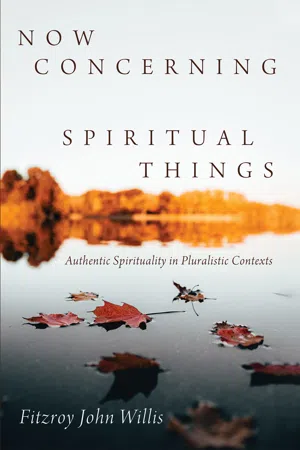
Now Concerning Spiritual Things
Authentic Spirituality in Pluralistic Contexts
- 220 pages
- English
- ePUB (mobile friendly)
- Available on iOS & Android
eBook - ePub
About this book
In a pluralistic world of competing truth claims, how can one discern what is truly representative of God? How can we live and communicate what is authentically "spiritual?" How do we bridge the religious impasse between believers and a post-Christendom and pluralistic context where individuals may consider themselves to be spiritual, yet are offended by the person of Jesus? Can relativism be an effective means of evaluating truth from falsehood? What role should race, gender, and socioeconomic background play in society and the church?
These are just a few of the questions this study addresses in presenting a more balanced, dialogical, and biblical criterion for authentic spirituality. The insights on how to discern, live, and communicate what is authentically spiritual are significant for interreligious and ecumenical dialogue across denominations. These insights contribute a way to more effectively communicate divine truths to all, for it is conversant with various sources of knowledge about God and is accountable to feedback from these sources of truth. For example, tacit knowledge such as that derived from faith, and spiritual gifts, as well as rational, or philosophical claims to truth, along with Western, Eastern, and Southern modes of thinking, are all incorporated.
Information
Topic
Theology & ReligionSubtopic
Christian TheologyPart I
Authentic Spirituality in the Old Testament
It is fair to say that most commentators do mention the idea of criteria when discussing authentic spirituality. Bezuidenhout, for example, focuses on criteria for the functioning of charismata.1 But his work only deals with Pauline criteria based on 1 Corinthians 12–14. While a major portion of this study will also address Pauline thought, part I and chapter 1 will expound the OT antecedent to such thought and assess whether there is a criterion or criteria for discerning authentic spirituality in the OT.
1. Bezuidenhout, Pauliniese kriteria. See also “Trinitarian Nature of the Pauline Criteria.”
Chapter 1
Authentic Spirituality in the Old Testament: An Emphasis on Prophecy
1.1 Introduction
MY emphasis in this chapter will be on OT prophecy, not only because of the centrality of the prophets in religious history, but also because prophecy is considered among the charismata (1 Cor 12:10)—which is significant in consideration of authentic spirituality. And even though the OT does not use the term charismata to describe prophecy, since the term χαρίσματα was coined by the apostle Paul and is limited to the Pauline corpus and 1 Peter 4:10 of the Christian Bible, it is generally agreed that the charism of prophecy that the apostle Paul describes in the New Testament (NT) is in direct continuity with OT prophecy.2 Moreover, the OT “messenger formula” of “thus says the Lord” and the ascribing of prophecy as a gift from the Spirit in the NT (1 Cor 12:4, 7–11) make it clear that such prophecy was considered to be revelatory of God and authentic spirituality. To be sure, it is to divine revelation that Paul attributed genuine prophetic activity in the OT. Despite this truth, the OT background to prophecy is usually excluded or only briefly summarized when discussing the charism of prophecy described in the NT.3
That being said, in an uncertain religious climate where false prophets (Balaam) at times speak a true oracle from Yahweh, speak presumptuously in Yahweh’s name (Hananiah, Zedekiah), and where true prophets might lie (old prophet in 1 Kings 13) or attempt to mislead people (Miriam, Saul, Gehazi), there is need to have tests for prophecy. Indeed, because human nature and communication is fallible, and if it is true that prophecy is always accompanied by false prophecy, then there is need for criteria to discern what is authentic,4 on the part of both the prophet and the people.5 This charismatic criteriology, then, is no mere academic exercise. There is practical and spiritual significance in determining prophetic criteria, especially since “OT abuses of prophecy are just as relevant to our contemporary situation as they [were] in the OT context and in the early church.”6
This chapter seeks to clarify what was brought in the way of prophetic understanding through tradition, from the times of the OT through antiquity, to establishing a criterion for genuine prophecy within a present-day context—which should go a long way toward constructing a conclusive statement regarding criteria for authenticating prophecy that perhaps will give proper perspective to the entirety of this project.
1.1.1 Defining the term “prophet”
Before addressing this issue, however, it will be instructive to define the term “prophet” and the concept of prophecy in the pluralistic OT context. Interestingly, the root of the English word “prophet” is not found in the OT. The term “prophet” is derived from the Greek word prophētēs, which is a combination of the words pro, which means before, and phēmi, which means to say something, orally or in writing.7 Thus, the word “prophet” conveys the idea of “communicating before.” More specifically, a prophet communicates for God, before the people of God.8 In the OT, three main words are used to refer to prophets. The more familiar of these Hebrew words is na͂ḇi̇. It is used in designating members of a prophetic guild, court prophets, and even false prophets. Thus, the definition given by Lasor et al. of a prophet (na͂ḇi̇) as one communicating for God, and for the people of God, is oversimplified in that it limits the term to “prophets of Yahweh”—whom this work considers to be “true prophets.”
Unlike Lasor et al., Joseph Blenkinsopp suggests “the prophet [nãḇï] was one who proclaims a message on behalf of another, generally a deity.”9 Blenkinsopp affirms the seemingly contradictory passive and active basis of prophecy that Alfred Guillaume suggests when he defines the nãḇï as “one who is in the state of announcing a message which has been given to him.”10 For Guillaume, the prophet is passive because he or she is called by a deity, and the prophet is active in that he or she announces or proclaims a message. Additionally, the prophet is an instrument to accomplish the things of God. Indeed, Jan Ridderbos seems to have been correct in positing that the word nãḇï has an external meaning, and concerns people who have in common external things, primarily a claim to be the mouth of God.11 The nãḇï, then, is primarily a proclaimer or forth-teller, but the nãḇï can also be a predictor or foreteller.12 The other two words that refer to a prophet are rõeh and hõzeh. Both can be translated as “seer,” and seems to have given way to the word nãḇï, for 1 Samuel 9:9 says, “he who is called a prophet [nãḇï] now was formerly called a seer.”
1.1.2 The concept of prophecy
Based on the definitions for the prophet, it is fair to say that prophecy involves the proclamation of a prophet. Certainly, the OT considers prophecy to be supernatural (cf. Amos 3:7ff.; Jer 1:5ff.) in that it has its source in God. But a modern scholar like Hermann Gunkel, ...
Table of contents
- Title Page
- Acknowledgments
- Introduction
- Part I: Authentic Spirituality in the Old Testament
- Part II: Authentic Spirituality in the New Testament
- Part III: Contemporary Implications of Authentic Spirituality in Pluralistic Contexts
- Part IV: Conclusion
- Bibliography
Trusted by 375,005 students
Access to over 1.5 million titles for a fair monthly price.
Study more efficiently using our study tools.
Frequently asked questions
Yes, you can cancel anytime from the Subscription tab in your account settings on the Perlego website. Your subscription will stay active until the end of your current billing period. Learn how to cancel your subscription
No, books cannot be downloaded as external files, such as PDFs, for use outside of Perlego. However, you can download books within the Perlego app for offline reading on mobile or tablet. Learn how to download books offline
Perlego offers two plans: Essential and Complete
- Essential is ideal for learners and professionals who enjoy exploring a wide range of subjects. Access the Essential Library with 800,000+ trusted titles and best-sellers across business, personal growth, and the humanities. Includes unlimited reading time and Standard Read Aloud voice.
- Complete: Perfect for advanced learners and researchers needing full, unrestricted access. Unlock 1.5M+ books across hundreds of subjects, including academic and specialized titles. The Complete Plan also includes advanced features like Premium Read Aloud and Research Assistant.
We are an online textbook subscription service, where you can get access to an entire online library for less than the price of a single book per month. With over 1.5 million books across 990+ topics, we’ve got you covered! Learn about our mission
Look out for the read-aloud symbol on your next book to see if you can listen to it. The read-aloud tool reads text aloud for you, highlighting the text as it is being read. You can pause it, speed it up and slow it down. Learn more about Read Aloud
Yes! You can use the Perlego app on both iOS and Android devices to read anytime, anywhere — even offline. Perfect for commutes or when you’re on the go.
Please note we cannot support devices running on iOS 13 and Android 7 or earlier. Learn more about using the app
Please note we cannot support devices running on iOS 13 and Android 7 or earlier. Learn more about using the app
Yes, you can access Now Concerning Spiritual Things by Fitzroy John Willis in PDF and/or ePUB format, as well as other popular books in Theology & Religion & Christian Theology. We have over 1.5 million books available in our catalogue for you to explore.