eBook - ePub
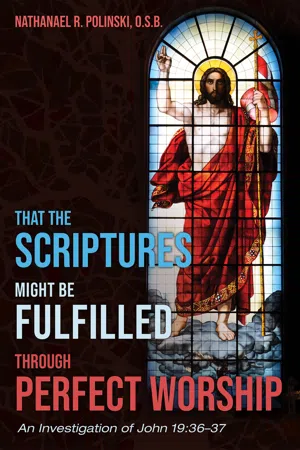
That the Scriptures Might Be Fulfilled through Perfect Worship
An Investigation of John 19:36–37
- 198 pages
- English
- ePUB (mobile friendly)
- Available on iOS & Android
eBook - ePub
That the Scriptures Might Be Fulfilled through Perfect Worship
An Investigation of John 19:36–37
About this book
The hour of Jesus is a fundamental theme running throughout John's Gospel (2:4--19:27) referring to Jesus' glorification (7:39; 12:16, 23, 28; 13:31, 32; 16:14; 17:1, 5) in his passion and death (3:14; 8:28; 12:32, 34). Immediately after the culmination of Jesus' hour (19:25-30) John provides a unique account of things that took place following Jesus' death (19:31-34), apparently important to his audience (19:35), in which he recognizes scriptural fulfillment (19:36-37). At first glance, the fulfillment attested by the scriptures explicitly provided seems straightforward and of little significance, simply corresponding with the fundamental elements of the narrative in 19:32-33. Yet such an understanding runs contrary to John's limited use of explicit Scripture citations (compared with the other evangelists) at a most critical moment in the Gospel. Rather, consistent with his allusive and engaging style, the evangelist relies on his audience to utilize the context he provides and the contexts he has presumed throughout his Gospel to perceive the depth and the expansiveness of the fulfillment he has recognized in Jesus' hour. It is through these contexts that we gain greater insight into the fulfillment attested by John 19:36-37, illuminating Jesus' hour and the entire Gospel.
Information
1
Introduction
Significance of the Fulfillment Attested by John 19:36–37
John 19:36–37 presents the final explicit OT witnesses of the Gospel in the form of a double citation of Scripture. The fulfillment attested by the Scripture citations presented by John near the end of the Passion Narrative might seem straightforward and limited, that is, as only referring to what explicitly took place in 19:31–34. Consideration of the testimony provided by 19:36–37, however, in the context of the overall Gospel as well as the contexts presumed by the evangelist provides insight into the depth and expansiveness of their attestation. Such insight into the broader fulfillment attested by John 19:36–37 does much to illuminate the Gospel and, in particular, the culmination of Jesus’ passion and death.1
By placing them as the final scriptural quotations in his Gospel, John implicitly attaches immense importance to the two OT fulfillment citations in John 19:36–37: “For these things happened in order that the scripture might be fulfilled: ‘a bone of him shall not be broken.’ And again another scripture says: ‘they shall look to whom they pierced.’”2 John provides no explanatory remarks, however, to assist his audience in understanding the fulfillment of these scriptures as he perceived it at the culmination of Jesus’ hour.3 The absence of such information, however, is undoubtedly part of John’s allusive style by which he engages his audience. He often motivates them to discover additional depth of meaning beyond the evident literal sense of the Gospel text through the external contexts (e.g., first–century Judaism, Christian worship) he presumes and the literary context he provides.
By offering no explicit guidance for comprehending the fulfillment of 19:36–37 after the culmination of Jesus’ hour (19:25–30) nor of the things that took place following his death (19:31–35), John requires his audience to rely entirely on contextual information. This study considers the collective implications of fundamental aspects of first-century Judaism presumed by John in light of the Gospel’s proximate context of early Christian worship to gain greater insight into the fulfillment attested by 19:36–37. The balance of this chapter provides preliminary information about this passage and the overall Gospel based on recent scholarship as well as an overview of the present investigation of 19:36–37.
Preliminary Information on John 19:36–37 and the Overall Gospel
Whereas one can perceive a sense of importance associated with 19:36–37 based on its position in the Gospel, occurring just after Jesus’ death (19:25–30) and “these things” that subsequently happened (19:31–35), the recognition of insights of recent scholars dramatically increases its significance. Francis Moloney convincingly argues that the evangelist not only considered himself to be writing Scripture, but that the content of his work brings Scripture “to its completion, its fulfillment, its τέλος;” that “the Scriptures have been fulfilled and perfected in the death of Jesus.”4 Moloney’s insights on the inherent claims of the Gospel combined with Richard Hays’s observations on John’s allusive style expand the field of view regarding the fulfillment attested by 19:36–37 and the contexts upon which it draws.5 Hays observes that John’s Gospel explicitly cites Scripture significantly less than the Synoptics giving “each citation that does appear . . . greater gravity as a pointer to Jesus’ identity.”6 At the same time, John requires his audience to draw upon the context he presumes in order to obtain information not explicitly provided by him. First-century Judaism, specifically in its worship and Scriptures, is a fundamental part of his presumed context.7
Regarding John’s utilization of the OT in 19:36–37, Martinus Menken has examined the sources of the Scriptures presented in 19:36 (Exod 12:46; LXX Exod 12:10; Num 9:12; Ps 34:21 [LXX 33:21]) and 19:37 (Zech 12:10) as well as aspects of the fulfillment attested by them.8 His rigorous textual analyses of each of these verses and of other passages in which John employs the OT have provided substantial evidence about particular passages and the evangelist’s capabilities and tendencies.9 Whereas subsequent textual analysis of 19:37 has generally affirmed evidence presented by Menken, scholars have also posited distinct hypotheses on the manner by which John arrived at the final form of the Scripture presented.10 In examining 19:36, scholars have made use of the presumed context of first-century Jewish worship, specifically Passover, to consider an aspect of the fulfillment it attests.11
First-century Jewish worship plays a prominent role in both the structure and content of the Gospel.12 In terms of the structure, John refers to three different Passovers (cf. 2:13; 6:4; 19:14) to establish contexts from the beginnings of Jesus’ public ministry (2:13) through the culmination of his hour (19:14; cf. 19:31, 42) and he utilizes other Jewish feasts to provide the background for a sizable portion of the Gospel (5:1—10:42). In supplying the context for words spoken (e.g., 7:37–39; 8:12) and actions taken (e.g., 19:14–16), the feasts also contribute to the content of the Gospel.13 The advances in scholarship on first-century Judaism have provided valuable information to illuminate this fundamental part of John’s presumed context.14 E. P. Sanders’s Judaism: Practice and Belief 63 BCE–66 CE offers extensive information on first-century Jewish worship.15 He also implicitly provides guid...
Table of contents
- Title Page
- Acknowledgments
- Abbreviations
- Chapter 1: Introduction
- Chapter 2: John’s Presumed Context of Worship in First-Century Judaism
- Chapter 3: John’s Proximate Context of Early Christian Worship
- Chapter 4: Ancient Exegetical Methods Relevant to John 19:36–37
- Chapter 5: Exegesis of John 19:36–37
- Chapter 6: Summary and Synthesis
- Bibliography
Trusted by 375,005 students
Access to over 1.5 million titles for a fair monthly price.
Study more efficiently using our study tools.
Frequently asked questions
Yes, you can cancel anytime from the Subscription tab in your account settings on the Perlego website. Your subscription will stay active until the end of your current billing period. Learn how to cancel your subscription
No, books cannot be downloaded as external files, such as PDFs, for use outside of Perlego. However, you can download books within the Perlego app for offline reading on mobile or tablet. Learn how to download books offline
Perlego offers two plans: Essential and Complete
- Essential is ideal for learners and professionals who enjoy exploring a wide range of subjects. Access the Essential Library with 800,000+ trusted titles and best-sellers across business, personal growth, and the humanities. Includes unlimited reading time and Standard Read Aloud voice.
- Complete: Perfect for advanced learners and researchers needing full, unrestricted access. Unlock 1.5M+ books across hundreds of subjects, including academic and specialized titles. The Complete Plan also includes advanced features like Premium Read Aloud and Research Assistant.
We are an online textbook subscription service, where you can get access to an entire online library for less than the price of a single book per month. With over 1.5 million books across 990+ topics, we’ve got you covered! Learn about our mission
Look out for the read-aloud symbol on your next book to see if you can listen to it. The read-aloud tool reads text aloud for you, highlighting the text as it is being read. You can pause it, speed it up and slow it down. Learn more about Read Aloud
Yes! You can use the Perlego app on both iOS and Android devices to read anytime, anywhere — even offline. Perfect for commutes or when you’re on the go.
Please note we cannot support devices running on iOS 13 and Android 7 or earlier. Learn more about using the app
Please note we cannot support devices running on iOS 13 and Android 7 or earlier. Learn more about using the app
Yes, you can access That the Scriptures Might Be Fulfilled through Perfect Worship by Nathanael R. Polinski,Nathanael R. Polinski O.S.B. in PDF and/or ePUB format, as well as other popular books in Theology & Religion & Biblical Criticism & Interpretation. We have over 1.5 million books available in our catalogue for you to explore.